Joseph Hobbs at Ben Nevis: The Canadian Who Left Nikka a Column Still
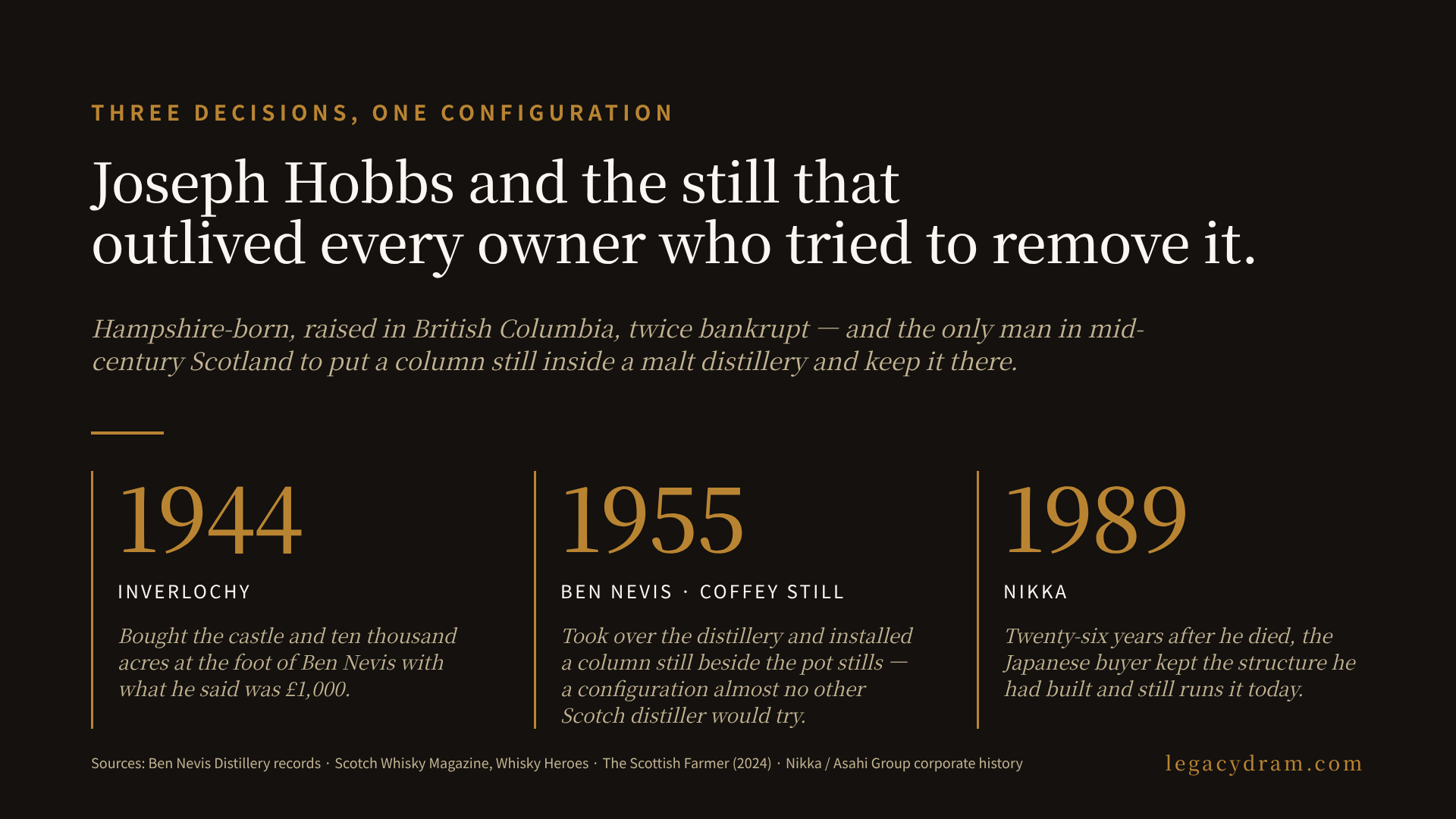
There is a distillery at the foot of Ben Nevis that belongs to a Japanese company. Most people who know that fact stop there. The reason it belongs to a Japanese company starts with a man named Joseph Hobbs, who was born in Hampshire in 1891, taken to British Columbia at the age of nine when his father went bankrupt, made a second fortune in North America during the years it was illegal to sell whisky in the United States, lost that fortune too, and came back to Scotland in the 1940s with what he later claimed was a thousand pounds. He bought a castle. He bought a thousand head of Aberdeen Angus cattle and set them grazing on a glen behind the castle. Then he bought the distillery, and in 1955 he installed a column still next to the pot stills, which is something almost nobody else in Scotland was doing at the time. He died in 1963. The distillery was sold, then sold again, and in 1989 the last buyer was Nikka, the Japanese whisky company that already owned a distillery on Hokkaido. They kept the column. The bottle of Ben Nevis 10 on my shelf was made on equipment a twice-bankrupt outsider installed because nobody else thought it belonged where he put it.
Hampshire, Vancouver, and a building that finished on the wrong day
Hobbs was born in Hampshire in 1891. The family left for British Columbia in 1900 after his father’s bankruptcy, which is a detail the secondary literature tends to skip past and which I think matters. The first thing he saw a parent fail at was business. He spent his twenties in the Royal Navy during the First World War and his thirties in shipping and real-estate development out of Vancouver, where he was, by the late 1920s, doing well enough to commission the Marine Building, an Art Deco tower on Burrard Street that was for a brief period the tallest building in the British Empire west of Toronto. The Marine Building was completed in 1930. The Wall Street crash had happened in October 1929. Hobbs was, by 1932, bankrupt for the second time in his family’s history.
He kept the shipping business, which is the part of the story the romantic version skips and which I am going to handle once and then leave alone. During United States Prohibition, between 1920 and 1933, Hobbs’s vessels carried what one Scottish newspaper later described, with admirable understatement, as “hundreds of thousands of cases of bootleg whisky” to the California coast. The whisky was bought in Scotland, shipped legally to Belgium or elsewhere outside US territorial waters, transferred to Hobbs’s ships, and run in to landing points along the Pacific seaboard. He was, in modern parlance, a logistics company whose primary customer was the black market. There were, by all accounts, considerable margins. The article I read said you could buy whisky for twenty-five dollars a case in Scotland and sell it in the US for sixty. I have no way to verify the figures, but the order of magnitude is consistent with what other contemporary smugglers reported. The trade ended in December 1933 with the repeal of the Eighteenth Amendment. Hobbs spent the next decade in North America, declined, by the secondary literature, into a series of less successful ventures, and emerged in the early 1940s as a man with shipping experience, a long memory of the Scotch whisky trade, and what was left of a third fortune.
This is, I think, the part of the biography to dwell on before the Highland chapters arrive. Hobbs was not a man who came to Scotland to honour a tradition. He came to it because he had been moving Scotch whisky in commercial quantities for twelve years during Prohibition and knew, in operational detail, what the supply chain looked like from the loading-dock side. The single-malt distiller in a glen, the grain distillery in Fife, the blender in Edinburgh: these were upstream nodes on a line that, in his head, terminated in the hold of a ship anchored off Catalina Island. He arrived in Inverness-shire after the Second World War with a working knowledge of the industry that almost nobody else in the Highland landowning class had.
A castle, a thousand cattle, and the wrong country to put them in
In 1944 Hobbs bought Inverlochy Castle and the estate around it, near Fort William, at the foot of Ben Nevis. The estate ran to more than ten thousand acres. The castle was Victorian, built in the 1860s by the second Baron Abinger on the site of a much older ruin, and had been in the Abinger family until the Second World War. Hobbs moved in.
What he did next is the part of the story that always loses a Scottish audience, because it makes no sense unless you remember which continent he had spent the previous forty years on. He bought twelve hundred and fifty head of Aberdeen Angus cattle and turned the estate into a ranch. The Great Glen Cattle Ranch, as it was known by 1945, was a North American-style open-range operation on the southern slopes of the Great Glen, complete with cattle drives, branding, and on at least one documented occasion a man on horseback in a hat that local newspapers struggled to describe without using the word cowboy. Hobbs ran cattle on the slopes of Britain’s tallest mountain because that is what he had done in Canada. The cattle, like the column still that arrived later, were not consulted on whether they belonged in Scotland.
The ranch operated for sixteen years. It was, by the standards of Highland agriculture, enormous and economically marginal, and its primary effect on the surrounding industry was to make Joseph Hobbs the largest single Aberdeen Angus operator in the British Isles for most of the 1950s. The final roundup was in October 1961. He sold the herd, retained three hundred acres centred on the castle, and turned his attention, by then aged seventy, almost entirely to the distillery he had bought six years earlier.
What “blended at the still” was supposed to mean
In 1955 Hobbs took over Ben Nevis Distillery. The previous owners were the descendants of the founder, John “Long John” MacDonald, who had built the place in 1825 and had given his height (six feet four inches) to the Long John brand of blended whisky. The MacDonald family had run Ben Nevis as a pot-still malt distillery for a hundred and thirty years. Hobbs ran it that way for about a year and then did the thing nobody else was doing. He had a Coffey still installed inside the existing distillery building, next to the pot stills. It was a column still, a continuous still, the same design Aeneas Coffey had patented in 1830 and that John Haig had installed at Cameronbridge in the 1830s to make grain whisky industrial.
The configuration is worth describing carefully because it was, in 1955, almost without precedent in Scotland. The industry standard, established by Distillers Company Limited over the previous eighty years, was that grain whisky was made in large Lowland grain distilleries on Coffey stills, malt whisky was made in Highland and Islay distilleries on pot stills, and the two streams were brought together in a blending warehouse owned by a blending house in Edinburgh or Glasgow. Grain and malt were never produced under the same roof. The supply chain was specifically segregated, partly for tax reasons, partly because the two technologies required very different operators, and largely because the industry had organised itself that way and saw no reason to change.
Hobbs put both stills in the same building. He matured the spirit, both grain and malt, in the same warehouse complex behind the still house. He blended the two on site, under his own name, and sold the result as Hobbs’s Choice, Sandy Macnab’s, and Old Angus, three blends most readers will not have heard of and which I had not heard of either before I started researching this piece. The idea, as far as I can reconstruct from the secondary sources, was that vertical integration would let him bypass the blending houses entirely. The cashflow from selling finished blended whisky directly was, on paper, considerably better than the cashflow from selling cask spirit to Edinburgh. Hobbs called the arrangement “blended at the still.” It is the only configuration of its kind that anyone tried at scale in Scotland in the twentieth century, and even now it has perhaps two or three modern analogues (Loch Lomond in particular) and no real lineage.
I want to be honest that the commercial outcome was modest. Hobbs’s Choice did not become a major blend. The Long John brand, which was attached to the distillery historically, continued to be made elsewhere and bought by Schenley Industries in the 1950s as a separate business, which is part of why the eventual buyer of Ben Nevis would be a Schenley subsidiary. The column still produced grain spirit that mostly went into Hobbs’s own blends and into sale to other blenders who needed cheap grain to pad out their volume. It was not a runaway success. What it was, was structurally novel. The infrastructure he assembled (two distillation technologies, both maturation regimes, a blending operation, and the warehouse capacity to hold all three) sat at Ben Nevis as a working piece of vertical integration for the next twenty-six years. It was running when he died in 1963. It was still running when his family sold the distillery in 1981.
Lochside, and the same idea in a different town
In 1957 Hobbs did it again. He bought Lochside Distillery in Montrose, on the east coast of Scotland, and installed the same configuration: a column still and pot stills under the same roof, producing grain and malt for blending on site. Lochside was at that point an old brewery building that had been converted to whisky production in the 1950s. Hobbs’s purchase made it the second of two distilleries in Scotland operating in this format. He ran the two together as a pair until his death.
Lochside is, today, gone. After Hobbs’s family sold up in the early 1970s, it passed to Distillers Agency, then Allied Lyons, then closed in 1992 and was demolished in 2005 for housing. There are casks of Lochside single malt still in private hands and the bottles command considerable money on the secondary market for the same reasons closed-distillery bottles always do: finite supply, romantic story, no possibility of further production. The point I want to make is structural rather than nostalgic. Hobbs built the same configuration twice. After his death, one site (Ben Nevis) was bought by a Japanese company that decided to maintain the configuration, and one site (Lochside) was bought by an industry conglomerate that decided not to. The difference between the two outcomes is the difference between a buyer who saw the structure as the asset and a buyer who saw the brand as the asset. The structure, in the end, was the more durable thing.
What Nikka kept
Hobbs died on the estate in 1963. His family ran Ben Nevis for another eighteen years and then, in 1981, sold it to Long John International, which by then was itself a subsidiary of Whitbread, the English brewer. Long John ran it for five years and closed it, apparently for reasons of overcapacity in the industry rather than any specific failing of the site. The Coffey still was removed from the building in 1981 during the sale.
In 1989 Whitbread sold the distillery to Nikka. The price has not, to my knowledge, been made public. The decision is documented in the Nikka corporate history as a strategic acquisition: Nikka had been buying both grain and malt spirit from Ben Nevis on contract through the late 1970s to use in its own blends, and the purchase converted a supplier relationship into a wholly-owned subsidiary. Nikka recommenced distillation in 1990 and has run Ben Nevis continuously since.
The thing Nikka kept, which is the thing the piece is finally about, is the structural decision Hobbs made in 1955. Ben Nevis under Nikka produces both single malt (sold as Ben Nevis 10, among other expressions) and grain spirit (used in Nikka’s blended products, including some that are exported back to the Japanese market under brands like Black Nikka). A column still was reinstalled at Ben Nevis under Nikka ownership, not the original Hobbs still, which had been removed in 1981, but a replacement built to the same operational role. The configuration that Hobbs assembled in the Highland glen at the foot of Britain’s tallest mountain, against the grain of the entire DCL-organised Scotch industry, is now the configuration that allows a Japanese parent company to source both halves of its blend from one Scottish site. Nikka, in other words, runs the place the way Hobbs ran it, but on terms that work out because the buyer is Japanese rather than because the operator is Scottish.
I do not think there is a clean reading of this in either direction. The romantic version says Hobbs anticipated Nikka. He did not. He was, in 1955, building a vertical-integration play for his own benefit, and Nikka was not a serious presence in the global Scotch industry yet. The cynical version says Nikka inherited a misfit asset that happened to fit their needs. That is closer to true, but it underplays the fact that the misfit configuration is the reason they wanted the asset. What is actually the case, I think, is simpler: a single decision made in 1955 by a man who would die eight years later created a structure that survived two transfers of ownership and was acquired in 1989 by a buyer whose own business model needed exactly that structure. The clause held. The column came back.
The slopes are quiet
Hobbs is buried in the grounds of the Inverlochy estate. The castle is a hotel now, a five-star property managed by a luxury group, with the family library still in place and a tartan-wearing concierge at the door. The Great Glen Cattle Ranch is gone; the slopes behind the castle have reverted to deer forest and rough grazing. The distillery is run by a Japanese company whose head office is in Tokyo, fifty miles from where Hobbs’s grandfather, in another life, lived in Hampshire. The Aberdeen Angus herd is dispersed and the brand burns are in private collections. The shipping company that ran the whisky to Catalina Island in 1928 is, of course, gone. Of the four enterprises Hobbs assembled at the foot of Ben Nevis between 1944 and 1957 (estate, ranch, malt whisky, grain whisky), two became museum and two became liquid. Only the liquid still answers when called.
The bottle of Ben Nevis 10 on the shelf in 2026, at forty-six percent ABV, contains malt spirit distilled around 2015 in the pot stills the MacDonald family installed in the nineteenth century, matured in warehouses on a site that Hobbs assembled in 1955, owned by a company that bought the place because it could deliver exactly the grain-and-malt combination that he had installed against the prevailing industry logic seventy years earlier. He saw none of it. He died before the Nikka acquisition by twenty-six years. He died before the second-fill sherry hogsheads in the warehouse had reached double figures. The decision he made about how to organise the still house has outlived him by sixty-three years and is the structural reason a Japanese company writes the cheques that pay the wages of the men who now operate the place.
I find this quietly moving in a way the biographical material does not quite anticipate. Hobbs was, by most contemporary accounts, a difficult man: the rancher who would not consult, the bootlegger who would not apologise, the bankrupt who would not retire. He arrived in the Highlands in 1944 as an outsider and remained one. The Highland landowning class did not warm to him. The Distillers Company Limited did not invite him to the table. The blending houses did not adopt his format. He did the work anyway, alone, on the estate of a borrowed castle, with twelve hundred cattle he had no real cultural reason to keep and a column still nobody in the immediate neighbourhood had asked for. He died, and the distillery he had built changed hands twice and ended up, in 1989, in the ownership of the only other company in the world that wanted what he had built.
It is a thing I think about when I drink the ten-year-old. The man on the slope was wrong about almost every cultural question he had to answer and right about the one structural question that turned out to matter. The slope is quiet now. The column is running.
If you want to read further on the surrounding decisions: I have written previously on John Haig at Cameronbridge and the Coffey patent of 1830, which is the upstream technical decision Hobbs inherited when he installed his column still in 1955; on Frank McHardy and the silent years at Springbank, the Campbeltown counterpart to the Highland story above and a different mechanism for keeping a small distillery from being absorbed; on Bessie Williamson at Laphroaig from 1954 to 1972, an Islay individual-owner story whose dates run almost exactly parallel to Hobbs’s at Ben Nevis; on John Ramsay at Edrington, the corporate-board counterpart against which Hobbs’s single-owner decisions read as a different category; and on Charles Doig, the Elgin surveyor whose pagoda silhouette became the visual identity of half the malt distilleries Hobbs’s blends bought from; and on Sam Bronfman at Seagram, whose 1949 acquisition of Chivas Brothers is the other Canadian outsider story in mid-century Scotch. The Japanese side of the story I have written about in Takeshi Taketsuru and the Coffey still that became Nikka’s signature (in Japanese), which is the closest existing piece to the configuration Hobbs built; and in Iwai Kiichiro and the founding of Hombo Mars Whisky, the Japanese counterpart of the outsider-in-his-own-industry story Hobbs ran in Scotland. My broader argument about who owns what in modern Scotch is at kenimoto.dev.