Long John Whisky: Ben Nevis 1825, Bankrupt 1856
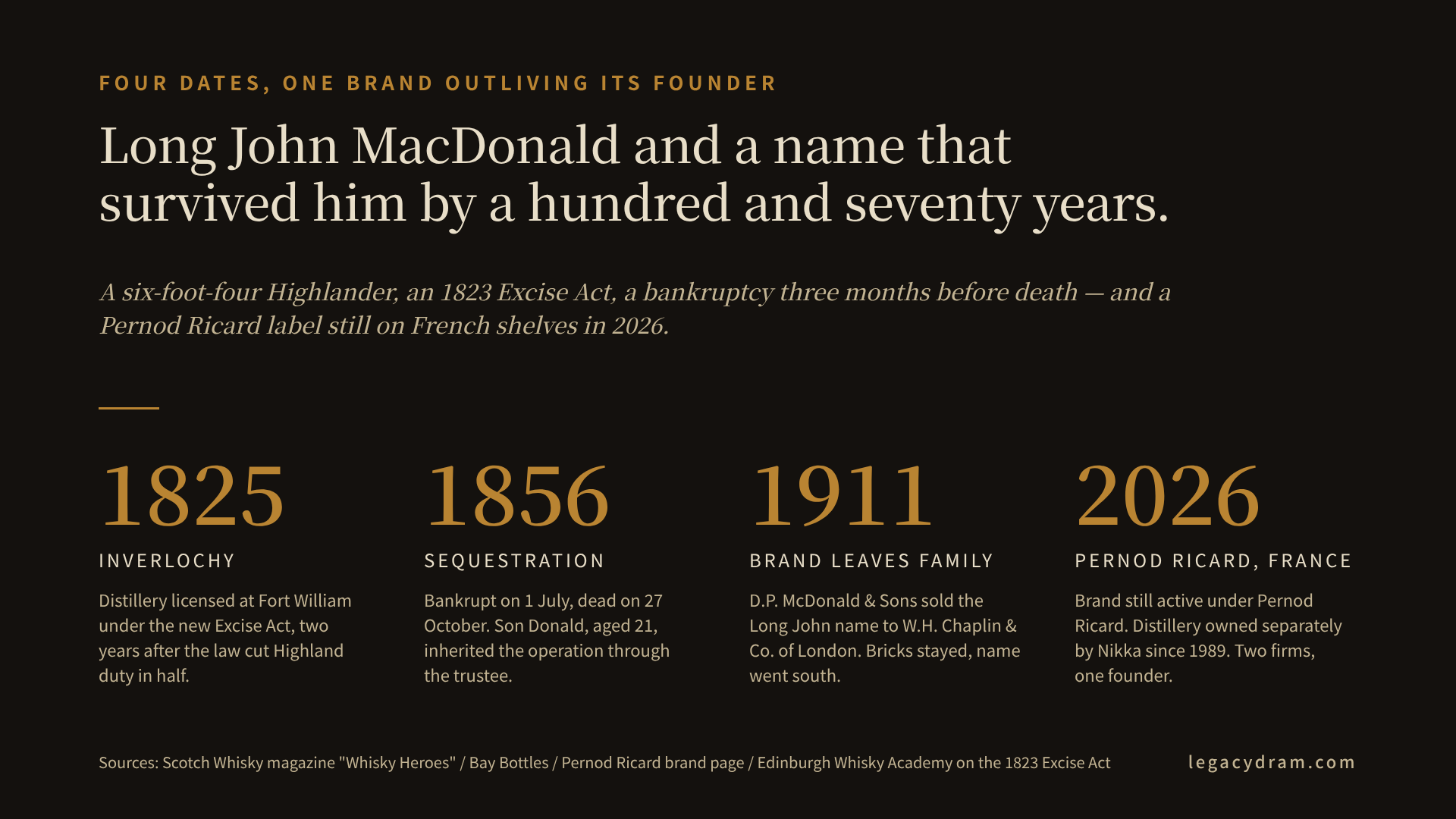
There is a blended Scotch in French supermarkets in 2026 that is named after a Highland man’s height. He stood six feet four inches in stocking feet, which in the early nineteenth century in Lochaber put him a head above almost anybody he met. His name was John MacDonald, and a Glasgow newspaper, reporting his death on the 27th of October 1856, called him by the name his neighbours used: “Mr John MacDonald of the Ben Nevis Distillery, familiarly known by the name of Long John.” Three months and twenty-six days before that obituary appeared, on the 1st of July of the same year, the Edinburgh court had declared him bankrupt. Between those two dates he was a sequestrated debtor, not a distiller. The Long John brand (the blended whisky now owned by Pernod Ricard, still drunk in France, claiming on the back label to contain something like thirty malt and grain whiskies) has by 2026 outlived him by a hundred and seventy years. He never saw any of it. He saw the first thirty-one.
Who actually built it, and why this question matters
The literature on Ben Nevis has not made up its mind about whether John MacDonald founded the distillery in 1825 or only became its proprietor a few years later. Some accounts (the official Ben Nevis site among them) credit “Long John McDonald” as the 1825 founder, full stop. Others, drawing on local Lochaber records, name Angus McDonnell as the man who actually broke ground in 1825 on the banks of the Lochy near Fort William, and have MacDonald entering as a partner in 1830 and buying out the remaining stake for £1,200 in 1831. I cannot resolve which is right, and I am not sure the question has a clean answer two centuries on. What both versions agree on is that by 1831 the distillery was John MacDonald’s, and that the social act being performed in either 1825 or 1831 was the same: a Lochaber Highlander who had no inherited capital was now the licensed proprietor of a legal whisky distillery, which a generation earlier would have been an impossibility.
I want to dwell on that. The relevant fact is not the precise founding year but the policy window that made the distillery possible. The Excise Act of 1823, passed two years before the building was put up, cut the duty on Scotch spirits by more than half (down to two shillings and fivepence per proof gallon), set the minimum legal still size at forty gallons, introduced a ten-pound annual licence, and, perhaps most consequentially, allowed distillers to warehouse their spirit duty-free until sale. For the first time in living memory, running a legal Highland distillery was not, on the unit economics, materially worse than running an illicit one. The 1824 licence at George Smith’s Glenlivet is the most-cited consequence of that Act. The Ben Nevis licence the next year was the second consequence, in a different glen, on the other side of the watershed. MacDonald is best understood as a member of the first cohort of legally-licensed Highland distillers after the 1823 reset, not as a heroic founder who saw something nobody else saw. The Act opened the door. He stepped through it.
What he had going for him, apart from his height, was that he was a Highland man putting a distillery in the Highlands at a moment when most of the legal capital in the industry was still Lowland. Inverlochy is at the south-western end of the Great Glen, fifteen feet above sea level, fed by water off the granite of Britain’s tallest mountain, with the harbour at Fort William giving sea access to Glasgow. The location was viable. The licence was affordable. The Lochaber lairds, by one account, picked MacDonald specifically because he was a known local (a tenant of theirs, in some readings) and not an Edinburgh outsider. He was, in modern terms, the inside candidate for a regulatory opportunity. The romantic reading is that the lairds saw a giant and chose him. The structural reading is that they saw a man they could control and chose him. I think the structural reading is closer.
The brand was him, literally
The thing that almost everybody outside the trade gets wrong about Long John is the order of operations. The man was not called Long John because of the whisky. The whisky was called Long John because of the man. He was six feet four in stocking feet (call it 193 centimetres, in a population where the male average was nearer 168), and the nickname was being used at the distillery before there was a registered brand to attach it to. When MacDonald, sometime in the 1830s or 1840s, began bottling and selling his own single-distillery output under a name, the name was already on him. “Long John’s Dew of Ben Nevis” was the registered formulation. It is, as far as I have been able to establish, one of vanishingly few major Scotch brands whose name derives from the physical body of the founder rather than the geography, the family surname, or a marketing invention. Glenlivet is the glen. Macallan is the surname. Talisker is the bay. Long John is the man’s height, recorded in cotton stockings, in a parish register somebody no longer alive once looked at.
The brand made him locally famous in the way that mid-Victorian provincial figures could be famous: a known character in Fort William, a story told in Inverness, mentioned in passing in the Glasgow press when his casks went to market. He was, by the standards of the Highland whisky trade in the 1840s, doing genuinely well. The single problem he had, which would in the end be the only problem that mattered, was that he had bought the distillery on borrowed money and never quite caught up. The £1,200 he paid Angus McDonnell in 1831, if that transaction is correctly reported, was a very large sum for a tenant Highlander to have raised, and what he raised it with was debt. Distilling was capital-intensive even at the small scale he was operating at. Casks cost money. Malt cost money. Coal cost money. The bank was patient as long as the trade went his way.
Around 1855, the trade turned. Demand softened. Prices for Highland single-distillery whisky weakened. The bank ran out of patience. On the 1st of July 1856 his estate was sequestrated under Scots bankruptcy procedure, which meant a trustee took control of the assets and his right to manage the distillery in his own name was, formally, ended. He died at the distillery on the 26th of October 1856. The Glasgow Herald published the obituary the following day. He was fifty-eight by one estimate; the parish records on his exact birth year are themselves contested, with some sources placing him as born around 1798 and others a year either side. What is not contested is that he died as a man whose property was no longer his. The distillery passed, through the sequestration trustee, to his twenty-one-year-old son Donald Peter MacDonald.
I want to be straightforward about this part. The man whose height became a globally-recognised Scotch brand died with no estate to leave. The brand survived him; the founder did not survive the brand. There is a temptation in the secondary literature to soften this into a story about a colourful character who left a legacy. The accurate version is harder. He borrowed too heavily, the trade went against him in a single bad year, the bank acted, and three months later he was dead. The legacy was carried by his son, who was not bankrupt and could.
What Donald Peter did with the wreckage
Donald Peter MacDonald did what a great many Victorian inheritors of marginal businesses did: he turned the brand into the asset and let the bricks be a producer of the brand. By 1864, eight years into his tenure with the bankruptcy three years cleared, weekly output had risen from the two hundred gallons his father had been producing to roughly three thousand. That is a fifteen-fold increase in less than a decade. The market for Highland whisky was, by the 1860s, recovering, the railway had arrived at Fort William, and Donald Peter rode the wave with more discipline than his father had been able to bring to it. In 1878 the family put up a second distillery, Nevis Distillery, next door to the original Ben Nevis. Both were run by the same family, both producing the same whisky for the same brand, on the theory that the brand could absorb more output than one set of stills could provide. The two operated in parallel until 1908, when they were merged back into a single licensed entity.
Donald Peter died in 1891. The next generation, his sons and nephews, made the structural decision that determined everything that followed. They were no longer interested in operating a Highland distillery as a primary business. They were interested in the brand (the inherited Long John name, which by the 1900s was being blended in Glasgow and sold across the Empire), and even more in the cash that the brand could be sold for. In 1911 the family, by then trading as D.P. McDonald & Sons Ltd (the spelling had dropped the a: McDonald rather than MacDonald, and they were, by then, a Glasgow-registered company more than a Lochaber one), sold the Long John brand to a London blender called W. H. Chaplin & Co. The sale separated the brand from the distillery. The bricks at Inverlochy stayed under D.P. McDonald ownership for another generation; the name went to London. After 1911 it is no longer accurate to say that “Long John” and “Ben Nevis” are the same business. They are two businesses that happen to share a graveyard, and whose ownership runs forward in two non-overlapping branches.
I want to flag the year 1911 as the structural hinge. It is the year a Highland family decision converted an inherited personal-name brand into a transferable commercial asset. Everything subsequent (the move to Seager Evans in 1927, to the American group Schenley Industries in 1956, to Whitbread in 1975, to Allied Domecq in 1989, to Pernod Ricard in 2005) is a sequence of corporate ownership changes for an asset that was created in the 1840s by a tenant Highlander measuring his own height and turned into a commodity in 1911 by his grandsons in a Glasgow office. The structural decision was Donald Peter’s family in 1911, not the founder. The founder had been dead for fifty-five years when the brand left the family. He had no part in the decision that determined how his height would be sold.
The Long John brand is, as of 2026, owned by Pernod Ricard and is sold primarily in France, where it is among the top-selling blended Scotches. It contains, by the brand’s own claim, around thirty malts and grains, with the Tormore distillery providing the bulk of the base. There is no Ben Nevis single malt in the modern Long John blend in any structural way. The brand has been an industrial blend of other people’s whisky for over a century. The connection to the Fort William distillery is a romantic one, not a productive one.
What happened to the distillery itself
After 1911 the distillery remained in family hands, under the name D.P. McDonald & Sons, then under Macdonald, Greenlees Ltd through a series of trade-sale and merger transactions in the early twentieth century. It struggled through the inter-war period and was closed for parts of the 1930s and 1940s. The sequence from 1944 onwards is the Joseph Hobbs story I have written about elsewhere, and I will not repeat it here at length, except to draw attention to the temporal distance: Hobbs bought the surrounding Inverlochy estate in 1944, a hundred and nineteen years after MacDonald had laid out the original stillhouse, and the distillery itself in 1955. The two men never met and could not have met. The connection between them is not biographical but topographical. They are two people who made independent decisions about the same patch of ground, separated by a century and a quarter, and who together account for the configuration the Japanese company Nikka now operates.
The post-Hobbs ownership of the distillery (Whitbread from 1981, Nikka from 1989) is documented in the Hobbs piece; the current core expression is the Ben Nevis 10-year-old, bottled by Nikka to a specification the founder would not recognise. The thing that I find worth noting in the present essay, which is about the founder rather than the buyer, is that the distillery and the brand are in 2026 owned by different companies. Ben Nevis distillery is Nikka (a subsidiary of Asahi). Long John brand is Pernod Ricard. They have been separately owned for over thirty-five years, and structurally separately owned for over a hundred. The man whose height generated both of them is buried somewhere in Lochaber and has no descendants in either firm.
What he traded away, and what was traded away after him
If I am trying to draw out the decisions worth noting, they go in two groups.
MacDonald’s own decisions, between roughly 1823 and 1856, were three. He took the regulatory opportunity the Excise Act opened in his glen, which a great many Highland tenants did not. He borrowed heavily to convert tenancy into ownership of the distillery, which his available capital did not really support. And he let his own physical body become the brand, which gave him local recognition in the 1840s and turned out to be the single most durable asset he created. He did not understand at the time that the brand was the asset. He thought the distillery was the asset. His son, eight years after his death, saw the brand as the asset. His grandsons, in 1911, sold the brand and kept the bricks. By 1989, both had been sold to two different international firms. The founder’s decision to put his name on a bottle outlasted every subsequent decision the family made about the underlying business.
The family’s decisions, between 1864 and 1911, were the inverse. They built a second distillery (1878), they merged it back (1908), they restructured the company name, they raised production, they cultivated the trade, and then, in the end, they sold the only thing that mattered. The 1911 sale of the Long John brand to W. H. Chaplin & Co. is, in retrospect, the moment the founding family stopped owning what the founding had created. They retained an operating distillery. But what they had created in the 1840s was not, in the end, a distillery. It was a name. The name went to London. The bricks stayed at Fort William and would, eventually, end up Japanese.
A grave in Lochaber, a label in Carrefour
I went looking for John MacDonald’s grave during the research for this piece and could not, in the end, definitively locate it. The parish records around Inverlochy and Kilmonivaig in the 1850s are imperfectly digitised, and the obvious candidate burial sites have been disturbed by twentieth-century construction. He is somewhere in the soil within walking distance of the distillery. There is no marker that I have been able to identify, no obelisk, no plaque on the still-house wall. The man whose physical height is, in 2026, embossed in raised relief on a Pernod Ricard bottle in a Carrefour supermarket in Lyon has no monument in his own glen.
I find this hard to write about without slipping into bathos, but I will try to keep it level. The brand on the French bottle is not the man. The brand is a thing that was made out of him by his son and his grandsons and a London blender and an American conglomerate and a French multinational, none of whom met him, and most of whom did not know his actual biography. He has been turned, by the operation of two centuries of corporate ownership transfer, into a label component. The actual decisions he made (the leveraged purchase from Angus McDonnell, the gallons-per-week of output, the trade contacts, the cask sales to Glasgow blenders) have left almost no documentary trace and have been forgotten even within the trade. What survives is the height. Six feet four in stocking feet. The unit of measurement is the man.
He went bankrupt on the first of July, 1856. He died on the twenty-sixth of October of the same year. The bank had been the immediate cause. The distillery he had built passed to a son who was twenty-one years old at the time and who would, within a decade, multiply its weekly output by fifteen. The brand he had named after himself would, in 2026, be drunk in France, in dilution that bears no relationship to any whisky he ever made, and would be unrecognised by him if he were shown the bottle. I think he would have shrugged at this. He was, by every account that survives, a practical man. The romantic reading would say the brand carries his memory. The accurate reading is that the brand carries the marketing-rights residue of a name his neighbours used to describe his physical body. The two readings are not the same.
There is a working distillery at the foot of Ben Nevis. There is a blended whisky on a French shelf with his nickname on the label. He is buried somewhere in the same parish. The three facts do not, any longer, sit inside the same business. They sit inside three separate ones, owned by three separate companies, operated under three separate sets of decisions made by people he never met. The clause that connected them was severed in 1911 by his own grandchildren, and he had been dead for over half a century by then. I think this is the honest version of the story. The brand is older than any of the men currently selling it and younger than the founder’s bones.
Related: Joseph Hobbs at Ben Nevis and Inverlochy, the Canadian outsider who bought the same distillery 119 years after MacDonald laid it out, is the structural counterpart to the present piece: the founder’s view of the same patch of ground that the buyer’s view answers. On the founding-cohort context, see Glenlivet and Glenfiddich’s two founding families for the parallel Speyside case that shares MacDonald’s policy window. On the late-Victorian brand-trade environment that swallowed the Long John name in 1911, see the Pattison Crash of 1898 and William Sanderson’s 1882 blind panel for VAT 69, which together describe the blending-house industry into which the brand was sold. My continuing argument about whose decisions actually persist in the bottle on a 2026 shelf is at kenimoto.dev.