The Coffey Still at Cameronbridge: Grain Whisky and John Haig
For most of my drinking life I have avoided writing about this man, because I was a single-malt drinker and I treated grain whisky the way an audiophile treats MP3s: as the lossy thing the other people drank. The single-malt frame is built around the pot still, the named distillery, the warehouse on the sea loch. It has very little room in it for the man who, in a flat industrial town in Fife in the 1830s, took an Irish exciseman’s continuous-distillation patent and quietly turned grain whisky into the cheapest, most consistent neutral spirit in the United Kingdom. If you drink Johnnie Walker Red, Famous Grouse, Chivas, Ballantine’s, J&B, or any other blended Scotch made in the last hundred and fifty years, somewhere between sixty and seventy percent of what you are drinking is in a direct lineage from a decision John Haig made before any of those brands existed.
This is going to be a piece about that decision, and about the people who made it possible, and about why none of their names are on the bottle. I want to be honest in advance that there are no heroes here, in either direction. Haig was not a visionary. The single-malt distillers who spent twenty years in court trying to legally define him out of existence were not villains. They were Highland landowners who had real economic reasons to want the word whisky reserved for what came out of a pot still in a glen, and they lost the argument because the argument was lost on the day Aeneas Coffey filed UK patent number 5974.
The Haigs were already distillers when John was born
The first thing to say is that John Haig did not invent the family business. He inherited it. The Haig family had been distilling in the Scottish Lowlands since at least the seventeenth century, and his mother was a Stein, which is a name that ought to register if you have read any history of pre-Coffey Lowland distilling. The Steins were the other Lowland distilling dynasty, and they had been experimenting with continuous and semi-continuous still designs since the 1820s. By the time John Haig was born in 1802 in Stirlingshire, the Haigs and the Steins were collectively running the largest grain-distilling operations in Scotland, and most of what they made went south to the English gin trade as base spirit.
This is the bit that the romantic version of Scotch whisky history quietly skips, because it is unflattering to the amber liquid from the Highland glens story. In 1820, Lowland Scotland was distilling industrial volumes of cheap grain alcohol on a continuous basis, and most of it was not even being sold as whisky. It was being shipped to London to flavour gin. The Lowland grain distillers were, in modern terms, the bulk-API contract manufacturers of the Georgian spirits industry. The Highland malt distillers were the boutique brands. Both have always existed. The myth that Scotch whisky began as a Highland farm trade and was later industrialised by southern interlopers is a romanticism written backwards from the 1960s, when single malt had to be marketed as a premium product against a flood of blended.
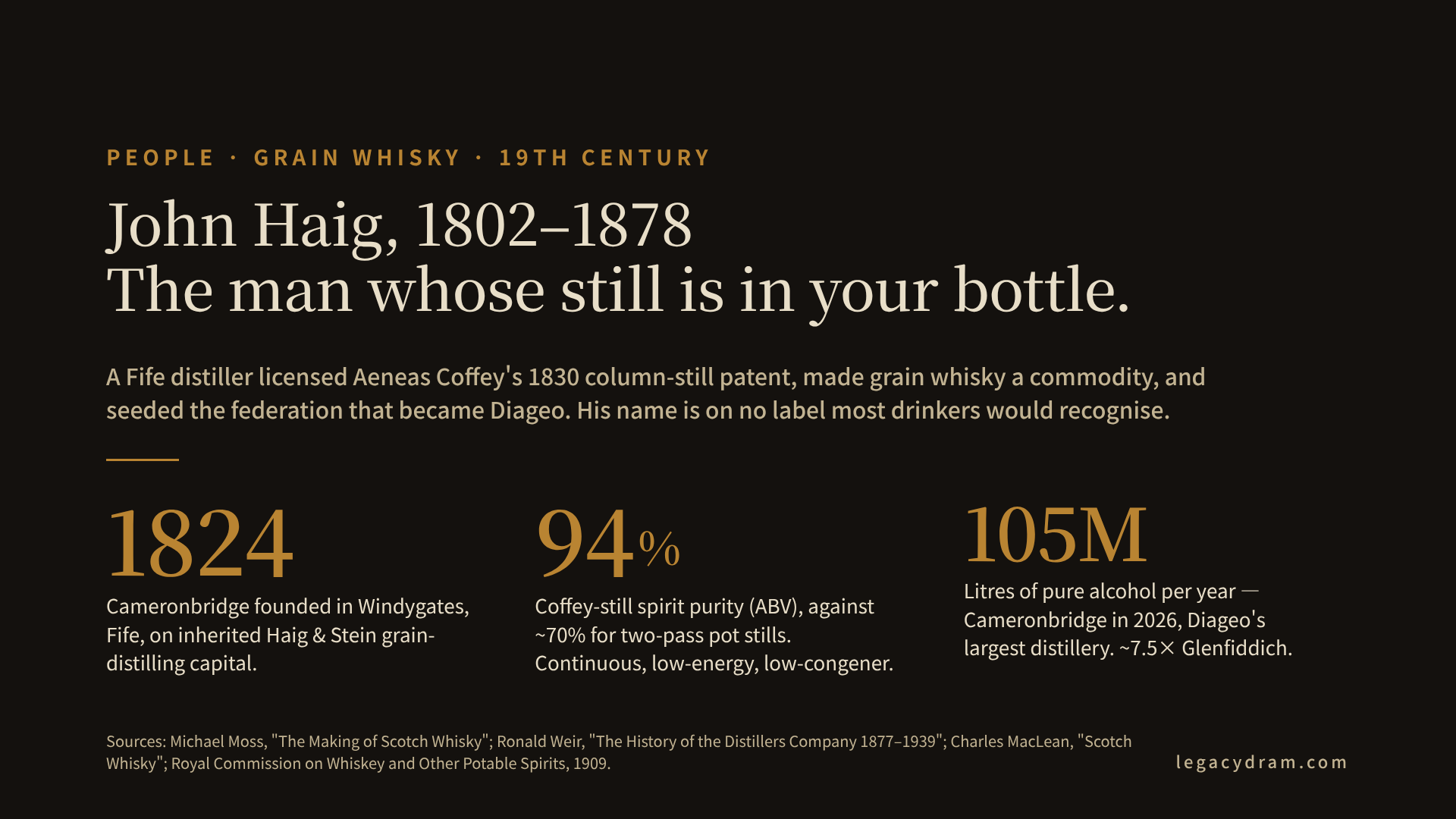
Haig’s family business gave him, by inheritance, access to grain supply chains in Fife and Edinburgh, capital, and a working knowledge of every kind of still that had been built in Britain in the previous fifty years. He founded the Cameronbridge distillery in 1824 in Windygates, Fife, near the village of Cameron Bridge, which is the bridge that gave the place its name. He was twenty-two. The distillery, in its original form, used pot stills and a Stein-design continuous still that the family had developed in-house. This is the form Cameronbridge ran in for about ten years.
Then a former Inspector General of Excise in Ireland filed a patent in London.
What Coffey actually invented
Aeneas Coffey was Irish, a Dublin-based civil servant who had risen through the Excise Service to become Inspector General before resigning in 1824 to run the Dock distillery in Dublin. He had spent his entire working life measuring the output of stills for tax purposes, and he had spent the last few years of it on the Dublin side of the Irish Sea watching the Stein-family continuous stills work, imperfectly, in Scotland. In 1830 he filed UK patent number 5974, in London, for what he called the patent still. The whisky industry of the next century called it the Coffey still. The petroleum-refining industry, which adopted the same design forty years later, called it a fractional distillation column, and that is what it actually is.
The mechanics are worth understanding because they explain almost everything else in this piece. A pot still is a batch reactor. You fill it with fermented wash (about eight percent alcohol), heat it, collect the vapour, condense the vapour. The first distillation gives you a low-strength distillate called low wines at around twenty percent. You put that into a second pot still and run it again. You get spirit at around seventy percent. To go higher you would need to distil a third time, which is what Auchentoshan, Springbank’s Hazelburn, and the Irish triple-distillers do. Each pass through the still throws away most of the volume and most of the energy and keeps a small amount of higher-purity liquid. It is, in chemical-engineering terms, a low-throughput batch separation with high fixed cost per cycle.
Coffey’s still does the same separation continuously and in two columns. The first column is called the analyser. Wash enters near the top and falls down across a series of perforated plates while steam is injected at the bottom and rises through the same plates. The two streams meet on each plate, and at each plate the steam picks up volatile compounds (mostly ethanol) from the wash and the wash gives them up. By the time the steam reaches the top of the analyser, it is carrying most of the alcohol from the wash. By the time the wash reaches the bottom, it is mostly water and dissolved residues, which drain out as spent wash. The alcohol-laden steam then enters the bottom of the second column, called the rectifier. The rectifier is the same shape, with the same plates, except that on each plate the rising vapour exchanges with falling liquid (the reflux, condensed from the vapour at the very top and trickling back down) rather than with fresh wash. Each plate is, in effect, one theoretical distillation. By stacking thirty or forty plates in a column, you can perform thirty or forty distillations in series, continuously, without stopping. The spirit comes off near the top of the rectifier at around ninety-four percent ABV, which is close to the azeotrope of ethanol and water (95.6%) and is the maximum purity an atmospheric still can produce.
So the comparison, in numbers: pot still, batch, two cycles, seventy percent ABV, lots of congeners (the flavour and aroma compounds that survive low-purity distillation), low throughput, high energy cost per litre. Coffey still, continuous, ninety-four percent ABV, almost no congeners (because the column strips them out at intermediate plates and sends them down the drain with the spent wash), high throughput, low energy cost per litre.
The output of a Coffey still is, chemically, a much cleaner spirit than what comes out of a pot still. It is also a much less flavourful one. This is the trade-off the rest of the story is about.
Haig adopted the patent within a decade
John Haig was related to Aeneas Coffey by marriage. The exact degree is one of those genealogies that the secondary literature gives slightly different versions of, but the connection was close enough that when Coffey filed his patent in 1830 and was struggling to license it in Ireland (the Irish pot-still distillers, having more pride than market sense, refused to touch it), Haig was among the first people in Britain to take a license. He installed a Coffey still at Cameronbridge in the mid-1830s. The dates given in the secondary literature range between 1834 and 1838; I have not been able to find a primary source that fixes the year.
What is fixed is what happened next. Cameronbridge under Haig became the largest grain distillery in Scotland within a decade. The economics were not subtle. A Coffey still ran continuously, used less energy per litre than the pot-still operation it replaced, produced spirit at a purity that allowed it to be diluted with neutral water rather than further-distilled, and could be scaled by adding more plates rather than by building more buildings. Where a pot-still distillery was constrained by how many stills it could heat and how often it could clean them, Cameronbridge was constrained only by how much grain it could buy.
This is the part of the story where I should write that Haig was a visionary who saw what the others did not. I am not going to write that, because the evidence does not support it. Haig was the cousin of the man who held the patent, was already running a Lowland grain distillery that had been on Stein-design continuous stills since his father’s generation, and made the licensing decision a moderately competent business heir would have made in his place. The Coffey still was, by 1835, the obvious technology for any distiller whose product would not suffer from being less flavourful. Haig’s was a grain distillery whose product was being shipped to London to be turned into gin. Less flavourful was a feature.
The thing he did that the others did not was hold the contract for long enough to compound. He ran Cameronbridge for the next forty years. He used the cashflow from the grain operation to buy or partner in pot-still distilleries (the family also owned Markinch and, later, Glenkinchie among others), and he gradually accumulated, through his and his cousins’ interests, control of most of the Lowland grain-distilling capacity in Scotland. By the 1860s the Lowland grain trade was an oligopoly. In 1877, six of the largest grain distillers, with Haig family interests prominent, federated as the Distillers Company Limited. This is the body that, over the next sixty years, would consolidate first the grain trade, then the malt trade, then the blending houses, and would eventually be acquired in 1986 by Guinness and renamed, in 1997, Diageo. Cameronbridge is still there. It is still Diageo’s largest distillery by a substantial margin: roughly one hundred and five million litres of pure alcohol a year, against Glenfiddich’s fourteen million.
John Haig himself died in 1878, the year after DCL was incorporated. He was seventy-six. He had run the same distillery for fifty-four years.
The Highland distillers tried to legislate him out of existence
The fight I want to spend the middle of this piece on is the one Haig did not live to see, but which he had made inevitable. By the 1890s, the price difference between grain spirit and malt spirit had become large enough that blended Scotch (a mixture of Coffey-still grain whisky with a small proportion of pot-still malt) was selling at a fraction of the price of single malt and was outselling it everywhere in the English market. The blending houses (Walker, Dewar, Buchanan, and so on) had figured out that you could give grain whisky a reasonable flavour profile by adding ten to thirty percent malt to it, and you could give that blend a recognisable brand identity by being consistent batch-to-batch. The Highland malt distillers, who could not match the price and whose product was no longer the default thing in the consumer’s glass, lobbied for years for the word whisky to be legally restricted to pot-still spirit.
In 1903, the Islington Borough Council, somewhat improbably, took up the cause and prosecuted two London publicans for selling whisky that was actually blended (i.e. mostly Coffey-still grain). The case made it through the magistrates’ court on a split decision and the Highland Distillers’ Association seized the opening. In 1908, after years of pressure, a Royal Commission was convened to settle the question. The commission heard evidence from both sides for a year. Then, in 1909, it ruled.
The ruling is the part most people forget. The Royal Commission said that whisky was a spirit obtained by distillation from a mash of cereal grains saccharified by the diastase of malt, and that this definition included both pot-still and patent-still spirit, and that therefore blended whisky was whisky. This was a complete defeat for the Highland malt distillers and a complete legitimation of the grain trade. The Coffey still was, from that point, the standard production technology of the Scotch whisky industry, and the blending houses were free to expand into the global market they had been quietly building for thirty years.
The thing that strikes me most about this fight, reading the contemporary accounts, is how badly the Highland malt side miscalculated their tactical position. They went to court hoping to ban grain whisky. The court instead issued a formal definition that included grain whisky and conferred on it the same legal status as their own product. Before 1909, blended Scotch was a popular consumer product of slightly ambiguous legal standing, vulnerable in principle to a legislative attack. After 1909, it was the legally-defined default form of Scotch whisky, and the malt side had paid the costs of the prosecution that made it so. I do not think there is a clean way to write the people trying to kill the technology accidentally made it legally bulletproof without sounding glib, but that is what happened. The Highland Distillers’ Association handed the grain trade its constitutional charter.
John Haig had been dead for thirty-one years.
What is in your glass
If you walk into a bar in 2026 and order a Famous Grouse and soda, what arrives is approximately seventy percent grain whisky and thirty percent malt whisky, with the grain side disproportionately likely to have come out of Cameronbridge or one of its two or three sister distilleries. The malt side will be a blend of perhaps twenty or thirty different single malts, mostly Speyside, mostly aged five to eight years, mostly bought on contract through the long-running reciprocal cask-trading arrangements between the big blending houses. The flavour you experience as Famous Grouse is mostly the malt component, because the grain side is engineered to be flavour-neutral and the malt side is engineered to deliver brand identity. But the liquid you drink, by volume, is mostly Cameronbridge.
This is the architecture Haig made possible. It is also, in commercial terms, the architecture that made Scotch whisky a global product. Single malt would not have left Scotland in any volume until at least the 1960s without the grain-and-malt blended format to introduce it to foreign drinkers, because pot-still production simply could not have met the demand. The grain still is the platform on which the malt category survived as a niche product through its hardest century.
For readers who came to my work through the Kindle title on cost-performance whisky, I think this is the missing piece in why blends like Ballantine’s Finest, Famous Grouse, and Johnnie Walker Red are drinkable at the price they are. The grain spirit is cheap because Coffey-still production at Cameronbridge-scale costs a fraction per litre of pot-still production at Glenfiddich-scale. The malt spirit is expensive but you only need thirty percent of it. The blend hits a price point neither category could reach on its own. The reason your Friday-night cheap blend tastes acceptable is not that the brand is being generous; it is that the supply chain has been re-engineering this trade-off in continuous improvement for one hundred and ninety years, starting with the still John Haig licensed in Fife in the 1830s.
The Beckham coda
The last thing I want to write about, and I will keep this short because the appropriate register is mild embarrassment, is that there is a Scotch whisky brand called Haig Club. It was launched by Diageo in 2014, in a square blue bottle, marketed primarily through a sustained association with the footballer David Beckham, and it is a single-grain whisky made at Cameronbridge. It is, in other words, a piece of straight-line marketing in which the Haig family name, dormant for over a century since DCL absorbed it, was reactivated by the corporate successor of DCL to put a celebrity face on a bottle of Cameronbridge grain spirit. As a piece of brand-recovery work it is competent. As a tribute to the man whose name is on the label, it is roughly as accurate as putting Faraday’s face on a Duracell battery.
I do not want to be too hard on it. It is at least the first time in a century that Haig has appeared on a Scotch label in any prominent form, and the liquid inside is in a direct production lineage from the distillery he built. But the man on the label is not the man whose name is on the label, and the man whose name is on the label has been absent from the popular history of Scotch whisky for so long that you can put a footballer’s face next to it and the average drinker will reasonably assume the footballer is the more important historical figure. He is not. John Haig is, by any defensible measure, more responsible for what is in the bottle on the bar in front of you than any other single person in the history of Scotch whisky, and the bottle has, for the most part, forgotten him.
That is the thing I find quietly sad about him. The Highland figures of his century (the Grants, the Smiths, the Mackenzies) have been folded into the marketing of the distilleries they founded and are at least dimly familiar to anyone who reads the small print on a label. Haig has been folded into the marketing of a celebrity bottle and is not familiar to anyone. The technical decision he made in the 1830s, in a flat industrial town in Fife with no glen and no romance attached to it, is the technical decision the industry was built on. The fact that it is invisible from the outside is, I suspect, exactly how he would have wanted it. He was running a business, not a brand. He did the work. He took the licence. He compounded the cashflow for fifty-four years and handed the federation to his successors. He died in 1878 in Edinburgh, in a house I cannot find a photograph of, and the only thing on his gravestone that the modern drinker would recognise is the surname, which is now a footballer’s perfume.
If you want to read further on the surrounding decisions: I have written previously on Charles Doig, the Elgin surveyor whose pagoda silhouette became the visual identity of the Highland malt distilleries Haig’s blends bought from; on Auchentoshan, Hazelburn, and the mathematics of triple pot-still distillation, which is what the Coffey still made unnecessary at industrial scale; on Brian Kinsman at Glenfiddich and the engineering of consistency, which is the post-1960s single-malt answer to the blended format Haig’s grain enabled; and on Frank McHardy at Springbank, whose distillery is one of the very few that still resists the format Haig’s industry settled on. My broader argument about who owns what in modern Scotch is at kenimoto.dev.