Frank McHardy Springbank: 1979-89 Silent Years
There is a phrase the whisky industry uses, silent years, that nobody likes to bring up in a shareholder meeting. It sounds romantic, the way legacy system sounds dignified when you are not the engineer maintaining it. In practice, a silent year is a distillery that has stopped making spirit (sometimes for a quarter, sometimes for a decade) while the warehouses keep aging the casks that were laid down before the lights went out. Whisky maturation does not pause. The math keeps running even when the boilers do not.
In 1979, Frank McHardy was promoted to manager of Springbank distillery in Campbeltown. He was thirty-five years old and had joined Springbank as assistant manager two years earlier. Almost immediately after the promotion, Springbank stopped making whisky.
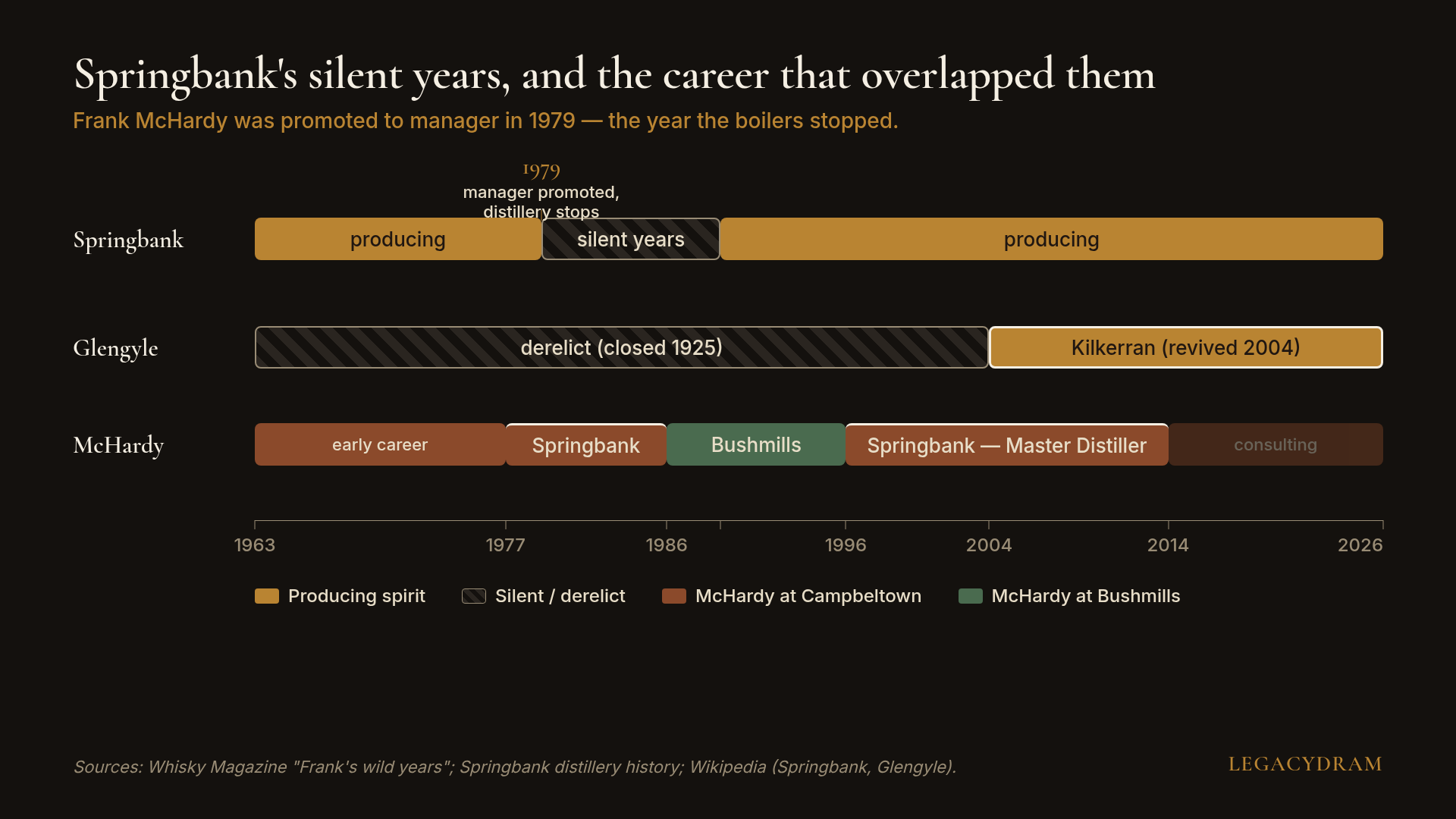 The UK economy had collapsed into recession, scotch was in industry-wide oversupply, and the Mitchell family (who had owned the distillery since 1837 and have, to date, never sold it) decided that the most honest response to a glutted market was to stop adding to the glut. Springbank went silent in 1979 and did not come back to anything like full production until 1989.
This, I would argue, is what maintenance mode actually looks like in any industry. Not the polished version where you write the runbook, hand the system off, and go home. The real version: the build has stalled, the tickets are piling up, headcount is frozen, and someone has to keep the lights on for a piece of infrastructure that is not currently shipping anything. Because in ten years, somebody is going to need to know exactly what state it was in when it stopped.
I am interested in McHardy because he became Master Distiller of a system that had been silent for most of his early career there, and because the bottles signed with his name today are mostly not, strictly speaking, his. They are someone else’s stewardship that he protected, at exactly the moment when protecting them was hardest to defend on a spreadsheet.
A career that does not fit a clean timeline
McHardy started in whisky in 1963, at nineteen, at the Invergordon grain distillery, in a job that involved sweeping floors. (This is, I promise, going to matter again later.) He moved to Tamnavulin and Bruichladdich, picked up the production side of the trade, and arrived at Springbank in 1977. Two years later he was running it, which sounds like a promotion but was, in practical terms, an inheritance of a problem.
He left Campbeltown in 1986 for Bushmills, on the north coast of Northern Ireland. Bushmills was the world’s oldest licensed distillery, then owned by Irish Distillers. He spent ten years there, eventually as Head Distiller, working with triple-distilled Irish style and a fundamentally different rhythm. This is the part of his career that whisky hagiographies tend to compress, because it makes the Springbank narrative messy: the man widely associated with surviving Springbank’s silent years was not actually there for most of them. He had already left.
He came back in 1996, by then fifty-two, as Master Distiller, and stayed until he retired in 2014. Eighteen years in the second tenure. Whisky Magazine inducted him into their Hall of Fame the same year, the nineteenth person to be added. He is, as of writing, alive and consulting on small distilleries around the world. None of this is a tidy myth.
What he actually did when he came back
By 1996, Springbank had been making spirit again for seven years, but the operation had no forward production plan. According to Whisky Magazine’s long profile of his career, “Frank’s wild years,” McHardy’s first move on return was to set a twenty-year plan: tie sales directly to production, narrow the sprawling product list, and direct everything toward Springbank’s own brands rather than the third-party blenders’ supply line that had defined Campbeltown for a century.
He also reviewed and replaced large parts of the wood inventory, applying what he had learned at Bushmills about cask management. Bushmills, being newer to single-malt prominence, had been forced to think about wood more rigorously than Springbank, where the casks had simply been there.
Two of his decisions, though, have done more than the rest to define what is now in the bottle.
The decision to keep floor malting
Springbank is the only Scotch whisky distillery that performs every step of production in-house, including malting one hundred percent of its own barley on a traditional malting floor. A handful of other distilleries (Bowmore, Highland Park, Laphroaig, Kilchoman, Balvenie, Benriach) floor-malt some portion of their barley. None of them do it for the whole supply.
Floor malting is not, strictly speaking, defensible on a spreadsheet. Industrial maltings can produce malted barley to spec, in volume, at a price that an in-house operation cannot touch. The labour is hard, the throughput is low, and the variability of a hand-turned malting floor is, if you are being honest, a quality-control risk dressed up as a tradition.
McHardy did not invent floor malting at Springbank. That was inherited. What he decided, repeatedly across eighteen years, was not to stop. He held the position that the integrity of the spirit’s character depended on controlling the malting profile in-house, even at a cost the rest of the industry had long since written off. The Mitchell family’s structural decision not to take outside capital made this defensible: there was no quarterly board to whom the choice had to be justified.
It is a trade-off, not a triumph. Springbank’s bottle prices reflect the cost of in-house malting, and so does its limited availability. The single-malt premium boom of the 2000s and 2010s rescued the economics; without that boom, the same decision held in 1998 could just as easily have looked like vanity. The luck of being in the right decade is part of why the position survived. It is worth saying out loud.
The Glengyle revival, and the stills from Invergordon
In 2000, Hedley Wright (head of the Mitchell family company, J&A Mitchell) bought a derelict Campbeltown distillery called Glengyle, which had last produced spirit in 1925. The plan was to revive it as a working distillery so that Campbeltown, which had once held thirty-odd distilleries and now had two, could be officially recognised as a distinct whisky region again. The Scotch Whisky Association’s regional definitions have a minimum-distilleries criterion. Three was the threshold. The revival was, in part, a piece of regulatory engineering.
McHardy oversaw the conversion of a derelict barn into the new Glengyle distillery, a project that began in 2003 and produced its first new-make spirit on March 25, 2004. He installed two pot stills that had originally come from the Invergordon complex, including from the closed Ben Wyvis malt distillery, which had operated within Invergordon’s grain distillery from 1965 to 1976. These were the stills he chose, and the only way that detail does not read as on the nose is if you were not trying to avoid it: the man who began his career sweeping floors at Invergordon in 1963 ended it, four decades later, installing Invergordon’s old stills in the distillery he was reopening.
I do not know whether he picked those stills for the symbolism, or whether the symbolism is the kind of thing that finds you when you have worked in one industry long enough. The public record does not say.
”Work in Progress”
Glengyle’s whisky is bottled under the name Kilkerran, because the rights to Glengyle as a whisky brand belong to Loch Lomond Distillers, who use it for a blend. The naming is incidental. The more interesting decision was about how to release the spirit while it was still maturing.
From 2007, Kilkerran was sold under a series called Work in Progress: annual releases that openly told the customer the whisky was not yet at its intended age. The first was a three-year-old. Subsequent releases, mostly annual from 2009 to 2015, walked the spirit forward toward the eventual twelve-year-old core release in 2016. The series is unusual because most distilleries hide the under-mature years; Kilkerran chose to publish them.
This was, again, a trade-off. Selling a three-year-old as a “work in progress” can be read as transparency, or as a way to monetise the gap between cash-out and cash-in for a new distillery. Both are true. McHardy, as far as the record indicates, supported the more honest framing: show the customer the maturation curve rather than wait for the curve to land. It fits the rest of his style: not romantic about the product, willing to publish the messy intermediates.
The bottles that are not his
Here is the part of the story I keep getting stuck on.
The Springbank 25 you can occasionally find on a shelf today was distilled before McHardy returned in 1996. The Springbank 21, in many releases, was distilled before he came back too. The casks that defined the Springbank brand during the post-2000 single-malt boom were laid down by teams working under his predecessor, during years when the distillery was barely running, in some cases during the silent years themselves. McHardy’s eighteen-year tenure as Master Distiller is mostly the work of choosing which of those casks to bottle, when, at what strength, with which wood transitions. He did not distil them.
This is true of most master distillers in scotch, because the lag from still to label is fifteen to twenty-five years. Anyone bottling a twenty-five-year-old today is releasing somebody else’s spirit. But the gap is unusually visible at Springbank, because the silent years are still in the inventory, slowly getting older, slowly running out. There are casks behind those warehouse doors that have been there since the early 1980s, distilled by a team McHardy was technically running for two of those silent years before he left for Bushmills, and then aged for a decade by the people he had left behind.
I find this honest, in a way that the more triumphal version of his career is not. The decisions that shipped under his name include a great deal of someone else’s work. The decisions that are most clearly his own (the wood reset, the floor-malting hold, the Glengyle revival, the Kilkerran transparency) are mostly still in casks, still maturing, and will not fully land in the public record until long after he stopped going into the warehouse to check on them.
He retired in May 2014. The Glengyle 2004 spirit he supervised on its first day will turn twenty-two this year. The Kilkerran 12, released two years after his retirement, was distilled within his first weeks of project oversight at the new distillery. Whoever bottles a Kilkerran 25 in 2029 (and someone will) will be releasing a decision he made in 2004 about a still that came from the place he started his career.
That is the thing about whisky as a profession, and it is the thing about most long-lived systems too. The work outlives the worker, and not in the heroic legacy sense. In the much more uncomfortable sense: you do not get to find out, in your own lifetime, whether the call you made was right.
Related reading
- The Reflux Equation: Why Glenmorangie’s Stills Are 5.14 Metres Tall (and What Bill Lumsden Inherited) — same era of inherited still geometry, different family of decisions
- Welcome to LegacyDram — why we read whisky like legacy code
Sources
- Whisky Magazine, “Frank’s wild years” — whiskymag.com
- Springbank distillery’s published history — springbank.scot
- Glengyle / Kilkerran distillery — kilkerran.scot
- Whisky Magazine Hall of Fame announcement (2014)
- Wikipedia entries on Springbank and Glengyle