Bill Lumsden's Ten Glenmorangie Private Edition Experiments
The Glenmorangie distillery in Tain is the kind of place where the most important design decisions were made by people who died before television was invented. Its wash stills are 5.14 metres tall, the tallest in Scotland, and they have been that height since 1843 because the founder, William Matheson, bought a pair of second-hand gin stills instead of the onion-shaped pots the trade preferred. The lyne arms angle upward. The reflux is high. The new make comes off light, floral, and ester-forward, and everyone agrees this is what Glenmorangie is supposed to taste like. (I have written about the geometry itself in Glenmorangie Still Height: How Reflux Shapes the Spirit, because the metalwork is the load-bearing wall of the whole story.)
Into this fixed hardware, in 1995, walked a Heriot-Watt biochemist named Bill Lumsden. His doctoral training at the International Centre for Brewing & Distilling was in microbial physiology and fermentation science, which is the polite academic description of “how yeast behaves when you feed it barley wort.” He came in as Distillery Manager, was promoted to a directorship, and has held the title Director of Distilling, Whisky Creation and Whisky Stocks since 2012. He is, on paper, the person most responsible for what Glenmorangie has tasted like for the last thirty years.
He is also, and this is the joke I keep coming back to, a fermentation scientist who was not allowed to touch the fermentation for the first twenty-four years he worked there.
What “not allowed to change” looked like in practice
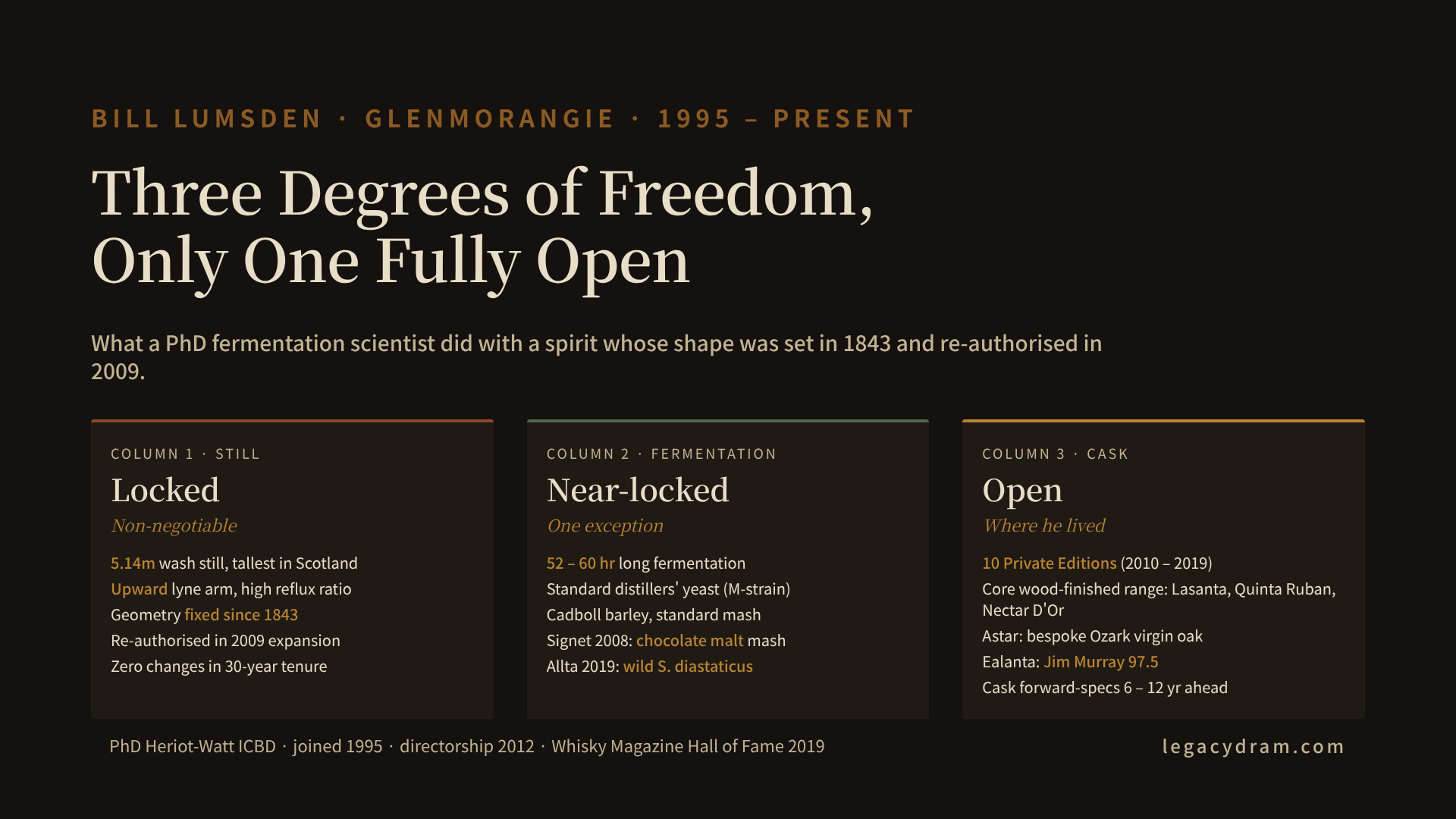
I have said elsewhere on this site that the tall stills are essentially non-negotiable. They are load-bearing to the brand. LVMH bought Glenmorangie in 2004 for £300 million, and when they funded a stillhouse expansion in 2009 they insisted the four new stills be built to the same 5.14m geometry as the 1843 originals. That was the corporate decision to freeze the interface. Everything Lumsden did downstream had to work with a spirit whose character was set by copper of a specific height and by a lyne arm at a specific angle, both fixed before his career started and both re-authorised for another forty years while he was in post.
The fermentation side had a similar inheritance problem, though less absolutely. Glenmorangie had long run a fifty-something-hour fermentation on distillers’ yeast, and the pattern was stable. Any change there risked destabilising a spirit profile the sales team had spent decades explaining. Lumsden’s colleague Brendan McCarron, who joined as Head of Maturing Whisky Stocks in 2014, is closer to the day-to-day washback than Lumsden is. I have written about that division of labour in Glenmorangie Fermentation: Long-Ferment and Allta Wild-Yeast Chemistry; the point for this article is that fermentation, too, was a place where you did not experiment casually.
That left casks. It left barley. It left, for one dramatic exception, the mash bill. And it left, for one dramatic experiment released at the very end, the yeast.
Lumsden spent twenty-four years working through the list.
Signet (2008): the one time he changed the input
Signet was released in 2008 and it is the odd one out in the Glenmorangie catalogue. Every other Glenmorangie sits on top of the same wash: standard Cadboll-grown barley, malted normally, fermented on distillers’ yeast, distilled through the tall stills. Signet does not.
Signet’s mash bill contains a roughly twenty-percent addition of high-roast chocolate malt, the same category of malt more familiar to brewers of stouts and porters than to Scotch distillers. The malt is tumble-roasted the way coffee beans are roasted; the flavour it carries into the wash is coffee, cocoa, and burnt sugar. Lumsden has said the inspiration was Jamaican Blue Mountain coffee. The final bottling marries whisky from the chocolate-malt distillate with older stocks aged in ex-bourbon, sherry, and virgin charred oak casks.
I want to write that Signet is Lumsden’s masterpiece. It is not, and pretending otherwise would flatter him. Signet is the only Glenmorangie product that addresses the underlying lightness of the spirit at the source. It moves upstream of the still. It says: the wash itself will be different this time. Everything else Lumsden has ever shipped is a wrapper around a standard wash.
But Signet has stayed a side branch for almost two decades. It has not spawned a Signet 12, a Signet Cask Strength, a Signet peated. It sits at the top of the price ladder as a curiosity, and Glenmorangie’s growth continued to come from the core wood-finished range: Original 10, Lasanta, Quinta Ruban, Nectar D’Or. The one time Lumsden was allowed to change the input was permitted precisely because the result was too weird to scale. If Signet had been a runaway commercial success at £100 a bottle, Glenmorangie’s identity would have been at risk in a way LVMH would not have tolerated. It is a monument, not a strategy.
I keep this in mind whenever I read a Bill Lumsden interview where he talks about experimentation. He experimented on the wrapper. When he touched the interface, once, the experiment was pre-quarantined by price and volume so it could not accidentally take over.
Private Edition 1–10 (2010–2019): the wrapper, methodically
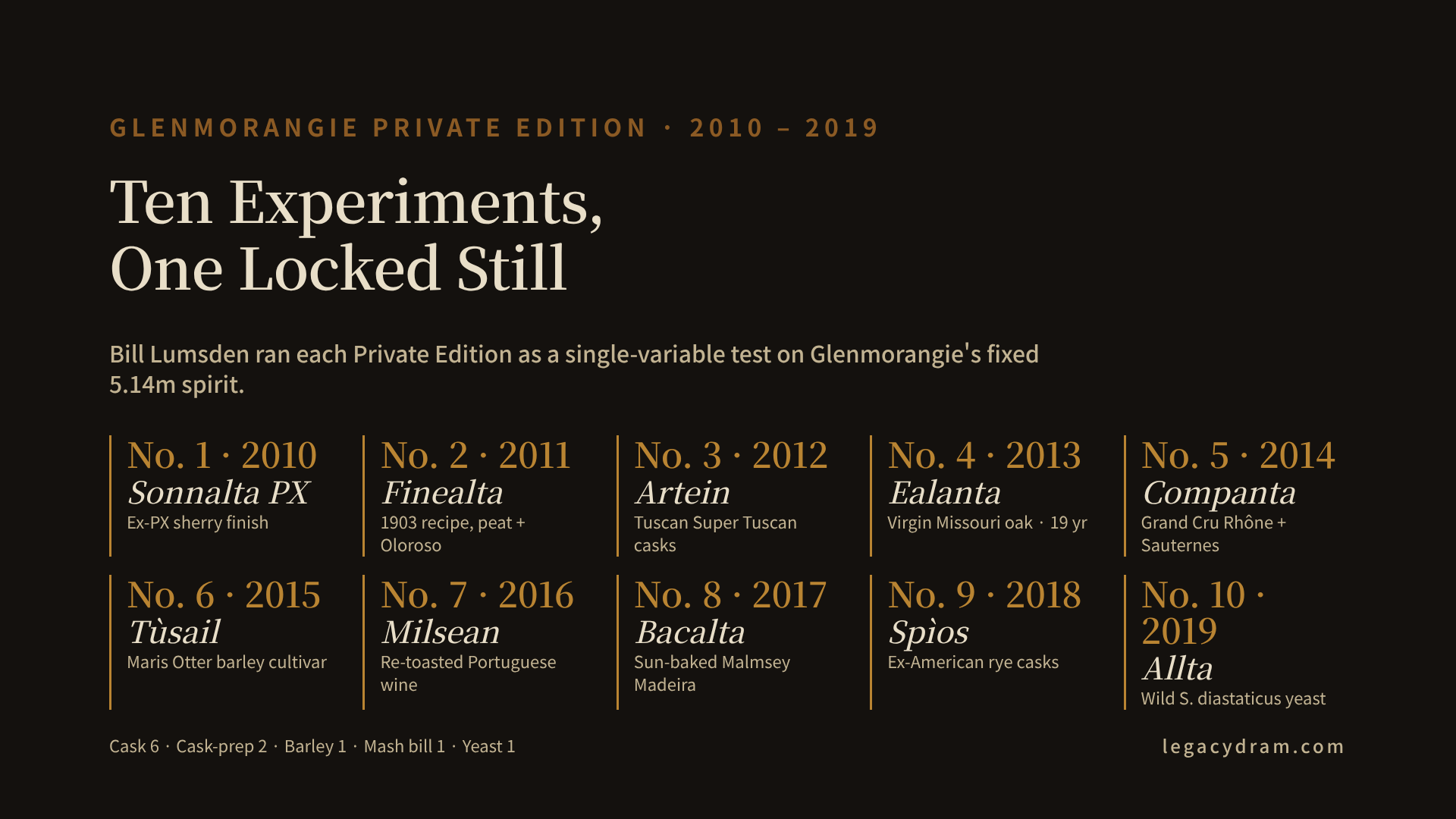
The Private Edition series was announced in 2010 with the release of Sonnalta PX. Ten annual limited editions followed, at roughly one per year, closing with Allta in 2019. The pattern is worth stating flatly, because the marketing tends to obscure it: each Private Edition isolates one experimental variable while keeping the rest of the process on the standard Glenmorangie footing.
- No. 1 Sonnalta PX (2010): 10-year Glenmorangie finished in ex-Pedro Ximénez sherry casks. Variable: cask finish, PX sweet-sherry direction.
- No. 2 Finealta (2011): a claimed reconstruction of a 1903 Glenmorangie recipe, with a small proportion of peated malt and Oloroso finishing. Variable: mash-bill smoke plus cask finish.
- No. 3 Artein (2012): 15-year finished in Tuscan Super Tuscan (Sassicaia and similar-style) casks. Variable: red-wine cask finish.
- No. 4 Ealanta (2013): 19-year matured (not finished) entirely in virgin American white oak from the Mark Twain National Forest in Missouri. Variable: full-life maturation on virgin oak, no ex-bourbon step.
- No. 5 Companta (2014): finished in Grand Cru wine casks from the Rhône and Sauternes. Variable: Grand Cru red plus sweet white in parallel.
- No. 6 Tùsail (2015): distilled from Maris Otter barley, a heritage brewing variety not typically used in Scotch. Variable: barley cultivar.
- No. 7 Milsean (2016): finished in Portuguese red-wine casks that had been re-toasted while still soaked with wine. Variable: cask preparation, specifically the STR-adjacent trick of caramelising residual wine sugars into the fresh toasted surface.
- No. 8 Bacalta (2017): finished in bespoke Malmsey Madeira hogsheads that had been sun-baked for two years in Madeira. Variable: fortified-wine cask preparation, this time with heat.
- No. 9 Spìos (2018): fully matured in ex-American rye whiskey casks. Variable: cask lineage, specifically rye-seasoned rather than bourbon-seasoned American oak.
- No. 10 Allta (2019): distilled with a wild Saccharomyces diastaticus strain isolated from barley grown in the fields around the distillery at Cadboll. Variable: yeast strain.
If you line up the variables you notice something. Casks account for six of ten (Sonnalta, Artein, Companta, Milsean, Bacalta, Spìos). Cask preparation accounts for two more (Milsean’s re-toast, Bacalta’s Madeira bake). Only Tùsail moves upstream to the barley cultivar. Only Finealta touches the mash bill. Only Allta moves all the way back to the yeast.
Six-of-ten cask, two cask-prep, one barley, one mash, one yeast, is not a random distribution. It is the shape of a career spent working within a single degree of freedom. The wrapper layer had almost all the moves.
Ealanta and the awkward Jim Murray moment
Ealanta was released in early 2013 and was named World Whisky of the Year in the 2014 Jim Murray Whisky Bible, with a published score of 97.5 out of 100. This is often cited as the crowning credential of Lumsden’s career, and Glenmorangie’s marketing pages linked to the Murray citation for years.
I want to talk about what Ealanta actually was, because it says something interesting about the wrapper strategy.
Standard Scotch practice fills freshly distilled spirit into casks that have already held bourbon. American law requires bourbon to use new charred oak, exactly once, so the bourbon industry generates a huge volume of once-used American white oak barrels which then get shipped to Scotland as first-fill or refill ex-bourbon casks. The Scotch industry has been running on this arbitrage for the better part of a century. The bourbon casks arrive with a specific extraction curve: charred surface, partially depleted lactones, some residual bourbon sugars, and a wood profile already broken in by four to nine years of use.
Ealanta ignored all of that. It was aged for nineteen years in virgin American white oak, casks that had never held anything. The wood was sourced from slow-grown trees in the Missouri Ozarks, air-seasoned, coopered, charred, and filled directly with 1993 Glenmorangie new make. No bourbon step. No first-fill dilution. The extraction was, by any Scotch standard, aggressive: vigorous vanillin generation, high oak lactone extraction, heavy tannin uptake. It was a Highland malt subjected to something closer to a bourbon maturation regime.
This is the honest read: Ealanta was a Highland malt trying to be a bourbon at the wood layer. The high reflux Glenmorangie spirit is soft, low in fusel weight, and normally leans on delicate ex-bourbon or refill casks to preserve that character. Putting nineteen years of it into virgin American oak was, in the language of the still, using the wood to overpower the geometric identity of the spirit. It worked, in the specific sense that Jim Murray scored it 97.5. It also, in the more general sense, was Lumsden using the only lever he had (the cask) to erase the constraint he was working under (the still).
The Jim Murray endorsement itself has aged less well. Murray’s scoring has drawn substantial criticism in the years since for its tasting-note vocabulary and for the concentration of scoring authority in a single palate. I do not raise this to detract from Ealanta, which is a genuinely interesting whisky, but because the “World Whisky of the Year” line in Glenmorangie’s press pack does not, on inspection, mean quite what a general reader assumes it means.
The tradeoff was real. Ealanta was 5,000 bottles from a specific set of casks laid down in 1993. It was, by construction, not repeatable at any scale. And the strategy of “use bigger wood to dominate the spirit” cannot be applied to a core-range 10-year-old without disowning what Glenmorangie is. Ealanta won a prize. It did not open a route.
Jim Swan, working in Wales at the same period, was building a much more portable version of the same idea: the STR cask process, designed to rejuvenate tired wine barrels into aggressive-extraction casks for new-world distilleries with no bourbon-cask supply chain. Swan’s method has scaled across a dozen distilleries on five continents. Ealanta scaled to one 1993 vintage in Tain.
Allta (2019): the fermentation experiment he waited twenty-four years to run
I want to spend a moment on the last Private Edition, because it is the one that circles back to the biochemist who walked in the door in 1995.
Allta means “wild” in Scottish Gaelic. It is a Glenmorangie distilled with Saccharomyces diastaticus, a wild yeast strain isolated from barley grown in the fields around the distillery at Cadboll. Standard Scotch distillers’ yeast is a domesticated Saccharomyces cerevisiae, bred for high alcohol tolerance and a well-characterised congener profile. S. diastaticus is neither. It carries an enzyme, glucoamylase, that the standard distillers’ strains do not, which lets it ferment dextrins the standard yeast cannot touch. Higher ethanol yield, different residual-sugar profile, different ester portfolio.
For a fermentation scientist, running a wild-yeast batch through a production washback is the experiment. It is the thing that PhD training in microbial physiology and fermentation science actually prepares you to reason about. Lumsden had been in the building for twenty-four years by the time it happened.
It was also, by construction, a one-off. S. diastaticus is, in industrial practice, the yeast you spend money to keep out of your other tanks; it does not stay where you put it, and a contaminating drift into a standard washback would shift the flavour profile of the core range in ways you would only catch in lab weeks later. Allta ran once, in a contained batch, followed by a full disinfection of the equipment. There will not be an Allta 12 or an Allta Cask Strength. The wild-yeast experiment is a locked-glass exhibit, not the start of a new production line.
The Private Edition series ended with Allta. There has not been a No. 11.
What the wrapper strategy cost him
I have been reading the Private Edition catalogue as a proof of concept, but the honest reading also has to include what the strategy cost.
A distillery whose portfolio is built on second maturation is betting its identity on the world’s willingness to keep supplying used casks in the specific varieties the portfolio needs. Port pipes, Oloroso butts, Sauternes barriques, Malmsey Madeira hogsheads, Grand Cru Rhône casks, Tuscan Super Tuscan barriques, ex-American rye barrels: every one of those is a downstream buy from another industry, and every one is subject to that industry’s own contraction. Sherry-cask supply has been tightening for two decades. Fortified-wine cooperages consolidated. Grand Cru estates have their own recycling economics. A wrapper-heavy identity means the wrapper is load-bearing, and load-bearing things break in ways interior-decorated things do not.
You can see the pressure in the release cadence. The early Private Editions (Sonnalta 2010, Finealta 2011, Artein 2012, Ealanta 2013) are cask-story rich. The mid-series (Tùsail 2015, Milsean 2016) reach for barley cultivar and cask preparation. The late series (Allta 2019) moves all the way back to yeast. The trajectory of “what variables are still available to experiment on” is exactly what you would expect from a wrapper strategy running out of cask varieties to try.
Stuart MacPherson, running the Macallan wood programme in the same decade, faced the same supply pressure from the sherry-cask side and responded by buying a stake in the Jerez cooperage. Macallan can now audit its wood supply from the sawmill down. Glenmorangie under LVMH has not made a comparable move; the Private Edition series shows the strain of that decision in the shape of its later experiments.
The interface outlives the maintainer
Bill Lumsden is sixty-seven. He has not announced a successor. Brendan McCarron has been positioned in the Head of Maturing Whisky Stocks role since 2014, which is the traditional grooming path, but no public transition has been announced. Lumsden’s title, since a 2020 group restructure, is Head of Distilling, Whisky Creation & Whisky Stocks at Moët Hennessy — the LVMH spirits arm — which is a portfolio role spanning Glenmorangie, Ardbeg, and increasingly the wider group.
Whoever takes the day-to-day Glenmorangie role next will inherit the 5.14m stills, the upward lyne arms, the standard fifty-something-hour fermentation, and a wood programme whose forward specifications were written by Lumsden six to twelve years before they land in bottle. They will not get to redesign the still. The 2009 stillhouse expansion locked that geometry in for another forty years. They will inherit, as Lumsden did, an interface set by decisions no living person made.
The Private Edition series is, in that specific sense, an unusual document. Most Scotch distilleries do not publish ten annual controlled experiments on their own house style. Lumsden did, over a decade, and left ten data points on what a Highland malt can be made to do without changing the still. Any successor who wants to read the recipe books will find the range of possible moves fairly precisely mapped.
The tragedy, or the tidy engineering symmetry depending on your temperament, is that the one experiment Lumsden probably wanted most to run — the wild-yeast fermentation — was, by the biology of the organism, a one-off he could only run at the end. The fermentation scientist got to touch the fermentation once, in his twenty-fourth year, and by the design of the experiment the batch could not repeat.
The bottles are still on shelves in the specialist shops. They will keep being drunk long after their maker has been retired long enough that the trade has forgotten which of them was his idea. That is, as far as I have been able to tell, the standard outcome for anyone who spends a career working on a system old enough to be worth drinking.
Related reading
- Glenmorangie Still Height: How Reflux Shapes the Spirit — the 5.14m still, the 1843 origin, and the geometric constraint Lumsden worked inside for thirty years
- Glenmorangie Fermentation: Brendan McCarron’s Long-Ferment and Allta Wild-Yeast Approach — the day-to-day washback, the ester chemistry, and the successor being groomed
- STR Cask Explained: Jim Swan’s Shaved-Toasted-Recharred Method — a portable version of the “use the cask to overpower the still” strategy, built by a contemporary of Lumsden
- Macallan Oak Species: Stuart MacPherson’s Three-Wood Method — the same wood-programme problem, faced by a Speyside contemporary who bought his way up the supply chain
Sources
- Glenmorangie official — glenmorangie.com
- Heriot-Watt University, honorary graduates: William Lumsden — hw.ac.uk
- Scotch Whisky magazine — Glenmorangie Private Edition releases (Spìos, Bacalta, and prior) — scotchwhisky.com
- WhiskyCast — Murray Names Glenmorangie Ealanta “World’s Best Whisky” (2013) — whiskycast.com
- The Spirits Business — Glenmorangie Bacalta launch (2017), Milsean launch (2016) — thespiritsbusiness.com
- Master of Malt blog — Celebrating Signet — masterofmalt.com
- Whisky Magazine — Bill Lumsden Hall of Fame induction (2019) — whiskymag.com
- Wikipedia: Bill Lumsden and Glenmorangie