Ben Nevis 10 Review: Nikka's Heavy-Bodied Highland Malt at 46%
The bottle on the table this evening is a 46 percent non-chill-filtered single malt from the foot of Ben Nevis, distilled and matured on a flat piece of ground near the sea at Fort William. It cost me about fifty pounds at a specialist last winter, and I have opened it once before, mostly to smell it and put it back in the cupboard. I want to taste it in the company of two other bottles that are not really its rivals but its anchors: a Highland Park 12, which I reach for when I want peat as a background register, and a Glenlivet 12, which I pour when a friend says they do not like whisky and needs to be quietly corrected. Three Glencairn glasses, a small jug of room-temperature water, a plain oatcake for the mouth between drams. No music. Whisky, at that hour, wants nothing else.
Ben Nevis 10 is the odd one at the table. It is not floral like the Glenlivet and it is not peated like the Highland Park. What it is, if I try to say it in one line and then not embarrass myself for the rest of the piece, is body. The bottle feels heavier than it should when I lift it (a psychosomatic effect, not physics), and the liquid pours slightly thicker than the other two (which is physics, and I will get to why). It is the whisky at this table where the shape of the stillhouse and the shape of the mouthfeel are the same shape.
The oiliness is not an aesthetic decision
The single most consequential fact about Ben Nevis 10 is what happens between the wash still and the spirit still, and it is the fact that gets shortest paragraphs in the marketing copy. The distillery runs two wash stills of 25,000 litres and two spirit stills of 20,000 litres. Four stills total, not six. The shape is what matters: cone-bodied, wide-necked, with no reflux bowl and a lyne arm that comes off almost horizontal after the bend. Shell-and-tube condensers, not worm tubs.
Read that as an engineer would read it. A tall narrow neck with a bulge and a downward lyne arm gives you reflux, which is the vapour that condenses on the copper walls and falls back into the pot to be re-distilled. Reflux strips out the heavier congeners — fusel oils, long-chain esters, the oily sulphur compounds — and leaves behind a light, clean spirit. That is the Glenmorangie tall still recipe. A wide neck with a near-horizontal lyne arm, the way Ben Nevis runs it, does the opposite. Reflux is low. Vapour carries across into the condenser without much chance to fall back. The heavy stuff comes through. The spirit is oilier, heavier, and by any measurement of dry extract, thicker.
This is not a bug. This is the whole design. Ben Nevis was, for most of the twentieth century, primarily a blending component. The distillery’s job was to give a blend spine and mouthfeel, which meant sending oily, heavy new-make into the warehouse. When Nikka bought the place in 1989 and by all accounts sat down and looked at the equipment, they did not modify the stills. They kept them exactly as they were. Most of the roughly two million litres the distillery produces every year still goes east by tanker to Nikka’s blending sites in Japan. About nineteen thousand bottles a year come out under the Ben Nevis name as single malt. The rest is spine for somebody else’s whisky.
The founder’s box, still standing
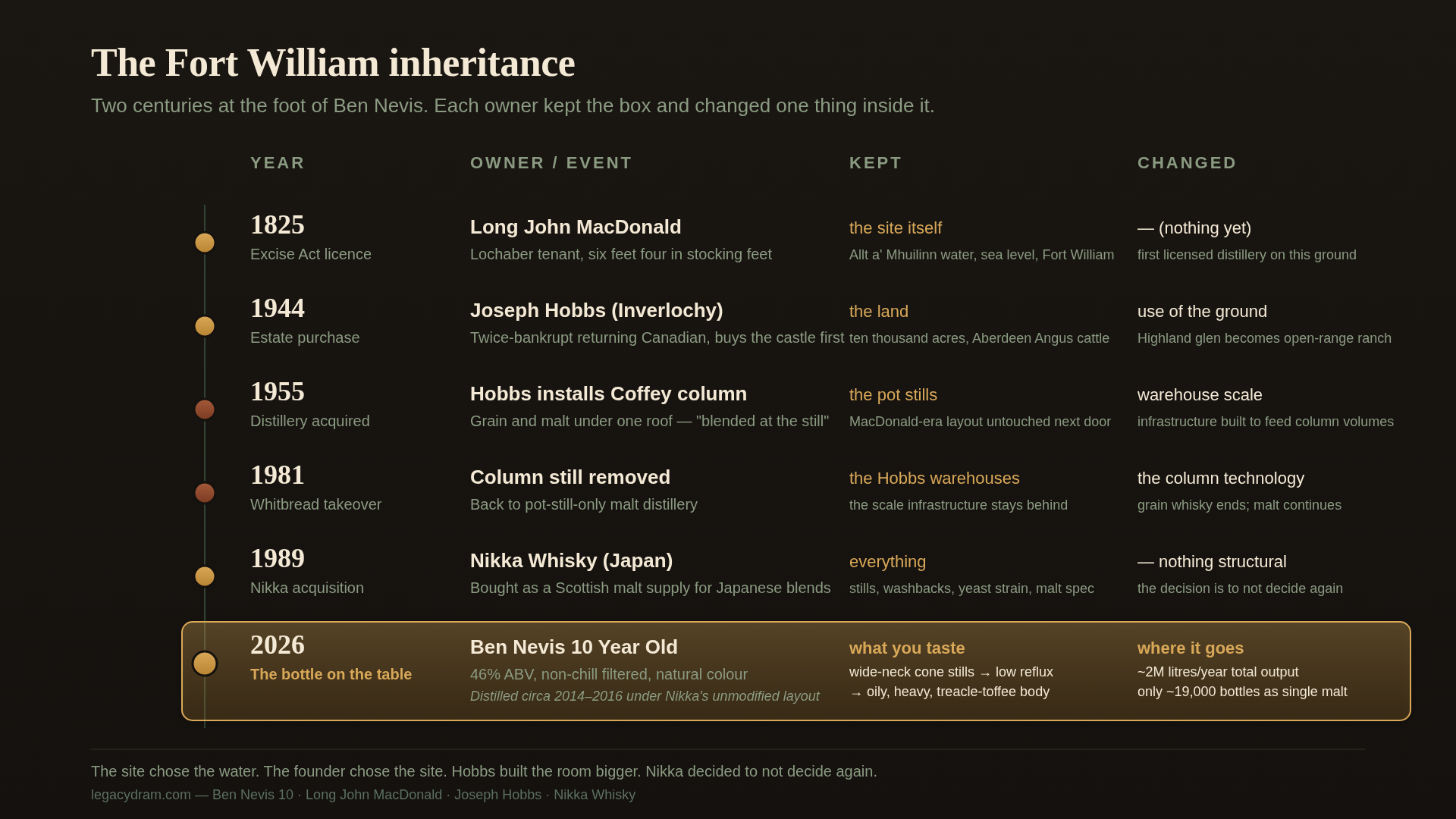
The distillery has been in the same spot at the foot of the mountain since 1825, which was two years after the Excise Act cut the duty on Scotch and made licensed Highland distilling economically viable for the first time. The founder was a Lochaber tenant named John MacDonald, six feet four in stocking feet, known locally as Long John before there was ever a brand attached to the name. He picked the site because Fort William gave sea access to Glasgow via Loch Linnhe, because the granite of Ben Nevis fed a clean water source (the Allt a’ Mhuilinn, a burn dropping off the mountain, piped underground from 230 metres up since 1925 to protect it from surface contamination), and because the land was cheap and the local lairds trusted him. He was bankrupt by 1856. He died three months later. But the box he had built was solid enough that no subsequent owner, and there have been nine of them, has ever moved it.
I want to be honest about what this means for what I am drinking. The 1825 location does not literally survive in the glass in the way the 1955 equipment does. Nobody is running spirit through 1825 pot stills. But the site chose the flavour before anyone had a word for it. Water off a granite mountain fed by snowmelt runs low in dissolved minerals; the flat sea-level ground gives the warehouse a stable, cool, humid microclimate that slows evaporation losses and pushes the maturation towards flavour development rather than concentration. A distillery on a windy hillside in Speyside makes different whisky from a distillery in a damp glen at sea level under the tallest mountain in Britain, and it does so before anyone has changed a single upstream variable. Long John’s most durable decision was where to stand.
Hobbs put a column still in, and then, later, it wasn’t
The most interesting owner in the middle century was a twice-bankrupt returning Canadian named Joseph Hobbs, who bought the distillery in 1955 and installed a Coffey column still next to the pot stills. This is well-covered elsewhere: I have written it up at length, so I will only draw the part that matters for the glass in front of me.
Hobbs’s column produced grain spirit. That is what column stills do: they run continuously, at high strength, and turn out a light, neutral distillate suited to blending. What Hobbs wanted was to produce grain and malt under the same roof, blend on site, mature everything in the same warehouse complex, and cut out the Edinburgh blenders. He called it “blended at the still.” Commercially, it was a modest business. Structurally, it was almost unique in twentieth-century Scotland. And the column ran, alongside the pot stills, for twenty-six years.
Whitbread bought the distillery from Hobbs’s heirs in 1981 and immediately took the column out. From that point on Ben Nevis was, again, a pot-still-only single malt distillery. So the bottle on my table, filled from spirit distilled around 2014 to 2016, contains no atom of grain whisky that ever touched Hobbs’s column. That is the correct engineering answer.
The less correct but more interesting answer is that Hobbs did not leave the column behind. He left the warehouse infrastructure behind. To feed a column still at commercial volume, you need warehouse capacity — cask storage measured in the tens of thousands, not the hundreds — and mash and washback throughput scaled to feed both column and pots. Hobbs put that scale into the site. Whitbread inherited it. Nikka inherited it. The reason Ben Nevis today can send two million litres a year east and still bottle a nineteen-thousand-bottle single malt run is that the plant was built for volume that pot-only Speyside distilleries of a similar age were never built for. Hobbs left the room bigger than he found it. The current single malt drinks like it came from a bigger room than the label admits.
What Nikka decided by not deciding
Nikka bought Ben Nevis in 1989 for reasons that were partly nostalgic (Masataka Taketsuru had trained at Longmorn in 1918 and had strong Highland sentiment) and mostly operational (they needed a Scottish malt supply for their Japanese blends and single-malt brands, and buying a producing distillery was the cheapest way to secure one). What they did on arrival is more revealing than the fact of the purchase. They did not modernise the stillhouse. They did not enlarge the pots. They did not switch to worm tubs (which would have been on-trend by the late nineties) or install a lauter mash tun with programmable rests (that came later, and it was subtle). They did not change the yeast, which is brewer’s pressed yeast — a slightly dated choice, most Scottish distilleries use a distiller’s dry yeast now — running a 48-hour fermentation in eight washbacks, six of stainless steel and two of Oregon pine.
I read this decision as the same shape of decision a Japanese engineer would make about a working machine tool inherited from an older shop. You do not modify the parts of the tool that are producing to spec, because you cannot always tell in advance which parts of the tool are producing to spec and which parts are producing to a spec you have not yet noticed. You keep the machine, run it, and let the output tell you what to change. Thirty-seven years in, they have changed nothing structural. The output has told them not to.
The 46 percent non-chill-filtered, natural-colour bottling under the Ben Nevis name is a comparatively recent decision — a formal recognition that the character coming off the pot stills is worth showing at strength rather than diluted for a blended bottle. The core cask spec is ex-bourbon American oak with an ex-sherry European oak seasoning layered on top. Both refill-heavy. The idea is not to bury the spirit under wood.
What is actually in the glass
Fifteen minutes after pouring, no water yet. Three glasses in front of me.
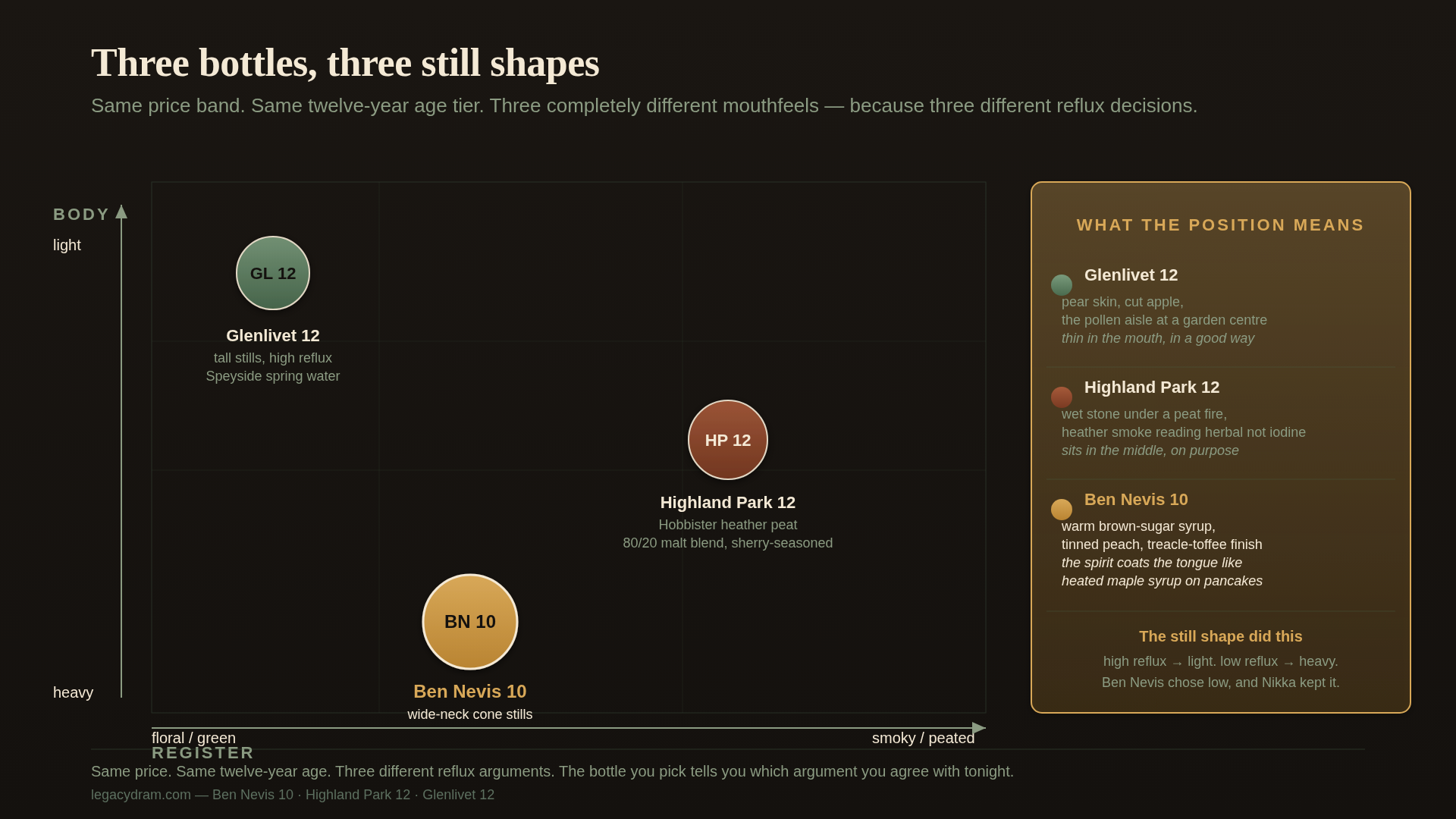
The Glenlivet 12 opens with what a friend once described, accurately, as the pollen aisle at a garden centre in April. Cut apple, pear skin, a sweet floral top that reads more perfume than fruit. The palate is thin in the mouth — thin as a positive quality, not a deficient one, in the way a good white wine is thin — with vanilla and hay finish. It is a distillery pointing at reflux, and the copper walls in Glenlivet’s tall stills have done their job.
The Highland Park 12 opens with the same top perfume half-hidden under a note like a wet stone that has been under a peat fire. Heather smoke that reads more herbal than medicinal (the Hobbister-peat register I have written about elsewhere), a sherry-hint on the back of the palate, medium body. It is a whisky calibrated to sit in the middle, and it does.
The Ben Nevis 10 is the different animal at the table. The nose is heavy: warm brown sugar syrup with a little burnt butter behind it, some tinned peach in heavy juice, and, if I look for it, a rope-and-leather note that is unusual in a modern Highland malt. The mouth is where the still shape shows up. The spirit coats. It sits on the tongue the way heated maple syrup sits on a stack of pancakes, and the finish carries a treacle-toffee register that stays for a long time, punctuated by a mineral bitter note on the way down that I associate with the water source. There is a very light smoke suggestion in the very back — Ben Nevis is nominally unpeated but occasionally runs light peated batches for blending, and the current 10-year-old carries a trace — but you have to be paying attention to find it.
Add a small teaspoon of water and the syrup thins out into what a baker would call the middle of a Christmas cake: raisins soaked in nothing stronger than tea, orange peel, a faint clove. The nose gains complexity; the mouth loses a little of the sheer coating and turns more sipping-friendly. This is a whisky that likes water. I would drink it with a shortbread biscuit and a slice of Wensleydale in December. I would not drink it before a run.
The context around the bottle
Price in the UK sits around forty-five to fifty-five pounds; in the US expect fifty to sixty dollars. In Japan, where Nikka distributes it directly, it moves at three thousand five hundred to four thousand five hundred yen, which is one of the best value propositions in Scotch single malt sold in the country. Availability is steady. Nikka runs about nineteen thousand bottles a year of the official 10, which is small by industry standards but consistent — you can walk into a good specialist and find it most weeks. It is not a hunt.
Who is it for? Anyone who wants a heavy-body Highland malt that is not carrying a peat or a sherry marketing story. Anyone curious about what a distillery designed for blending tastes like when it is bottled as a single malt. Anyone drinking with someone who has bought too much peat lately and needs a reset. It does not want to be a summer whisky. It wants a fire, a book, and a piece of dry sponge cake.
What to check next time you open the bottle
Drink Ben Nevis 10 in winter, in the evening, at around 18 to 20 degrees room temperature, with a plain shortbread biscuit and no music. On the fifth sip, notice how long the treacle-toffee note lingers between swallows. That length is the piece of the spirit the still shape put there. The wide neck and horizontal lyne arm carried the heavy congeners across into the receiver; the shell-and-tube condenser did not scrub them out; the refill American oak did not overwrite them. What you are tasting is a decision the equipment made in 1955, was reinforced by Nikka’s decision in 1989 to change nothing, and shows up in the glass tonight because the warehouse had room to age the run without hurrying it.
Then, for contrast, pour a small measure of the Glenlivet 12 alongside it. The Glenlivet is going to taste, on this comparison, almost translucent. That is not because it is a lesser whisky. It is because it was made in tall stills built for the opposite decision. The whole reason the Highland region has a range of single malts worth drinking is that different distillers, over two hundred years, chose different sides of the reflux argument, and the bottles on the shelf are the accumulated record of those arguments. Ben Nevis 10 is one side of it, with the receipts.
References
- Alfred Barnard, The Whisky Distilleries of the United Kingdom (1887), Ben Nevis chapter.
- Ben Nevis Distillery, official site, Fort William.
- Nikka Whisky Distilling Co., official Ben Nevis page, 1989 acquisition onwards.
- Whiskybase, Ben Nevis 10 Year Old tasting archive.
- Maltspedia, Ben Nevis Distillery production specifications.
- Related on this site: Long John MacDonald and the original Ben Nevis; Joseph Hobbs and the cattle ranch at Ben Nevis; Highland Park 12 review; Glenmorangie still height and reflux.