Laphroaig Owner 1954-1972: Bessie Williamson
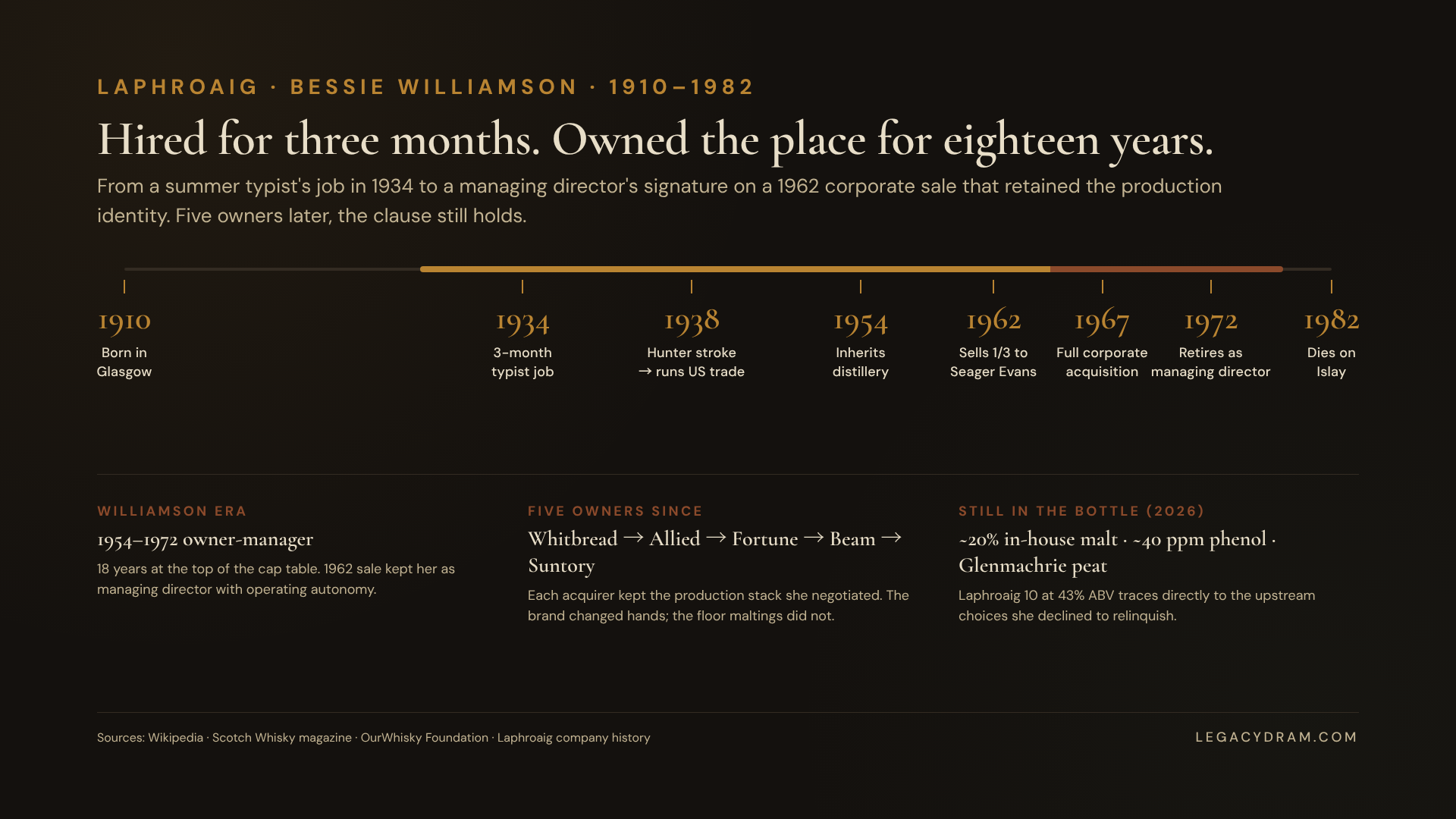
Bessie Williamson was hired in the summer of 1934 as a three-month shorthand typist at Laphroaig distillery, on the south coast of Islay. She had just finished a general arts MA at Glasgow University, was waiting to start a teacher-training course at Jordanhill, and needed a holiday job. She stayed forty-eight years. She owned the distillery for eighteen of them. The intervening events involved a will, a man who had a stroke in 1938, and a corporate sale in 1962 with a clause that has, four owners later, still not been broken.
What interests me about Williamson is the structure of her tenure rather than the headline. She was, in fact, the first woman to run a Scotch distillery in the twentieth century, though the wording matters and I will come back to it. The more useful frame, in modern engineering terms, is that she was three very different things in sequence: a founding employee without equity for twenty years, an inheriting owner for eight, and a managing director under acquisition for a decade. The bottle in front of you was shaped most by the third role, which is the one the marketing material talks about least.
The twenty-year apprenticeship without a title
Williamson was born in Glasgow in 1910. She read Arts at Glasgow University from 1927, graduated MA in 1932, and intended to teach. While she waited for her place at Jordanhill College of Education, she worked as an office assistant for her uncle, an accountant. The Laphroaig job, two years later, was supposed to be a summer fill-in. Her MA was in Arts, not chemistry: she had no formal training in distilling, brewing, or any of the technical disciplines that the trade would later credit her with mastering.
The owner of Laphroaig at the time was Ian Hunter, then in his late forties, unmarried, no children, the great-nephew of the brothers who had built the distillery in the 1810s. By 1934 he had been running the place for twenty-six years. He hired Williamson, presumably, because his correspondence had outgrown what he could do himself, and Glasgow MAs were the cheapest white-collar labour the depression had on offer.
In 1938 Hunter had a stroke and was, by most accounts, confined to a wheelchair from then on. This is the moment the trajectory bends. With Hunter’s mobility limited and the United States about to become Laphroaig’s most important export market (in part because the medicinal smoke was, with a straight face, sold as having medicinal qualities during Prohibition), Hunter sent Williamson to America to handle US distribution on his behalf. She was twenty-eight, four years into a temporary job, with no formal authority and a single shareholding she did not yet own.
This is, I think, the part of the story that the founder-mythology framing obscures. Williamson did not rise quickly. She accrued decisions for two decades without a job title that reflected them, the way founding employees accrue equity without a vesting schedule when the cap table has not been written. In 1944 she was, in practical terms, running the distillery. That is the year the secondary literature settles on for “she was effectively the manager.” In 1950 D Johnston & Co was incorporated as a limited company and Williamson was named company secretary with a small shareholding. That is the first time her name appears on a piece of paper that confers actual authority. By then she had been at Laphroaig for sixteen years.
Hunter died in 1954. He had no children. His will left Williamson the controlling interest in the distillery, the family house at Ardenistiel, and the small island of Texa just offshore. The standard reading of this is that Hunter trusted her completely; the more interesting reading is that he had been delegating to her for twelve years and the will simply reified an arrangement that already existed. Founding employees, when there is no formal mechanism to convert tenure into equity, sometimes get inheritances. It is not a reliable career strategy.
The 1962 sale was not a sale
The narrative I want to argue against is the one where Williamson, in 1962, sold Laphroaig and walked away. She did neither. She sold one-third of D Johnston & Co to Seager Evans & Co, a London-based distiller and blender that already owned Long John and was itself, by then, a subsidiary of the American conglomerate Schenley Industries. She stayed on as managing director. Seager Evans acquired the remaining two-thirds in 1967. She remained managing director until she retired in 1972. The full transition from her sole ownership to corporate control took ten years and was, throughout, an arrangement in which she was the person actually running the distillery.
I would call this an acquisition with operating-autonomy retained. It is the same shape as Slack inside Salesforce, or GitHub inside Microsoft, or, to stay in the spirits world, Glenfarclas’s stubborn family independence inside an industry that has otherwise consolidated to four global owners. The acquired company keeps its production decisions; the acquirer gets cashflow and a brand. What mattered in the 1962 contract was the operating-autonomy paragraph, not the cheque.
The reason this works in spirits, and the reason Williamson could negotiate it in the first place, is that Laphroaig had something its corporate buyers could not replicate. They could buy the trademark, the warehouses, the casks already aging. They could not, in the short term, buy the production identity: the floor malting, the Glenmachrie peat moss, the medicinal phenolic profile that had been built into the buildings and the bog over the previous century. A corporate buyer that standardised those out of existence in year three would, in year fifteen, be selling something with the same label but a different liquid. Long John, which had no real consumer brand of its own and badly needed one, knew this. So did Schenley.
So the clause stayed. The floor maltings stayed. The peat bog stayed. Williamson stayed.
What is actually still in the bottle
Laphroaig today is owned by Suntory Global Spirits (until 2024 called Beam Suntory). Between Williamson’s retirement in 1972 and 2026, the distillery has passed through Whitbread, Allied Domecq, Fortune Brands, Beam Inc., and Suntory. That is five corporate parents in fifty-four years. Every one of them has rewritten the marketing. The continuity that has survived across all five is the physical production stack.
Laphroaig still floor-malts roughly twenty percent of its own barley on-site. The other eighty percent comes from the Port Ellen Maltings four miles up the coast. The in-house malt is peated to between forty and sixty parts per million phenol; the Port Ellen malt sits in the thirty-five to forty-five range. The new-make spirit that comes off the stills carries roughly twenty-five ppm into the cask. After ten years in the warehouse, that drops to about ten ppm in the bottle. The peat itself is cut from Glenmachrie Peat Moss, which the distillery owns. Glenmachrie is a basin bog rich in heather, lichen, and sphagnum moss, chemically distinct from the blanket bog at Castlehill that feeds Port Ellen Maltings.
None of those decisions were made by Bessie Williamson. They were made variously in the nineteenth century, by Hunter in the first half of the twentieth, and by managers since. What Williamson did, between 1954 and 1972, was decline to give them up in exchange for capital. The 1962 sale was the moment when Laphroaig could have been standardised into the Long John blending pool, a perfectly reasonable corporate decision that would have made the cashflow more predictable and the brand identity weaker. It didn’t happen. It hasn’t happened since.
If you open a bottle of Laphroaig 10 in 2026, at forty-three percent ABV, the medicinal TCP-and-iodine character on the nose is the chemistry of three phenolic compounds: guaiacol, four-methylguaiacol, and p-cresol. They were adsorbed onto germinating barley in the kiln in 2015 or 2016, then partially volatilised through the stills, then sat in oak for a decade. The compounds are a function of the peat the distillery cuts, the malting it does on its own floor, and the kilning regime it has not changed. That continuity is what Williamson sold a third of the company to preserve.
On the wording of “first”
The Wikipedia article on Williamson is careful. It calls her the second woman to manage a Scotch whisky distillery, and the first during the twentieth century. Most of the secondary literature, and all of Laphroaig’s own marketing, simplifies this to the first woman. The simplification flatters Williamson at the expense of two earlier women whose work the industry has largely forgotten.
Helen Cumming ran an illicit still on a farm called Cardow, on the north bank of the River Spey, from 1811. She sold her whisky from the kitchen window and used a red flag on the laundry line to warn the neighbours when the excisemen were on the road. After her husband died, her daughter-in-law Elizabeth Cumming inherited the licensed distillery in 1872 and ran it for the better part of seventeen years, expanding it threefold in 1884 and selling it to John Walker & Sons in 1893. Alfred Barnard, writing in 1887, gave Elizabeth Cumming credit for the continued success of the distillery entirely. The Cardow distillery, now spelled Cardhu, still exists. Diageo owns it. It supplies Johnnie Walker.
I am clarifying, not debunking. The Cumming women managed and owned a Scotch distillery in the nineteenth century. Williamson did the same in the twentieth. The marketing tagline that calls her the first elides the Cardow story, which is itself one of the more interesting passages in distilling history and which deserves not to be flattened in service of a different woman’s biography.
What is genuinely unusual about Williamson, and what the secondary literature would do better to lead with, is the path. Elizabeth Cumming inherited from her husband. Williamson inherited from her employer, after twenty years on staff, with no familial relationship of any kind that survives in the record. The will that gave her Laphroaig was, by the standards of 1954, an anomalous instrument. The path is the story; the gender of the destination is incidental.
The clause has outlived everything else
Williamson retired from Laphroaig in 1972, aged sixty-one. She continued to live on Islay until her death in May 1982, and was buried at Bowmore Round Church on the western side of the island. She had no children. The shares she had not already sold passed out of her estate. The distillery, by then, was deep inside Whitbread, which had bought Long John from Schenley three years earlier.
In the forty-four years since her death, Laphroaig has changed hands four more times. Each acquirer inherited the operating-autonomy structure that Williamson and Hunter’s lawyers had written into the 1962 contract. The structure was practical rather than literal: production decisions had been honoured by the previous owner, and to break that pattern would have meant rebuilding a peat supply, a malting floor, and a phenolic profile that the new buyer had paid a premium specifically to acquire. The clause did not need to be enforced. It needed only to be expensive to break.
She was hired for three months. She left forty-eight years later, having owned the place for eighteen of them. The peat bog she negotiated to keep still sits behind the distillery. The malt floor she declined to mothball still produces roughly a fifth of the grain that goes into Laphroaig 10. The bottle on the shelf in 2026 is, in a literal chemical sense, the inheritance she did not entirely give away.
If you want to read further on the surrounding decisions: I have written previously on Frank McHardy’s stewardship of Springbank through the silent years, the Campbeltown counterpart to the Islay story above and a different mechanism for keeping a small distillery from being absorbed. Rachel Barrie’s blend-matrix work at BenRiach, GlenDronach, and Glenglassaugh is the modern female-master-blender role, distinct from Williamson’s owner-manager role and worth keeping in a separate category. The MacAskill brothers at Talisker are the nineteenth-century Hebridean founder-owners against whom Williamson’s twentieth-century inheritance reads as the reverse case.