John Ramsay and the Seventeen Years: The Edrington Master Blender Who Kept Macallan and Highland Park the Same Bottle
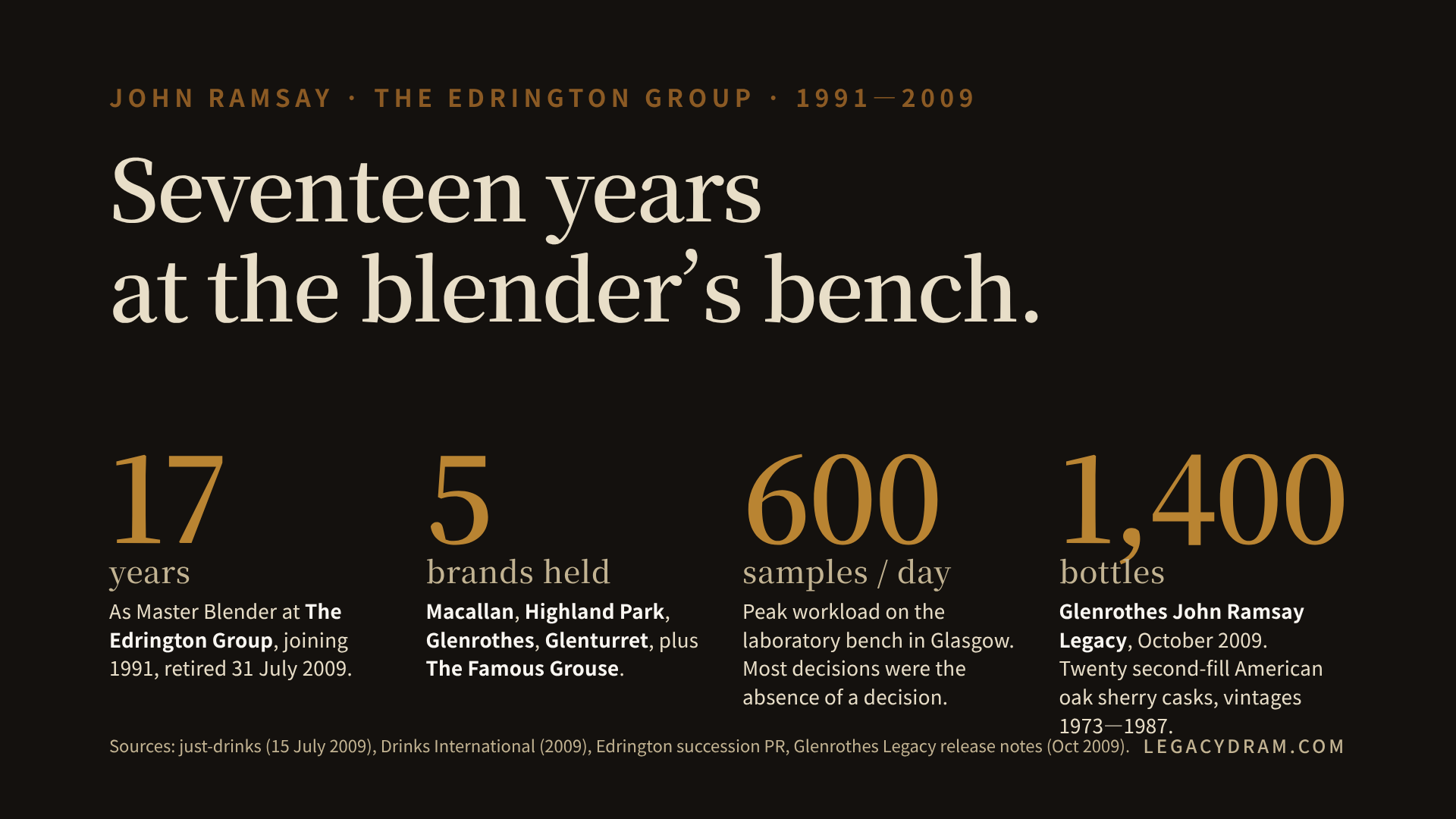
For seventeen years, from 1991 until his retirement on 31 July 2009, John Ramsay held the title Master Blender at The Edrington Group, and the bottles you can still buy today that say Macallan 12 Sherry Oak and Highland Park 12 on the label are bottles whose flavour profiles passed through his nose on the way out the door. He did not invent either of them. He kept them recognisably the same for seventeen years, which is a different kind of decision, and a smaller one to romance.
I am suspicious of any whisky press release that uses the word “steward.” But sometimes the press release is right, and the man really did spend almost two decades not breaking anything.
The brands he held
The portfolio Ramsay inherited in 1991 was not a personal choice. Edrington, in its pre-1999 form Highland Distillers, owned the four single malts that became the company’s strategic core: The Macallan (Speyside, the sherried flagship), Highland Park (Orkney, the heather-peated middle ground), The Glenrothes (Speyside, vintage-led), and Glenturret (the smallest, the inventoried “home of The Famous Grouse” at Crieff). Layered on top of those was the blend that paid the bills: The Famous Grouse, the unpretentious blended Scotch that has been a fixture of the British grocery shelf since 1896. Add Cutty Sark, which Edrington stewarded until it sold the brand to La Martiniquaise in 2018, and you have the brand surface area Ramsay was responsible for between 1991 and 2009.
He was, by the standing description in trade-paper interviews around his retirement, going through up to 600 samples a day. Most of them would not result in a decision. The decision was the absence of a decision: this one tastes like the cask it should be in, send it on, do nothing.
I find this image more useful than the romantic one. The job of a master blender in a multi-brand group is not to compose. It is to recognise. You sniff a sample, you compare it against the mental reference of what that liquid is supposed to be at that age in that warehouse, you decide whether it converges or diverges, you mark the sheet. Six hundred times a day. The job is closer to QA than it is to perfumery.
What he did to Macallan
The flavour identity of Macallan in the early twenty-first century, with its dried-fig and walnut-oil heaviness, with the colour that on a tasting flight is two shades darker than anything next to it, is largely the product of one supply-chain decision: sherry-seasoned European oak, sourced through Jerez under multi-year contracts with cooperages and seasoning houses (Andalusian and Galician oak, with the Tevasa cooperage as Edrington’s long-standing partner). The casks are not, in the Spanish sense, used sherry casks. They are casks built specifically for whisky, seasoned with sherry for around two years in Jerez, and shipped to Scotland already imprinted with the chemistry of an oloroso or fino fill.
Ramsay did not invent this policy. It predated him. What he did, across his seventeen years, was institutionalise it as a procurement programme on a scale large enough to support the brand’s growth. Edrington today keeps tens of thousands of seasoning casks in Spain at any given time. That number is not a single man’s achievement, but the procurement framework that holds it together was built up during his tenure, in negotiation with the sherry industry’s own retreat in the same period (Jerez shipments to Britain fell roughly in half between 1980 and 2000).
This is the part of the work I find genuinely admirable, and it is also the part with no romance whatsoever. Sherry-seasoned casks are romantic until you read the procurement contract. Jerez does not seal a deal with a handshake and a glass of fino. It seals it with a clause about humidity and seasoning duration. The casks cost several times what a refill bourbon barrel costs. Edrington pays it, and the price ends up in the line of the Macallan 12 you buy. The trade-off is open: brand identity at premium cost, defended against an industry trend that, in the 1990s, was sliding toward more flexibility and lower wood spend.
What he did to Highland Park
Highland Park 12, as I have written elsewhere on this site, is built on a roughly 20:80 ratio of Hobbister-peated malt to commercial unpeated malt, finishing in the glass at around 4–6 ppm of phenols (the broad family of aromatic compounds released when peat smoke meets germinating barley). That ratio was not Ramsay’s invention either. The 1990s Highland Park I can still find on a shelf is in continuous shape with the 1980s Highland Park I cannot.
What Ramsay did, on the Highland Park side, was bring the older-aged expressions into focus. The 18 year old, the 25, and the 40 were either created or codified into the modern range during his tenure; the Highland Park 18 in particular acquired the shape of the bottle and the standing it has now between 1997 and 2007. He also signed off on dozens of the limited single-cask releases that became the Orkney distillery’s collectable arm in the early 2000s. Industry profiles often describe him as the nose behind the older Highland Parks, and that is true in the same limited sense in which a managing editor is the writer of a newspaper. He approved them. The peat and the heather were already there.
The trade-off on the Highland Park side was different from the Macallan one. Where the Macallan policy was about keeping a single liquid pristine across a rising volume, the Highland Park policy was about extending the range upwards: deciding which warehouses had stock old enough to release, deciding what year an “18” had to taste like, deciding when to walk a vintage out the door instead of into a blend.
The Glenrothes, and the personal bottle
There is a piece of evidence about Ramsay that I find more revealing than any of the official press around him, and it is the bottle Edrington released for him when he retired: The Glenrothes John Ramsay Legacy, in autumn 2009, 1,400 bottles, drawn from twenty second-fill American oak sherry casks he hand-selected from Glenrothes vintages between 1973 and 1987.
Two things in that sentence are worth pausing on. The first is that Glenrothes, not Macallan, not Highland Park, was the bottle he chose for his own farewell. Glenrothes is the smaller distillery, the quieter one, the one whose vintage-release format he had personally been instrumental in promoting through the 1990s and 2000s. The second is that the casks were American oak (the species Quercus alba, the bourbon-barrel default), not European, and second-fill, not first-fill. The man who institutionalised the most maximalist European-oak sherry policy in Speyside, when given the chance to bottle his own legacy in any wood he liked, picked second-fill American oak.
I do not want to over-read this. It might just be that those were the casks he had been watching the longest. But I think it also says something accurate about how he understood his job. The Macallan policy was the brand’s; the Highland Park range was the brand’s; the Famous Grouse blend was the brand’s. The bottle that was actually his was a quieter one, in a wood that lets the spirit through.
What it cost not to experiment
Ramsay’s seventeen years overlap almost exactly with Bill Lumsden’s ascent at Glenmorangie, where the explicit strategy was the opposite: the Designer Casks programme, the Ardbeg experiments, the willingness to put a sauternes finish or a burgundy cask into the market and see what happened. Lumsden was, by his own description, the opposite kind of blender. He composed; he did not steward. Both styles are real and both are necessary, but they are not interchangeable, and the trade press of the 2000s tended to remember the composers more than the stewards.
The trade-off, then, is structural. A steward at a multi-brand group has very little room to experiment, because every experiment touches a brand identity that other people in the company are selling on its consistency. The cost of stewardship is that the work is mostly invisible. The benefit is that, when you come back to the same bottle ten years later, it is the same bottle. The Macallan 12 of 2003 and the Macallan 12 of 2009 are not the same liquid in any literal sense (different casks, different vintages, different proportions in the vat), but they converge on the same nose. That convergence is the product, and the product survives the producer.
The handover, in two halves
The succession arrangement Edrington announced in 2009 was, formally, a single handover: Gordon Motion took over from Ramsay as group master blender, after a publicly stated two-and-a-half-year mentorship inside the laboratory in Glasgow. But underneath the formal arrangement was a quieter structural one. Bob Dalgarno had been the Macallan-specific whisky maker since 2000, working alongside Ramsay on the Macallan side of the portfolio for the better part of a decade before Ramsay retired. Dalgarno was not appointed at the moment of Ramsay’s exit; he had already been there. What changed in 2009 was that the group-level oversight passed to Motion, and the brand-specific Macallan responsibility stayed with Dalgarno, who kept it until he himself moved to The Glenturret in 2017.
This is the part of the story the press release elided. The handover was not one transition but the closing-out of an already-distributed structure. Ramsay’s authority during his last decade had not been monolithic; it had been the senior, group-level sign-off on top of brand-specific people doing the brand-specific work. Letting Dalgarno keep Macallan and giving Motion the group seat was, in effect, the formalisation of the way the laboratory had already been running.
What does not say his name
Ramsay’s name appears on no bottle that is still in regular distribution. The Glenrothes John Ramsay Legacy is long gone from the open market (the secondary-market price has drifted into a range that makes me suspect very few of the original 1,400 are actually being drunk). The two bottles that carry his seventeen years most directly, Macallan 12 Sherry Oak and Highland Park 12, say someone else’s name on the back label, the way succession is supposed to work. The Famous Grouse, the brand for which the industry called him “the nose” in retirement profiles, does not name a blender at all on the bottle, in keeping with the conventions of mass-market blended Scotch.
He retired three years short of seventy, after, in his own description, smelling more whisky than was probably reasonable for one human nose. He stayed on as a consultant, lectured at the Edinburgh Whisky Academy, and let go of the daily sample sheet. The work is in the bottles, which are the same bottles, which is what he was hired to make sure of.
Cross-links on this site: I have written about Gordon Motion and Highland Park 12, Ramsay’s chosen successor on the Orkney side; Bob Dalgarno and Golden Promise barley at Macallan, the colleague who kept Macallan after Ramsay stepped back; Stuart MacPherson and the three oaks, the forester who runs Edrington’s wood programme upstream of the blending laboratory; Rachel Barrie at BenRiach and Glendronach, Ramsay’s industry contemporary on the Speyside-Highland axis; Stephanie Macleod at Aberfeldy, the same job at the rival group across the table; and Alfred Barnard and the 1887 atlas, the documentarian whose Glen Grant and Macallan entries the modern blending laboratory is, in its way, still working from.
Primary sources: just-drinks announcement of Ramsay’s retirement (15 July 2009); Drinks International announcement of the Famous Grouse master blender retirement (2009); Edinburgh Whisky Academy biographical entry; Cigar Aficionado feature on Glenrothes vintages; Glenrothes press release on the John Ramsay Legacy bottling (October 2009: 1,400 bottles, twenty second-fill American oak sherry casks, 1973–1987 vintages).
Cross-checks: Whisky Advocate’s 2024 coverage of Gordon Motion’s own retirement, which retrospectively dated Motion’s start under Ramsay; The Drinks Business archive on Bob Dalgarno’s appointment as Macallan whisky maker in 2000 and his move to The Glenturret in 2017; the Charles MacLean and Misako Udo standard references for the Highland Distillers / Edrington corporate history. Where industry sources gave “seventeen years” and the calendar gives eighteen (1991–2009), I have used “seventeen years” as the figure most commonly cited at the time of his retirement.