Pagoda Roof Distillery: Doig's 1889 Ventilator
If you walk into any whisky shop in 2026, half the bottles on the wall will be wearing the same hat. A four-sided pyramidal cupola with the corners flared up, sitting on a steep-pitched roof above a stone gable. It is on the front label of Glenfiddich, the visitor-centre signage at Cardhu, the tea towels in the Glasgow airport gift shop, the side of every shipping carton Diageo prints. It is, in 2026, the universally recognised shorthand for Scotch whisky. If a designer needed to draw “single malt” in two seconds, that is what they would draw.
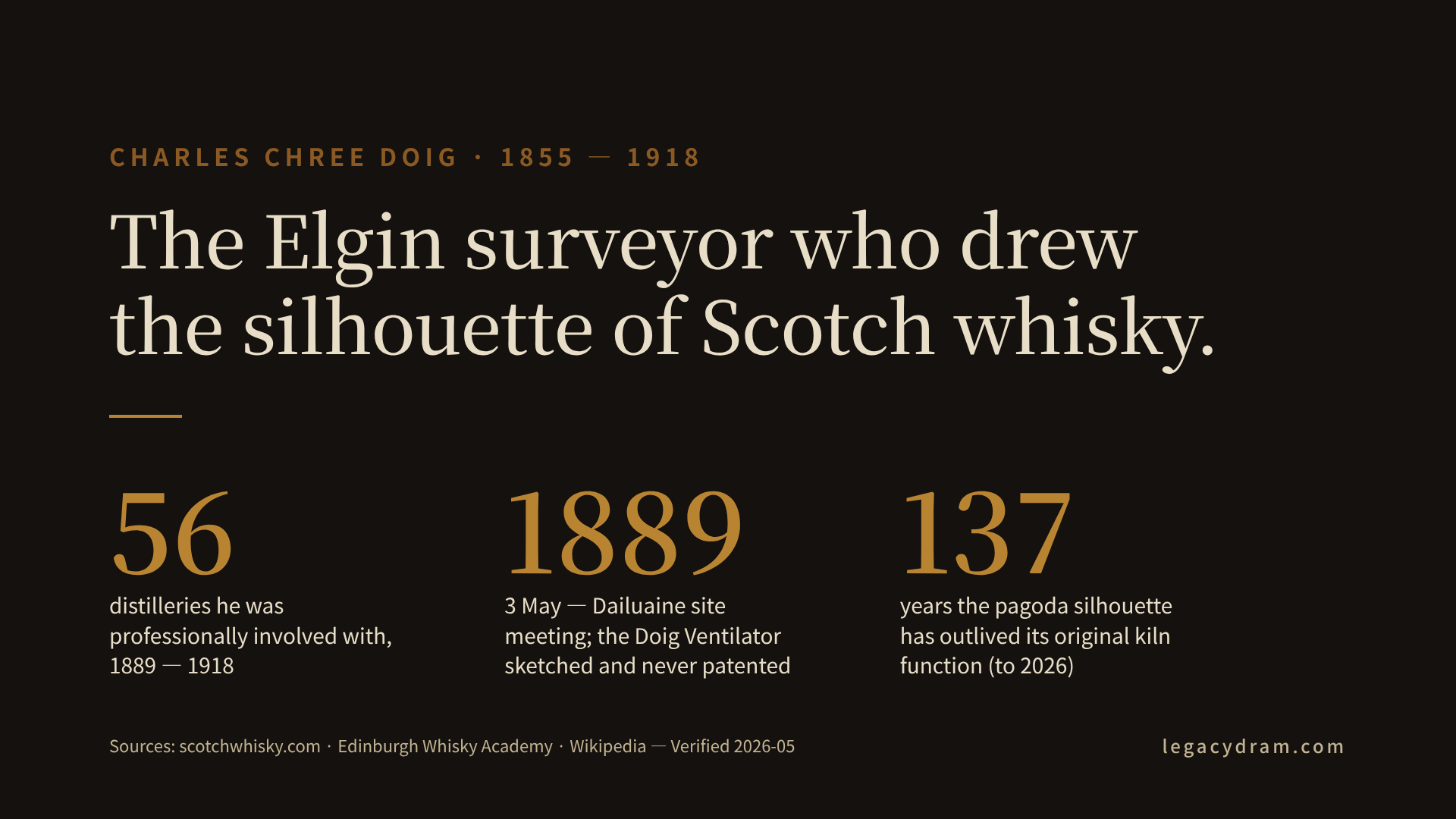
It is also a piece of late-Victorian industrial ventilation hardware, sketched at a site meeting on 3 May 1889 by a thirty-four-year-old surveyor from Elgin, as the answer to a peat-smoke draw problem at a single distillery on the River Spey. The man who drew it had no architectural manifesto, never seems to have patented the design, and worked for the next twenty-nine years as the contracted designer of 56 distilleries before dying, in 1918, the year after fire destroyed the original at Dailuaine.
I want to write about Charles Chree Doig, because the legacydram bench is otherwise full of master distillers and master blenders and inheriting owners (Bessie Williamson, Frank McHardy, Dennis Malcolm, John Smith), and Doig fits none of those categories. He was the contractor. He is what happens when a piece of solved engineering becomes, by accident and by widespread adoption, the visual identity of an entire industry.
A surveyor, not an architect
Doig was born in 1855 in Alyth, a small market town in Perthshire about ten miles north-east of Blairgowrie. The standard biographies have him moving to Elgin in 1882 (he was twenty-seven, recently married) to join a surveyor’s practice in what was, by then, the administrative town for the booming Speyside malt-whisky industry. He worked his way to partner, and by 1890 he had set up his own practice. He stayed in Elgin for the rest of his life.
The first thing worth saying is that architect is a slightly generous title for the role he was filling, and that the slight generosity matters. The Royal Institute of British Architects, then as now, was a closed professional body for designers of buildings of architectural significance: civic, ecclesiastical, residential. A surveyor in a Highland town who designed industrial sheds for an extractive trade was, in the RIBA’s terms of the day, a building contractor’s draughtsman with delusions of grandeur. Doig is not mentioned in any of the standard architectural histories of nineteenth-century Scotland. The 1918 obituary in the Builder is short and respectful in the way short obituaries of provincial professionals always are.
This matters because the easy version of the Doig story is under-recognised genius of distillery architecture, and that framing borrows credibility from a profession he was not really doing. He was an industrial-scale civil-engineering subcontractor for the malt-whisky boom. The output was sheds, kilns, warehouses, and the connecting pipework. The reason the output became iconic was not that the designs were architecturally distinguished. It was that there were a great many of them, all by the same hand, in the same compact region, during the eighteen years that the Speyside boom had unlimited capital. The volume made the silhouette legible. The silhouette became the brand.
I think this is the right framing because it is also how a great deal of consequential engineering actually works. The reason every modern web application looks broadly the same is not that the underlying frameworks are aesthetically considered. It is that one of them, at a particular moment, was the cheapest and most reproducible way to ship a working product, and the team that shipped fastest shipped most, and the shape of their first hundred sites is the shape every subsequent client expects. The pagoda is a Speyside design system.
The 3 May 1889 site meeting
The specific decision that I want to spend most of the article on happened at a single site meeting. Dailuaine distillery, on the Spey near Carron, was being expanded. Doig was the appointed designer. The problem on the table was the kiln: the kiln roof.
The kiln, in a traditional floor-malting distillery, is the building where the germinated barley (now called green malt) is dried over a peat fire to stop further growth and to dose the malt with the phenolic smoke compounds that, in maturation, will become the smoke note in the bottle. The barley sits on a perforated floor (the haircloth) above the fire, between roughly six and twelve inches deep, for somewhere between twelve and forty-eight hours depending on the recipe. The smoke and the heat have to draw upwards through the bed, even with the moisture, and out through the roof, without lingering on the malt long enough to scorch it or wet enough to soak the lower layers.
The state of the art in 1889 was a thing called a Cardinal’s hat: a rotating fluted cowl, conical, mounted on a single pivot, weathercock-shaped, very much like the cowls still found on Kentish oast houses where hops are dried. It worked, in the sense that it turned with the wind and so always pointed downwind, which kept the rain out of the fire. It worked poorly, in the sense that the draw was directional and inconsistent and the malt at one corner of the kiln would dry differently from the malt at the opposite corner.
What Doig sketched at the 3 May site meeting was different in two specific ways. The roof became a steeply pitched pyramid, which raised the cupola well above the working face of the bed and gave the rising air a long flue. The cupola at the top was no longer a rotating directional cowl but a fixed, four-sided box with slatted vents on each side, so that the draw was the same regardless of which direction the wind was blowing in. The label pagoda is, strictly, wrong. It is a cupola with a pitched cap. The pagoda comparison stuck because the silhouette resembles a Far Eastern temple roof, and because the comparison was already in the air thanks to the Glasgow International Exhibition of the same period. The cupola comparison is technically correct and aesthetically less seductive.
The Dailuaine ventilator was installed during the 1889 rebuild. Doig was, in his own correspondence and the contemporary trade press, more pleased with the draw than with the look. The look is what got reproduced. He sketched it; he never (in any record I have found) attempted to patent it. The Patent Office records of the 1890s contain no Doig kiln-ventilator filing. This becomes the second-most consequential decision in his career, after the design itself.
The non-patent
I want to say something about not patenting the design, because if Doig had patented the Doig Ventilator in late 1889 or 1890, the Scotch whisky industry of 2026 would look physically and visually different.
Patent protection in the 1890s ran for fourteen years from filing, extendable in certain cases. If Doig had filed in 1890, his exclusive licensing rights would have run to 1904 or 1918, exactly the window in which forty of his fifty-six distilleries were built. He could have insisted on a licensing fee for every Cardinal-hat replacement installed in Scotland, or restricted the design to his own commissions, and either decision would have suppressed the spread of the silhouette. The pagoda would have been the Doig & Wittet trademark, not the industry’s. It is plausible that other architects, working around the patent, would have settled on a different ventilator geometry (a multi-stack chimney, a hipped roof with louvres, a flat-roofed plant) and that the visual signature of Scotch whisky, settled by the time the boom collapsed in the late 1890s, would now be a different shape entirely.
He did not file. The contemporary trade press of 1890 to 1895 documents the Doig Ventilator at Dailuaine, then at Cardhu, then at Strathisla, then at Knockdhu, then at Speyburn, then at Aultmore and Glen Elgin and Glentauchers, on what was effectively an open-source basis. Rival distillers’ agents could walk into Dailuaine, look at the kiln, walk back out, and commission a copy in the next valley. Many of them did so without using Doig at all, and the standard 1890s Speyside greenfield distillery design contains Doig’s solution whether or not Doig had been hired.
The conventional engineer-founder reading of this story is Doig was a giving man who put the industry above himself. I would offer the less flattering reading, which is: Doig was a working surveyor who had no obvious mechanism for monetising a piece of vernacular industrial draughtsmanship, in an era when the patent system was expensive and uncertain for individuals, and who quite reasonably converted his name recognition (from being the man at the original Dailuaine commission) into a steady flow of greenfield commissions over the next twenty years. He sold the next ventilator, and the one after that, and the kiln-house attached, and the malt barn, and the stillhouse, and the warehouse. He did not need to monetise the drawing because the drawing brought him the work. It is the same business model as an open-source library maintainer who gets paid in consulting fees.
I do not know whether Doig thought about it that way. The fact that he never wrote about the decision, in any record I have been able to find, is itself information.
Fifty-six distilleries and a kit of parts
By the time Doig died in 1918, he is credited with professional involvement in fifty-six distillery projects. The number is, in the secondary literature, suspiciously round: it occurs in several sources and may represent a single original tally that has been repeated rather than independently verified. Either way, fifty-something is the right order of magnitude. The geographic spread is more impressive than the number. Most of the Speyside greenfield distilleries of the 1890s carry his hand somewhere: Aultmore, Speyburn, Glen Elgin, Knockdhu (now anCnoc), Tomatin, Benriach, Glentauchers, Tamdhu, Glendullan, Glenrothes, much of the Cardhu and Glen Moray and Strathisla rebuilds. So, less expectedly, do Highland Park on Orkney, Talisker on Skye, and Ardbeg, Caol Ila and Laphroaig on Islay. The Doig practice (latterly Doig & Wittet, after his partnership with the Elgin builder G. M. Wittet) was, for roughly fifteen years, the de facto national contractor for malt-whisky construction.
The reason one practice could carry that workload is that he was operating with a kit of parts. The standard 1890s Doig distillery has a consistent layout: water source uphill, mash house and tun room on one side, stillhouse central, kiln with the pagoda at the gable end nearest the prevailing wind, dunnage warehouse downhill. The room sizes were modular. The roof pitches were repeatable. Local masons who had built one Doig distillery could build the next one without retraining. A small Elgin practice, with one principal and a handful of clerks of works, could ship a complete distillery from drawing to commissioning in eighteen months because most of the drawings already existed.
This is the part that I find most useful about Doig, and the part where the under-recognised genius framing breaks down most cleanly. He was not designing each distillery as a one-off architectural statement. He was running a small consulting practice that had productised greenfield distillery construction, and which had a competitive moat in the form of one specific ventilator design that everybody wanted on the roof. He was, in modern terms, the in-house architect of a Speyside-shaped Y Combinator batch.
The functional consequence is that 1890s Speyside distilleries are remarkably consistent in their underlying production geometry, which is one of the reasons that, eighty years later, when Diageo and Pernod Ricard and Edrington began consolidating ownership and re-tooling the production stack, the re-toolings were comparatively cheap. The kit-of-parts pays off twice: once on the way in, when the original was built quickly and cheaply; and again on the way out, when standardised geometry is easier to modernise. The kiln got electric heat. The mash tuns got steam. The stillhouse roof got pulled off and rebuilt with a steel frame. The pagoda did not, in most cases, get touched. There was no reason to touch it. It was the only part of the building anyone saw from the road.
The 1917 fire
The original Doig Ventilator at Dailuaine, the one he sketched on 3 May 1889, burned down in 1917. The fire was the kind of thing that happens in a wooden cupola perched on a steeply pitched roof above a peat fire that has been running on and off for twenty-eight years. The cupola was rebuilt afterwards in a similar style, and is still there, but the rebuild is post-Doig.
Doig himself died the following year, on a date in 1918 that I cannot fix precisely from the public record, aged sixty-three. He had been working from his Elgin practice up to the year of the fire. There is no record of him commenting on the destruction of the original, though I cannot believe he was not asked.
The pathos of it (and I will use the word carefully, because Doig is a man for whom the available emotional notes are mostly under-stated rather than over-stated) is that the original installation, the one piece of physical evidence that the design was his and his alone, did not outlive him by a full year. Everything else of his that survives is a copy. Fifty-some kiln cupolas in the Highlands and the Islands, all built to a drawing that exists now only in the imitations.
There is a further, slower pathos, which is that the function the cupola was designed to perform is largely obsolete. The vast majority of Scottish distilleries do not malt their own barley any more. Floor maltings closed at most sites between 1960 and 1990, the work moved to industrial malting plants at Port Ellen, at Burghead, at Glen Esk, at Bairds and Crisp and Boortmalt. The kilns at most distillery sites are empty. The pagoda, in many cases, is now a ventilation cap above an empty box. At Auchroisk, built in 1974, the pagoda was specified at the design stage even though the distillery has never had a malt kiln under it. At Arran, built in 1995, the same. The shape has, in the last fifty years, fully decoupled from the function. Doig’s drawing has become decorative.
I find this less depressing than it sounds. The decoupling is the proof that the design did its job. A piece of engineering that has been thoroughly internalised by an industry becomes invisible as engineering and visible as identity. The pagoda is not a ventilator any more. It is the way you know, from the road, that the building is a distillery. That is a different kind of survival than the one the original drawing was designed to achieve, but it is, on the evidence of the last hundred and thirty-seven years, the more durable one.
What is still on the bottle
On the front of a 2026 bottle of Cardhu 12, of Glenfiddich 12, of Glen Grant 10, of Knockando 12, of half of Diageo’s printed cardboard cartons and most of Suntory Global Spirits’ visitor-centre wayfinding, there is a pagoda. The shape is Doig’s. The fact that none of the kilns behind it are still in use is not commemorated anywhere on the label.
In 2026 the only Scottish distilleries still floor-malting any meaningful portion of their own barley are Springbank (one hundred percent), Bowmore, Highland Park, Laphroaig, Kilchoman, Balvenie and BenRiach (some percentage). Of those, Highland Park and Laphroaig were Doig commissions; Bowmore predates him. The remainder of his fifty-six are, almost without exception, kiln-less inside the pagoda. The drawing has outlived its purpose by an entire generation of industrial reorganisation and is now used, by the corporate owners who long ago closed the kilns, as the principal visual mark of the product’s authenticity.
I do not know whether he would have found that funny or sad. He left no record of speaking about either possibility. The Elgin practice closed shortly after his death. The Wittet partnership continued as a building firm into the twentieth century. The only thing that has survived all of that, without interruption, is the silhouette he drew on a piece of paper on 3 May 1889, in answer to a kiln-draw problem nobody now cares about, on top of a distillery whose original was burned down before he had finished arguing for it.
If you want to read further on the surrounding decisions: I have written previously on the 1901 rebuild of Cragganmore, which Doig oversaw, and the worm-tub geometry that John Smith’s son chose to keep unchanged through it; on the worm-tub condenser itself, the other piece of Victorian distillery hardware that has survived at sixteen sites into 2026, sitting alongside Doig’s pagoda as the other pre-industrial architectural mark of Speyside; on the Glen Grant purifier and Major James Grant, the other significant Speyside engineering decision of the same decade, which contrasts with Doig as engineering done inside a single distillery against engineering replicated across fifty-six; on Bessie Williamson at Laphroaig, which Doig had earlier worked on, and which sits in a different category of survival entirely; and on Bill Lumsden’s still-height work at Glenmorangie, a piece of vapour-physics engineering on a site whose stillhouse Doig partially redesigned; and on Benromach 10, the 1898 distillery Doig designed, closed by DCL in 1983 and reopened by Gordon & MacPhail in 1998 to rebuild the lightly peated Speyside style its pagoda kiln was originally built to dry.