Whisky Spirit Cut: 75-60% ABV Heart, Explained at Glenturret
Most of what a malt still produces never reaches a cask. On a typical spirit run, the keeper of the still throws perhaps two-thirds of the distillate straight back to be boiled again, and only collects the slice in the middle. The boast of a single malt, read coldly, is that it is the expensive offcut of a process whose main output is rejected liquid. Somebody decides where that keepable slice starts and where it stops, and at Scotland’s oldest working distillery that somebody is still a person with a nose, a hydrometer, and a brass-and-glass box that used to be locked by a tax officer.
That decision is called the cut, and it is the second great lever of spirit design. The first lever, reflux, decides what kind of vapour the still even makes. The cut decides which parts of that vapour you keep. You can build the most elegant still in Scotland and still ruin the spirit by keeping the wrong third of it.
The run comes off in three parts
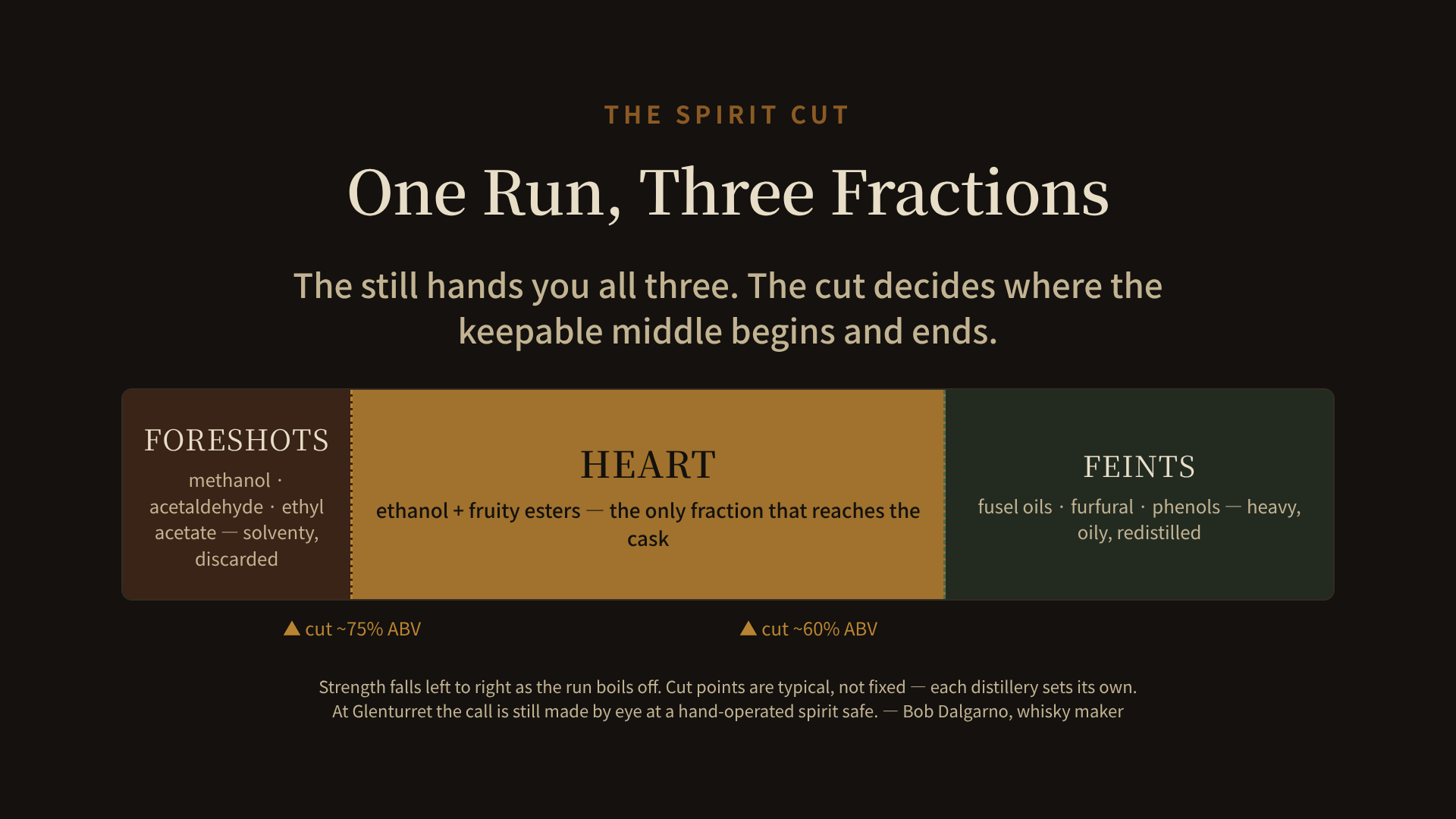
When a charge of low wines boils in the spirit still, the vapour does not arrive at the condenser as one uniform stream. It arrives in order of volatility: the lightest, lowest-boiling molecules first, the heaviest last. The stillman watches this parade go past inside the spirit safe and decides, in real time, where to start keeping it and where to stop. The run divides into three named fractions.
Foreshots (the heads) come off first: the most volatile, lowest-boiling compounds. This fraction is rich in methanol (the toxic, wood-spirit alcohol), acetaldehyde (sharp, green, solventy, the smell of an unripe apple having an argument with a bottle of nail varnish), and ethyl acetate (the glue-and-pear-drop ester). (Whisky Science) You do not want these in the bottle, both because they taste of paint stripper and because some of them are genuinely best not swallowed. The foreshots are diverted back into the next batch.
The heart (the middle cut) is the only fraction that goes to wood. It is mostly ethanol, carrying the fruity, desirable esters and the light aromatics that make a whisky smell like whisky. Everything a single malt will ever be at birth is decided by how much of this slice you take and exactly where you take it from.
Feints (the tails) come off last: the heaviest, highest-boiling fraction. Here live the fusel oils (a catch-all for the higher alcohols such as propanol, the butanols and amyl alcohol, all of them heavy, oily and faintly suffocating), furfural (a grain-derived compound that smells of toasted, almost burnt cereal), and the phenols that carry peat smoke. (Whisky Science) Late feints drift from pleasant (popcorn, mushroom, cereal) toward leathery, then frankly soapy, fishy and cheesy. A peated distillery will reach deeper into this fraction on purpose, because that is where its smoke lives. An unpeated one wants out before the funk arrives. The feints, like the foreshots, go back to be redistilled — though at Clynelish, the residue that lingers in the feints receiver itself has become the house signature over decades, and the still-house never fully cleans it out on purpose.
Where you turn the tap
So the cut is really two moments: the switch from foreshots to heart, and the switch from heart to feints. Distilleries manage these by strength, by time, or by both, watching the strength of the spirit fall as the run progresses and the alcohol boils off.
The classic way to call the first cut needs no instrument at all. Run a little of the distillate into water in the spirit safe: while foreshots are still present, the oils make the mix turn cloudy. The moment it stays clear (the demisting point), most of the foreshots have passed and the heart has begun. (Whisky Science) The second cut, heart to feints, is judged by strength, time, or taste according to each distillery’s practice.
The numbers below are typical, not gospel. Every distillery sets its own, and that is precisely the point: the cut is a dial, not a constant.
| Moment | What changes | Typical strength | What it controls |
|---|---|---|---|
| Heads → heart | Foreshots end, keeping begins | distillate runs clear (demisting test); often near ~75% ABV | how much solventy, volatile material you exclude |
| The heart | The keepable middle slice | collected as strength falls | the entire character that reaches the cask |
| Heart → feints | Keeping stops, tails begin | often around ~60% ABV | how much oil, weight and phenol you let in |
I have deliberately put the numbers in a table rather than the prose, because the temptation with the cut is to treat the figures as the answer. They are not. A distillery making a delicate, grassy triple-distilled Lowland and one making a heavy, worm-tub-cooled sulphury monster like Mortlach might both cut “around 60%” and produce nothing alike, because the spirit arriving at that strength is the product of their still shape, their reflux, their fermentation. The strength is a coordinate. The decision is what you do when you reach it.
Tight or wide: the same still, two spirits
This is the heart of the matter, and it is a genuine trade-off, so I am going to give both sides honestly rather than pretend one is correct.
A tight cut takes a narrow heart: you start late, stop early, and keep only the cleanest middle of the middle. The reward is a light, pure, ester-led spirit with very little oil or funk. The cost is twofold: you make fewer litres of keepable spirit per run, throwing more back to redistil, and you forgo the weight and texture that the edges of the heart would have contributed. Tight cuts make elegant whiskies that some drinkers find thin.
A wide cut reaches earlier into the foreshots and later into the feints: you keep more, and you keep heavier. The reward is body: oils, weight, a fuller mouthfeel, more of the cereal and phenolic depth that ageing can turn into something complex. The cost is risk. Go too wide and the fusel oils bring a soapy, sharp, headache-promising edge; reach too far into the tails and the feinty notes (sweat, cardboard, that cheesy back-end) never fully integrate, even after a decade in oak. Wide cuts make characterful whiskies that, done badly, taste rough.
Neither is the right answer, because “right” only exists relative to a house style. A clean Speyside built for sherry casks wants a tighter cut so the wood has a clear canvas: the same logic that drives Glengoyne’s painfully slow spirit run toward a clean, sulphur-free new make. A robust, oily malt destined to stand up to heavy peat or refill wood wants a wider one. The cut is not a quality setting where higher is better; it is a tuning fork, and you tune it to the note you are trying to play.
Reflux makes the vapour; the cut chooses it
It helps to see where the cut sits in the chain of decisions, because it is easy to confuse it with reflux, and they are not the same lever.
Reflux is about what vapour the still produces. A tall neck (Glenmorangie’s stills run over five metres), a bolt-on purifier (Glen Grant’s water-cooled jackets, or Ardbeg 10’s clean-citrus-smoke purifier arrangement), a slow run, a boil bulb — all of these make the heavy molecules condense and fall back to be re-boiled, so that what reaches the condenser is already skewed light and fruity. Reflux shapes the composition of the stream.
The cut is about which part of that stream you keep. It operates downstream, on whatever the still hands it. You could run two distilleries with identical stills and identical reflux, give them the same vapour, and end up with two different whiskies purely because one keeps a tight heart and the other a wide one. Reflux sets the menu; the cut places the order. A distillery designs its spirit by doing both. The cut is the more nerve-racking of the two, because reflux is mostly built into the copper and fixed, while the cut is a live decision a tired human makes on a Tuesday night shift, batch after batch, and can get wrong.
Why Glenturret still does it by hand
Which brings us to the brass box, and to why one distillery insists on a human judging the cut by eye when the rest of the industry has long since automated it.
Glenturret, in Perthshire, claims to be Scotland’s oldest working distillery: officially dated to 1763, with illicit distilling on the site decades earlier, though it is fair to note the title is contested by the likes of Strathisla and Littlemill, and “oldest” in Scotch is a competitive sport. (Wikipedia) It is small (on the order of 340,000 litres of pure alcohol a year, a rounding error next to the industrial Speysiders), with a single wash still and a single spirit still. And it is almost defiantly manual. Its mash is stirred by hand with a wooden rouser, the last hand-operated mash tun of its kind in Scotland, and the cut is called by its stillmen by eye, drop by drop, at a hand-operated spirit sample safe.
Glenturret is not the only distillery that has resisted the industry’s default automation drift, and it is worth naming the neighbours so the choice does not read as pure eccentricity. In Campbeltown, Springbank has kept floor malting in-house under Frank McHardy and the Mitchell family for decades rather than outsourcing to a commercial maltster. On Islay, Bruichladdich was rebuilt in 2001 around the surviving 1881 Victorian pot still geometry, and Adam Hannett has spent eleven years deciding not to change it. Each of these is a different lever than the cut — a different point in the process where a distillery has decided which risk it would rather carry — but they are the same shape of decision, and they are the small club of distilleries that Glenturret’s manual spirit safe belongs to.
That spirit safe is worth a moment, because it is a fossil of the relationship between whisky and the state. The device was made compulsory by the 1823 Excise Act, the law that turned Scotch from a smuggler’s trade into a licensed industry. It sealed the distillate at its most vulnerable point (as it left the still, before anyone had measured how much there was) so that no spirit could be siphoned off untaxed. Until 1983, the only key to the padlock belonged to the local Customs and Excise officer. (Scotch Whisky Association) So the very instrument through which Glenturret’s stillmen judge the cut by nose and hydrometer was designed not to help them make better whisky, but to stop them stealing it. The craft tool is a tax tool that outlived its tax.
Presiding over the spirit at Glenturret is Bob Dalgarno, who spent more than three decades at Macallan, joining in 1984 and working up through every stage of production (mashman, brewer, stillman) before becoming its whisky maker and, eventually, the man who decided which barley Macallan grew. (That barley decision is its own story, and one I have told elsewhere.) When Lalique bought Glenturret at the end of the 2010s, it brought Dalgarno in to build the distillery’s modern range. The detail that matters here is that he was himself a stillman: he has personally stood at a spirit safe and made the cut by hand. He knows exactly what he is choosing to keep human.
I want to be careful not to turn this into a hymn, because the romance of “by hand” hides a real engineering trade-off, and an honest craft account has to say so. A human cut is a single point of failure with a nose. It does not scale; it cannot run unattended; it varies with the operator’s cold, their fatigue, their attention on a long night. Automated cut-control (strength meters, timed valves) exists precisely because it is repeatable in a way a tired person on a back shift is not. What Glenturret buys by staying manual is not accuracy in the metrological sense; a machine would hit the same ABV more reliably. What it buys is judgement: a person can smell that a particular run is coming through heavier than usual and adjust, where a timer fixed to the clock cannot. Whether that judgement is worth the inconsistency is exactly the kind of question that has no clean answer, and Glenturret has simply decided which risk it would rather carry.
What ends up in the glass
Pour the new spirit Dalgarno’s team makes and the cut is right there, before any cask has had a say. A relatively generous Highland heart gives a malty, slightly oily, fruit-and-cereal new make with enough body to take active oak without disappearing into it — the deliberate output of where those two cut points were placed. Taste it against a tightly-cut Lowland and the Glenturret is the one with more to grab onto; taste it against a wide-cut, peat-led islander and it is the cleaner of the two. Same three fractions, different boundaries, different whisky.
The thing I keep returning to, as an engineer, is that the cut is the most consequential decision in distilling that leaves no trace. Reflux is legible in the shape of a still you can photograph. The cut is invisible: a boundary in time, drawn and redrawn every batch by a person watching liquid in a box. Two-thirds of the run is thrown away so that one-third can be exactly right, and the line between them is a human judgement that no label records. When you next drink something clean and light, or something heavy and oily, you are tasting where somebody decided to open the tap, and where — a few minutes and a few percent of strength later — they decided to close it again.
Related reading
- The Slowest Spirit Run in Scotland: Robbie Hughes and Copper Contact at Glengoyne — slowing the run to make a clean spirit before the cut even chooses it
- The Reflux Equation: Why Glenmorangie’s Stills Are 5.14 Metres Tall — shaping the vapour with height, upstream of the cut
- Bolt-On Reflux: Major James Grant’s 1872 Purifier at Glen Grant — a device that lightens the vapour the cut then selects from
- Peter Mackie’s Malt Mill: The Laphroaig Clone That Never Was — identical stills next door, a different whisky, because the cut is not on the drawing
- Caol Ila 12 and Billy Stitchell: Port Askaig’s Quiet Islay — how far a peated distillery reaches into the feints to keep its smoke
- 大麦品種という根の選択 — Bob Dalgarno と Macallan の Golden Promise — the same man, an earlier decision: which barley to grow
Sources
- Whisky Science — Pot still distillation: foreshots, heart, feints and the demisting cut
- Scotch Whisky Association — What was the 1823 Excise Act?
- Wikipedia — Glenturret distillery
- The Glenturret — Our Distillery: hand-mashing and the spirit safe