Ardbeg 10 Review: The Purifier Behind Islay's Clean Citrus Smoke
I used to think peat was just a polite word for someone setting the malt on fire and deciding to bottle the accident. My first heavily smoked drams tasted like licking a wet ashtray that had been left out in the rain, and I could not work out why grown adults paid extra for the experience. I was handed a glass of Ardbeg 10 at room temperature, in a plain tulip glass, next to a pour of Lagavulin 16, and I braced for two versions of that same wet ashtray. I was wrong, and not in the direction I expected.
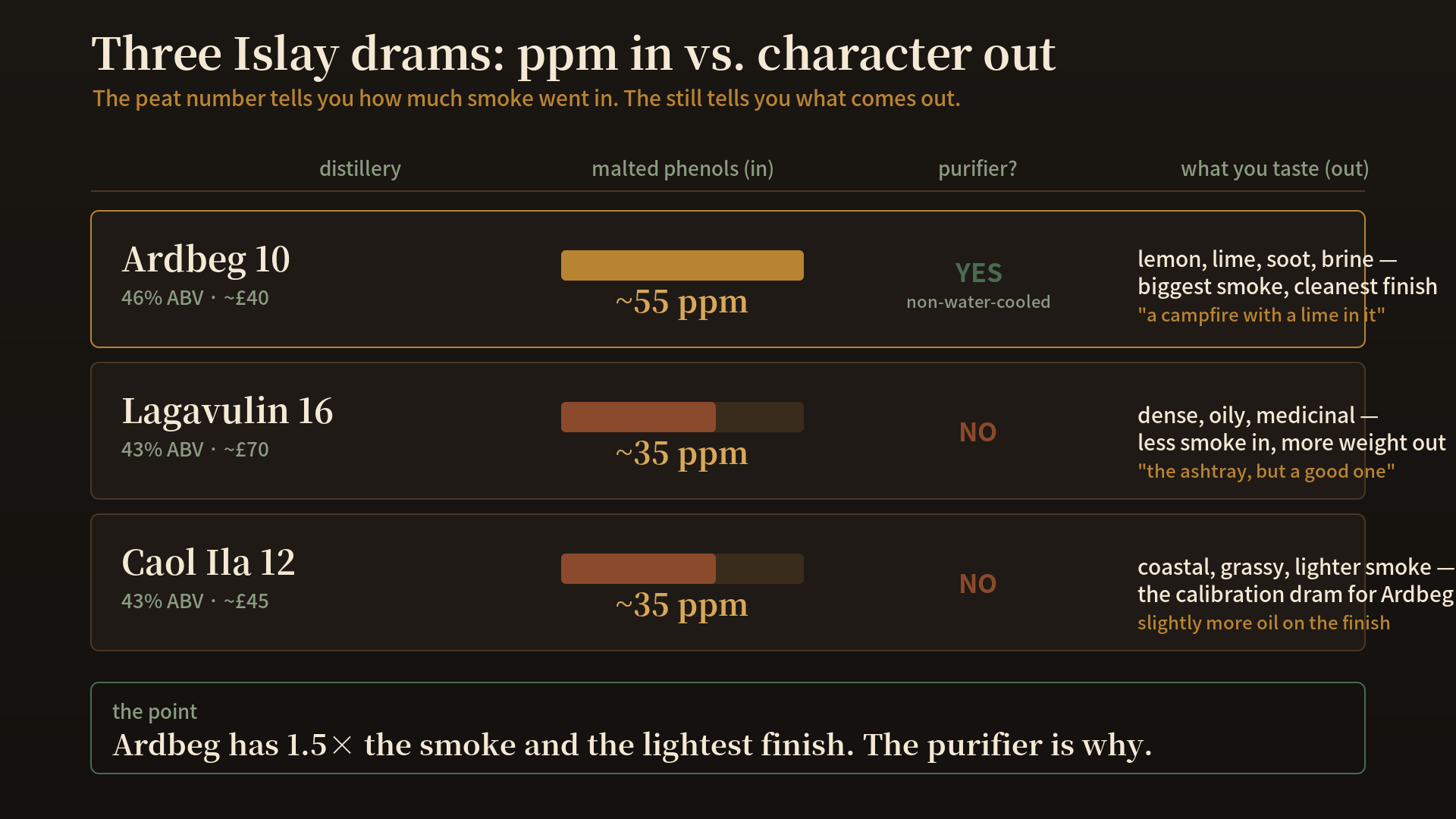
The Lagavulin was dense, oily, slightly medicinal — the ashtray, but a good one, the kind you would defend in an argument. The Ardbeg was smokier on the nose and yet lighter in the mouth: lemon, sea salt, soot, and then a clean finish that closed without the oily film I expected. It read like a bonfire with a slice of lime thrown into it. The strange part is that the Ardbeg is the more heavily peated of the two by a wide margin. It has no business being the cleaner drink. The reason it is comes down to a piece of pipe roughly the length of your forearm.
The bottle, before the engineering
Ardbeg 10 is bottled at 46% ABV, without chill-filtration, and sits at around £40–45 on the British market (roughly $55–65 in the US). For a single malt with this much reputation attached to it, it is almost suspiciously affordable, and it is one of the few peated Islays I would happily recommend to someone buying their first bottle of the style. It is widely stocked. You do not need to hunt for it.
Here is what I taste, and what I think each note is actually made of:
- Lemon and lime over wet ash on the nose. Bright citrus sitting on top of a cold-campfire-the-morning-after smell, not a hot-smoke smell. The smoke is there immediately, but it does not arrive as a wall.
- Brine and oyster shell. That faintly mineral, low-tide note that makes the dram feel coastal rather than just smoky.
- Tar, creosote, and a flash of black pepper mid-palate. This is the part that reminds you it is, in fact, the most heavily peated dram on the island.
- A clean, drying finish. Long on smoke and salt, short on oil. Your mouth does not stay greasy. This is the tell.
That last point is the whole article. A spirit malted to this phenol level should, by rights, leave a heavy, slightly waxy coat behind. Ardbeg does not. To explain why, I have to go to the still — and then to the man who decided, for thirteen years, to leave the still alone.
What the purifier actually does
A pot still is a sorting machine that sorts by boiling point. You heat a wash, the most volatile compounds leave first, and you collect the fraction you want before the heavy, oily, sulfury tail catches up. The catch is that in a plain still with a downward-sloping lyne arm, a lot of that heavy fraction makes it across to the condenser anyway. You get smoke, but you also get weight and oil.
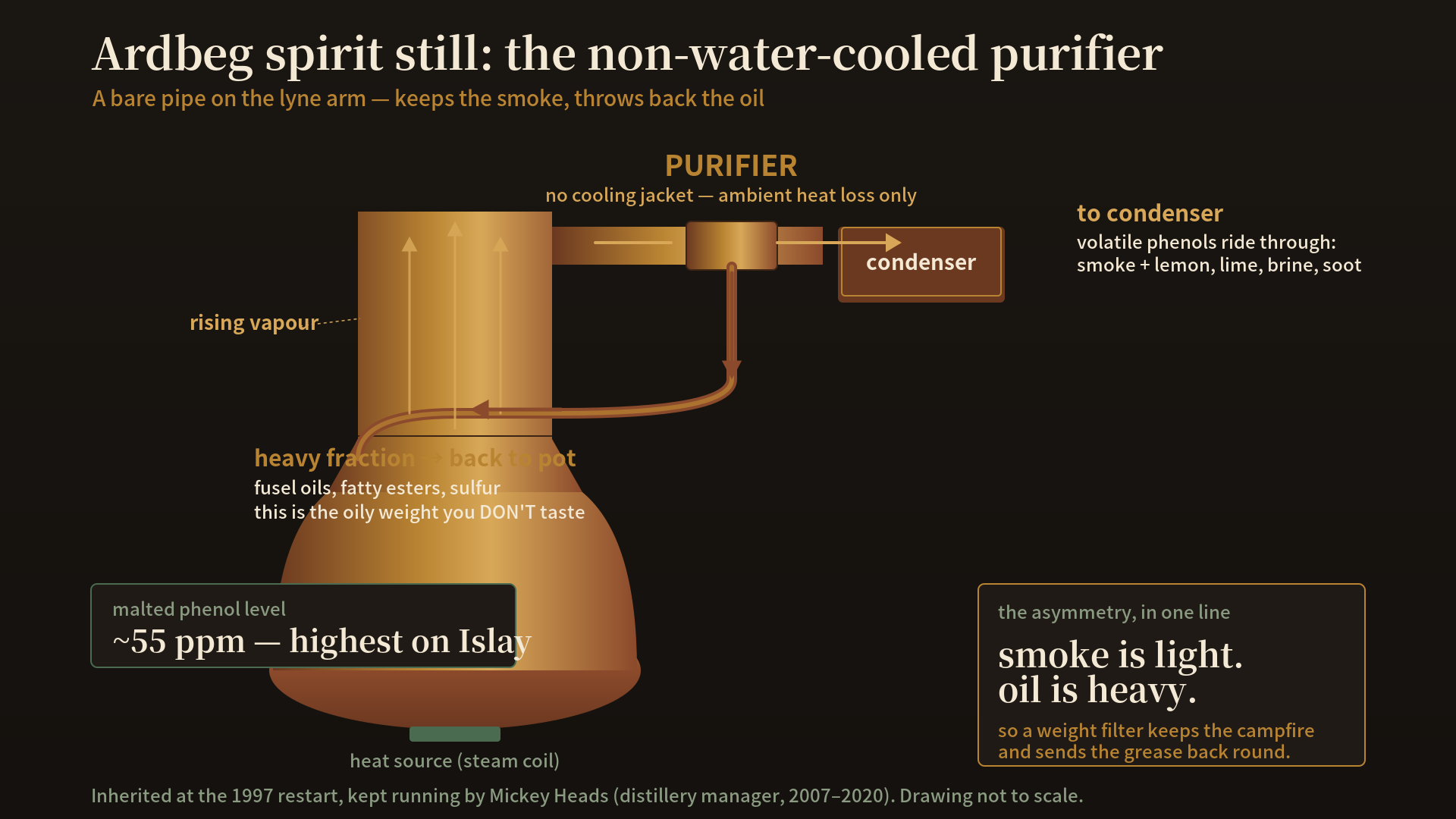
A purifier is a small device fitted to the lyne arm (the pipe that carries vapour from the top of the still to the condenser) to intercept the heavier vapours on their way out. As the vapour passes through, the heavier (higher-boiling) molecules condense back into liquid, and a thin return pipe drops that liquid straight back down into the pot to be boiled a second time. The light, volatile molecules keep going to the condenser. Everything heavy goes around the loop again. (Islay Whisky Academy)
This is reflux: sending part of the vapour back to be re-distilled. The more reflux you run, the more copper contact the spirit gets and the lighter and cleaner it comes out, because copper strips sulfur and the heavy oils never reach the bottle. Ardbeg leans on this hard enough that the distillery describes its process as roughly two-and-a-half distillations rather than the standard two: two full passes, plus the extra fractional re-boiling the purifier forces on every run. (Maltspedia)
The interesting bit, the bit that makes Ardbeg taste the way it does, is the asymmetry. Phenols — the smoke compounds picked up from peat smoke during malting, things like guaiacol (a charred, faintly medicinal note) and various cresols — are relatively volatile. They ride along with the light fraction and make it through the purifier to the condenser. The heavy oils, fatty esters, and sulfur compounds do not; they condense in the purifier and get sent back. So the purifier filters by weight, and it happens that smoke is light and oil is heavy. You keep the campfire and throw back the grease. That is the whole trick: clean citrus smoke is what you get when you select hard for volatility on a malt that was loaded with smoke to begin with.
The peat numbers make the point. Ardbeg malts to roughly 50–55 ppm phenols, generally the highest on Islay. Its near neighbours Caol Ila and Lagavulin both sit around 35 ppm, two-thirds of Ardbeg’s load. (Whiskipedia) On paper Ardbeg should be the heaviest, oiliest, most punishing of the three. In the glass it is the brightest and most citric. The ppm tells you how much smoke went in. The purifier tells you what shape it comes out.
Same idea, different plumbing: Ardbeg vs Glen Grant
If the word purifier sounds familiar, it is because Glen Grant in Speyside runs one on all eight of its stills, and uses it to make a spirit that is the polar opposite of Ardbeg: light, floral, apple-and-pear, no smoke at all. Same device, opposite reputation. It is worth being precise about why.
There are two flavours of purifier. Glen Grant’s is water-cooled: a copper jacket with cold water running through it, deliberately chilling the vapour so that even fairly light compounds condense and fall back. It is an aggressive filter, tuned to strip a Speyside spirit down to its floral skeleton. Ardbeg’s is non-water-cooled: closer to a bare length of pipe on the lyne arm, with no cooling jacket, relying on ambient heat loss alone. (Dave’s Whisky Reviews) It is a gentler filter — and it has to be. If Ardbeg chilled its purifier as hard as Glen Grant does, it would strip out too much of the smoke along with the oil, and you would lose the thing people buy Ardbeg for.
So the same engineering principle (re-boil the heavy fraction, keep the light one) gets tuned in opposite directions for opposite goals. Glen Grant turns the dial to maximum and makes a spirit with no weight and no smoke. Ardbeg turns it to a careful middle setting and makes a spirit that keeps all of its smoke and sheds most of its oil. (There is, by the way, a third way to push reflux up without any purifier at all: build the still tall, the way Glenmorangie does, or run the spirit cut slow, the way Glengoyne does. Geometry, speed, and a bolt-on pipe are three answers to the same question.)
The deflating truth here is that nobody at the distillery is doing this with a calculator. There is no technician computing partial pressures over the spirit safe. There is a still that was built a certain way, a purifier that was set a certain way long before anyone currently employed was born, and a collective decision, renewed every single day a run is made, to not change it. Which brings me to the man whose job that decision was.
What Mickey Heads kept
Ardbeg’s modern story is one of near-death and rescue. The distillery fell silent in 1981, sat largely idle through the 1980s, and was bought in 1997 by the Glenmorangie company, which restarted it. (Ardbeg distillery, Wikipedia) Reopening a distillery is the one moment when you genuinely could change everything: re-spec the stills, drop the purifier, chase yield. Ardbeg did not. The purifier stayed.
The man who ran the place through its modern peak was Mickey Heads, who became distillery manager in 2007 and retired in October 2020 after thirteen years. (Whisky Magazine) Heads was not a parachuted-in executive. He spent his entire working life on Islay and Jura, which on islands that small means the spirit was effectively his native language. Under him Ardbeg was named Distillery of the Year three years running, from 2018 to 2020, and the core range filled out underneath him with An Oa and Wee Beastie. (Drinks International)
But the decision he is in the bottle for is the invisible one. Every run of Ardbeg is a chance to second-guess the purifier: to ask whether the yield you lose sending heavy vapour back round the loop is worth it, whether you could make a heavier, fuller, arguably more fashionable Islay by easing off the reflux. Heads’s job, day after day for thirteen years, was partly to be the person who answered no. Not to invent the clean citrus smoke — that was inherited, plumbed in decades before him — but to protect it from improvement. The hardest engineering work in a long-lived system is rarely building the clever part. It is recognising the clever part for what it is and keeping your hands off it. Heads handed over to Colin Gordon, who came across from Lagavulin, and the pipe is still there.
Next time you pour one
Buy the Ardbeg 10. It is cheap, it is everywhere, and it is the most honest expression of what the still does. Pour it at room temperature, no ice, in a glass that narrows at the top so the smoke collects where you can find it. If you can, put a Caol Ila 12 beside it, because Caol Ila is the cleanest of the no-purifier Islays and makes the perfect calibration dram: similar coastal smoke, but you will feel slightly more oil and weight in the Caol Ila’s finish, the weight that Ardbeg’s purifier quietly throws back into the pot.
Then do the one thing the engineering tells you to do: pay attention to the finish, not the nose. Anyone can make a big smoky nose; you just burn more peat. The achievement is the way the Ardbeg’s smoke arrives huge and then leaves clean, with no oily film sitting on your tongue afterwards. That clean exit is the purifier. That is a small pipe on a lyne arm, set to a precise middle setting a long time ago, and a succession of people, Heads chief among them, who looked at it, understood exactly how much money the lost yield was costing, and decided that the lime in the campfire was worth more. You are tasting a decision not to optimise. They are rarer than they should be, and this one costs about forty pounds.
Related reading
- Bolt-On Reflux: Major James Grant’s 1872 Purifier at Glen Grant — the same device, water-cooled and turned to maximum, making a spirit with no smoke at all
- Caol Ila 12: Billy Stitchell and the Clean Side of Islay — the no-purifier neighbour, and the best calibration dram for an Ardbeg
- The Reflux Equation: Why Glenmorangie’s Stills Are 5.14 Metres Tall — pushing reflux up with still height instead of a pipe
- Glengoyne’s Slowest Spirit Run — pushing reflux up with distillation speed
- Adam Hannett, Bruichladdich, and Three Levels of Peat — how phenol ppm is designed in the first place
- Kilchoman Farm Distillery: How Anthony Wills Built Islay’s First New Distillery in 97 Years — the only Islay distillery running its own barley field; Ardbeg’s contrast for the farm-to-bottle Islay model
Sources
- Islay Whisky Academy — Scotch Series 35: Purifiers
- Maltspedia — Ardbeg Distillery: production guide
- Whiskipedia — Phenols
- Dave’s Whisky Reviews — Let’s Talk Purifiers: ‘Water Cooled’ & ‘Non-Water Cooled’
- Ardbeg distillery (Wikipedia) — en.wikipedia.org/wiki/Ardbeg_distillery
- Whisky Magazine — Ardbeg’s renowned distillery manager is retiring
- Drinks International — Ardbeg commemorates retirement of distillery manager Mickey Heads
- The Whiskey Wash — Ardbeg 10 Year Old Review