Malt Mill 1908: Peter Mackie's Lost Islay Distillery Inside Lagavulin
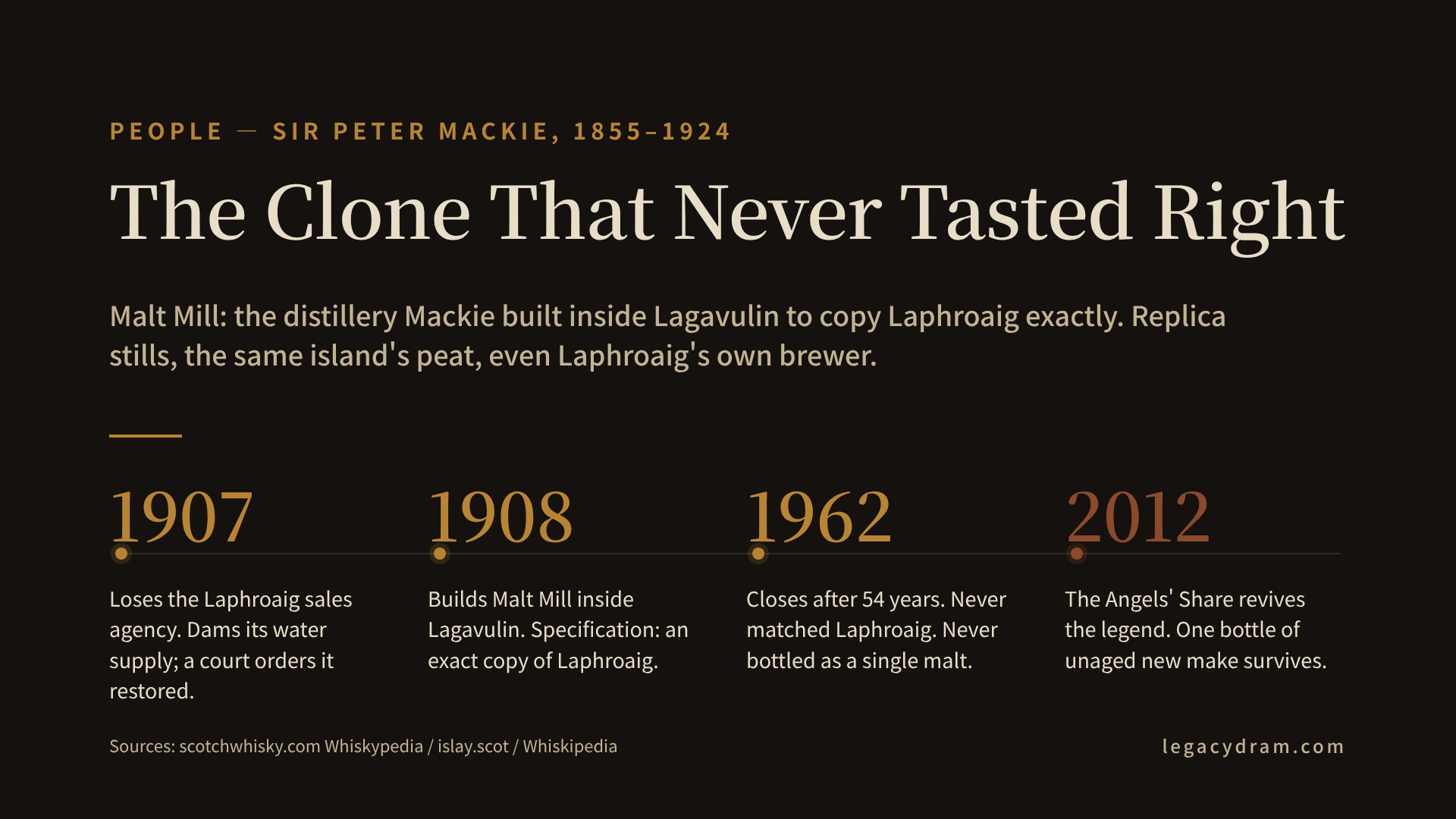
By the time Peter Mackie decided to clone his neighbour’s distillery, he had already tried blocking their water supply with stones. The clone was the more dignified of the two responses, which tells you something about the first one. In 1908, on the south coast of Islay, Mackie built a second, smaller distillery inside the walls of Lagavulin, which he owned. Its name was Malt Mill, and its entire reason for existing was to produce an exact copy of Laphroaig, the distillery two miles up the coast that had just fired him.
Malt Mill ran for fifty-four years. It never once made Laphroaig.
The feud is the famous part, and it is a good feud. What interests me more is that Malt Mill is the closest thing whisky history has to a controlled experiment on its own central question: what actually makes a distillery’s spirit taste the way it does? Mackie put real money on the proposition that the answer was equipment, materials, and people, all of which can be bought. He was wrong, publicly, for five decades, and the way he was wrong is more instructive than most successes.
The agency, the dam, and the court
First, the constraint he was operating under, because the clone was not an act of pure curiosity.
Mackie had been connected to Lagavulin since 1878, when he arrived as a young man to learn distilling in the business of his uncle, James Logan Mackie. By the 1890s he had taken control of the firm, registered the White Horse blend, and turned himself into one of the dominant figures of the blended-Scotch era, alongside the Dewars and the Walkers. Mackie & Co was also the sales agent for Laphroaig: the Johnston family made the whisky, and Mackie’s firm sold it, taking most of the annual output into its own blends.
The arrangement fell apart in 1907. The accounts collected at scotchwhisky.com and islay.scot agree on the shape of it: the Johnstons, with a newly arrived and newly qualified engineer named Ian Hunter looking after the family’s interests, concluded that Mackie was paying them too little for too much of their whisky, and declined to renew the agency. Mackie sued to keep it and lost.
His response was not subtle. Laphroaig drew its process and cooling water from the Kilbride stream, and that stream crossed ground Mackie controlled. He had it dammed with stones. Laphroaig, without water, stopped. The court ordered him to put things right, and the water went back. However fondly the feud is retold now, the plain version is this: it was the behaviour of a man using his physical control of a neighbour’s inputs to punish a lost contract, and the courts of Edwardian Scotland, not famous for their sentimentality, sided with the neighbour both times.
So by 1908 Mackie had exhausted the legal route and the hydrological one. What he had left was engineering. If he could no longer sell Laphroaig, he would manufacture it himself.
The specification of the copy
The clone was not a half measure, and this is the part that makes Malt Mill worth an essay rather than a footnote. Mackie copied everything that could be copied.
He built two new pot stills, pear-shaped, modelled on Laphroaig’s. The Whiskypedia entry records that Malt Mill had its own malting floors and its own pair of washbacks, so that the barley and the fermentation would not simply be Lagavulin’s under another name; only the mash tun was shared with the host distillery. The kilns burned peat cut from the same island, the same few square miles of bog. And for the variable that everyone in 1908 would have called the real secret, Mackie went and hired Laphroaig’s own brewer, the man who carried the process in his hands.
Stills, maltings, fermentation, peat, personnel. As a procurement exercise it was complete. A modern engineer would recognise the move immediately: same hardware, same dependencies, same senior operator, rebuilt in a new environment, and the build still refuses to reproduce. I will allow myself that comparison once, because Malt Mill earned it eighty years before software did.
The spirit that came off those pear-shaped stills was, by every surviving account, good whisky. It was peaty, it was Islay, and it was not Laphroaig. It was not Lagavulin either, which is the genuinely strange part; sitting in the same yard, sharing a mash tun, it made a third thing. Year after year. The blenders took it, because good smoky filler was always welcome in White Horse and in Mackie’s Ancient Scotch, the only label that ever printed Malt Mill’s name. But the stated objective, the one the distillery had been built to hit, never arrived.
The variables he could not buy
Why it failed is the question Malt Mill was unintentionally built to answer, and the answer assembled itself slowly.
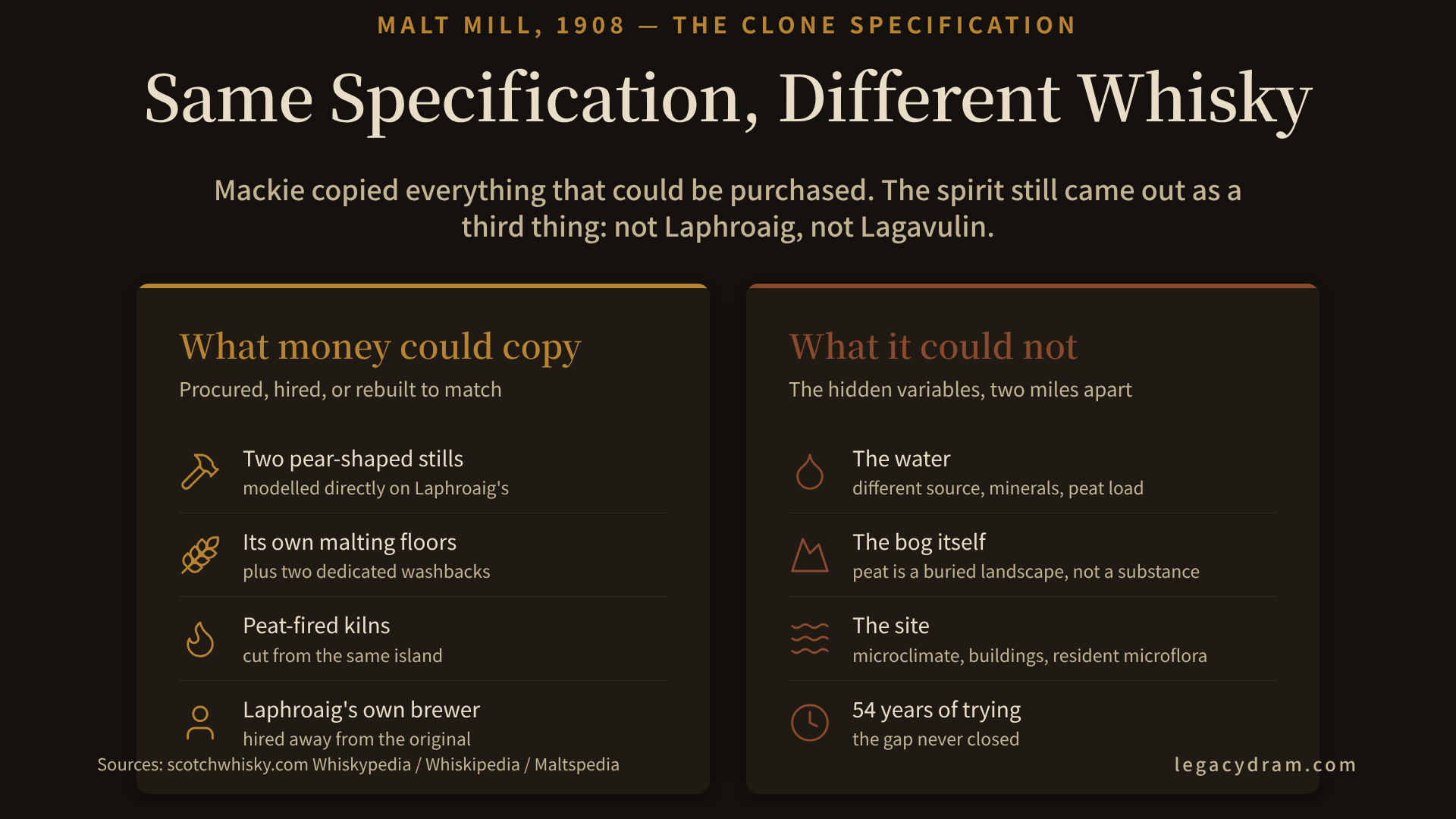
The water was different. Laphroaig’s Kilbride supply and Lagavulin’s hill lochs do not carry the same minerals or the same peat load, and water touches everything: the mash, the fermentation, the dilution, the condensers. The peat was different, because peat is not a substance but a buried landscape, and a bog two miles away is a different mix of dead heather, moss, and time; when it burns, it smokes differently, and that smoke is what the malt remembers. The site itself was different: the shape of the buildings, the temperature of the air in the washbacks, the resident population of yeasts and bacteria that no one in 1908 knew to think about. Each variable was small. Stacked, they were the whole signature.
The industry now states the lesson as settled doctrine: you cannot move a distillery, and you cannot copy one. Diageo’s own telling of the Lagavulin story leans on Malt Mill as the proof. Every distillery that has since tried to relocate even its own production, with its own staff and its own recipes, has rediscovered the result the hard way.
Here is where I am supposed to write that Mackie, a great industrialist, absorbed the lesson with scientific grace. The record suggests he mostly stopped talking about the objective. The distillery stayed busy, the spirit went quietly into the blends, and the failure was simply never declared, which is one way to end an experiment. Mackie was constitutionally incapable of the other way. His contemporaries called him Restless Peter; the diplomat and writer Robert Bruce Lockhart, who knew the whisky trade intimately, summed him up as one-third genius, one-third megalomaniac, and one-third eccentric. This was a man who in his later years invented a flour called BBM (bran, bone and muscle), milled it at his Craigellachie distillery, and required his employees to bake with it. A man who could make his office eat experimental flour was never going to stand in front of his shareholders and announce that two miles of Islay had defeated him.
And the deeper unfairness, the one I find genuinely poignant rather than comic, is that everything else Mackie touched worked. White Horse became one of the great global blends. Craigellachie, which he co-founded in 1891, still runs today. He was made a baronet in 1920; he wrote books; he died in 1924 a rich and honoured man. The obituaries had no shortage of triumphs to list. The one project where he had specified the outcome most precisely, staked his pride most openly, and controlled the most variables, is the one that never did what it was told.
Fifty-four years, zero bottles
Mackie died sixteen years into the experiment. Malt Mill outlived him by thirty-eight more, passing with the rest of his empire into the Distillers Company and onward into what is now Diageo. Successive owners kept it running, presumably because decent peated malt always had a home in a blend, and because shutting a distillery is a decision while letting one run is merely a habit.
The end, when it came in 1962, was undramatic. Lagavulin needed a bigger still house; Malt Mill’s two stills were absorbed into the rebuild, its buildings were repurposed, and the experiment closed its ledger at fifty-four years of production and zero bottles of single malt. As far as the historians at scotchwhisky.com can establish, Malt Mill was never once bottled on its own. Every drop went into the anonymity of the blending vats. The whisky that was supposed to prove a point ended up as an ingredient in other people’s, its name surviving on no label except a long-discontinued blend.
There is a coda, and it is the reason most people who know the name Malt Mill know it at all. In 2012, Ken Loach built his film The Angels’ Share around the discovery of a mythical last cask of Malt Mill, treated in the script as the rarest whisky on earth, which by then was simple realism. After the film came out, Lagavulin’s then manager produced something the script had not dared invent: a single sample bottle, passed quietly from manager to manager, drawn from Malt Mill’s final spirit run in June 1962. It sits today in the visitor centre at Lagavulin, in the building that once held Malt Mill’s own maltings. In 2018, a five-centilitre miniature said to be a blender’s sample of ten-year-old Malt Mill distilled in 1959, though the auction house openly admitted authentication was impossible, sold at auction for £3,400.
Look at what is actually in that visitor-centre bottle, though. It is new make: clear, unaged spirit, bottled the week the stills went cold. It never saw a cask. Which means that mature Malt Mill, the whisky itself, the thing fifty-four years of mashing and smoking and distilling were spent producing, now exists nowhere, and no living person can say what it tasted like. We know only the two things the record insists on: it was not Laphroaig, and it was not Lagavulin. It was the taste of one man’s refusal to accept that some things cannot be specified, and like the man, it is gone; the proof that every distillery is unrepeatable turned out to be unrepeatable itself.
If you want the other side of this story: the Ian Hunter who took Laphroaig’s agency away from Mackie in 1907 is the same Ian Hunter who, decades later, left the distillery to his secretary; I have written about that in Bessie Williamson and the inherited distillery. Alfred Barnard’s 1887 atlas documents the Islay that Mackie apprenticed in, roughly a decade after he first arrived at Lagavulin and twenty years before the agency dispute broke it open. And the blended-Scotch economics that made a captive peated-malt distillery worth owning at all are the subject of John Haig, Cameronbridge, and the Coffey still. White Horse Fine Old still carries Lagavulin malt today, and it is the closest a thousand-yen bottle gets you to the yard where this whole experiment happened.