Fettercairn Cooling Ring: The Only Water-Cooled Stills in Scotch
Every other still house in Scotland treats the outside of a spirit still as a shell, not as a surface. You heat the wash from the bottom, you control the vapour from the inside, you make the copper walls thicker or thinner or taller or squatter — and everything about the spirit character is decided by what happens on the inside of the copper. The outside of the still is just where the paint goes.
Fettercairn does not treat the outside of the still as a shell.
On its two spirit stills, a perforated copper collar sits around the neck like a garland. Cold spring water flows through the collar and cascades down the outside of the still, in a slow, deliberate curtain, throughout the entire spirit run. From ten feet away it looks like a very small waterfall running over a very old kettle. The copper wall chills from the outside; heavier vapours climbing the inside of the neck condense on the cooled surface and fall back down to be redistilled. Only the lightest esters and the most volatile aromatics make it past the cold zone to the lyne arm. The resulting new make tastes of fresh pineapple and green mango and warm pear skin, which is not a normal Highland outcome and is not an accident.
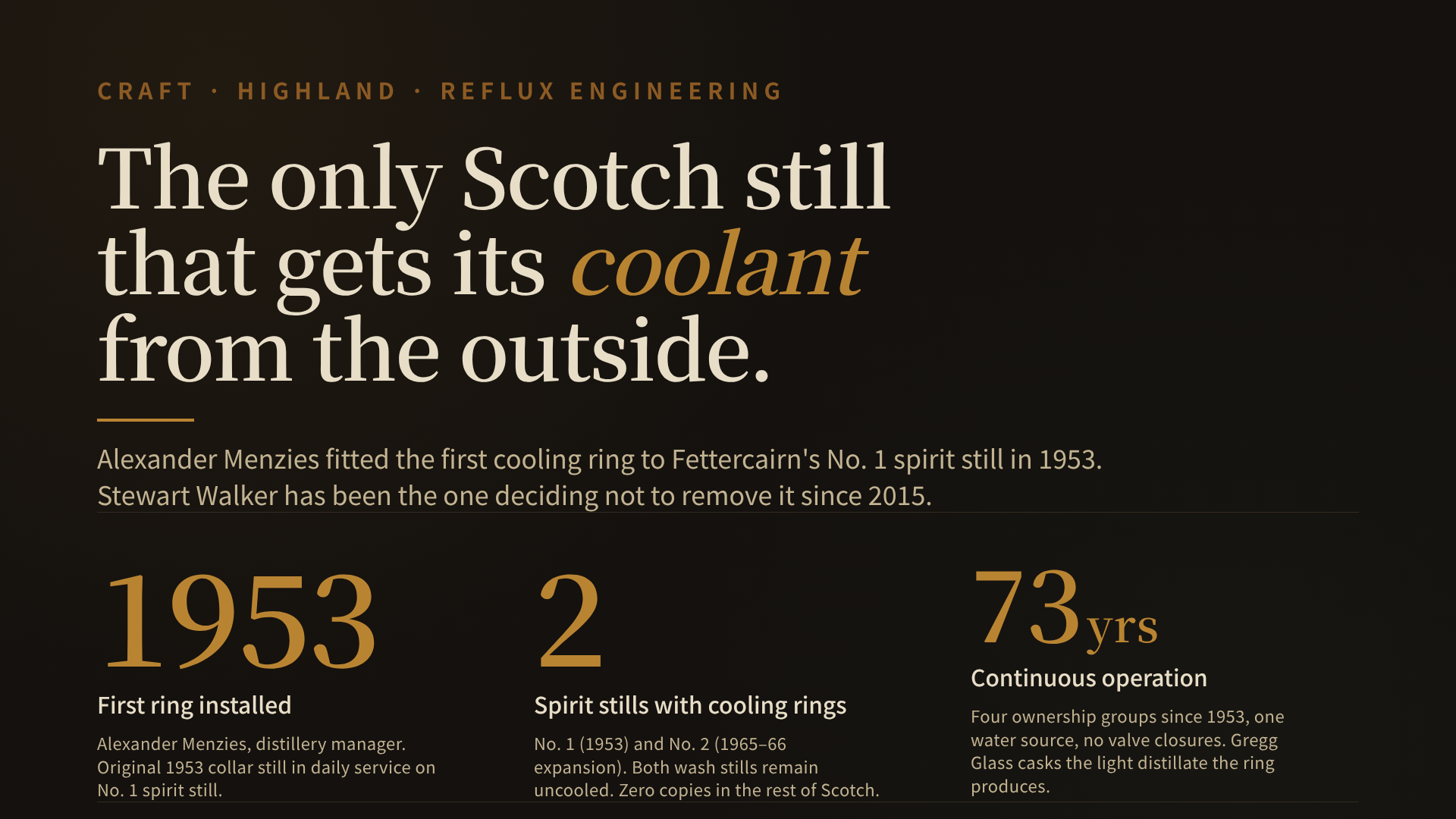
The person who bolted the first ring on was Alexander Menzies, then distillery manager, in 1953. That original 1953 ring is still in service on the No. 1 spirit still today. (Bourbon Lens) A second ring was fitted to a new No. 2 spirit still during the 1965–66 capacity expansion. Both wash stills stayed uncooled. No other distillery in Scotch has copied him. (Whisky Shop, Fettercairn official)
Seventy-three years and four ownership changes later, the person defending Menzies’s decision is Stewart Walker, who grew up in the village of Fettercairn and watched the distillery workers walk to their shifts. Walker joined the distillery in January 1990 as a warehouse operator, moved through mashing, brewing, and distillation, and became distillery manager in 2015. (Scotsman Food and Drink) His public description of the ring is admirably plain: A wonderful yet simple creation that has such an influence on our new make spirit. His quieter job is to keep saying no every time somebody asks whether the whole thing could just be replaced with a taller still.
What the ring actually does, in physics you can check
Distillation is a filter that runs on boiling points. What comes out of a still is dominated by whatever molecules are volatile enough to make it past the cold zone at the top. Every design choice in a still house — height of neck, angle of lyne arm, temperature of condenser, presence or absence of purifier, worm tub or shell-and-tube — is a way of moving that cold zone around and choosing where the cut happens.
In the rough neighbourhood of what leaves a wash still:
- Ethyl acetate (pear-and-nail-polish ester, boils at 77°C)
- Ethanol (78.4°C)
- Higher esters and short-chain aldehydes (roughly 80–110°C)
- Fusel oils like isoamyl alcohol (~132°C)
- Long-chain fatty-acid esters, sulfur compounds, DMS byproducts (well above ethanol, into the 150°C+ range)
A conventional still copes with this range by making the neck tall enough that heavier vapours run out of thermal energy and condense on the inside of the copper before they reach the lyne arm. This is called reflux — heavier vapours falling back down for another pass through the pot. Glenmorangie pushes this to an architectural extreme with 5.14-metre necks. Glen Grant does it with a water-cooled purifier jacket installed inside the vapour path in 1872. Loch Lomond does it with a column of perforated plates that lets the operator pick where the cut happens on the day. All three approaches cool the vapour from the inside.
Fettercairn cools it from the outside. The perforated copper collar sits around the shoulder of the neck; water flows through the collar and out through the holes, forming a thin curtain that runs down the external copper surface for the full length of the spirit run. Heat conducts through the copper wall from inside to outside — that is what copper does — and the inside of the neck sits several degrees cooler than it otherwise would. Everything that was borderline about to condense on the inside now definitely does. The threshold moves down by whatever the temperature drop across the copper wall happens to be, and the cut becomes structurally lighter.
The chemical consequence is the part that lands in your glass. Short-chain esters (ethyl butanoate, ethyl hexanoate — the ones responsible for pineapple, green apple, tropical fruit) have boiling points close to ethanol’s, so they slip past the chilled wall and make it to the condenser. Long-chain fatty-acid esters, fusel oils, and sulfur compounds hit the cold copper, condense, and go back down the neck for a second boil. Some of them break down on contact with hot copper on the way back; most just sit at the bottom of the pot as spent-run residue. What reaches the condenser is dominated by the light, tropical, ester-forward fraction. Fettercairn’s official tasting notes for the 12-year-old call out pineapple, nectarine, tropical fruit, and pear. (Whisky Advocate) That is not marketing colour. That is the compound profile the ring selects for.
(At this point the reader is supposed to do the heat-transfer arithmetic — copper thermal conductivity is roughly 400 W/m·K, the neck wall is a few millimetres thick, the vapour side sits somewhere around 80–90°C, the water side sits near the ambient of the local spring. The answer is that the inner wall runs a handful of degrees below the freely-flowing vapour, which is exactly what you want for reflux. Nobody in the still house is doing this calculation live. They are looking at the spirit safe and trusting that the water has been flowing the way it has flowed since 1953.)
Alexander Menzies’s actual decision: reroute the coolant
In 1953, Alexander Menzies had a problem. The style Fettercairn was making did not match what the blended-whisky market was asking for. The two spirit stills sat as they had been rebuilt after the 1887 fire that destroyed the original distillery, and their shape produced a heavier, weightier spirit than the light-fruited blending fillers of the post-war 1950s wanted. (Wikipedia — Fettercairn distillery) He had two obvious options and one non-obvious one.
The obvious options were both expensive. He could rebuild the still house with taller, narrower spirit stills — a serious capital line item, and one that would have meant months of downtime. Or he could put purifier jackets inside the vapour path, in the Glen Grant tradition, which meant welding new copper geometry into every still. The non-obvious option was to redirect coolant water — of which Fettercairn had an abundance from Loch Kinnairdy behind the distillery — down the outside of the neck of the existing still. Buy a perforated collar, plumb it into the spring water line, mount it around the still, open the valve, walk away.
The engineering case for the external cooling ring, against the alternative of rebuilding, comes down to three things a working manager in 1953 would have cared about:
- Capital cost is trivial. A perforated copper collar and a few metres of pipework are hand-fabrication work. A new pot still, and the crane and stillhouse modification to hang one, are not. The cost ratio is at least two orders of magnitude apart.
- Reversibility is complete. If the lighter spirit did not sell, Menzies could close a valve and go back to the original spirit envelope in an afternoon. A new still geometry cannot be undone. This is the engineering equivalent of shipping a change behind a feature flag with a rollback plan.
- The pot stays untouched. The interior geometry of the still — the pear-shaped base with the gradually narrowing neck — is unmodified. The wash and low-wines profile going into the still on the first pass is the same as before. Only the last few degrees of thermal control at the top of the neck are being changed. The still house, as a system, gains one new configurable knob without any of the existing knobs being disturbed.
What Menzies bought with the ring was a fundamentally different spirit envelope on the same underlying still. Fettercairn went from a heavier Highland to the tropical-fruited style that has been the house signature for the seven decades since. The 1953 ring is still on the No. 1 spirit still. When the distillery doubled its capacity in 1965–66, a matching ring was fitted to the new No. 2 spirit still. (Bourbon Lens) Both wash stills remained uncooled, because the wash still’s job is bulk vapour transfer to the spirit still — cooling it would strip fermentation congeners you actually want to bring forward for the second distillation to choose from.
The trade-off Menzies absorbed was throughput. Every drop of condensate that runs back down the neck of the spirit still is wash that has been paid for, malted, mashed, fermented, and heated once, and now has to be heated again. Industry rules of thumb put the yield hit from active external reflux somewhere in the 5–10 per cent range against an unringed run, though as with the reflux ratio no distillery publishes an audited number. Menzies wore that penalty in exchange for a spirit envelope that matched where the market was heading. A structurally lighter Highland was worth the yield hit in a decade when the blenders wanted lighter fillers.
He also, structurally, gave up the option of Fettercairn ever making a heavier or peated single malt without disowning the geometry that defines it. This is the standard cost of building your identity on a specific piece of engineering: the identity is now load-bearing in both directions. Fettercairn cannot drop a heavy sulfury dram onto the shelf in 2026 without unpicking seventy-three years of what the ring was installed to prevent.
The Gladstone tangent, briefly
Fettercairn was founded in 1824 by Sir Alexander Ramsay of Fasque, who had been one of the Highland landowners campaigning for the 1823 Excise Act that made small-scale legal distillation commercially viable. (Wikipedia — Fettercairn distillery) Ramsay lost his fortune five years later, and in 1829 he sold the estate — Fasque House, its grounds, and the distillery — to Sir John Gladstone, a Liverpool merchant. Sir John’s fourth son, William Ewart Gladstone, grew up at Fasque, a mile up the road from the still house.
William went on to serve four terms as UK Prime Minister and, more relevantly for this story, wrote the 1860 Spirits Act while Chancellor of the Exchequer under Palmerston. The 1860 Act permitted for the first time the blending of Scotch malt whisky and grain whisky in bond, before duty was paid — the legal foundation for every blended Scotch that came after. Andrew Usher’s Old Vatted Glenlivet, John Walker’s Kilmarnock blends, James Buchanan’s Black & White all rest on that piece of primary legislation. The child who watched the Fettercairn stills fire up as a boy grew up to write the law that made blending itself possible. He never took ownership of the distillery — that stayed with his older brother’s line of the family until 1924 — but the Gladstone name is on the founding paperwork of both this specific still house and, indirectly, of blended Scotch as a category.
I mention this only because the cooling-ring decision is much more legible when you can see the two centuries of continuous ownership behind it. Fettercairn was in the same family from 1829 to 1924, sold to Ross & Coulter in 1924, and joined Whyte & Mackay in 1973. (Wikipedia — Fettercairn distillery) Menzies made the 1953 ring decision under a Ross & Coulter successor management that was still, culturally, running a distillery the Gladstones had built. The people who chose not to remove it in the seventy-three years since have been custodians of a house that is used to thinking on long horizons.
Stewart Walker and the discipline of keeping the water on
Stewart Walker joined Fettercairn in January 1990. He worked through warehouse, mashing, brewing, and distillation over twenty-five years, and became distillery manager in 2015. (Scotsman Food and Drink) The cooling rings had been running for thirty-seven years when he arrived and had been running for sixty-two by the time he took over. His job, on the days when it is not about mashing yields or condenser scale or the seven hundred and twelve visitor questions a distillery manager gets a year, is to keep saying yes to leaving the rings on.
That yes is not obvious. Every consultant tour, every capacity review, every efficiency benchmark comparing Fettercairn to peer Highland distilleries turns up the same finding: the yield penalty of external reflux is real, and taller stills would deliver a comparably light spirit at higher throughput. Walker’s job, quietly, has been to keep declining that trade. His public reasoning is short: We do things the way we learned them, from the people who worked here years ago. That reads, on a first pass, as heritage marketing. Read a second time, in the context of what would actually happen if the rings came off, it is a technical position: the pot geometry and the ring together define a spirit envelope that a fresh design cannot replicate without a decade of maturation trials and a certain amount of category confusion. The cheaper option — retrofit taller stills — would take the still house out of production for months and would produce a slightly different spirit than the ring does, because taller-still reflux is not identical to external-collar reflux. The chemistry converges but does not perfectly match. Gregg Glass, the Master Whisky Maker who has re-anchored the modern range around Fettercairn 12, 16, 22, and 28, would inherit a slightly different palette to blend from. Nobody in Whyte & Mackay’s product management has, so far, asked for that.
The visible work of Walker’s tenure has been the tour programme, the 200th anniversary campaign in 2024, and the US market launch in 2025 that finally brought Fettercairn to American shelves after two centuries. (Forbes — Fettercairn Scotch Now Available For The First Time In The US) The invisible work is that the water is still flowing down the outside of both spirit stills as I write this in July 2026. The 1953 ring is still on No. 1. The 1965–66 ring is still on No. 2. Nobody has closed the valve.
There is a version of this profession that is loud, and there is a version that is quiet, and Walker is squarely in the second one. His job description, if written honestly, includes the line do not authorise removal of the cooling ring, regardless of who asks. Menzies did the interesting engineering. Walker’s job is to keep that engineering intact for another few decades.
The spec sheet you actually want
Fettercairn’s numbers, cross-checked across recent published sources (Whisky.com database, Whisky Shop distillery profile):
- Stills: 4 total — 2 wash, 2 spirit — each 12,800 litres. Pear-shaped bases, gradually narrowing necks.
- Cooling ring: on both spirit stills only. Wash stills uncooled.
- Fermentation: 56–60 hours in 13 Oregon pine washbacks. Long enough to build up secondary lactobacillus activity that contributes to the tropical-ester profile.
- Water source: Loch Kinnairdy and springs from the Grampians. Same water runs down the outside of the stills as through the mash.
- Heating: steam coils (converted from direct-fired after post-1887 rebuilding, in stages).
- New make spirit: 68% ABV, tropical fruit forward.
- Site history: founded 1824 (Sir Alexander Ramsay), Gladstone family 1829–1924, Ross & Coulter 1924, Whyte & Mackay 1973–present.
Two ways to push the reflux ratio up, from the outside
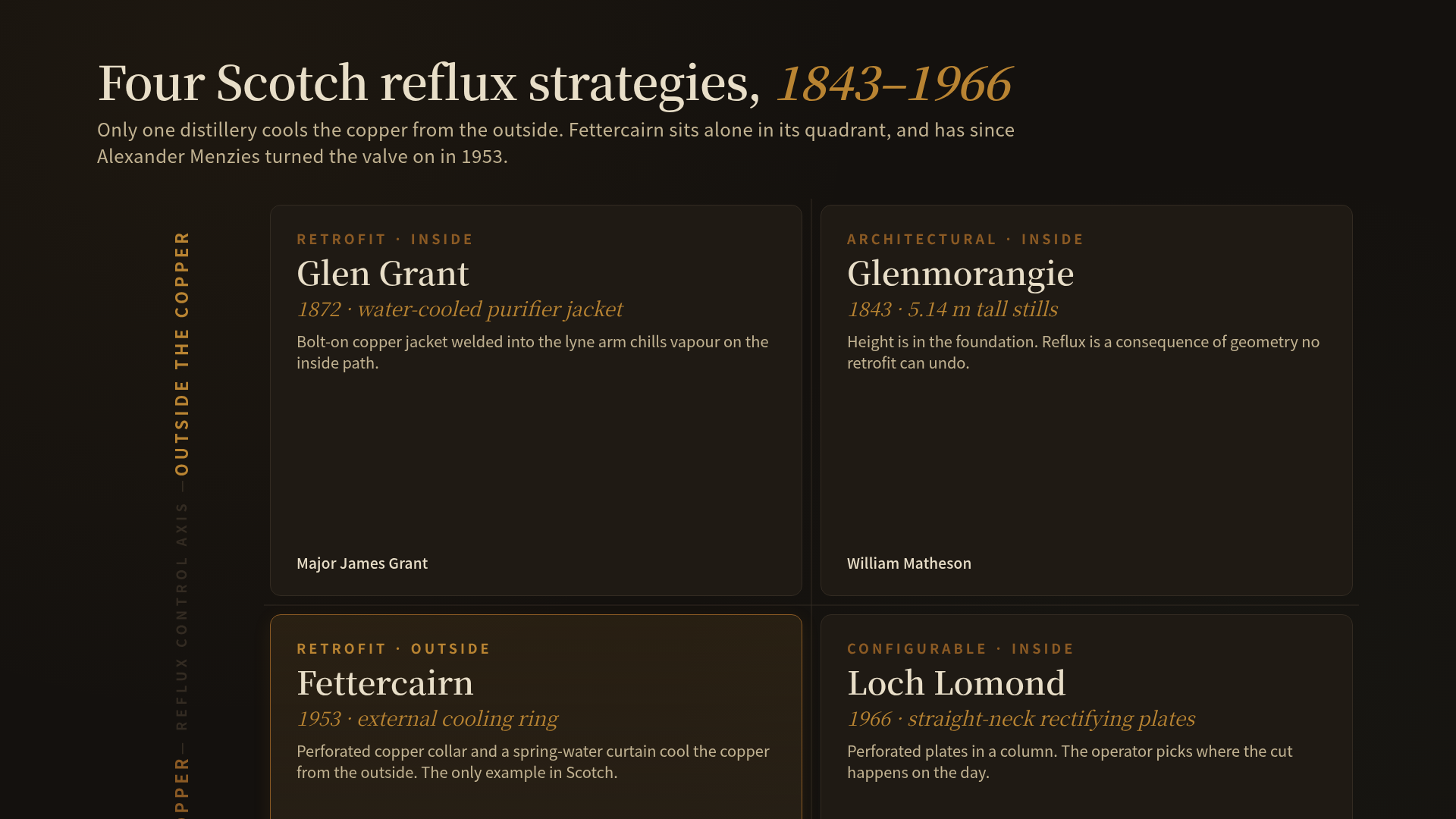
There is a taxonomy of reflux control choices in Scotch that I find useful for reading a spirit blind. Roughly:
- Architectural, from the inside: Glenmorangie 1843, 5.14m stills. The height is in the foundation. You cannot retrofit it away. Reflux is a consequence of geometry.
- Retrofit, from the inside: Glen Grant 1872. Major James Grant’s water-cooled purifier jacket welded into the lyne arm. Cheap, reversible, permanent in practice because a hundred and fifty years of house style now hangs on it.
- Retrofit, from the outside: Fettercairn 1953. Alexander Menzies’s perforated copper collar and a curtain of spring water. Cheaper still, more reversible still, and the only example in Scotch.
- Operator-configurable, on the day: Loch Lomond straight-neck 1966. Perforated plates in a column; Michael Henry chooses where to draw the spirit.
Fettercairn sits alone in the retrofit-from-outside quadrant. It is the version of the problem that treats copper as a two-sided heat exchanger rather than a shell. The engineering literature has this pattern in other places — cooling the exterior of a reaction vessel to control an exothermic run, chilling the outside of a fractionation column to sharpen the cut — but no other Scotch distillery has borrowed the pattern back into whisky-making. This is either because the rest of the industry never noticed, or because they noticed and decided the yield hit was not worth it, or because a cooling ring only makes sense at a distillery whose pot geometry is fixed and whose water supply is right there behind the still house. All three are probably true.
What you actually taste in a Fettercairn 12
If you pour a Fettercairn 12 (40% ABV, roughly £45–55 in the UK on release, mostly first-fill bourbon with a small proportion of PX-seasoned refill), you are drinking Menzies’s 1953 valve decision filtered through seven decades of operational discipline and Gregg Glass’s cask stewardship. The technical signal shows up on cue:
- Fresh pineapple and green mango on the nose. These are short-chain fruit ester signatures (ethyl butanoate, ethyl hexanoate) that the ring’s chilled inner wall waves through untouched.
- Nectarine, warm pear skin, and citrus on the front palate. Higher-volatility esters and terpene-adjacent compounds that survive the cold zone.
- Roasted coffee and clove on the mid-palate. These are the first-fill bourbon cask contribution — Gregg Glass’s re-anchored programme leans on active oak to give a light distillate structural bass notes without swamping the fruit.
- A light, almost dry finish with very little sulfur weight. DMS, hydrogen sulfide, dimethyl trisulfide — all sitting at boiling points that the cold copper eats. Fettercairn’s new make is remarkably low in sulfur signature by industry standards.
Stand the Fettercairn 12 next to a Cragganmore 12 (short stills, worm tubs, sulfury Speyside) and the difference is not subtle: Cragganmore’s meaty weight against Fettercairn’s clean tropical brightness are opposite corners of the design space. Stand it next to a Glenmorangie Original 10 (same tropical direction, different architecture) and the differences are finer — both are light, ester-led Highlands, but the Fettercairn carries a slightly warmer, waxier body because the pot geometry underneath the ring is still a broad-shouldered pear rather than a gin-still-derived narrow column. The ring strips the heaviest fractions out, but the pot below it is a Highland pot, and that comes through.
It is worth saying what the bottle is not. The Fettercairn 12 is not a sherry-led sledgehammer in the Aberlour A’Bunadh mould. It is not a peated dram, and the cooling ring makes it structurally difficult to ever be one. It is not particularly high-strength, and the 40% ABV is close to the floor of the category. What it is, and what it has been designed to be, is a bright, tropical, clean Highland that carries the ring’s fingerprint into the glass. That is what Menzies engineered for, and what Walker has kept engineered for, and what Gregg Glass now casks for.
The interface outlives the maintainer
Alexander Menzies is not a household name in whisky. He does not appear in the Glenmorangie history books or the Diageo brand strategy decks. As far as I can tell from public sources, he never gave a filmed interview about the 1953 decision. The ring is his engineering will and testament, and it has been running for seventy-three years with almost no revision. That is a longer working life than most of the engineers whose names are in the marketing material would have imagined for their own designs.
Stewart Walker’s contribution is not architectural. His contribution is that the water is still flowing. When he retires — the distillery has not published a timeline, and none is expected — his successor will inherit the same constraint he did, plus the additional seven decades of every quarterly review at which someone did not remove the ring. That accumulated weight is a real engineering asset. A younger stillhouse without Fettercairn’s seventy-three-year continuity would find it much harder to justify the yield penalty. Fettercairn’s justification is this is who we have been since 1953 and taking it off would mean deciding to be someone else, which is not a technical argument but is a very hard argument to displace.
When you next pour a Fettercairn 12, what you are tasting is a 1953 coolant-routing decision, taken by a working distillery manager under Ross & Coulter successor management, using a two-century-old spring water supply that was already flowing behind the still house before the distillery existed, filtered through seventy-three years of custodianship under four ownership groups, expressed in the pineapple and pear on the nose of a bottle sold in a country the distillery only officially entered in 2025. That is a fairly long causal chain for a curtain of water on the outside of a copper still. But that is what long-lived engineering work looks like when it keeps working. Alexander Menzies did the interesting thing in 1953. Stewart Walker’s version of the interesting thing is that he has, for eleven years and counting, kept doing nothing about it. The bottle rewards both of them, in about equal measure.
Related reading
- Whisky Purifier Pipe Explained: How Glen Grant’s 1872 Bolt-On Reflux Stayed — the retrofit-from-inside cousin of the cooling ring
- The Reflux Equation: Why Glenmorangie’s Stills Are 5.14 Metres Tall — the architectural-commitment alternative
- Loch Lomond Straight-Neck Stills: Michael Henry’s Rectifying Cap Method — the operator-configurable end of the same design space
- Alistair Cunningham’s Lomond Still at Scapa: Adjustable Reflux by Plate Angle — another mid-century retrofit answer to the same reflux question
- Worm Tub Condenser Explained: Stewart Bowman, Brora, and 16 Distilleries — the opposite condenser design, keeping sulfur and weight in
- Cragganmore 12: Worm Tubs, John Smith, and the Heavy Side of Speyside — the opposite direction: engineering for a heavier spirit
Sources
- Fettercairn official — About Us
- Fettercairn distillery (Wikipedia) — en.wikipedia.org/wiki/Fettercairn_distillery
- Scotsman Food and Drink — Meet the Distiller: Stewart Walker, Fettercairn Distillery
- Whisky Shop — In Fine Fettle — Fettercairn Distillery
- Bourbon Lens — Highland Hidden Gem Fettercairn Expands U.S. Presence
- Whisky Advocate — Whisky of The Week: Fettercairn’s 12 and 16 Year Olds
- Whisky For Everyone — Distillery Visit / Fettercairn
- Whisky.com — Fettercairn Distillery database entry
- Forbes — Fettercairn Scotch Now Available For The First Time In The US
- Food Manufacture — Inside Fettercairn Distillery as it celebrates 200 years of whisky