Whisky Purifier Pipe Explained: How Glen Grant's 1872 Bolt-On Reflux Stayed (Dennis Malcolm's 63 Years)
There is a piece of copper plumbing strapped to the lyne arm of every single still at Glen Grant. It has been there, in one form or another, since 1872. The local name for it is the purifier. It is a water-cooled jacket around a length of pipe that runs from the neck of the still back into the still itself. Vapour climbs the neck on its way to the condenser; some of that vapour hits the cold pipe, condenses on the inside surface, and trickles back down to the pot to be boiled a second time. The lighter molecules keep going. The heavier molecules go around the loop again. The whisky that comes out is light, floral, and finishes with apple and pear. The whisky that does not get into the bottle is whatever was too heavy to make it past the cold jacket.
That cold jacket was bolted on by a man called Major James Grant, who took over the distillery in 1872 at the age of twenty-five. He had inherited it from his uncle, the second-generation James Grant who had co-founded the place with his brother John in 1840. The Major did not rebuild the stills. He did not commission new geometry. He kept the existing pots and welded a small, cheap, novel device onto each one. A hundred and fifty-four years later, all four wash stills and all four spirit stills at Glen Grant still wear his purifier. Glen Grant is, as far as I can tell from public records, the only Scotch distillery to fit purifiers to every still in the house. (Maltspedia)
The job of curating that decision, for the last sixty-three years of those one hundred and fifty-four, belonged to Dennis Malcolm. Malcolm was born on the distillery grounds in 1946 and joined the company in 1961 as an apprentice cooper at the age of fifteen. He retired in June 2024 as Master Distiller and Brand Heritage Director. (The Spirits Business) He saw the distillery pass through four owners. He saw the lineup multiply from a handful of expressions to a portfolio with NAS, 12-year, 15-year, 18-year, and 50-year bottlings. He did not authorise the removal of a single purifier. The decision he is going to be remembered for, in this house at least, is the one he kept choosing not to make.
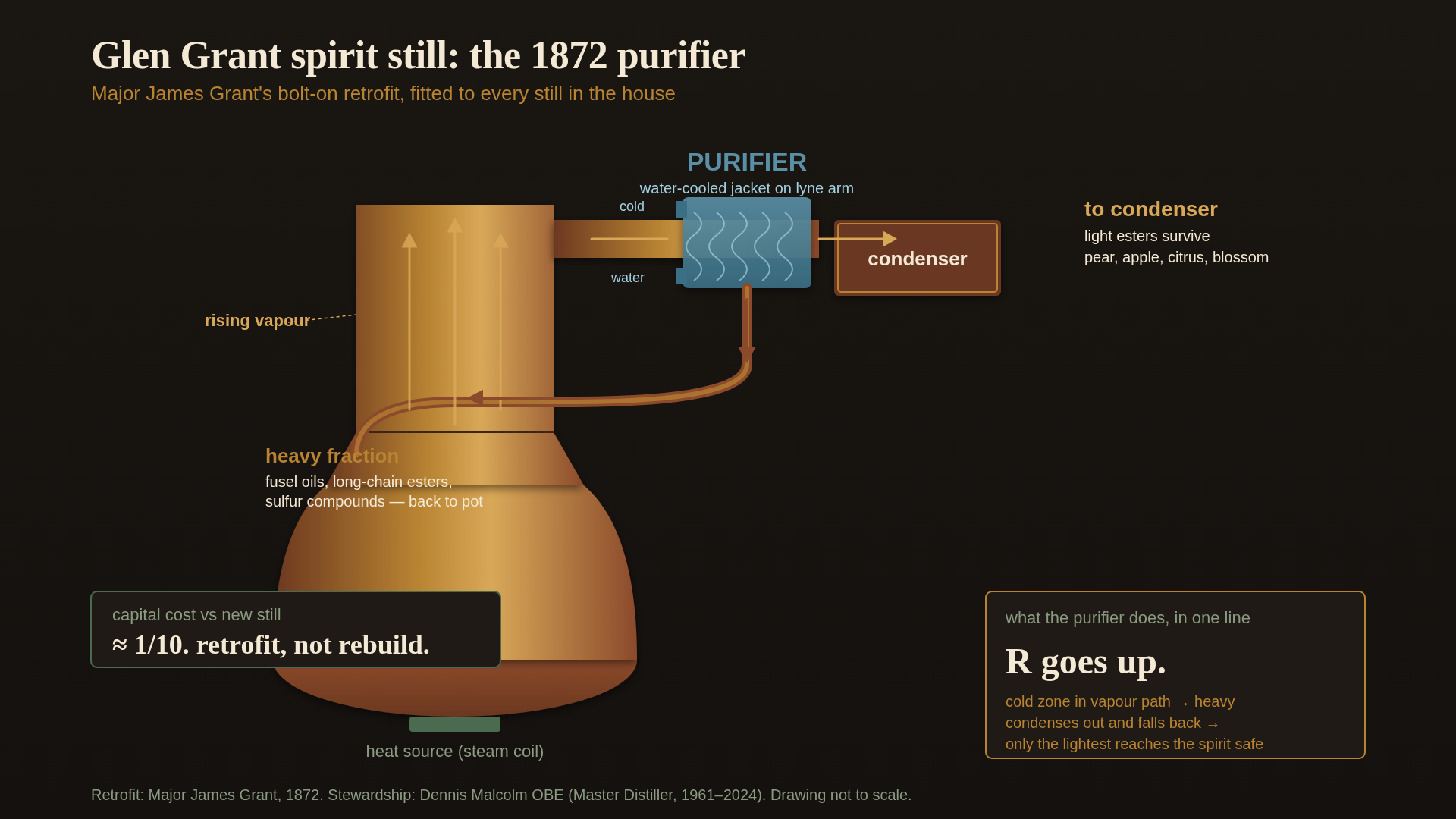
What the purifier actually does, in five lines
The point of distillation is that different molecules boil at different temperatures. In the rough neighbourhood of what comes off a wash:
- Ethyl acetate (a pear-and-nail-polish ester, boils at 77°C)
- Ethanol (78.4°C)
- Higher esters and short-chain aldehydes (roughly 80–110°C)
- Fusel oils like isoamyl alcohol (~132°C)
- Long-chain esters, fatty acids, sulfur compounds (well above ethanol, into the 150°C+ range)
In a plain pot still, the vapour rises from the wash, traverses the lyne arm, hits the condenser, and gets collected. Whatever boils below the cut-off temperature comes through. If the neck is short and the lyne arm slopes downward, almost everything makes it across, including the heavy, oily, sulfury fractions. The spirit is dense, meaty, and tastes of meat and minerals.
A purifier adds a small cold zone halfway through the vapour’s journey. Imagine a section of the lyne arm wrapped in a copper jacket through which cold water flows. The wall of that section sits at, very roughly, ten to twenty degrees below the vapour temperature. Anything with a boiling point near or above the wall temperature will start to condense on the inner surface. The heavier the compound, the more eagerly it condenses. A small pipe carries that condensate back down to the still pot, where it gets re-boiled. (Edinburgh Whisky Academy)
This is reflux, in the technical sense. The reflux ratio R is, in introductory column-distillation textbooks, the volume of liquid returned to the still divided by the volume of liquid finally collected. R = L/D. A still with no purifier and a downward lyne arm runs at R close to one. Glen Grant’s stills, with the purifier active and the lyne arm pitched upward into the cold jacket, run substantially higher. I have not seen a published number from the distillery, and I would not trust one if I did, because R varies by cut, by season, and by how cold the cooling water is on the day. The order of magnitude, though, is unambiguous: every drop of condensate that goes back down the purifier pipe is throughput that you are voluntarily not selling.
The chemical consequence is the part that ends up in your glass. Ethyl acetate and other short-chain esters have boiling points close to ethanol’s, so they make it past the cold jacket. Long-chain fatty-acid esters, fusel oils, and sulfury compounds preferentially condense on the cold copper and go back to be boiled again, where some of them break down on contact with hot copper and some simply sit there. What reaches the condenser is dominated by the light, floral, ester-forward fraction. Glen Grant new make tastes of apple, pear, white blossom, and citrus zest, with very little fusel weight. None of this is luck. It is undergraduate distillation engineering, expressed in copper and rivets installed by a man in 1872.
(At this point the reader is supposed to do the partial pressure arithmetic. The answer, in honest practice, is that no one in the still house is doing partial pressure arithmetic. They are watching the cut break on the spirit safe and trusting that the cold jacket is set the way it has been set for a hundred and fifty years. The arithmetic is what we use afterwards to explain why what they did worked.)
Major James Grant’s actual decision: retrofit, not rebuild
The Major took over Glen Grant in 1872, just before the late-Victorian boom that would carry blended Scotch into every English drawing room and every colonial outpost. (Wikipedia: Glen Grant distillery) He had grown up around the trade. He had seen what The Glenlivet, fifteen miles south, was doing with George Smith’s tall pots and the lighter Speyside style they produced. He had a market signal that the light, ester-led style was where English and continental palates were heading. He did not have unlimited capital to rebuild a whole still house.
What he did was buy tall, narrow new stills and, more interestingly, install a water-cooled purifier on each one. The Glen Grant company history calls the combination of tall stills and purifiers his single most consequential change. (The Glen Grant) Tall stills you can read as a conventional 19th-century Speyside move. Purifiers on every still you cannot. To this day, no other Scotch distillery fits purifiers to all four wash and all four spirit stills.
The engineering case for a purifier, against the alternative of just buying even taller stills, is not romantic. It comes down to three things:
- Capital cost. A new pot still is, in 1872 money or in 2026 money, a serious capital line item. A purifier is a hand-fabricated copper jacket plus some pipework and a cooling water line. The cost ratio between rebuilding a still and bolting on a purifier is at least an order of magnitude. The Major picked the cheap option.
- Reversibility. A purifier can be removed in a morning. A new still configuration cannot. If the lighter spirit had not sold, he could have closed the cooling water valve, drained the jacket, and gone back to what his father’s generation had been making. This is the engineering equivalent of putting your bet behind a feature flag.
- Modularity. The geometry of the still pot stays untouched. The wash still still produces the same low-wines profile it always did. The purifier is bolted into the vapour path between still and condenser. You can change cooling water flow rate, change purifier size, change the angle of the lyne arm into the jacket, all without touching the rest of the still house. The still house, as a system, becomes a stack with one new layer in it.
What he paid for that flexibility was throughput. Every drop returned through the purifier pipe is wash that you have already heated and that you now have to heat again. Estimates I have seen in industry literature put the yield penalty somewhere between five and ten per cent compared to the same still without a purifier, though as with the reflux ratio nobody at Glen Grant is going to give you a clean number on the record. The Major absorbed that penalty in exchange for a spirit envelope that matched where the market was heading. The Italian market in particular, once it found him in the 1960s, would prove him correct several times over.
He also gave up the option, structurally, of ever making a heavier style of Glen Grant. Once every still in the house has a purifier and every cooperage decision is built around a light, ester-led new make, you have spec’d yourself out of the meaty, sulfury, peated, or oily side of the catalogue. This is not a downside the Major would have lost any sleep over in 1872 — the Italian and English markets were not asking for that style from him — but it does mean that Glen Grant cannot, today, drop a heavy peated expression onto the shelf without disowning the geometry it has built a hundred and fifty years of brand identity around. The purifier is load-bearing in both directions. It makes the spirit possible and it makes the alternatives impossible.
Glenmorangie tall, Glen Grant retrofit: two ways to push the same ratio up
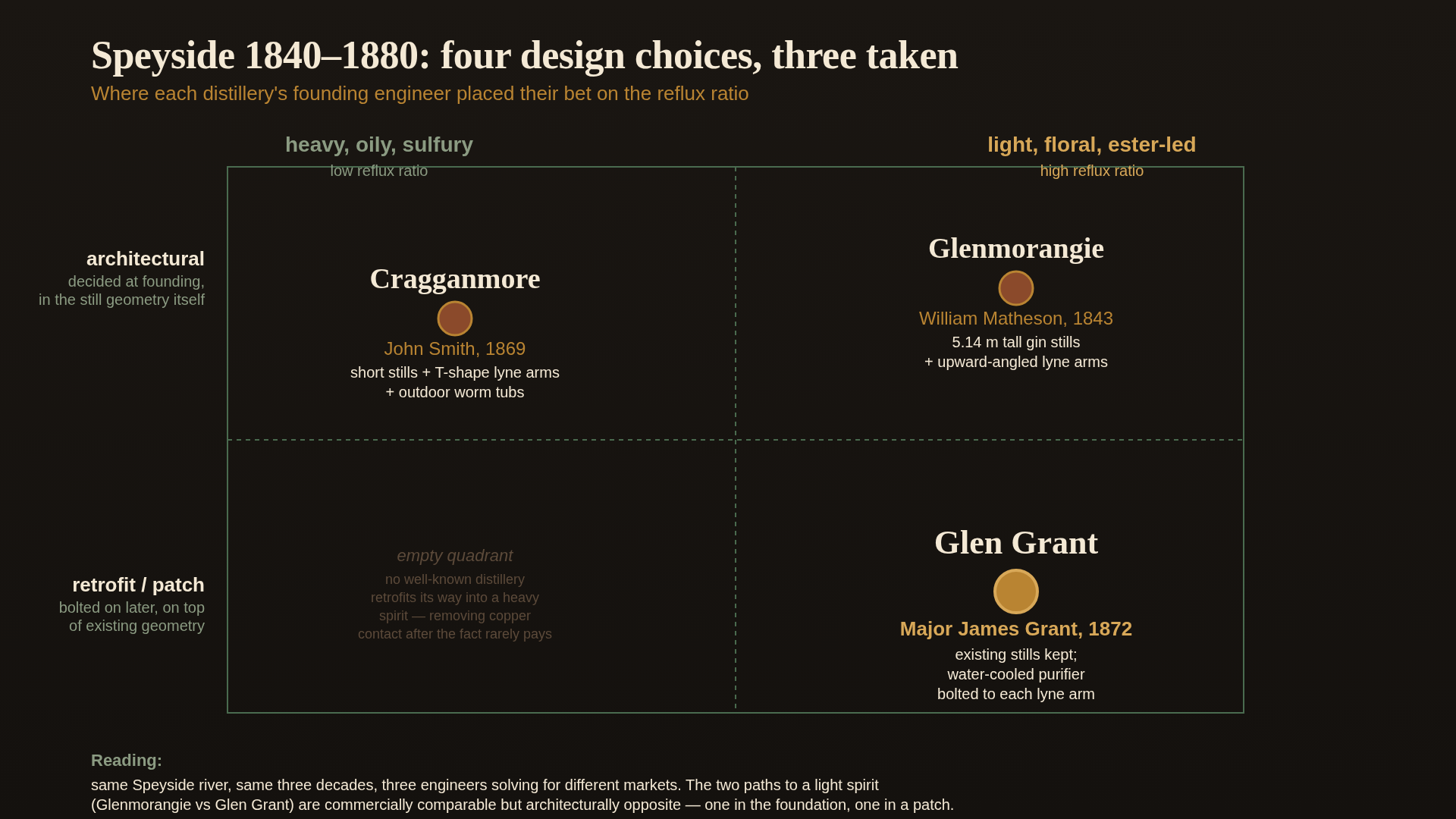
I wrote a piece a few weeks ago about Glenmorangie’s 5.14-metre stills and the high reflux ratio they produce. That distillery’s geometry was decided at founding, in 1843, when William Matheson bought second-hand gin stills because new onion-shaped pots were beyond his budget. The reflux ratio is a side effect of the still height. The light, ester-led spirit is the consequence.
Glen Grant arrives at a comparable place by a completely different route. The Glenmorangie story is we built the still tall from day one and the spirit follows. The Glen Grant story is we kept the still the same and bolted a cold zone into the vapour path thirty-two years later. Same family of outputs — light, floral, pear-forward, low fusel — different family of engineering decisions.
The way I think about it as an engineer:
- Glenmorangie made an architectural commitment in 1843. The 5.14m height is in the foundation. You cannot retrofit your way out of it without rebuilding the still house. Bill Lumsden, who has worked there since 1995, builds wrapper layers on top of the spirit: cask finishing, wood specifications, second-maturation programmes. He cannot edit the interface.
- Glen Grant made a retrofit commitment in 1872. The purifier is a mod, a patch, an installable layer. The Major built it as a layer because he wanted the option to remove it if the market did not arrive. The market did arrive, the patch became permanent, and a hundred and fifty years later the patch is what defines the house.
There is a Speyside variant of this same problem that goes the other way, by the way. Cragganmore, thirty miles south of Glen Grant on the same Spey river, kept its short stills, its T-shaped lyne arms, and its outdoor worm tubs since 1869. John Smith’s design produces the heaviest, meatiest Speyside in the standard catalogue, and the worm tubs ensure that almost no copper-vapour contact happens after the lyne arm exits the still house. It is the same era as the Major’s retrofit, in the same region, designed for the opposite end of the spectrum. The fact that you can taste a light orchard-fruit Speyside next to a sulfury meaty Speyside, both made within a half-day’s drive of each other, is the consequence of two engineers in the 1860s and 1870s solving for different markets with their respective still geometries and refusing, in the century and a half since, to converge.
Dennis Malcolm and the discipline of not pressing the button
When Dennis Malcolm arrived at Glen Grant in 1961 as a fifteen-year-old apprentice cooper, the purifiers had been on every still for eighty-nine years. (Whisky Magazine) When he retired in June 2024, they had been on every still for one hundred and fifty-two. He sat through four ownership transitions in that period: Glenlivet Distillers, Seagram, Pernod Ricard, and from 2006 onward the Italian group Campari, which paid €115 million for the place. (Wikipedia: Glen Grant distillery) He worked under, with, and over a succession of corporate managers each of whom would have had every commercial right to ask whether the throughput penalty was worth it. None of them, as far as I can tell, ever got an answer that ended with yes, take them off.
That refusal is not glamorous. The visible work of the master distiller in this period was the lineup itself: Glen Grant 10, 12, 15, 18, the NAS Arboralis, the Major’s Reserve range, the limited fiftieths and sixties. Malcolm authorised a quiet expansion of cask programmes: bourbon refill and first-fill mixed in larger proportion in the entry tier, sherry seasoned cask for the older expressions, and a degree of cautious experimentation with Pinot Noir and Madeira finishes for special editions. He also stewarded the brand through the loss and slow recovery of its Italian dominance.
But the central craft decision was the one nobody saw. Every quarter, every audit, every brand strategy review at which someone asked what if we ran the next batch without the purifier in line and saw what came off, somebody had to be the person who said no. For most of those sixty-three years, that person was Dennis Malcolm.
He was recognised with an OBE in 2016, “for services to business and the Speyside community”. (The Spirit of Speyside) The citation is generic. The actual reason he is in the bottle is not.
The Italian market story is worth telling here because it puts a number on what the purifier was worth. A British-Italian merchant called Armando Giovinetti walked into Glen Grant in 1961, the same year Malcolm joined as an apprentice cooper, and bought a hundred cases of the 12-year-old. Within a few years, single malt sales of Glen Grant in Italy were running at 250,000 cases annually. (Whisky Magazine: Glen Grant and the Italian Influence) Glen Grant was, by the mid-1960s, the largest selling whisky in Italy of any category, blends included. It would remain the world’s top-selling single malt until the mid-1980s. (Scotch Whisky: Glen Grant)
That market was sold on the lighter, drinkable, ester-led style. The five-year-old expression that became the Italian favourite was specifically commissioned to lean further into that profile. None of that exists without Major James Grant’s 1872 retrofit. Pulling the purifiers in any decade between 1872 and 1985 would have been, in commercial terms, the equivalent of removing the load-bearing wall of the Italian whisky market. It is no accident that Campari, an Italian aperitif company with deep roots in the same market that Glen Grant defined, bought the distillery in 2006. They bought the spirit envelope that the Major’s purifiers produced.
What you actually taste in a Glen Grant 12
If you pour a Glen Grant 12-year-old (43% ABV, mostly first-fill bourbon with a portion of refill, around £40-50 a bottle on the British market), you are drinking 1872 plumbing filtered through 154 years of operational discipline. The technical signal is unmistakable once you know what to listen for:
- Apple, pear, and white peach on the nose. These are short-chain ester signatures, the molecules that survive the cold-jacket selection and dominate the head and heart of the cut.
- Citrus and orchard blossom in the front palate. Higher-volatility aldehydes and terpene-adjacent compounds that the purifier waves through.
- A clean, light malt body with almost no oily mouthfeel. Long-chain esters and fatty acids preferentially condense at the purifier and never make it to the bottle. The mouthfeel is what they would have added if they had.
- A short, clean finish with very little smoke or sulfur. Sulfur compounds, especially dimethyl sulfide and related, have intermediate boiling points and condense readily on cold copper. The cold jacket eats them.
Stand the Glen Grant 12 next to a Cragganmore 12 and the difference is not subtle. The Cragganmore is meaty, sulfury, with a long oily finish; the Glen Grant is light, dry, and the finish closes in a third of the time. Stand it next to a Glenmorangie Original 10 and the difference is finer (both are light, ester-led Highland-shaped spirits), but the Glen Grant carries slightly more weight in the front palate, because the still pot itself is closer to a conventional onion shape than Glenmorangie’s gin-still-derived geometry. The purifier strips the heaviest compounds out, but the pot below it is still a Speyside pot. That is the geometry the Major chose not to touch.
It is worth saying what the bottle is not. The Glen Grant 12 is not a complex sherry-led Speyside in the Macallan or Glenfarclas mould. It is not a peated dram. It is not a maritime-influenced Islay-adjacent spirit. The purifier rules those out structurally, and a hundred and fifty years of brand identity rules them out commercially. What is in the bottle is what was always going to be in the bottle. The Major designed for it. Malcolm kept it possible. Campari, presumably, will keep paying to keep it possible for as long as the Italian market keeps drinking it.
The interface outlives the maintainer
Dennis Malcolm handed over in June 2024 to his successor at Glen Grant. The purifiers stayed on. The cooling water lines stayed on. The four wash stills and four spirit stills, all eight of them still wearing the Major’s 1872 modification, were going to keep doing what they have done since before the British Empire’s high-Victorian peak. Whoever is master distiller in 2050 will inherit the same constraint Malcolm did, plus the additional weight of every decade since 1961 in which somebody could have removed it and did not.
This is the part of long-lived engineering work that I find the most honest. Most of the consequential calls in any system are taken by people whose names do not survive into the marketing material. The Major’s name is on the master distiller’s office door, but his work is not framed as engineering work: it is framed as heritage. Dennis Malcolm’s name is on a sixtieth-anniversary special bottling, but the work he did was, in the largest sense, the work of not changing the system. That work is invisible by construction. There is no patch in the codebase showing that he chose not to commit something. There is only the running system, in 2026, doing what it has done since 1872.
When you next pour a Glen Grant 12, what you are tasting is an 1872 capital-efficiency decision filtered through a sixty-three-year stewardship and stabilised by a market that found the spirit in 1961 and never let it go. The light, floral, apple-and-pear character in the glass is, in the strictest sense, what happens when one engineer in his twenties chooses to retrofit rather than rebuild, and a quiet succession of people then choose, for one hundred and fifty-four years, not to remove what he built. The fact that any of that ends up in a glass on a Sunday evening is, as far as I can tell, the standard outcome for any system that lasts long enough to be worth drinking.
Related reading
- The Reflux Equation: Why Glenmorangie’s Stills Are 5.14 Metres Tall — the architectural-commitment way to push the reflux ratio up
- Cragganmore 12: Worm Tubs, John Smith, and the Heavy Side of Speyside — the same Speyside, the opposite design philosophy
Sources
- The Glen Grant — theglengrant.com and master distiller pages
- Glen Grant distillery (Wikipedia) — en.wikipedia.org/wiki/Glen_Grant_distillery
- The Spirits Business — Glen Grant master distiller Dennis Malcolm OBE to retire
- Whisky Magazine — A life in whisky: Dennis Malcolm’s 60 years in scotch
- Whisky Magazine — Glen Grant and the Italian Influence
- Scotch Whisky: Whiskypedia — Glen Grant
- The Spirit of Speyside — Queen Honours Speyside Star
- Maltspedia — Glen Grant Distillery technical profile
- Edinburgh Whisky Academy — What is reflux and how does it influence Scotch whisky character?