Caol Ila 12 Review: 35 ppm Islay, Citric Peat
The conversation that prompted this happened in a small bar in Shibuya: two friends, three drams already on the bill, and one of them (a software architect who reads whisky labels with the same patience he reads release notes) looked at his Lagavulin 16 and said, “Caol Ila is, what, two or three miles up the same coast as Lagavulin? Why does nobody ever talk about it?”
I had a half-answer at the time, and the bartender, mercifully, was busy. The longer answer is what I want to write down here, because the distillery that produces the most whisky on Islay produces the least amount of attention per litre, and there is a structural reason for that, and the reason is that almost everything the distillery makes is, on purpose, anonymous.
The bottle on the shelf below the famous one is the Caol Ila 12. It costs about £40 in the UK and around 6,000 yen on Amazon Japan, which is roughly half the asking price for a Lagavulin 16 and almost identical to a Bowmore 12. The 12 is the Caol Ila that gets to come out from under the blend stack and have its name on the front. The rest of what the distillery makes (and there is a great deal of it) goes into Johnnie Walker.
The family that managed it without being on the bottle
The label says Caol Ila was founded in 1846 by Hector Henderson, a Glasgow merchant who built a small stillhouse on the bay next to Port Askaig and named it after the Gaelic for “Sound of Islay”, the narrow stretch of water between Islay and the Paps of Jura. The label does not say that Henderson failed within eight years, or that the place changed hands twice in the nineteenth century, or that Distillers Company Limited (DCL, eventually Diageo) absorbed it in the 1920s, or that for the last hundred years the people who actually ran the distillery were not in any way the people whose names were on the company letterhead.
For four generations of one family, the people who actually ran it were the Stitchells.
Billy Stitchell was the fourth. His great-grandfather, both of his grandfathers, and his father all worked at Caol Ila across the late nineteenth and twentieth centuries. Billy himself joined in the mid-1970s, soon after the rebuild reopened the plant, and stayed until the end of 2013: nearly forty years of one tenure on one site. He eventually became distillery manager, the senior on-site role, the person responsible for what went into the wash and what came out of the spirit safe. He retired into a small note in Diageo’s annual rare malts series: the 2013 Special Releases included an unpeated Caol Ila at 59.6%, named the Stitchell Reserve, the kind of acknowledgement a company gives an employee whose work nobody outside the gate has heard of but whose departure represents a meaningful loss of memory.
The Stitchell Reserve cost about £400 at release and now changes hands at auction for considerably more. It is not the bottle to drink. The 12, at £40, is — and the reason to drink it is that the spirit inside has the geometry of a stillhouse Billy and his predecessors and his successor inherited, decided not to change, and worked inside until the spirit was the thing the geometry produced.
The 1972 rebuild
If you want to understand why Caol Ila does not taste like Lagavulin, the year that matters is not 1846. It is 1972.
Until 1972 the distillery on the bay below Port Askaig was a small, traditional Islay operation with two stills, its own malting floor, and a production volume that would not make a meaningful contribution to any blend. DCL had owned the place for nearly fifty years and the spreadsheet had decided, by the late 1960s, that the small Islay distillery was structurally inadequate for the role they wanted it to play. The role they wanted it to play was the heavy peated component of Johnnie Walker, at industrial scale, on Islay, while the other Islay distilleries DCL did not own — Bowmore, Bruichladdich, Bunnahabhain, Laphroaig — were either independent or owned by competitors.
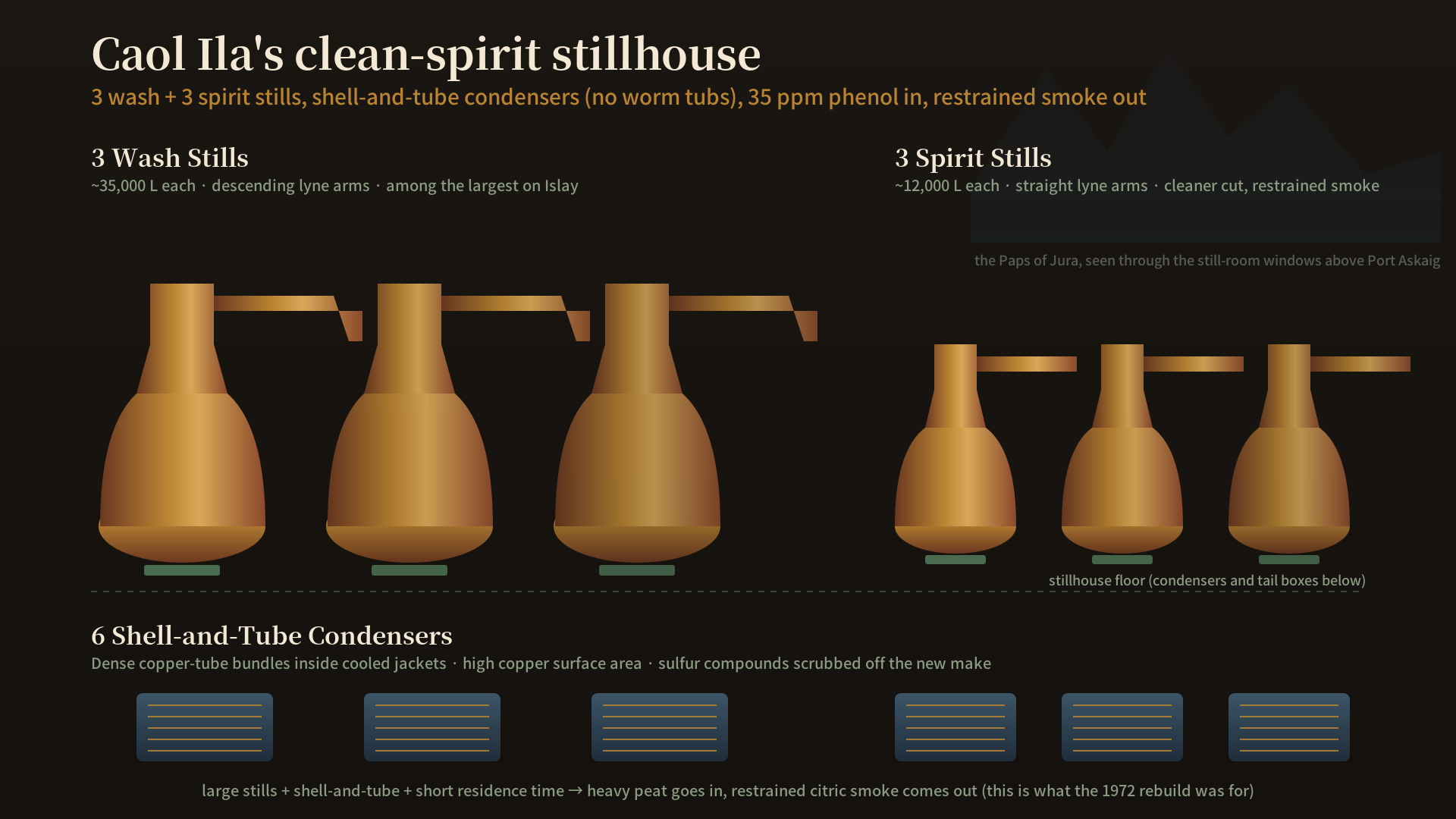
So in 1972 they demolished the distillery. The entire old plant came down. What they built in its place was a substantially larger stillhouse with six pot stills — three wash, three spirit — designed for a production volume roughly triple the previous capacity. Critically, they did not put in a malting floor. From 1974 onward, all of Caol Ila’s malted barley would come from Port Ellen Maltings, the centralised Diageo facility on the south coast of Islay that supplies most of the Islay distilleries to spec. The decision to skip on-site malting was an economic one and also a quality-control one: Port Ellen could deliver malt to a precise phenol specification, on schedule, in tonnage, which a single distillery’s own malting floor could not.
That phenol specification, for the standard peated production, is roughly 35 ppm, which is lower than the 40-something ppm that Lagavulin and Laphroaig run at, and considerably above the unpeated end of the spectrum. The barley is dried over peat smoke at Port Ellen, lorried up to Caol Ila on the other side of the island, and that is where the peat enters the spirit.
The decision the rebuild did not undo
The decision that the 1972 rebuild did not undo, and that distinguishes Caol Ila from Lagavulin three miles down the coast, is the type of condenser.
A condenser is the cold-finger that turns hot alcohol vapour back into liquid as it leaves the still. There are two broad families. Worm tubs are long copper coils sitting in outdoor tubs of cold water; vapour spends a long time in a relatively small surface area of copper, sulfur compounds survive into the new make, and the resulting spirit reads as meatier, heavier, sometimes savoury. Shell-and-tube condensers are dense bundles of small copper tubes inside a water-cooled jacket; vapour meets a much larger copper surface area per unit volume, sulfur compounds get scrubbed off, and the spirit comes out lighter and cleaner.
Lagavulin uses shell-and-tube as well, in fact, but it pairs them with a notoriously slow distillation cycle and small stills that maximise vapour residence time. Caol Ila’s stillhouse is the other direction: large stills (the wash stills are around 35,000 litres each, on the bigger end for Scotland), a relatively short run, and shell-and-tube condensers that pull sulfur out aggressively. The result is that 35 ppm of peat goes in at the malt mill and comes out the other end as a spirit that is unmistakably smoky but also clean, citric, and, for an Islay malt, surprisingly light on its feet.
This is what the architecture was designed to produce. It is a heavy peated spirit that behaves like a much lighter one. It blends well, which is the whole point.
Three glasses, one Wednesday
On the kitchen table this Wednesday: Caol Ila 12 at 43%, Lagavulin 16 at 43%, Bowmore 12 at 40%. Three Islay malts, three different stillhouse philosophies, no ranking implied, no flight order beyond palest to darkest by colour because that is what is mechanically easiest with three Glencairns. The friend from the bar was not present. I would have wanted to keep talking and would have ended up not actually drinking the whisky, which is the failure mode of tasting in company.
The Caol Ila 12 smells, on the first nose, like a beach bonfire that has been left to die overnight: cold ash on damp wood, with a wedge of lemon someone discarded near the firepit hours ago, the citrus oil oxidising in the salt air. Underneath the smoke is a green note: not a fresh herbal green but the dustier green of seaweed dried on rocks in the sun. On the palate the smoke arrives second, behind a clean citric sweetness that is closer to lime pith than to lemon, and the finish is short for an Islay, almost abrupt, leaving a thin film of olive brine and warm ash on the back of the tongue. Three drops of water and the smoke recedes further, the lime becomes more available, and a faint vanilla appears from the cask that was not present neat. This is a spirit that has been engineered, through the shell-and-tube condensers and the large still surface area, to be approachable. It is the Islay malt you can serve to someone who has never knowingly drunk Islay before without inflicting on them what Lagavulin would inflict.
The Lagavulin 16 sat next to it, four years older and at roughly twice the price, is a different proposition entirely. The nose is the same kind of smoke but riper and wetter; the bonfire is still burning, the iodine is medicinal, and there is a dried-fig and bitter-orange-peel layer that the additional sixteen years and the slow distillation have put into the cask. On the palate the smoke is structural. It carries the whole dram. The finish lasts about three times as long as the Caol Ila’s and the salt is no longer a thin film; it is a tide that comes in and stays. The two are not in competition. They are doing different jobs. The Lagavulin is what you pour after dinner and stop talking for a while. The Caol Ila is what you pour while you are still cooking. (If the Lagavulin end of that spectrum is where you want to keep looking, Lagavulin 16 next to Talisker 10 is the same slow-still philosophy carried across the ferry to Skye and into a worm-tub condenser instead.)
The Bowmore 12 is the geographic counterweight, made on the other side of the island at the only Islay distillery that still maintains a working floor malting (about 30% of its own malt, the rest from Port Ellen). On the nose it is smoke and sea but with a tropical-fruit note — passion fruit, slightly underripe mango, a sweetness that is fruit rather than malt. The palate is softer than either of the others and the smoke is more melded into the body rather than sitting on top. It is the Islay malt where the peat is not the headline. At roughly the same price as the Caol Ila, it makes the case that you can have peated Islay in the £35–£40 bracket without being asked to commit to the Lagavulin proposition. (For the fuller Bowmore 12 argument — the 30% floor malting, Eddie MacAffer’s fifty-year tenure, and why the phenol number understates what the palate actually reads — see Bowmore 12: Eddie MacAffer and the Islay Phenol Question.)
The three together are an honest education. The peat ppm at the malt mill is roughly comparable across all three (35 / 40-something / 25 respectively, depending on the source), but the spirit in the glass is shaped much more by the size and geometry of the stills and the choice of condenser than by the phenol input. The Caol Ila is the one that demonstrates this most clearly because the gap between its input (heavy peat) and its output (clean, citric, restrained smoke) is the widest. Billy Stitchell spent forty years working inside that gap. The 40-something-ppm end of that ladder — where the peat input is roughly the same but the stillhouse pushes the smoke back rather than pulling it forward — is worth reading in Ardbeg 10 next to Laphroaig 10, where the divergence comes from a purifier and a hand-picked cut rather than from condenser choice.
What to verify next time you pour one
If there is a Caol Ila 12 in the house and you would like to taste what the stillhouse is doing rather than what the marketing says it is doing, three things to look for.
First, the shape of the smoke. It should be cool, ash-like, lemon-adjacent rather than medicinal. If it reads as iodine or as wet wood-tar, you are most likely smelling a Caol Ila Distillers Edition (a different bottling, finished in Moscatel casks) or an independent bottling at higher strength. The 12 at 43% is engineered to keep the smoke restrained.
Second, the citrus. Lime pith, not lemon zest; oxidised, not fresh. This is the signature of the shell-and-tube condensers and the tall, clean spirit cut. A worm-tub Islay would not give you this register.
Third, the brevity of the finish. The Caol Ila 12 finish is short on purpose. If you find yourself reaching for the glass again sooner than you expected, that is not the dram being thin; that is the dram being designed to keep blenders’ workflows efficient. Most of what the distillery makes is intended to land in a Johnnie Walker bottle, where a long, demanding finish would be a problem rather than a feature. The single malt expression inherits that design even when it is bottled on its own.
The £40 bottle is, in my view, the most efficient peated Islay introduction on the shelf right now. The £80 Lagavulin 16 is a better bottle in absolute terms and I would not pretend otherwise. But the Caol Ila is what four generations of one family on a small Scottish island built specifically so that the rest of the world could drink peated whisky and not always know it. The bottle is the part that gets to come out from under the blend stack and tell you what was happening there the whole time.
Try this bottle
Affiliate link below. If you buy through it, LegacyDram earns a small commission and the price you pay does not change. Alcohol-related links are intended for readers of legal drinking age (20+ in Japan, 21+ in the US).
Related reading
- The Reflux Equation: Why Glenmorangie’s Stills Are 5.14 Metres Tall (and What Bill Lumsden Inherited): another stillhouse where the geometry, not the recipe, is the spirit
- The Asymmetric Five: Talisker 10, the MacAskill Brothers, and What 1960 Did Not Take: a worm-tub Diageo distillery one ferry north — useful contrast to Caol Ila’s shell-and-tube choice
- Bessie Williamson, Laphroaig, and the 1954–1972 Inheritance: another Islay distillery, another manager who inherited rather than designed the place — useful counterpoint to the Stitchells’ four-generation continuity
- Kilchoman Farm Distillery: How Anthony Wills Built Islay’s First New Distillery in 97 Years: the only Islay distillery that grows its own barley — Caol Ila is the volume side of Islay, Kilchoman is the deliberate farm-to-bottle side
Sources
- Caol Ila distillery — Wikipedia
- Diageo names Billy Stitchell’s successor at Caol Ila — WhiskyCast
- Caol Ila Unpeated Stitchell Reserve (2013 Special Release) — Master of Malt
- Caol Ila distillery profile — Scotch Whisky
- Caol Ila — Maltspedia distillery profile
- Port Ellen Maltings — Distiller
- Caol Ila 12 Year Old — Master of Malt
- Caol Ila 12 Year Old — The Whisky Exchange