Glengoyne Slow Distillation: Why Robbie Hughes Runs at 4L/min
Glengoyne prints a number on its bottles and repeats it on every tour: the slowest distillation in Scotland. The spirit comes off the still at a trickle, roughly four to five litres a minute, and the distillery is quietly proud of how little that is. The number should sound wrong to anyone who runs a system for a living: slow is the thing we optimise away, the queue we page someone about. The boast, read straight, is that Glengoyne is the least efficient malt operator on the hill.
It is nothing of the kind. The slow run is a deliberate purchase of something the fast operators cannot buy back later, and the man who keeps making that purchase, batch after batch, is Robbie Hughes, who has managed Glengoyne since October 2003. What he is buying with all that wasted time is contact with copper.
Why slow is a chemistry decision, not a patience decision
Distillation looks like one process and is really two, running on top of each other, and Glengoyne’s slow run is tuned to win both.
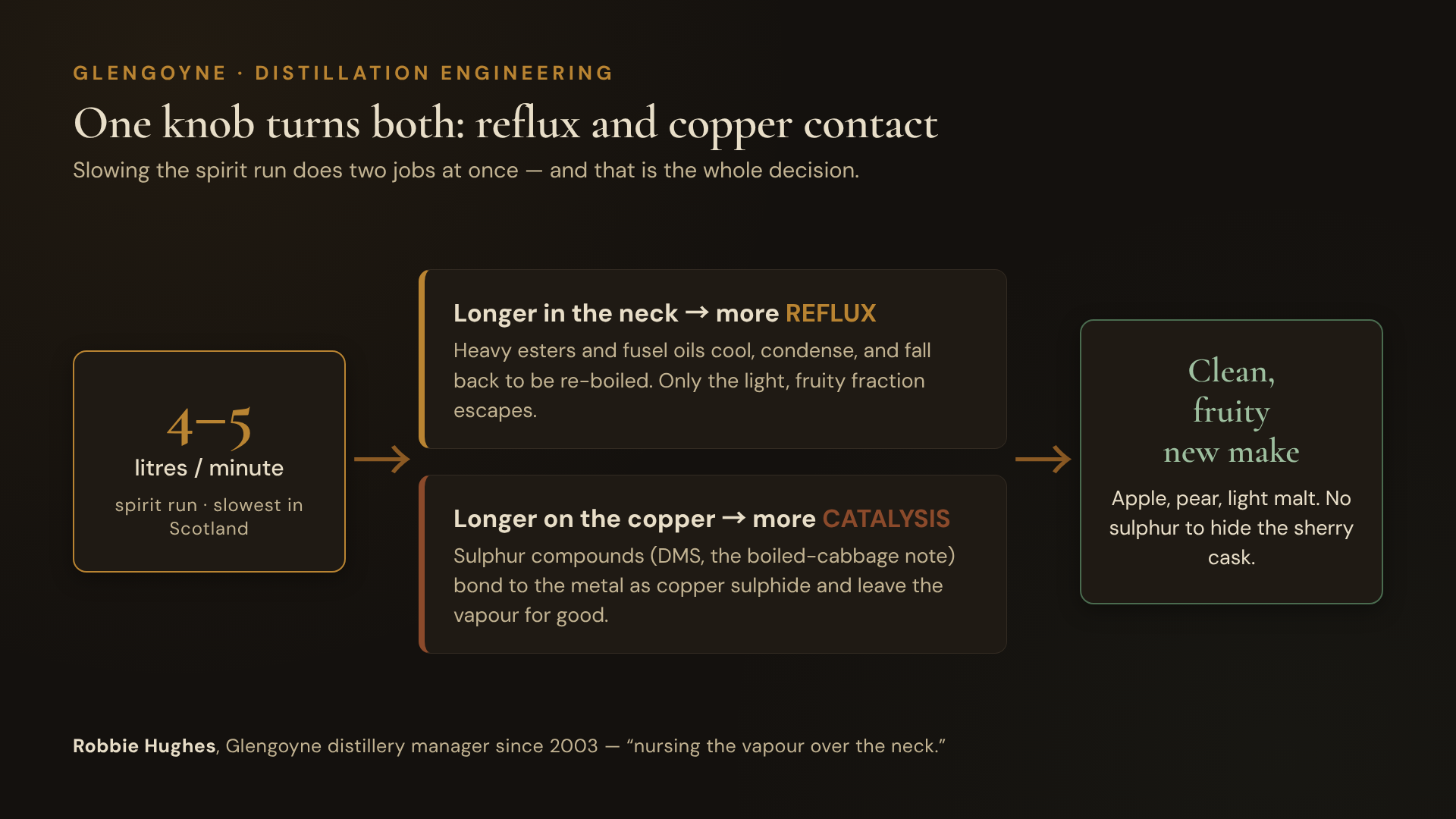
The first process is reflux, and it sorts molecules by how easily they evaporate. Vapour rises from the boiling wash, climbs the neck of the still, and heads for the condenser. Along the way, the heavier molecules — long-chain esters, fusel oils (the heavy alcohols that bring oily, solventy weight), the high-boiling sulphur compounds — cool, condense back into liquid on the copper, and drip down into the pot to be boiled a second time. The lighter, fruitier molecules keep climbing and make it out. Reflux is, in plain terms, a sorting machine that keeps re-running the heavy fraction until only the light fraction escapes. The more reflux you generate, the lighter and more ester-led the spirit.
The second process is copper catalysis, and it does not care about boiling points at all. Sulphur compounds in the vapour (hydrogen sulphide, methanethiol, the family that smells of struck matches, drains, and boiled cabbage) react chemically with the copper surface they touch. They bond to the metal and leave as copper sulphide, the dark patina that coats the inside of every working still. (Whiskipedia) This is not a filter; it is a reaction. It needs surface area and it needs time on the surface. A sulphur molecule that brushes past the copper in a fast-moving vapour stream may never react. The same molecule, loitering against warm copper in a slow stream, reacts and is gone.
Here is the elegant part, and the reason Glengoyne’s whole identity hangs off one variable. Slowing the spirit run increases both processes simultaneously. Slower vapour spends longer in the neck, so more of it cools and refluxes; slower vapour also spends longer against the copper, so more sulphur reacts away. One knob (take-off rate) turns up reflux and copper contact together. You do not get to tune them independently, and at Glengoyne nobody wants to. They want both turned to maximum, which means the spirit run turned to minimum.
(At this point the engineer in you wants the partial-pressure equations and the copper-surface reaction kinetics so you can model the optimum. I had the same instinct. The honest answer is that no one in the still house is solving differential equations; Hughes is watching the cut on the spirit safe and trusting a take-off rate that has been dialled in over twenty years. The maths is what we use afterwards to explain why what he does works.)
The still that is built to slow vapour down
You cannot run a still slowly by willpower alone. The geometry has to cooperate, and Glengoyne’s does.
The distillery runs an unusual set: one wash still and two spirit stills, where most distilleries pair them one-to-one. (Maltspedia) The single large wash still (around 16,500 litres) feeds two smaller spirit stills (around 5,000 litres each), so the low wines from one wash run are split and re-distilled in two narrower vessels. Splitting the second distillation across two stills means each one runs gently, with more copper surface per litre of vapour than a single big spirit still would offer.
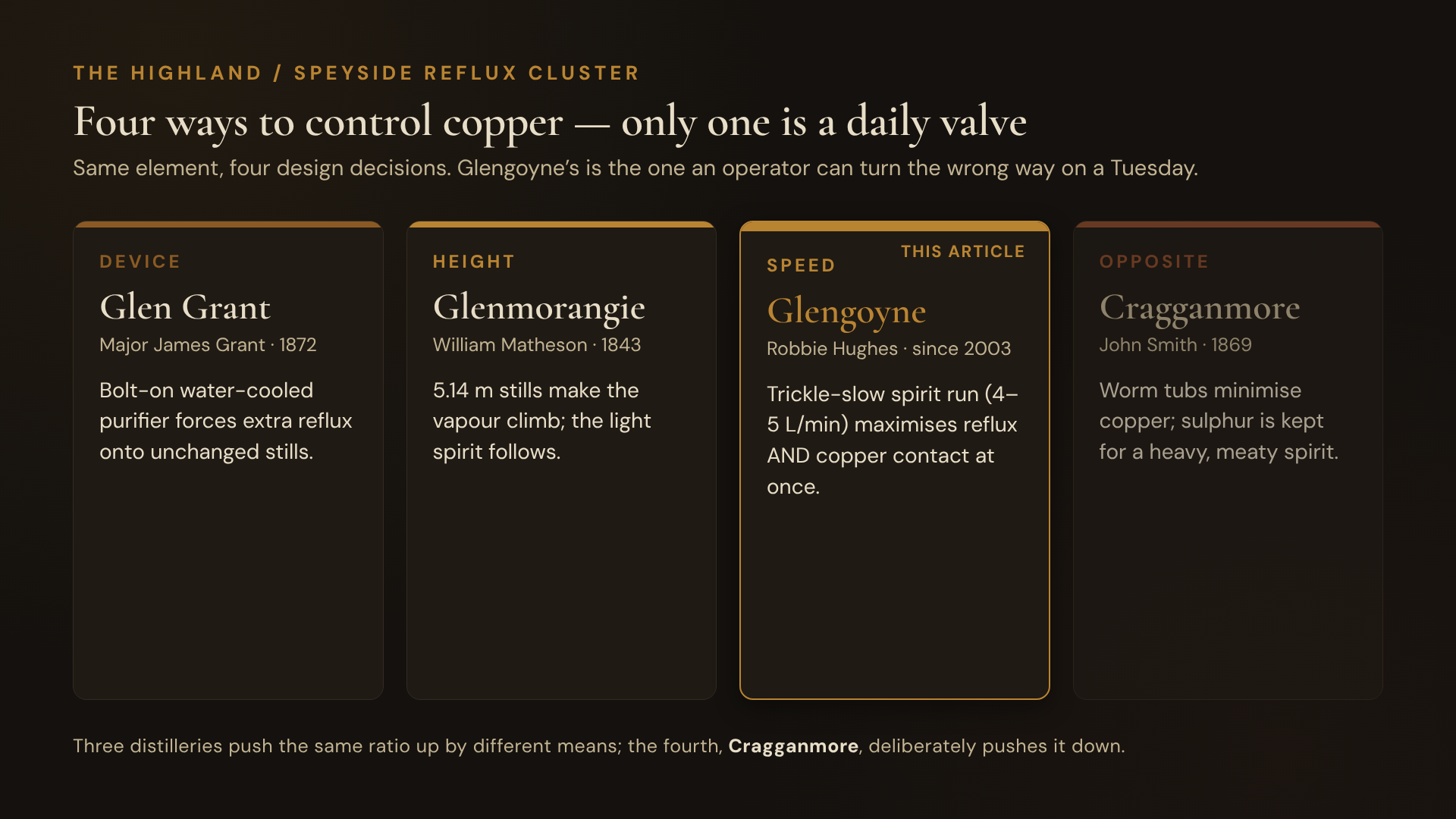
Every one of those stills carries a pronounced boil bulb: a bulge, sometimes called a boiling ball, between the pot and the neck. The boil bulb is a reflux amplifier. Vapour rising into the bulb expands, cools against the extra copper surface, and a chunk of it condenses and falls back before it ever reaches the neck proper. It is the same trick as a tall still (Glenmorangie’s 5.14-metre necks) or a bolt-on purifier (Glen Grant’s water-cooled jackets), achieved with a different piece of geometry: instead of making the vapour climb higher or hit a cold pipe, you make it expand into a copper balloon.
So Glengoyne has, in effect, three reflux mechanisms stacked: boil bulbs, the split second distillation, and the deliberately slow take-off, the one Hughes actually controls day to day. The first two are cast in copper and cannot be changed without rebuilding the still house. The third is a valve. It is the only one of the three that an operator can turn the wrong way on a Tuesday afternoon to make the quarter’s volume numbers, and the entire character of Glengoyne depends on him never doing that.
What slow actually removes: the sulphur story
The clearest way to see what the slow run is doing is to look at what is not in a glass of Glengoyne: sulphur.
Sulphur in new-make spirit is not automatically a flaw. Some distilleries want it: the meaty, struck-match, gunpowder weight that copper-shy stills and worm tubs preserve. But Glengoyne does not. Its entire brand is built on a clean, fruit-forward spirit with no smoke and no sulphur to hide behind, and the slow run is how it gets there.
The compound to watch is DMS: dimethyl sulphide, (CH₃)₂S, the molecule responsible for the boiled-cabbage and tinned-sweetcorn note in under-coppered spirit. Its heavier cousin, DMTS (dimethyl trisulphide), smells of onion and overcooked vegetables and has a detection threshold so low (around 33 parts per trillion in spirit-strength alcohol) that a trace is a problem. (Whisky Science) Both are stripped out by contact with copper. The slow run, by keeping the vapour pressed against the metal for longer, is a sulphur-removal programme dressed up as a distillation speed.
There is a catch that the marketing does not mention, and it is worth being honest about because it is exactly the kind of thing an engineer notices. Long, hot distillation does not only remove sulphur compounds; under the wrong conditions it can also generate some of them, as sulphur precursors break down in the heat. (Whiskipedia) So “run it slow forever” is not a free lunch. The win comes from the copper keeping pace with the chemistry, removing sulphur as fast as the heat liberates it. A still that ran slowly but had exhausted its copper (an old, thin, over-patinated still) would lose the benefit. The slow run only pays off because there is enough fresh copper surface, in the bulbs and the two spirit stills, to react with everything the heat throws at it. Speed and surface are a matched pair; Glengoyne tuned both.
Robbie Hughes and the throughput he keeps refusing
Robbie Hughes did not invent Glengoyne’s slow run (the geometry predates him), but he is the person who has chosen, every working day since 2003, not to speed it up. Before Glengoyne he worked his way through a long list of Speyside and Highland distilleries — Balblair, Glentauchers, Glendronach, Linkwood, Glen Elgin and more — which is to say he has seen what fast, sulphur-heavy, high-throughput distillation tastes like and decided he did not want to make it here. (Square Mile)
His own description of the method is better than any diagram. He runs the stills “painfully slowly,” he says, to strip the heavier flavours out before they ever reach the condenser, and he frames it as “nursing the vapour over the neck” rather than forcing it through. (Square Mile) That verb, nursing, is the whole control philosophy in one word. He is not pushing throughput up to a limit; he is holding it down to a target, and the target is set by chemistry, not by the production schedule.
Now the trade-off, both sides, because pretending it does not exist is how craft writing turns into advertising.
What slow buys: a clean, ester-led new make (apple, pear, light malt, almost no sulphur) that takes sherry-seasoned oak beautifully. Glengoyne matures in European and American oak seasoned with sherry, sourced to order, and a clean spirit is exactly the canvas that kind of cask wants. A sulphury, oily new make would muddy the sherry; a clean one lets it through. (Maltspedia) The slow run and the sherry-cask house style are not two separate decisions: they are the same decision, made twice.
What slow costs: litres. A still occupied by a slow run is a still not producing the next batch. Glengoyne’s total capacity sits around 1.1 million litres of pure alcohol a year from its three stills: modest, and modest on purpose. Speed the spirit run up and you would lift that number; you would also let more fusel weight and more sulphur slip past the copper, and the spirit would drift away from the clean profile the whole brand is built on. This is the textbook quality-versus-throughput control problem, and Glengoyne sits at the quality end and pays the throughput bill in full. Hughes could make more whisky tomorrow. It would be worse whisky, and it would no longer be Glengoyne.
If you want to feel how load-bearing the slow run is, look at the distillery that made the opposite choice. Cragganmore runs short stills into outdoor worm tubs that deliberately minimise copper contact, preserving sulphur to make a heavy, meaty Speyside. Same era of Scotch, same copper, opposite knob setting: Cragganmore wants the sulphur Glengoyne spends all that time removing. And Clynelish shows the third path: a managed, waxy, slightly sulphur-touched feints character that depends on copper contact being controlled rather than maximised. Three distilleries, one element, three completely different briefs.
What you taste, and where the slow run shows up
Pour a Glengoyne 12 (43% ABV, sherry-seasoned oak, around £40 on the British market) and the slow run is right there in the glass, if you know what you are tasting for.
- Apple, pear, and light orchard fruit on the nose. Short-chain esters: the light, volatile, fruity molecules that survive reflux while the heavy ones fall back. This is the reflux half of the slow run, bottled.
- A clean, sweet body with sherry weight but no muddiness. The copper has stripped the sulphur and the heavy fusel oils, so the sherry cask’s dried-fruit and toffee notes come through unobscured. This is the copper-catalysis half.
- Almost no smoke, no struck-match, no boiled-vegetable note. The DMS and DMTS are gone, eaten by the copper during all that time the vapour spent loitering in the neck. Their absence is the most expensive thing in the glass, and you will never notice it, which is the point.
- A finish that is sweet and clean rather than oily or sulphurous. The long-chain compounds that would add weight and funk refluxed back into the pot and never made the bottle.
Stand it next to a sulphur-forward, worm-tub Speyside and the difference is not subtle: the Glengoyne is the one that tastes like fruit and the other tastes like dinner. Stand it next to another clean Highland malt and the difference narrows, but the Glengoyne usually carries a particular roundness from the sherry-seasoned wood that the slow, clean spirit lets through without a fight.
Hughes has said he thinks Glengoyne is at its best as “a teenager”: old enough for the cask to have spoken, young enough that the clean spirit underneath is still audible. That is a tidy summary of the whole design. The slow run makes a spirit clean enough to still be there after fifteen or eighteen years in active sherry oak. Run the still fast, lose the copper contact, and you would have a spirit that the cask simply buries. The slow run is what keeps the spirit in the conversation all the way to the bottle.
The valve nobody is allowed to turn
The thing I keep coming back to, as an engineer, is that Glengoyne’s defining feature is not a thing they built. It is a thing they refuse to do. The boil bulbs and the split stills are hardware: capital decisions, taken once, cast in copper. But the slow run is an operating decision, taken fresh every batch, by a person standing at a valve that he could open wider any time he wanted more whisky.
Most systems fail not at the architecture layer but at the operations layer: somebody, under pressure to ship, quietly relaxes the constraint that made the thing good, and the degradation is invisible until it is in the customer’s hands. Glengoyne’s slow run is a standing invitation to exactly that failure, and the discipline of the place is that for twenty-plus years under Robbie Hughes the valve has stayed where the chemistry wants it, not where the spreadsheet would like it.
When you next pour a Glengoyne, what you are tasting is time: specifically, the time the vapour was made to spend against the copper because somebody decided throughput was the cheaper thing to give up. The fruit in the glass is reflux. The cleanness is copper. And both of them are the same number — the slowest spirit run in Scotland — held steady by a man who calls it nursing, and means it.
Related reading
- The Reflux Equation: Why Glenmorangie’s Stills Are 5.14 Metres Tall — the same goal, reached by height instead of speed
- Bolt-On Reflux: Major James Grant’s 1872 Purifier at Glen Grant — the same goal, reached by a device instead of speed
- Cragganmore 12: Worm Tubs, John Smith, and the Heavy Side of Speyside — the opposite decision, copper minimised to keep the sulphur
- Clynelish’s Waxy Feints: Jim Beveridge and the Managed Sulphur Line — copper contact controlled rather than maximised
Sources
- Maltspedia — Glengoyne Distillery technical profile
- Square Mile — Robbie Hughes: “I knew this could be a pretty good way to spend my working life”
- Whiskipedia — The role of copper in spirit production
- Whisky Science — Copper
- Edinburgh Whisky Academy — What is reflux and how does it influence Scotch whisky character?