Clynelish 14 Waxy: 50 Years of Uncleaned Feints
There is a tank at the Clynelish distillery in Sutherland, on the far north-east coast of the Scottish Highlands, that nobody is allowed to clean properly. It holds the dregs of distillation, the oily half-finished liquid that gets recycled back through the still, and over years it accumulates a layer of greasy residue on its inner walls. Most distilleries scrub this out. Clynelish leaves it. The residue is the product.
I want to be careful with the word “product” there, because it is the whole story. When you drink Clynelish and feel that strange, candle-like slick coating the roof of your mouth (the thing every tasting note calls “waxy” and never explains), you are tasting the contents of a tank that the distillery has decided, as a matter of policy, not to wash.
What a feints receiver is, and why it is normally clean
Quick vocabulary, because the rest of this does not work without it.
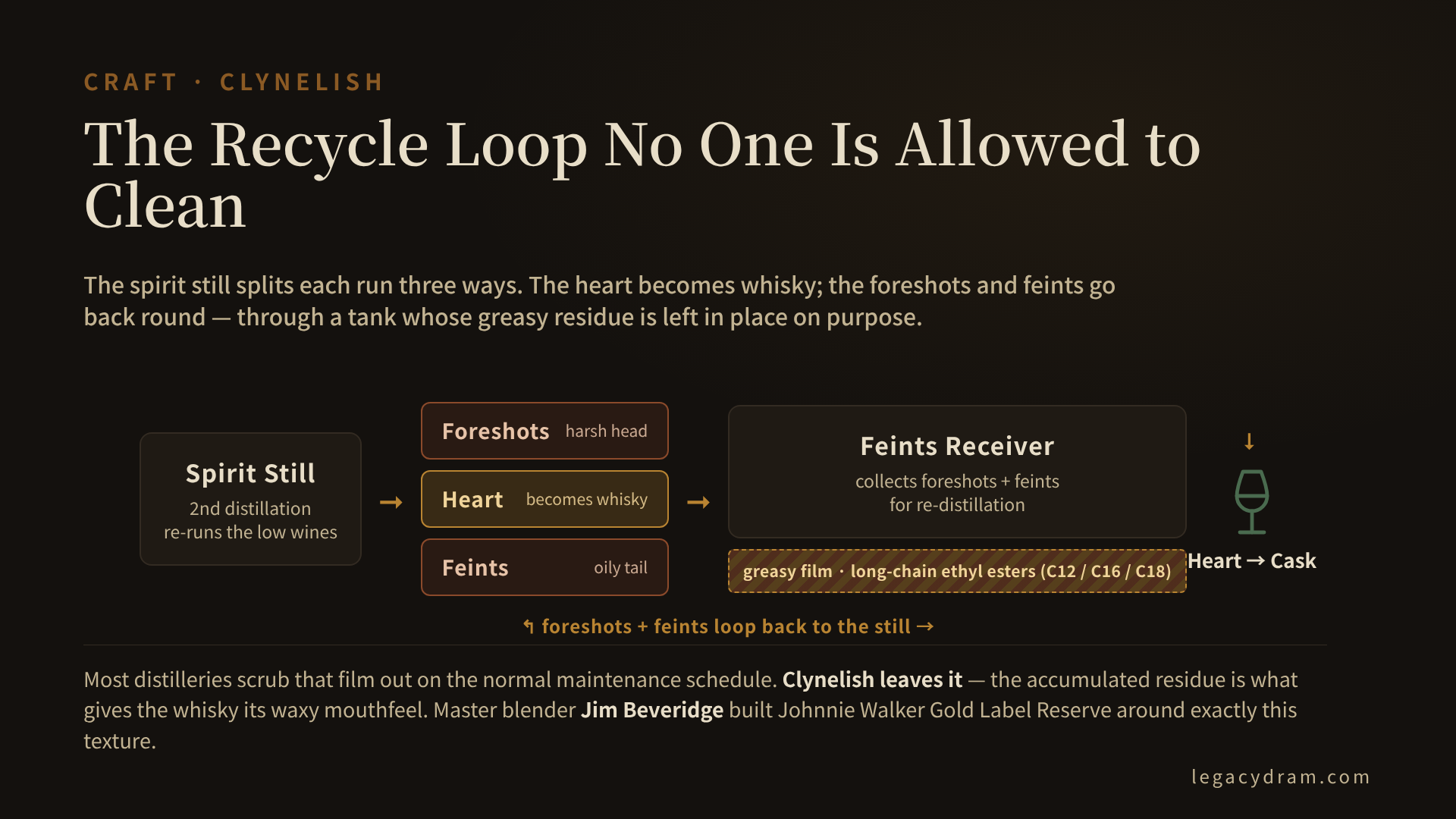
A malt distillery runs its spirit through the stills twice. The first still, the wash still, turns fermented beer into a rough, weak distillate called low wines. The second still, the spirit still, runs the low wines again and splits the output into three cuts by strength and character: the foreshots (the harsh, volatile head of the run), the heart (the clean middle, the only part that becomes whisky), and the feints (the oily, low-strength tail).
The foreshots and feints are not thrown away. They are collected in a tank, the low wines and feints receiver, and added back into the next batch to be re-distilled. It is a recycle loop: the heart goes to the cask, and the heads and tails go round again. Standard practice everywhere.
In almost every distillery, that receiver gets cleaned on the normal maintenance schedule, because letting a tank accumulate gunk is, from an operations standpoint, obviously bad. Residue is uncontrolled. It is the kind of thing a process engineer is paid to eliminate. A clean tank is a known quantity; a dirty one is a variable you are not measuring.
Clynelish runs the opposite policy, and it is the single decision that makes the whisky what it is.
The residue, in chemistry
Here is where I get to be specific, which is the part I enjoy and the part where, if you are drinking while you read, you may want to put the glass down.
The greasy film is made of long-chain fatty-acid ethyl esters: fatty molecules with a long carbon tail, the kind of thing that reads as oily or paraffin-like on the palate. The three that matter most at Clynelish are:
- Ethyl dodecanoate (ethyl laurate, a C12 chain): described as waxy, fruity, creamy, floral
- Ethyl hexadecanoate (ethyl palmitate, C16): waxy, creamy, milky
- Ethyl octadecenoate (ethyl oleate, C18): oily, faintly fatty
The defining physical fact about these molecules is that they are barely soluble in water. They stay dissolved only because new-make spirit is around 70% alcohol, and alcohol holds them in suspension. They concentrate in the oily feints fraction, which is exactly the fraction that gets recycled. So every time the feints go back through the still, a little more of this material carries over and a little more deposits in the receiver. The tank does not just hold the esters. It is a slow accumulator that enriches them, batch after batch, like a cache that is never invalidated.
And here is the payoff, the bit you actually feel. When you sip the finished whisky, your saliva dilutes it below the alcohol concentration that kept the esters in suspension. They come out of solution on the spot and form a microscopic oily film across your palate. That is the wax. It is not a metaphor or a flavour-wheel abstraction. It is a literal phase separation happening in your mouth, in real time, because chemistry that was holding together at 46% falls apart at the dilution of spit.
(I explained this to a friend mid-dram once. He swallowed, paused, and said it had been a better drink ninety seconds ago. I understand. There is a version of this hobby where you do not learn what ethyl palmitate is, and it is a more relaxing version. I do not live in it.)
The 2017 proof by deletion
If you propose that the dirty tank causes the wax, the obvious test is to clean the tank and see what happens. Clynelish has run that experiment, more than once, and not on purpose.
Historically, when the receiver was emptied and properly scrubbed during a silent season (the annual shutdown when a distillery cleans everything), the new make came back thin. The wax was gone. Someone eventually connected the two facts: the residue had specific value, and washing it away deleted the value. So the modern policy is deliberate. The gunk is removed during silent season and then put back, because the alternative is losing the thing the distillery is known for.
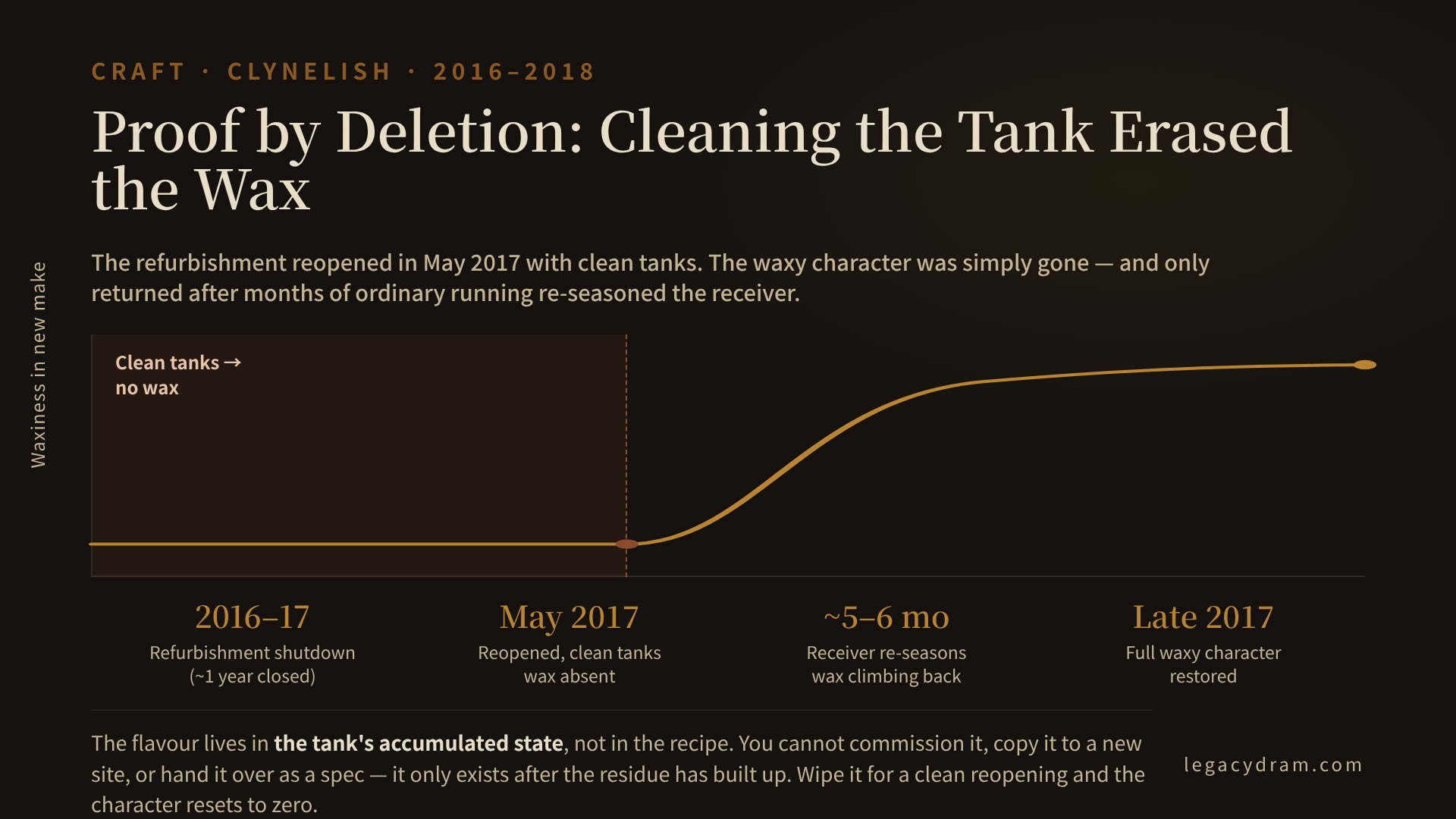
The cleanest demonstration came in 2016–17. Clynelish went through a major refurbishment, closed for the better part of a year, and reopened in May 2017 with a lot of equipment replaced and, critically, clean tanks. The waxiness was simply absent from the new make. It then took roughly five to six months of ordinary production for the receiver to re-season itself and for the wax to return.
Think about what that means as an engineering fact. The flavour is not in the recipe, the barley, the yeast, or the still geometry in any way you can write down and hand to a new site. It is in the accumulated state of one tank. You cannot commission it. You cannot copy it to a new distillery by replicating the spec, because the spec is “run for half a year and let a particular residue build up.” It is the distillation equivalent of behaviour that only emerges after a system has been running in production long enough to grow its own undocumented state, and it resets to zero the moment someone wipes it for a clean deploy.
The tradeoff, stated honestly
It would be easy to end here with “and that is why the dirty tank is genius,” but that is the kind of tidy conclusion this site exists to refuse. The dirty receiver is a real engineering tradeoff, and it costs something.
On the cost side: you are deliberately running an uncontrolled accumulator in the middle of a process that the rest of the industry has spent a century trying to make controlled and repeatable. The ester load in that tank is not a number anyone sets; it is whatever has built up. Batch-to-batch consistency now depends on the state of a residue layer rather than on a measured charge. After any deep clean you have a months-long dead zone where the spirit is off-character. The 2017 episode is exactly that liability made visible. And it runs against every instinct of modern food-grade production, where uncleaned surfaces are a hazard you eliminate, not a feature you cultivate. If you handed this process to a consultant tasked with optimising for cleanliness and throughput, they would scrub the tank on day one and destroy the distillery’s entire reason for existing.
On the benefit side: it produces a mouthfeel that is genuinely difficult to get any other way. Waxy texture is one of the few whisky characteristics that survives blending, dilution, and years in a cask. It gives a blend backbone and an oily continuity across the palate that a blender cannot easily fake with younger, cleaner malts.
Which is the right call? I am not going to tell you, because it depends entirely on what you are optimising for. If your objective is a clean, predictable, low-variance process, the dirty tank is indefensible. If your objective is a specific texture that nothing else delivers, it is the most important asset on the site. The honest framing is not “Clynelish is right.” It is “Clynelish has decided which variable it refuses to optimise, and it has paid for that decision in process control.”
The person who decided the residue was worth it
A craft story with no human in it is just a process diagram, and a process diagram does not explain why anyone tolerates the downside. Someone has to look at an uncontrolled, anti-modern, occasionally self-sabotaging tank and decide it earns its keep. For Clynelish, the most consequential someone was a blender.
Dr Jim Beveridge spent his career at Johnnie Walker. He joined in 1979 as an analytical chemist, which is worth pausing on, because it means the man who would later defend a deliberately dirty tank started out as exactly the kind of measurement-minded scientist whose training says you eliminate uncontrolled residue. He went on to serve about twenty years as Johnnie Walker’s master blender, was awarded an OBE in 2019 for services to the Scotch whisky industry, and retired at the end of 2021, handing the role to Dr Emma Walker, the first woman to hold it.
Beveridge built Johnnie Walker Gold Label Reserve around roughly fifteen handpicked whiskies, and he put Clynelish at its heart, the malt that sets the blend’s direction. He chose the waxy Highland spirit specifically because that oily texture gives the blend a continuity and weight the other components cannot. In other words, a trained analytical chemist looked at a flavour that exists only because a distillery refuses to do basic maintenance, and decided it was the foundation he wanted under one of the most valuable blends in the world.
That is the decision that closes the loop. The distillery’s choice to leave the tank dirty would be a curiosity if no one downstream valued the result. Beveridge is the named human who valued it, the one who took an uncontrolled process artefact and promoted it to load-bearing structure in a global product. The residue earns its keep because a man whose job was consistency decided that this particular inconsistency was worth protecting.
What you taste, and who to thank for it
Next time you pour a Clynelish (the 14-year-old is the easy one to find), pay attention to the texture rather than the flavour. Let it sit on your tongue and notice the slick, slightly waxy film it leaves behind as your saliva dilutes it. That film is ethyl palmitate and its long-chain relatives coming out of suspension in your mouth, esters that concentrated in a tank up in Sutherland that nobody scrubbed clean. If you have a Johnnie Walker Gold instead, the same texture is in there, threaded through the blend on purpose, because Jim Beveridge wanted it there.
What you are tasting is a refusal. Somewhere in the long history of this distillery, the people running it decided that the clean, optimised, well-controlled version of their process produced a worse whisky than the dirty one, and they have defended that decision through refurbishments, ownership changes, and every modern instinct that says you wash the tank. The wax is what it costs them in process control, and it is also the entire point. The fact that the most valuable thing on the site is a residue nobody is allowed to wash out is, as far as I can tell, the most honest sentence anyone has written about how character actually gets into a bottle.
Related reading
- The Reflux Equation: Why Glenmorangie’s Stills Are 5.14 Metres Tall (and What Bill Lumsden Inherited): another spirit shape set by a constraint, not a sensory ambition
- Cragganmore 12 and the Worm Tubs John Smith Refused to Replace: keeping deliberately “inefficient” kit for the flavour it gives
- Welcome to LegacyDram: why we read whisky like legacy code
Sources
- Scotch Whisky — Clynelish whiskypedia entry: scotchwhisky.com
- Cask Trade — “Clynelish Distillery: The Waxed Whisky Favourite”: casktrade.com
- Words of Whisky — “Distillery Visit: Clynelish Is Back On Track” (2017 refurbishment and wax recovery): wordsofwhisky.com
- Whisky Magazine — “Johnnie Walker master blender Dr Jim Beveridge stepping down”: whiskymag.com
- Long-chain fatty-acid ethyl esters and chill haze — flavour-descriptor and solubility data via distillation chemistry references