Glenmorangie Still Height (5.14m): How Reflux Shapes the Spirit
A friend pointed at her glass on a Tuesday and asked why Glenmorangie tastes the way it does. I made the mistake, before I had finished my own dram, of starting with the number. Five point one four metres. That is the height of the wash still at Glenmorangie’s distillery in Tain, on the eastern edge of the Highlands. It is the tallest pot still in any Scottish distillery, and the shape was already decided before any human alive today was born.
The current head of distilling at Glenmorangie is Bill Lumsden, who joined in 1995. He is a biochemist by training, with a PhD from Heriot-Watt’s International Centre for Brewing & Distilling on microbial physiology and fermentation science. He inherited the 5.14m stills, the upward-angled lyne arms above them, and a delicate, ester-forward spirit that those geometries determine before any human decision is made on the day. His career, in engineering terms, is what you do when the API was decided 152 years before you joined the team and you are not allowed to change it.
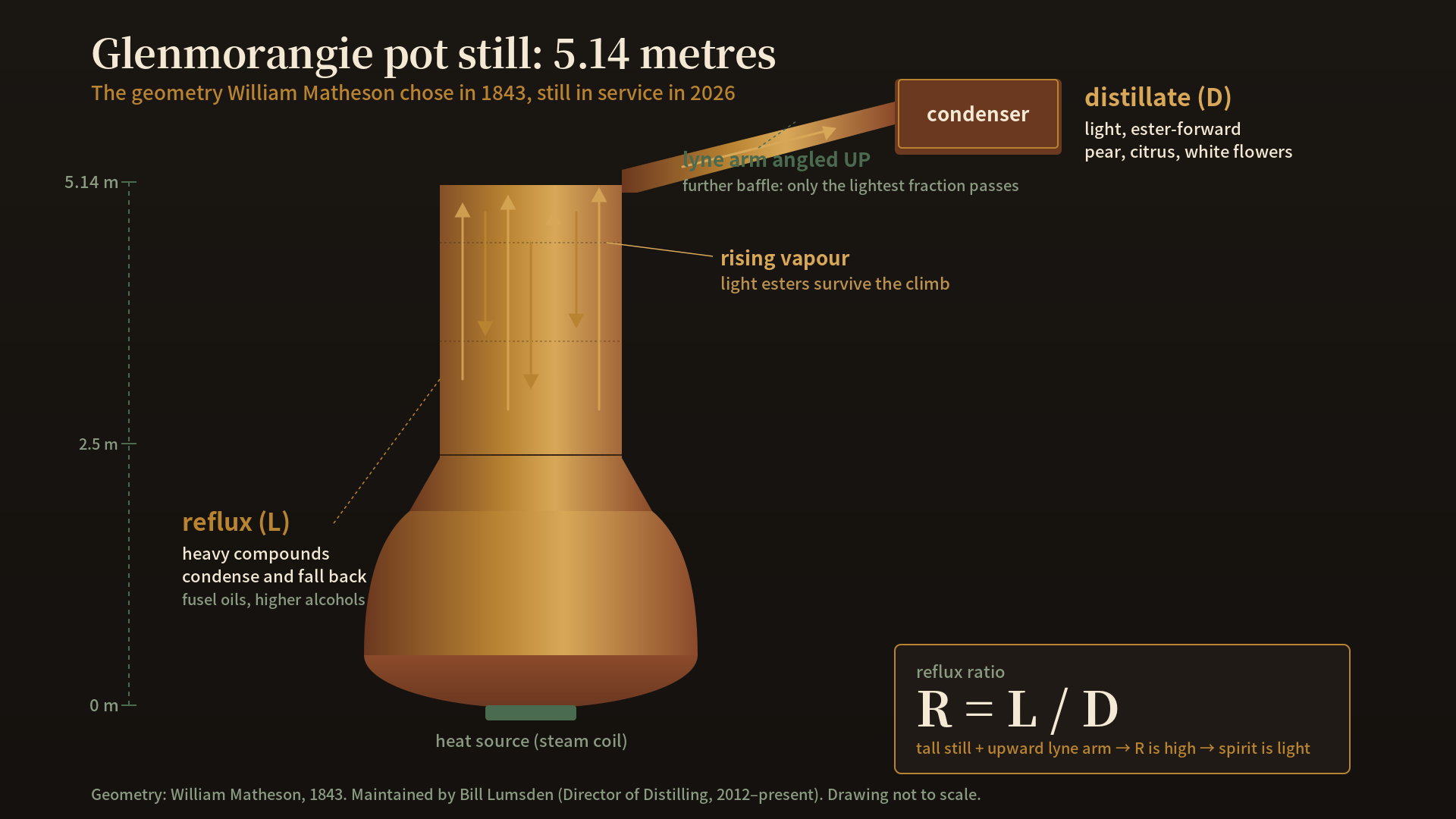
The reflux equation, briefly
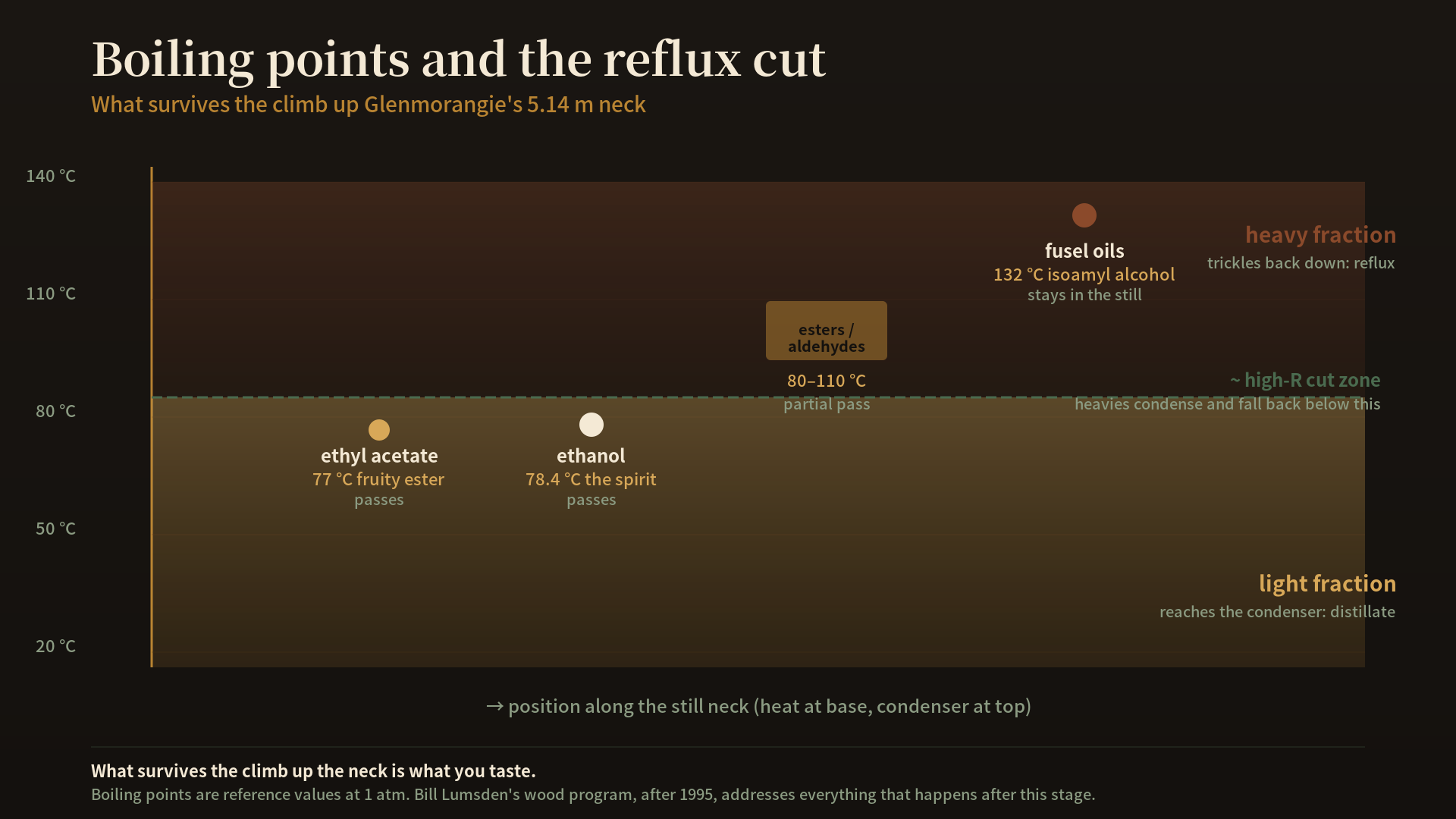
The point of distillation is that different molecules boil at different temperatures, so if you heat the wash carefully and collect the vapour, you can separate components by their boiling points. The volatiles you want in whisky are roughly:
- Ethyl acetate (a fruity ester, boiling point 77°C)
- Ethanol (78.4°C)
- Higher esters and aldehydes (around 80–110°C)
- Fusel oils like isoamyl alcohol (~132°C)
- Heavy oily compounds well above ethanol
In a pot still, the wash is heated and vapour rises up the neck. If the neck is short and the lyne arm slopes downward, the vapour reaches the condenser fast and you collect almost everything that flashed off the wash, including the heavier fusel oils. You get a heavy, oily, characterful spirit. Lagavulin works this way.
If the neck is tall and the lyne arm angles upward, the vapour has to climb against gravity and against a temperature gradient that drops as you move further from the heat source. The heavier compounds, with their higher boiling points, condense on the way up and trickle back down to be re-distilled. Only the lighter compounds make it to the condenser. The ratio of liquid returned to liquid distilled is the reflux ratio, traditionally written R = L/D. Tall still, upward lyne arm: R is high. The output is light, fruity, ester-forward.
Glenmorangie’s stills are 5.14m tall, and the lyne arms angle upward. R is high. The new make tastes of pear, white flowers, and citrus peel, with almost no fusel weight. None of this is mystery. It is undergraduate distillation engineering, expressed as a still made of copper and held together by rivets installed in 1843.
(I tried to explain this to my friend and watched her glaze over right around “isoamyl alcohol.” I do not blame her. This is what happens when you let an engineer talk about a drink. By the second pour she had stopped asking.)
“Giraffe-tall stills” and the 1843 problem
The Glenmorangie marketing copy will tell you the stills are “the tallest in Scotland” and, in some materials, “taller than an adult giraffe.” This is true. It is also one of those facts that sound like an explanation and are not. Telling someone the stills are giraffe-tall is, structurally, the same as telling them my codebase has a lot of lines. The number maps to nothing they can act on.
The actual story is more useful and more honest. William Matheson, who founded the Glenmorangie distillery in 1843 on the site of an old brewery, bought a pair of second-hand stills from a gin distillery because new pot stills built to the conventional onion shape were beyond what he could pay. Gin stills are tall, because gin distillation favours rectification: you want the lightest, most neutral spirit possible to carry the botanicals. The tall geometry was a side effect of someone else’s product requirement.
The light, ester-forward Glenmorangie spirit is therefore a consequence of a financial constraint, not a sensory ambition. Matheson did not set out to make the most delicate single malt in the Highlands. He set out to make whisky cheaply, and the still he could afford produced this whisky. The brand identity that has been built around the geometry over the next 180 years is, in the most literal sense, post-hoc rationalisation of a budget cut.
I keep this in mind every time I read a tasting note that talks about “intentionally elegant” Glenmorangie. The elegance is real. The intentionality, in 1843, was about money.
What Lumsden actually inherited
Bill Lumsden joined Glenmorangie in 1995, nine years before the company was sold. He came in as Distillery Manager, was promoted to a directorship around 1998, and has held the title Director of Distilling, Whisky Creation and Whisky Stocks since 2012. Industry awards have called him Master Distiller of the Year more than once. The directorship is the actual job title; the awards are decorations on it.
He is unusual in scotch in that he is a working biochemist. His doctoral training at Heriot-Watt was on the physiology of distilling yeast: how strain selection, fermentation duration, and nutrient availability shape the congener profile of the wash. Most distillery managers come up through the production side of the trade, with chemistry learned on the floor. Lumsden came in the other direction.
What he inherited, in 1995, was:
- A spirit shape determined by geometry, not by him: the 5.14m stills, upward lyne arms, and the high reflux ratio they produce. The new make was, and is, light, floral, and ester-forward.
- A flagship product (the 10-year-old, now called Original) that leans on those characteristics directly. A delicate Highland malt with limited cask weight.
- A market in the 1990s that increasingly asked Highland malts to compete with sherried Speyside bottlings on flavour density. Glenfarclas, Macallan, Aberlour: heavy, sweet, sherry-led drams that occupied the same shelf as the Glenmorangie 10 and made it taste, by comparison, thin.
His central problem, stated as a system design question: how do you give weight to a spirit whose under-determined character was settled before you were born, when the entire upstream pipeline is non-negotiable?
The wrapper layer: wood finishing as engineering decision
The standard summary of Lumsden’s career credits him with “pioneering wood finishing” in scotch. This is generous. Glenmorangie’s port-pipe-finished bottlings predate Lumsden by a few years, and other Highland distilleries had been experimenting with second maturation in different oak. What Lumsden did was systematise wood finishing into a core product line, give each finish a stable identity, and put the finishes at the front of the catalogue.
Quinta Ruban: ten years in ex-bourbon, finished in port pipes from the Douro. Lasanta: extra years in Oloroso and Pedro Ximénez sherry casks. Nectar D’Or: Sauternes barriques from Bordeaux. These are products with consistent specifications, repeatable cask sourcing, and a clear job: give the high-R distillate a second layer that the still cannot provide.
In engineering terms, this is a wrapper layer over an interface he is not allowed to modify. The base spirit is what it is. The cask program adjusts the output downstream. The Original 10 is the bare API, undressed; the finishes are the layers built on top of it, each tuned to a specific market position.
The honest version of this story includes the tradeoff. A distillery that defines itself by cask finishing is, by construction, betting its identity on second maturation as a stable supply. Port pipes, Oloroso casks, Sauternes barriques are all secondary markets for casks first used by other industries, and those industries change. When global wine fashion shifts, when sherry production contracts, when a port house consolidates, Glenmorangie’s product line has to adjust at the cask supply level rather than at the spirit level. Building everything on the wrapper layer means the wrapper layer becomes load-bearing.
Astar (released 2008, revived 2017) is the cleanest expression of Lumsden’s bench-scientist instinct. The casks are bespoke American oak, sourced from slow-grown trees in the Missouri Ozarks, where cold climate produces tight grain. The staves are air-dried for two years, toasted to a specific level, used to age bourbon for four years, then shipped to Tain. Lumsden specified the wood at the species, growth-rate, and seasoning level. It is forestry written in the same handwriting as a distillation protocol.
Signet (also 2008) goes the other direction. Instead of treating the spirit downstream, it modifies the input: high-roast chocolate malt added to the mash bill, producing a heavier, more coffee-like new make. It is the only Glenmorangie product I am aware of that addresses the underlying weight problem at the source. It is also the most expensive expression in the core range and the least replicable, because the malt has to be blended with the standard distillate to keep it recognisable as Glenmorangie. Signet has remained a single-product side branch for almost two decades. There is, I think, a reason for that.
The 2009 expansion: same shape, more of it
In 2004, LVMH bought Glenmorangie for £300 million, beating a competing bid from Pernod Ricard. The deal included Ardbeg and the now-divested Glen Moray. Lumsden was inherited along with the casks. Five years into LVMH ownership, in 2009, the company funded a stillhouse expansion that took the count from eight stills to twelve.
The interesting decision was not the expansion. It was that the four new stills were built to the same geometry as the 1843 originals. Same height. Same neck profile. Same upward lyne arm. They could have shortened the necks. They could have angled the lyne arms downward to give Glenmorangie a heavier expression to slot under the existing portfolio. They could have widened the spirit envelope. They did not.
I would like to have been in the LVMH-era purchasing committee meeting where this was decided, because the decision is, on its face, a 21st-century luxury conglomerate reaffirming a 19th-century cash-strapped grocer’s still order. The shape that William Matheson chose because he could not afford anything else is, by 2009, expensive heritage. It costs more to build a 5.14m still than a conventional one, and it produces less spirit per still per cycle, because reflux is, mechanically, throughput you are throwing away. LVMH paid for that throughput loss intentionally, because the spirit envelope it produces is what they had bought.
That is the moment the constraint flips from inheritance to choice. Matheson did not pick this geometry. The 2009 buyers did, by refusing to deviate.
What you actually taste
If you put an Original 10 and a Lasanta next to each other on a Sunday afternoon, the difference is the wrapper layer. The 10 gives you pear, vanilla, citrus oil, a faint malt warmth, and not much weight on the back palate. The Lasanta gives you orange peel, walnut, dark dried fruit, and the sherry tannin you expected to find in a Speyside heavy. The new make under both is, to within a small batch variance, identical. Everything that distinguishes them happens in the cask, after the still has done what its geometry forces it to do.
This is the cost and the benefit of building your portfolio as a wrapper. The cost is that Glenmorangie has limited variation at the spirit level: every line extension is a wood story, and the brand cannot easily produce a heavy peated dram or a thick oily one without disowning the still that defines it. The benefit is that everything in the range stays recognisably Glenmorangie. The interface is the same. The patches differ.
This is not the only way to run a single-malt portfolio. Springbank changes its peating level and its distillation count to produce three different spirit characters from the same stillhouse. Glenfarclas keeps the spirit profile fixed and varies only age and cask history. Glenmorangie’s strategy is the wrapper-heavy one, and it works, and it has limits, and pretending it does not have limits is the kind of branding move I am asking the reader not to take at face value.
The interface outlives the maintainer
Bill Lumsden is sixty-seven this year. He has not announced a successor. Whoever takes the role next will inherit the 5.14m stills, the upward lyne arms, the cask sourcing relationships, and the bench-science specifications that Lumsden wrote into the Astar program. They will not get to redesign the still shape. The 2009 stillhouse expansion locked in the geometry for at least another forty years; it would cost a quarter of the distillery’s capacity to retool, and LVMH has no commercial reason to ask.
The Astar casks Lumsden specified at the Ozark stave level will keep maturing long after he is gone. The Quinta Ruban port pipes are negotiated three or four turnover cycles in advance. The recipe books in his office, when he hands them over, will commit his successor to choices Lumsden made in the early 2000s about the colour of the dram in 2030.
This is the part of whisky that maps cleanly onto long-lived engineering systems. Most of what you ship was decided by people who do not know your name. Matheson chose the still shape with money he did not have. The eight original stills came down through six owners. Lumsden walked into a system whose most consequential parameter was settled before he was born and built a thirty-year career around managing the layer above it. The next person walks into the same constraint, plus thirty more years of inherited cask program decisions.
When you next pour a Glenmorangie 10, you are tasting an 1843 budget compromise filtered through a 1995 PhD’s wrapper layer, served at a strength a 2004 marketing committee approved. The fact that it tastes like a clean, easy dram of Highland whisky is its own quiet engineering achievement. The fact that the people responsible mostly do not get the credit is, as far as I can tell, the standard outcome for any system that lasts long enough to be worth drinking.
Related reading
- Glenmorangie Fermentation: Brendan McCarron’s Long-Ferment and Allta Wild-Yeast Approach to Honey-Citrus — the other half of the Glenmorangie honey profile, before the spirit ever reaches the 5.14m still
- Glenmorangie Original Tall Still: Why It Tastes of Peach and Citrus (Bill Lumsden) — the bottle that the still height and fermentation together produce
- Frank McHardy and the Silent Years: How Springbank’s Restart Survived Itself — another inherited-stillhouse story, very different ownership context
- Welcome to LegacyDram — why we read whisky like legacy code
Sources
- Glenmorangie official — glenmorangie.com
- Bill Lumsden, Master Distiller (Glenmorangie experience pages) — glenmorangie.com
- LVMH (parent group) — lvmh.com
- Whisky Magazine — whiskymag.com
- Wikipedia: Glenmorangie and Bill Lumsden