Lagavulin 16 Review: 35 ppm Peat, 43% Refill
I opened a Lagavulin 16 in a Kyoto bar last winter. The bartender, who had been pouring it since before the euro existed, said the same thing every long-time regular eventually hears at that counter: it hasn’t changed. He meant it literally.
The person primarily responsible for that fact is not the master blender whose name goes on the back label. It is a man named Iain McArthur. He first walked through the gates of Lagavulin in 1970, still a teenager. His first job was stencilling brand names and vintage dates onto the ends of casks. When Port Ellen closed in 1983, he was one of the crew filling the last barrels. He then returned to Lagavulin and stayed until he retired at the end of 2023. Fifty-three years, one distillery, effectively one job. In that stretch the phenol level of the malted barley coming in the door held at thirty-five parts per million. The cask policy — refill sherry butts, refill bourbon hogsheads, no first-fill in the flagship expression — did not move. The cut points on the spirit still did not move. Every meaningful specification of the sixteen-year-old held steady for the length of a career.
I want to write about what is in this bottle, and about why it is still what it is, given that the man whose fingerprints were on more of these casks than anyone else’s has now closed the warehouse door behind him for the last time.
Iain McArthur, the person the label does not name
McArthur was never the Master Distiller and never the Master Blender. He was, for the first several decades of his career, a cask stenciller. Later he became a warehouseman, then warehouse manager. In organisational-chart terms he was middle management in a Diageo subsidiary on a small island. What he actually was, in practice, was the person who saw every barrel go into a warehouse and every barrel come out.
I once asked a Diageo brand ambassador what changes had been made to Lagavulin 16 in the last decade. He looked at me the way you would look at someone asking whether the ocean had been rebranded. Consistency at Lagavulin is close to a religious commitment. “Consistency” sounds like a marketing slide when a global company puts it on a poster. What it means at Lagavulin, in practice, is that a man stood next to the same warehouse rows for over half a century, deciding, every day, not to make a small improvement. That is not romantic. That is a man refusing his own creativity for the shape of a whisky he did not personally design.
The cask policy he executed was written above him — Diageo’s blending team, currently under distillery manager Colin Gordon and the group’s central blenders, sets the assembly — and the flagship recipe was locked when United Distillers launched the Classic Malts range in 1988. McArthur’s job was to be the mechanism through which “do not change it” survived reorganisations, ownership shifts, and the temptation, every quarter, to make a slightly cleverer version of what was already selling. In 2023 Diageo bottled a single-cask eighteen-year-old called Iain’s Farewell Dram to see him off. The tin nods to what the back label never quite manages to say.
Where 35 ppm sits on the Islay ladder
The malted barley for both Lagavulin and Caol Ila comes from the same building — Diageo’s Port Ellen Maltings, a short drive west along the Islay coast. It is dried in giant drum maltings using peat cut from the Castlehill bog. Both distilleries take their malt at around 35 ppm phenol. That is the middle of the Islay range: Ardbeg specifies its barley at roughly 55 ppm, Laphroaig at around 40, Lagavulin and Caol Ila at 35, Bowmore at about 25, and Bunnahabhain at almost nothing for its unpeated core.
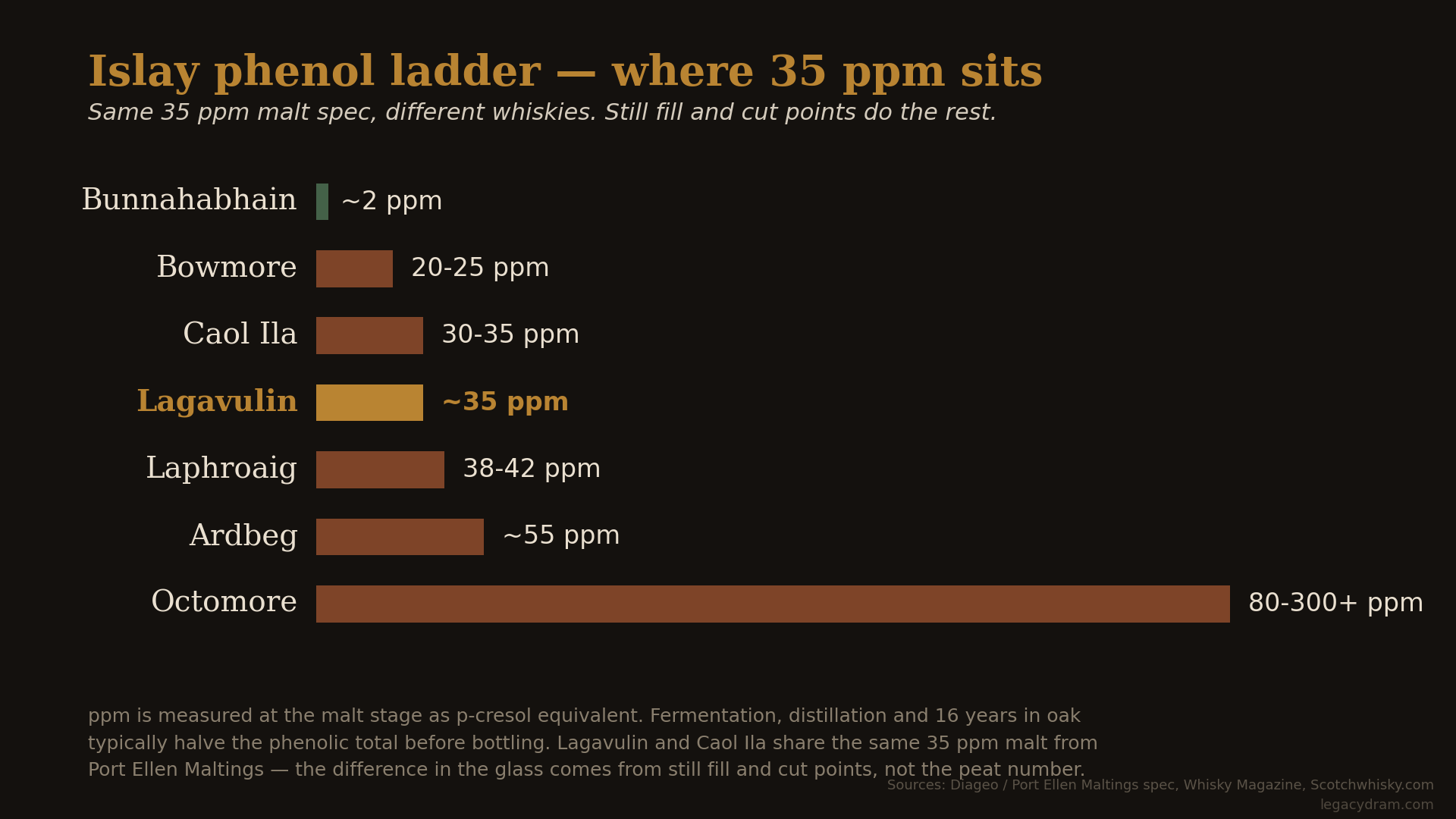
Two clarifications the ppm number tends to hide.
First, ppm measures the phenolic total on the malt, calibrated as p-cresol equivalent. What that number actually contains is a spectrum of compounds — guaiacol, syringol, cresol isomers, 4-vinyl guaiacol and other pyrolysis products from the peat smoke. Coastal Islay peat is guaiacol-heavy, which is why the smoke here reads more like a beach bonfire than the sooty, medicinal note you get from more tarry inland peats.
Second, the number falls. Sixteen years of maturation removes roughly half to two-thirds of the phenolic total: some is adsorbed by the cask wood, some evaporates through the angels’ share, some reacts with cask-derived compounds to become something that no longer answers to the same test. The bottle in front of you is not carrying 35 ppm on the palate. The ppm figure is the input specification. What is in the glass is the output of everything the input then had to survive.
What makes 35 ppm drink heavier than Ardbeg’s 55
If ppm were a straight ranking, Lagavulin 16 would sit below Ardbeg 10 in perceived weight. It does the opposite. Ardbeg drinks lighter, cleaner, more citric; Lagavulin drinks heavier, oilier, more mineral. Four choices at the distillery are load-bearing on that inversion.
Fermentation length. Lagavulin ferments for roughly fifty-five hours — long enough for late-stage esterification to lay down soft orchard-fruit notes underneath the smoke, without going as long as Ardbeg’s roughly sixty. Long fermentations shift the flavour compass toward fruit and away from cereal.
Still fill. Lagavulin runs its pot stills at an unusually high fill level — around 85 to 95 percent of capacity. Caol Ila, eight kilometres up the coast, fills to about 50. The higher fill suppresses reflux inside the still, meaning heavier compounds stay in the spirit stream rather than condensing back into the wash. That is a large part of why Lagavulin drinks the heavier of the two Diageo Islay flagships even though the malt spec is identical.
Cut points. Lagavulin takes its spirit run from roughly 72% ABV down to about 59%. Ardbeg’s purifier and its cut window (approximately 73% down to 62%) reject heavier compounds and hand the wash still a second chance to purify them. Lagavulin has no purifier. The wider, deeper cut is where the tar and creosote notes come from.
Cask assembly. The flagship is roughly seventy percent refill European oak sherry butt and thirty percent refill American oak hogshead, with no first-fill in the assembly. Refill wood contributes structure and slow fruit rather than a wall of vanilla or an Oloroso paint job. That is why the sherry side of Lagavulin 16 reads as a background suggestion of dried fig rather than a foreground of raisin syrup.
Together these four choices explain the drink. The malt spec is the input; the still, the cut, and the wood are the multipliers.
What is in the glass
Lagavulin 16 lists at 43% ABV, natural colour, and around £75–90 in the UK, roughly $100–120 in the US, ¥9,000–13,000 in Japan. Stock is stable rather than abundant — the sixteen-year-old runs at capacity most years — but it is on almost every serious back bar you will walk into.
I poured a Glencairn’s worth at room temperature, no water at first, and let it sit for ten minutes. Alongside I opened the current Ardbeg 10 for reference — same island, same coast, same specification file for the malt except for the ppm figure.
- Colour. Mahogany-amber. Diageo declares no colour additive on Lagavulin 16. Under a lamp the meniscus catches like weak black tea.
- Nose. Iodine at low concentration, the way a dilute antiseptic reads through a plaster; creosote from a treated fence post; dark chocolate melted into a warm spoon; dried figs from the sherry refill; wood smoke that has drifted across a beach for about ten minutes before reaching your nose. There is also a faint peel of blood orange somewhere behind all that.
- Palate. The mouthfeel arrives before the flavour does — heavier than 43% has any right to be. First sweetness from the refill sherry, mostly toffee and dried fruit; then a mid-palate turn into bitter chocolate and peat oil; then a slow warm-woody finish. Adding five to ten drops of water loosens the front layer of smoke and lets more of the fig come forward without diluting the mid-palate structure.
- Finish. Long. Salted caramel, dark chocolate and iodine recede in three staggered steps. What lingers is the ember smell you get from a fireplace ten minutes after the last log has burnt down.
The Ardbeg 10 next to it does not read as more heavily peated. It reads as cleaner: grapefruit peel, cold campfire, a citrus-and-brine finish that dries and disappears. The Lagavulin coats and stays. If you have ever wondered why two Islay flagships with nearly the same malt spec feel like opposite arguments, that difference is what you are tasting. Two engineering choices — the purifier on one still, the deep cut on the other — decide almost everything.
The one-paragraph aside about Peter Mackie
The Peter Mackie who bought Lagavulin in 1889 was the same White Horse magnate who, in 1908, built a tiny distillery inside the Lagavulin site called Malt Mill in an attempt to reverse-engineer Laphroaig after a licensing quarrel. The clone did not work. Malt Mill was closed in 1962. The relevant detail for the bottle in your hand is that Lagavulin’s identity was already stabilising, on this coast, at Mackie’s original spec, long before the Classic Malts line put the sixteen-year on shelves worldwide. There is more on that quarrel elsewhere: see the piece on Peter Mackie and the Malt Mill Laphroaig-clone experiment.
Distillers Edition and what the finish removes
Lagavulin also releases a Distillers Edition, first launched in 1997, which takes the same sixteen-year base and finishes it for several months in Pedro Ximénez–seasoned casks. It sits at 43% ABV, natural colour, and typically costs about a third more than the flagship. On the palate it is a study in what a PX finish removes: the medicinal iodine step and the tar edge are smoothed by concentrated raisin sweetness, and the finish gets shorter and sweeter. It is not a better whisky than the standard 16. It is a whisky in which someone has made a specific decision — round off the corners for a different drinking occasion — and Diageo has kept both on the shelf so the buyer can choose. The fact that Iain McArthur was minding both sets of casks in the same warehouse rows makes that choice legible: it was never one whisky against the other, it was one warehouse producing both because the estate could support both.
What to check the next time you open a bottle
Next time you pour a Lagavulin 16, put an Ardbeg 10 next to it. Two malts from the same maltings, ppm figures of 35 and 55, drinking, in that order, heavier and lighter. If ppm were destiny the ranking would flip. The still fill, the cut, and the purifier decide almost everything about what survives from the barley to the mouth. What you are checking, glass by glass, is whether an operational discipline held.
Iain McArthur was sixty-eight when Diageo signed off his fifty-year service award. The bottle in front of you, if you bought it in 2026, was distilled around 2010, when he had already been on the site for forty years, and it will still be sold in some form when he has been retired for a decade. Whisky is the record of what someone decided not to change. Lagavulin 16 is a strong argument that the record can outlast the person.
Try this bottle
Affiliate links. LegacyDram may earn a commission on purchases made via these links. Your price does not change. Please drink responsibly.
Related reading
- Ardbeg 10 Review: The Purifier Behind Islay’s Clean Citrus Smoke — 55 ppm on the malt, cleaner in the glass, and the pipe on the lyne arm that explains why.
- Bowmore 12 Review: Eddie MacAffer and Islay’s Middle Phenol — 25 ppm, the lightest of the classic Islay flagships, and the malt-floor discipline that keeps it there.
- Caol Ila 12 Review: Billy Stitchell and Port Askaig — same 35 ppm as Lagavulin, half the still fill, and how the cut point flips the character.
- Talisker 10: The MacAskill Brothers, Skye, and the Worm Tubs — a different island, a different piece of copper geometry, same insistence on not modernising the still house.
- Clynelish 14 Review: The Wax Jim Beveridge Kept in Gold — a northern Highland malt held at 46% for exactly the same reason: to preserve a specific mouthfeel that the plant is built to produce.
Main sources
- Whisky Magazine — Lagavulin warehouse manager Iain McArthur to retire: 1970 start, Port Ellen years, 1983 closure, fifty-three-year total.
- The Spirits Business — Lagavulin honours Iain McArthur with special bottling: the 2023 retirement and the eighteen-year single-cask Iain’s Farewell Dram.
- Whisky Advocate — Iain McArthur: The Wise Guy: warehouse-manager scope of work and daily discipline.
- Whisky and Wisdom — When fixation on peat and PPM gets OTT: identical 35 ppm malt spec between Lagavulin and Caol Ila, differing still fill (85–95% vs ~50%) and cut points (72→59 vs 75→65 ABV).
- Scotch Whisky Magazine — The truth about peated whisky and phenols: what ppm actually measures and how phenolic total falls during maturation.
- Wikipedia — Classic Malts of Scotland: 1988 United Distillers launch, six regional flagships, Lagavulin 16’s specification lock.