Alexander Walker 1865: Johnnie Walker's Rule
The thing to know about the man whose name is on the world’s best-selling Scotch is that he never drank it. John Walker, the Kilmarnock grocer whose shop opened on King Street in 1820, was a lifelong teetotaller. His name appears on the bottle because his son put it there. The doctrine inside the bottle — the one that says this should taste the same every time, forever, in any country — was put there by that son.
The son was Alexander Walker (1837-1889), and this article is about him. He trained in Glasgow as a tea merchant’s apprentice, took over the family grocery when his father died in 1857, and spent the next thirty-two years converting a provincial shop that happened to sell whisky into a firm that happened to sell groceries into, finally, a whisky house with a rule. The rule is what matters. He is the reason the Black Label you open tonight in Tokyo and the Black Label someone else opens tomorrow in Nairobi are, within a tolerance narrower than most people realise is possible for a cask-matured product, the same drink.
The problem the shop had
To understand what Alexander did, you need to see the problem he inherited. In Kilmarnock in the 1830s and 1840s, a grocer who sold whisky sold it mostly from the cask, by the dram or into a customer’s own jug. The whisky was single malt from one or two Highland distilleries; Lowland grain whisky was there too but was treated as a cheap filler. The honest difficulty was that the same distillery’s same expression tasted different from one cask to the next. Yeast strain fluctuation, maturation microclimate, the condition of the previous occupant of the cask — all of these moved the flavour cask by cask. The customer who liked last month’s dram and came back for another sometimes got a drink they did not recognise.
John Walker’s response to this was craftsmanlike rather than systematic: when he received casks whose character varied, he mixed them together in the shop, averaging the variation into something more predictable. The practice was called vatting, it was common across the trade, and it was Alexander Walker’s starting point rather than his invention. (The man who first turned the practice into a brand, by vatting Glenlivet in bond at Edinburgh in 1853 and selling it as Andrew Usher’s Old Vatted Glenlivet, had already done the harder conceptual work by the time Alexander inherited the shop. Alexander’s genius, if the word applies, was in what came next.)
What a tea merchant knows
Before his father died, Alexander had served an apprenticeship in Glasgow with a tea merchant. The detail matters, because the discipline of tea blending in Victorian Britain was already a mature craft and it taught him something the whisky trade had not yet formalised.
Tea blending is this: Assam will arrive one year stronger than usual, Ceylon weaker, a particular Keemun lot smoky in a way the previous shipment was not. The blender’s job is to arrive at the same cup every month regardless. Not an average of the inputs. The same output. You taste what has come in, you reach for the ratios that will cancel the drift, you tweak the proportions, and the customer who opens the tin at home does not notice that anything upstream has moved. The entire profession is organised around the premise that the raw material will keep misbehaving and the brand will not.
Alexander came back from Glasgow understanding that a recipe and a protocol are different objects. A recipe is a list of ingredients and quantities. A protocol is the operating procedure that keeps outputting the same thing when the ingredients drift. He took over the Walker shop in 1857 with the second concept already in his head.
Here I would like to tell you that he was then a genius of whisky blending. He was not, in any strict sense. What he did was transplant a procedure he had seen working on tea onto a different liquid. He did not invent a still, discover a new wood, or isolate a congener. He re-used a workflow. But the re-use was the thing: it was the first time anyone in Scotch had operated the trade as a continuous reproduction problem rather than as a sequence of acceptable one-offs.
Why the timing worked
Three years after Alexander took over the shop, the Spirits Act of 1860 made it legal to blend malt and grain whiskies in bond — that is, before paying duty on them. Before 1860, blending at commercial scale was punitively expensive because you paid tax on malt and grain separately, blended afterwards, and ate the margin. After 1860, a firm with warehousing and a steady hand could compose at industrial volume.
Alexander was twenty-three and already running a shop. The whole apparatus arrived underneath him at exactly the moment he was ready to use it. There is a version of history where he was unusually prescient; the fairer reading is that he was in the right place with the right training when the regulatory ceiling came off. By 1862, the firm was moving around 100,000 gallons a year.
The 1865 blend
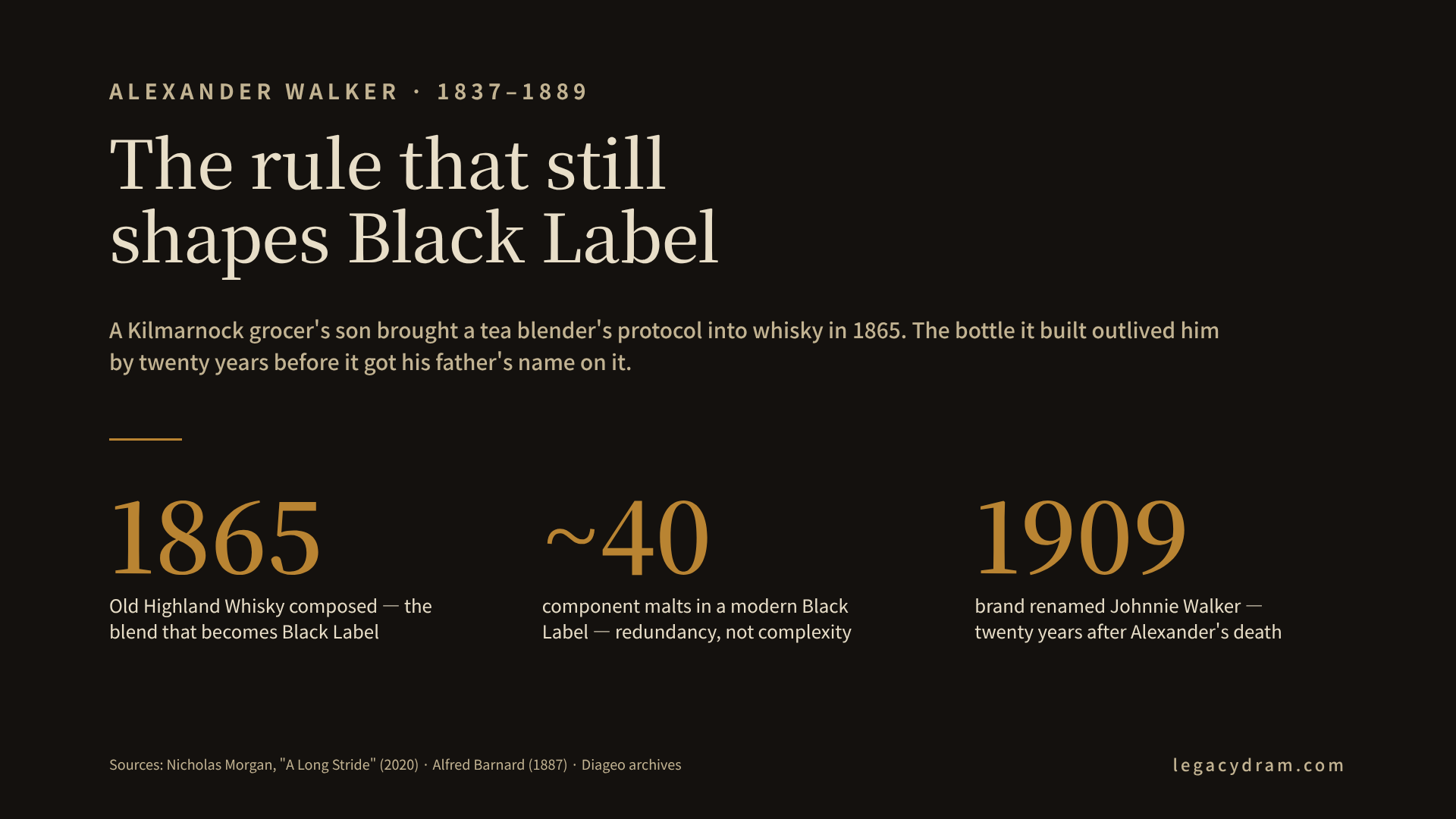
In 1865 he composed Old Highland Whisky and in 1867 he registered the copyright. This is the blend whose recipe lineage, with modifications, is still inside Johnnie Walker Black Label today. The engineering interest in it is less what it tasted like than how it was held constant.
A modern Black Label is spoken of as drawing on something like forty component whiskies. The reason to use so many is not primarily complexity, although the complexity is real. The reason is redundancy. If you build the required flavour profile on three malts and one of those distilleries goes dark for a year or a decade — as Clynelish did and as plenty of others have — your product is now a different product. If you build it on forty, each malt doing a smaller share of the work, you can lose any one of them and reach for a neighbour that does something close enough. The whole thing is a fault-tolerant design: not a monument held up by one pillar but a mesh, each node individually replaceable.
This is the same principle on which modern software is architected for availability. You do not build the critical system on one server; you build it on many, each absorbing a small fraction of load, each able to fail without the user noticing. Alexander Walker was running availability engineering on a maturing agricultural product in the 1860s. He did not call it that. He called it blending to a standard.
The master blender’s job, as it has been inherited by every twenty-first century practitioner from Jim Beveridge at Diageo back to the people running Dewar’s and Chivas, is this inheritance. The 12-year-old you buy in London should match the 12-year-old your sibling buys in Osaka. The 2026 batch should match the 2016. That constraint, enforced across every bottle, is the ongoing operation of the rule Alexander wrote in 1865.
The bottle and the label
He applied the same thinking to the container.
The square bottle came in during the 1860s or 1870s (sources differ, and the firm itself has given both dates at different times). It solved three problems at once: round bottles roll inside a packing crate and chip against each other; round bottles leave wasted triangular gaps where no glass fits; and round bottles need more protective packing material per unit. Square bottles pack flush. More fit in the same crate — the figures cited run around ten to fifteen percent — and far fewer arrive broken at the far end of a sea voyage. For a firm whose primary market was already across the Empire, the geometry of the glass was a freight-cost decision.
The twenty-four-degree slanted black-and-gold label appeared in 1867 and was itself trademarked in 1877. Set at an angle, the lettering can be made larger than horizontal lettering on the same label stock; on a shelf of mostly horizontal labels, the slanted one visually interrupts the row. It is a recognition device. The design was still working, essentially unchanged, when Diageo relaunched the entire range in 2015.
Three decisions, same doctrine. The blend holds the drink constant; the square bottle holds the shipping losses constant; the slanted label holds the shelf-recognition constant. Everything Alexander did was about stripping variance out of the system so that an identical product could be delivered reliably to the far end of a long and lossy supply chain. In an era whose other great whisky figures were building craft, he was building logistics.
Not a hero story
I want to be clean about the parts of this that are not flattering.
The engine that carried Old Highland Whisky to the world was the British Empire’s distribution network. The firm’s success in the 1870s and 1880s was the success of ship routes, colonial agencies, military messes, and the ordinary machinery of imperial trade. Alexander Walker was good at the thing he did; the thing he did also happened to sit directly in the current of nineteenth-century globalisation. Fair acknowledgement of that is not a diminishment, it is accuracy.
More structurally, the doctrine he built is in direct tension with everything the modern single-malt drinker claims to value. The joy of a cask-strength Lagavulin or a vintage-dated Glendronach is the opposite of what Alexander optimised for: it is the drinker tasting the variance, not having it hidden from them. The consistency rule flattens the distinctiveness of individual distilleries by design. That trade-off is real, and the whole blended-versus-single-malt argument that the industry has had with itself for a century is at bottom an argument about whether Alexander’s trade-off was the right one. There is no clean answer. There is a product people drink several billion bottles of a year, and there is a parallel product people on whisky forums fetishise. Both are legitimate; they are optimising for different things.
A smaller note, but a telling one. The heart of Black Label — the lightly grassy Speyside malt that gives the blend its direction — was for a long time understood to be Cardhu. John Walker & Sons bought Cardhu outright in 1893, paying Elizabeth Cumming £20,500 to secure the distillery and its production for the blend. Alexander had been dead four years. The man who built the whole architecture around keeping a specific flavour constant did not live to see his firm acquire the distillery that was supplying that flavour.
What he did not see
Alexander Walker died at Troon on 16 July 1889, aged fifty-two. He left the business to his sons, Alexander Walker II and George Paterson Walker, who ran it through the great expansion of the 1890s. Nine years after his death, in December 1898, the Scotch industry had its first great financial reckoning when the Pattison blending firm in Leith collapsed and took most of the speculative frame of the trade down with it; John Walker & Sons was one of the solidly built firms that survived the crash and emerged with proportionally more market.
The things that made the brand iconic came later. Tom Browne, a commercial illustrator, drew a man in a top hat and tails striding forward on a lunch menu in 1908 — nineteen years after Alexander’s death. In 1909, the firm formally renamed its blends, and the thing was called Johnnie Walker for the first time: Red Label at twelve shillings, Black Label at fifteen, White Label discontinued soon after. All of this was the work of his sons. The name that is on every bottle sold in a hundred and eighty countries today is the diminutive of his father’s name, applied by his children to the product that he had designed. He was the middle generation and he is the one not on the label.
Fifty years after that, in a different country entirely, a young Japanese engineer called Masataka Taketsuru was in Scotland, filling notebooks with the engineering of Scotch so that he could reproduce it at home. He was learning, among other things, the discipline that Alexander Walker had already installed in Kilmarnock half a century earlier. The idea that whisky could be made the same every time, by writing down what you did and sticking to it, was treated by Taketsuru as a technology to import. It was: the technology was the protocol, and the protocol was Alexander’s.
I opened a Black Label last month in a hotel room in a city Alexander never visited. It tasted the way it always does. The way it always does is itself the artefact — a flavour maintained against drift by a hundred and sixty years of continuous blending work, downstream of a procedure a twenty-year-old grocer wrote down for himself one afternoon in 1865. The procedure outlived him by every meaningful measure. He didn’t.
Related reading
- Clynelish 14 Waxy: 50 Years of Uncleaned Feints — Jim Beveridge, running the inheritance 160 years later.
- Laphroaig Owner 1954-1972: Bessie Williamson — another inheritance narrative, this one on the single-malt side.
- Pattison Crash of 1898: The Blending Bubble That Broke Scotch — the sector-wide reckoning nine years after Alexander died.
- Masataka Taketsuru’s Scotland Notebooks — the Scotch protocol exported fifty years on.
- John Glaser & Compass Box: The Transparency Fight — a modern blender arguing with the industry Alexander helped institutionalise.
Principal sources: Nicholas Morgan, “A Long Stride: The Story of the World’s No. 1 Scotch Whisky” (Canongate, 2020), the Diageo-authorised history; Wikipedia entries on “Alexander Walker (1837-1889),” “John Walker (grocer),” and “Johnnie Walker”; Charles MacLean, “Scotch Whisky: A Liquid History”; Alfred Barnard, “The Whisky Distilleries of the United Kingdom” (1887), written during Alexander’s lifetime; Kilmarnock History archives on the Walker shop on King Street. Dates where sources diverge — notably the introduction of the square bottle, variously given as circa 1860 and the late 1870s — are flagged in the body.