The Speyside That Stayed Heavy: Cragganmore 12, John Smith's 1869 Choke, and Why the Worm Tubs Are Still There
A Thursday evening in May, twenty degrees outside and twenty-two inside, four Glencairn glasses lined up on a kitchen counter that was supposed to have been wiped down before guests arrived (no guests; only me, and the cat, who is uninterested in single malts). Cragganmore 12 at 40%, Glenfiddich 12 at 40%, Glenfarclas 12 at 43%, Mortlach 12 Wee Witchie at 43.4%. Four Speyside bottles, three different answers to the same question about copper, and one man named John Smith who weighed 22 stone and decided in 1869 that the answer should be: as little copper as I can get away with.
I had set the flight up expecting to write about the Glenfarclas (the family-owned distillery, the direct fire, the Grant household that has held the place since 1865) and ended the evening writing about Cragganmore instead, because the bottle on the left of the row would not let me leave it alone. The flight comes to about 22,000 yen for four bottles you can keep on the shelf for a year, which is one of the more honest ways to learn what worm tubs do in a region that mostly does not use them anymore.
The man who managed six distilleries before he built his own
The Cragganmore visitor centre and the back label will tell you that the distillery was founded in 1869 by John Smith. They will not tell you what Smith had been doing for the thirty-six years before that.
Smith was born in 1833. By the time he leased three acres at Ayeon Farm from Sir George Macpherson-Grant of Ballindalloch Estate in 1869, he had already managed or worked at six Speyside distilleries, including Macallan, Glenfarclas, and the current Glenlivet site which he helped commission in 1858. He had also run Clydesdale at Wishaw, on the Lanarkshire coalfield south of Glasgow, which was the only one of the six that was outside Speyside and the only one that was Lowland. Wishaw mattered. It gave him a year or two of operating experience outside the Speyside fruity-light consensus, watching how a heavier, more industrial style of spirit ran on a different geography and a different cooling regime. When he finally got the lease at Ballindalloch, he had spent more than half his life running other men’s distilleries.
He was also, by every account, enormous. The standard distillery records have him at 22 stone (about 140 kg) and explain, almost in passing, that his preferred mode of long-distance transport was the train guard’s van, the only carriage that could comfortably accommodate him. The 22 stone is relevant not because it is a punchline (which it is) but because Smith built Cragganmore literally next to the Strathspey Railway with a private siding from Ballindalloch station. Cragganmore was the first Scottish distillery deliberately sited to use a railway. Smith’s body and his distillery were both, in different senses, built around the train.
Smith died in 1886. His younger brother George and then, in 1893, his son Gordon took over operations. Gordon brought in Charles Doig, the Speyside distillery architect, to rebuild much of the site in 1901–02. After Gordon died in 1923, his widow Mary Jane ran the distillery briefly and then sold it to a partnership between Peter Mackie (the White Horse blender) and the Ballindalloch Estate. Mackie folded his stake into the Distillers Company Limited (DCL) in 1927, and the distillery has been owned by DCL and its successors (United Distillers, UDV, Diageo) ever since. The Macpherson-Grant family kept their half until 1965.
That is six owners in 157 years. The first three were Smith family. The last three are corporate. None of them have rebuilt the stillhouse.
The choke
When Stuart Robertson, the current Cragganmore distillery manager, describes the still configuration to visitors, he uses one word more than any other. He calls it a choke.
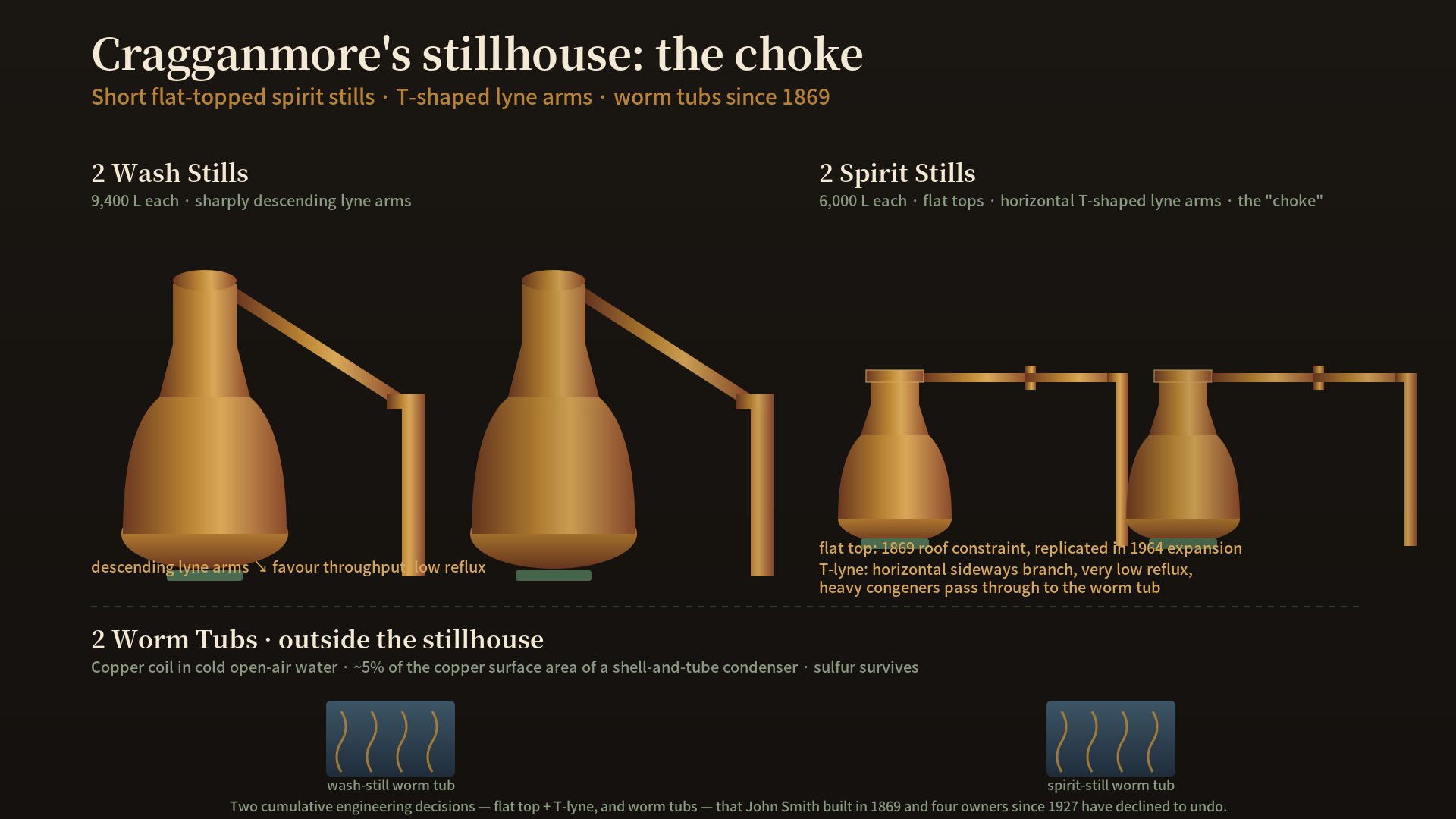
There are two wash stills (9,400 litres each, with sharply descending lyne arms) and two spirit stills (6,000 litres, considerably smaller, with flat tops and T-shaped lyne arms that branch horizontally rather than rising into the more conventional swan-neck shape). The flat tops have an unromantic origin: when the stillhouse was built in 1869, the spirit-still pots would not fit under the roof if they were given the normal upward neck, so the tops were truncated and the lyne arms taken out sideways. When Cragganmore expanded from two stills to four in 1964 and built a new spirit still alongside the original, they replicated the flat top exactly, even though by 1964 raising the roof a metre or two would have been entirely feasible. The new still was made to match the geometry of the old one. The choke was preserved.
A flat-topped spirit still with a horizontal T-lyne does two things to the vapour. First, it gives the heavy fraction of the wash less vertical distance to fall back to the pot, which would normally clean up a spirit. But because the lyne goes out sideways through the T-junction rather than rising and then descending, the reflux (the part of the rising vapour that re-condenses and falls back to the pot, leaving only the lighter, cleaner compounds to escape forward) is fairly low. The flat top compresses the geometry; the T-lyne flattens the slope. The result is more heavy congener leaving the still than you would expect from a still this short. Glenmorangie’s 5.14-metre stills throw heavy compounds back into the pot through sheer altitude; Cragganmore’s flat tops and T-arms refuse to do most of that work, and let the heavy material through.
Then the vapour reaches the worm tubs: long copper coils sitting in cold open-air water, two of them outside the stillhouse, one for the wash stills and one for the spirit stills. The vapour spends time inside a coil that has perhaps a twentieth of the copper surface area of a modern shell-and-tube condenser. (A shell-and-tube unit has, very roughly, a hundred small copper tubes inside a copper shell; the coil-in-water of a worm tub has a single tube, however long. The Edinburgh Whisky Academy puts the contact ratio at about 20:1 in favour of shell-and-tube.) Less copper contact means less catalytic removal of sulfur compounds. The volatile sulfides (dimethyl sulfide, dimethyl trisulfide, and the heavier mercaptans) are what copper would react away as copper sulfide and copper oxide on the wall of the condenser. The worm tubs let a measurable fraction of them survive into the receiver, into the cask, into the bottle.
Add the two together (short flat-topped stills with low-reflux T-lynes, and worm tubs with a fifth of the copper contact you would get from a 1990s condenser) and Cragganmore makes, on purpose, a heavier Speyside spirit than any of its near neighbours. Glenlivet and Glenfiddich and Macallan all chose, at some point in the 20th century, to install shell-and-tube condensers and tall lyne arms; Cragganmore did not. Glenfarclas next door kept worm tubs and direct fire, but uses very large stills with high reflux and ends up with a clean sherried profile in a different direction. Cragganmore is the Speyside that builds heaviness on purpose, with two cumulative engineering decisions that go back to John Smith’s choice of supplier in 1869 and the 1964 expansion team’s refusal to take the choke out.
What didn’t get changed in 1927, or 1964, or 1988
The history of a distillery is mostly the history of decisions not taken.
DCL took over Cragganmore via Mackie’s stake in 1927, two years before the great Speyside consolidation wave that would dismantle dozens of distilleries during the Depression. DCL kept Cragganmore running and kept the worm tubs. By the 1960s, the company was systematically converting many of its other Speyside distilleries (Cardhu, Glen Spey, Knockando) from worm tubs to shell-and-tube, on grounds of cooling efficiency, water consumption, and ease of maintenance. The cost would have been recoverable in a year or two. Cragganmore was not converted. Mortlach wasn’t either, and neither was Dailuaine for the spirit stills. The three together became the worm-tub Speyside survivors in the Diageo portfolio. The reasons in each case were not romantic; they were that the spirit was a known and useful blend component, and changing the condensers would change the spirit, and changing the spirit would mean redoing every blend the distillery contributed to. The decision not to convert was a working decision, not a heritage one.
When the stillhouse was expanded from two stills to four in 1964, the obvious modernising move would have been to put in a normal swan-neck spirit still and pair it with a normal shell-and-tube condenser. Neither happened. The new still was a copy of the old one. The new condenser was another worm tub. Diageo’s predecessor was, in 1964, taking the cumulatively expensive option in order to preserve a configuration nobody had defended publicly. The minutes of those decisions are not, as far as I can find, in the public record. The geometry is.
When United Distillers launched the Classic Malts of Scotland in 1988, the lineup ran Glenkinchie (Lowland), Dalwhinnie (Highland), Oban (West Highland), Cragganmore (Speyside), Talisker (Island), Lagavulin (Islay). Cragganmore was the Speyside choice. It was not, in 1988, the obvious Speyside choice. Glenlivet and Macallan and Glenfiddich were all bigger names. Cragganmore was selected, the eventual marketing copy implied without quite saying it, because its profile was not what most Speyside drinkers expected of the region, which meant a Speyside slot in the framework could carry something other than the fruity-light house style that was already over-represented in the single malt market.
The 1988 launch was, in other words, the marketing department arriving fifty-nine years late to recognise a configuration that had been physically true since John Smith’s 1869 choke and the 1927 DCL decision not to break it. The bottle was older than the brand.
Four glasses on the kitchen counter
Back to the May evening. The cat is asleep on a chair I would prefer she not sleep on.
Cragganmore 12, 40%, second-fill bourbon casks, refilled from a previous fill of bourbon, which means the wood is comparatively quiet and the spirit is doing more of the talking. The first nose, before water, is a strange small overlap of two registers: a savoury one and a sweet one. The savoury is not Mortlach-level meat. It is the smell of a butcher’s apron after a morning of cutting beef. Most of the smell is the apron’s cotton with a small share of dried protein and a tiny amount of cold rendered fat. The sweet sits beside it, separately: a malt-toffee that has not been caramelised quite to the bitter edge, more like the soft pale toffee in a treacle tart before the top browns. Underneath both is the dried-leaves note that worm-tub Speysides tend to leave: autumn beech leaves brittling on a cold path, not the smoke of them. On the palate the spirit has body but not weight; the savoury thickens slightly into something between marrow and umami broth, the sweetness extends into stewed orchard fruit (poached pear, mostly), and the finish leaves a faint sulfur trace at the back of the throat that reads as dried mushrooms rather than struck match. Two drops of water and the savoury softens, the dried mushroom recedes, and what comes forward is a heather-honey note that was not in the first nose. This is the famously complex nose the older whisky writers used to make a fuss about, and I think the fuss is justified, although I would describe it less as complexity and more as a balance between two systems (a savoury one from the worm tubs and a sweet one from the spirit-still geometry) that should not, on paper, sit comfortably beside each other but do.
Glenfiddich 12 next, 40%, refill American oak, with shell-and-tube condensers and tall lyne arms: the industrialised, throughput-optimised Speyside benchmark. The nose is brighter, lighter, more orchard fruit upfront, less of anything that resembles a butcher’s apron. Pear and green apple, a touch of vanilla, a thin grain note. On the palate, the spirit feels narrower; it does not occupy the centre of the mouth the way the Cragganmore did, and the finish is clean and short. There is no sulfur trace, because the copper has scrubbed it out at the condenser, and the spirit profile is what most British supermarket drinkers learned to call “Speyside” from the 1980s onward. Twenty-five years ago I would have said the Glenfiddich was the better dram; tonight I think it is the more efficient dram and the less informative one. It tastes of Speyside the way an Adidas Stan Smith tastes of a tennis shoe: recognisably, reliably, and without surprise.
Glenfarclas 12, 43%, same family-owned distillery since 1865, direct-fired stills + worm tubs, sherry-influenced casks. The added two-and-a-half percent ABV is doing real work; the spirit has weight that the Cragganmore at 40% does not quite reach. The nose is sherried (fig jam, dried apricot, a candied-orange-peel kind of sweetness), and the palate carries that into a more textured midpalate. The worm tubs here are doing similar chemistry to Cragganmore’s, but the still size is much larger, the reflux higher, and the cask programme heavily sherry-led, so the worm-tub character reads as a savoury underline beneath the sherry rather than the main signal. Drink Cragganmore and Glenfarclas side by side and you can identify a shared substrate, a worm-tub backbone, that is different in proportion but identifiable in kind.
Mortlach 12 Wee Witchie, 43.4%, 2.81-distillation, six asymmetric stills, worm tubs, the Diageo Speyside that decided to push every variable in the heavy direction at once. The nose is the most extreme of the four: a real meatiness, the kind of dripping smell you get from a roast that has just come out of the oven and is resting on a board, with a sherried sweetness over the top. The palate is denser still, almost chewy. If Cragganmore is heavy Speyside and Glenfarclas is sherried-heavy Speyside, Mortlach is heavy Speyside taken to a 2.81-distillation extreme that nobody else has tried. Reading the Mortlach beside the Cragganmore makes clear what the worm tubs are responsible for and what the 2.81 still configuration adds on top: the worm tubs give the savoury substrate, and the Cowie-Wee-Witchie still asymmetry adds the dripping-pan intensity that is Mortlach-specific. The two bottles are cousins, not rivals.
Where Cragganmore sits, and what to verify
The flight, as four bottles, runs to roughly 5,500–7,000 yen for the Cragganmore, 4,500–6,500 for the Glenfiddich, 5,000–7,000 for the Glenfarclas, and 6,500–9,000 for the Mortlach at Tokyo retail in May 2026. Call it 22,000 yen all in. As an introduction to Speyside cooling-and-lyne-arm geometry, the four glasses are unusually instructive: shell-and-tube benchmark, worm-tub flat-top short still, worm-tub direct-fired large still, and worm-tub 2.81-distillation extreme.
What I would ask any drinker to check the next time they have a Cragganmore 12 in front of them:
The savoury–sweet seam. It is the most distinctive thing the bottle does. Find the join between the worm-tub savoury (dried mushroom, butcher’s-apron cotton, dried leaves) and the spirit-still toffee. The seam is exactly where John Smith’s 1869 still geometry meets Charles Doig’s 1901 rebuild meets the 1964 worm-tub-preserving expansion meets the 1988 marketing decision. Four people in four different eras did not change the same configuration.
The body without weight. The spirit fills the centre of the mouth without being thick. That is what a short flat-topped spirit still with a low-reflux T-lyne and second-fill bourbon casks produces, and it is unlike both the Glenfiddich (narrower, cleaner) and the Glenfarclas (heavier, sherried) bracketing it.
The dried-mushroom finish. A small residual sulfur trace: not enough to register as a fault, just enough to differentiate from a shell-and-tube distillate. If you cannot find it at first, try the bottle a few weeks after opening; the sulfur softens with air and becomes more legible.
If those three are present in some proportion, you are tasting a configuration that DCL declined to convert in 1927 and the engineers declined to modernise in 1964 and the marketers chose to frame as the Speyside Classic Malt in 1988. Cragganmore 12 is forty percent of what John Smith decided in 1869 and what every owner since has decided not to undo. The brand is recent. The choke is not.
Try this bottle
Affiliate link below. If you buy through it, LegacyDram earns a small commission and the price you pay does not change. Alcohol-related links are intended for readers of legal drinking age (20+ in Japan, 21+ in the US).
Related reading
- Mortlach の worm tubs と 2.81 回蒸留 — George Cowie が「ちょうど良くない」を選んだ理由: the JA companion piece, on the same Diageo Speyside worm-tub family, taken to a different extreme by a different 19th-century engineer.
- The Reflux Equation: Why Glenmorangie’s Stills Are 5.14 Metres Tall (and What Bill Lumsden Inherited): the opposite Speyside engineering decision: tall stills designed to throw the heavy compounds back, with shell-and-tube condensers to scrub the rest.
- The Asymmetric Five: Talisker 10, the MacAskill Brothers, and What 1960 Did Not Take: another Diageo worm-tub distillery, kept intact after a 1960 stillhouse fire: the Islands counterweight to Cragganmore’s Speyside.
- Bessie Williamson and the 1962 Deal That Kept Laphroaig Floor-Malted: a different mode of preserving a configuration through a sale: Laphroaig’s autonomy clause is to Williamson what Cragganmore’s worm tubs are to the DCL acquisition.
- The Heather Half: Highland Park 12, Hobbister Peat, and What Gordon Motion Inherited from Orkney: a Classic Malts–era benchmark from a different region, also a custodian-not-inventor story.
- Benromach 10: How Gordon & MacPhail Reverse-Engineered the Speyside the 1960s Threw Away: the other way to a heavy old Speyside: peat and small slow stills instead of worm tubs, reconstructed from scratch rather than preserved unchanged like Cragganmore’s.
Sources
- Cragganmore distillery — malts.com / Cragganmore
- Wikipedia: Cragganmore distillery
- Whisky Magazine, “Cragganmore: The reclusive classic” — whiskymag.com
- Cocktail Wonk, “Peeking Inside Scotch Whisky Stalwart Cragganmore” — cocktailwonk.com
- Scotch Whisky on Cragganmore — scotchwhisky.com
- Maltspedia distillery profile — maltspedia.com
- Edinburgh Whisky Academy, “Worm Tub Whisky Distilleries” — edinburghwhiskyacademy.com
- Scotch Whisky, “How do worm tubs create sulphur notes?” — scotchwhisky.com
- Scotch Whisky, “Secrets of the lyne arm” — scotchwhisky.com
- Classic Malts of Scotland — Wikipedia
- The Whiskey Wash, “For Some Distilleries, Worm Tubs Leave Just the Right Amount of Sulfur” — thewhiskeywash.com
- Misako Udo, The Scottish Whisky Distilleries (Black & White, rev. ed.)
- Charles MacLean, Whiskypedia (Birlinn, 2014)
- Dave Broom, The World Atlas of Whisky (Mitchell Beazley, 3rd ed. 2020)