Clynelish 14 Review: Wax Mouthfeel at 46%
The bar was on the top floor of a business hotel in Kyoto, the kind where the bartender greets you in the pause before the elevator door reopens. I asked for a Clynelish 14. He poured it into a Glencairn glass and, before setting it down, ran the back of a knuckle around the inside of the rim and showed me the knuckle. It came away with a faint sheen — not from spilled whisky, but from the fatty-acid esters the distillery deliberately leaves in its spirit. “The waxy one,” he said, in English, and put the glass in front of me. I had asked, uselessly, whether he had anything unusual on the shelf. He gestured at the whole shelf and said everything on it was unusual to somebody.
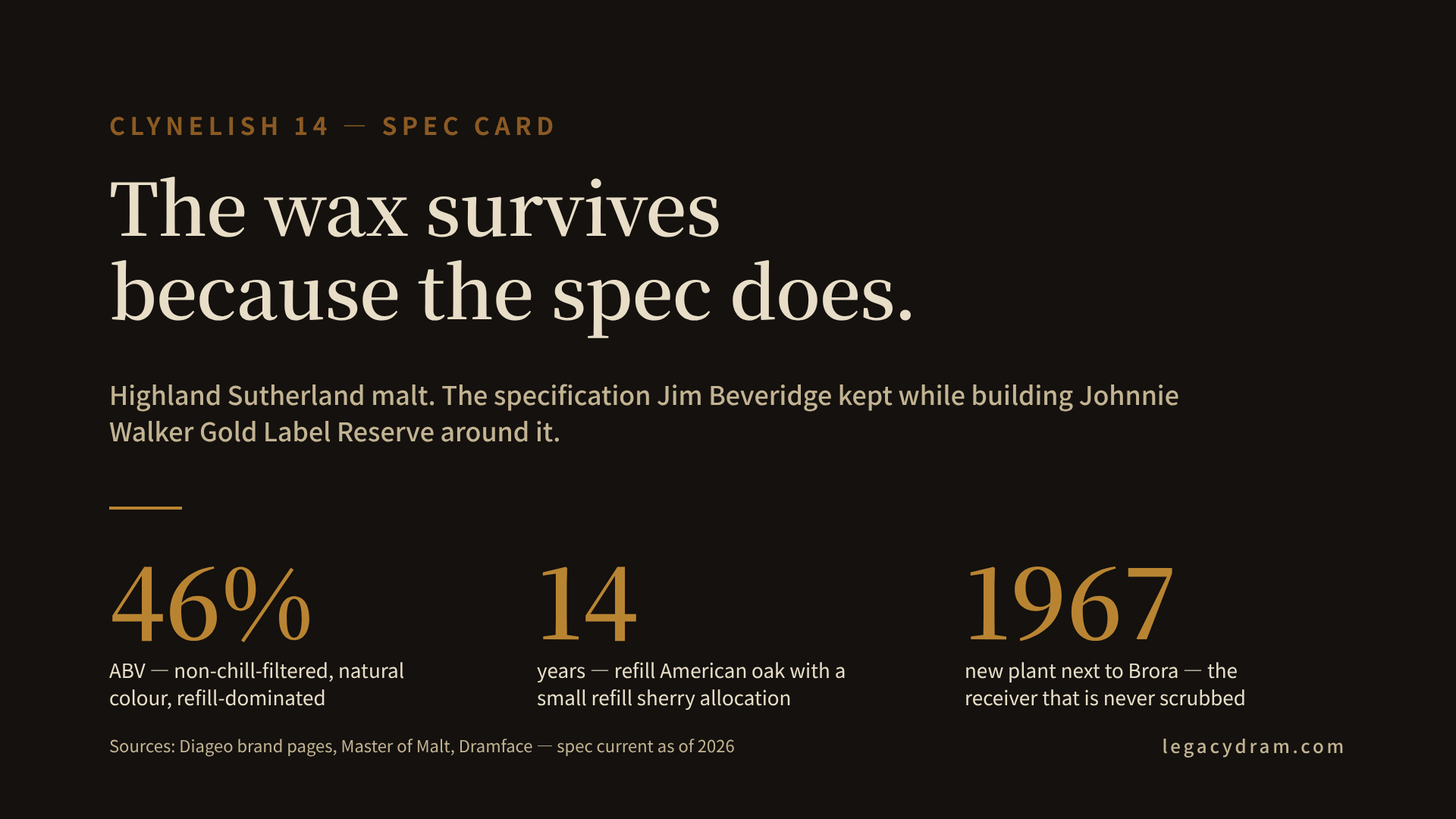
Jim Beveridge, who ran Johnnie Walker’s blending desk for the better part of two decades before retiring at the end of 2021, had spent forty years protecting exactly that sheen. He did not invent it. Clynelish’s wax is an accident of housekeeping — a tank the distillery has decided, since the 1970s, not to scrub properly — but Beveridge was the blender who built a global blend around it and kept the single malt at 46 percent, non-chill-filtered, when most of Diageo’s core-range Highland malts sit at 40. What arrived in the Glencairn was the surviving evidence of both decisions: an accident someone was paid to keep, and a spec someone was paid not to change.
I want to write about the bottle itself, and then about why it still tastes the way it does now that a different person signs off on the annual production plan.
Clynelish 14 — 46%, non-chill-filtered, around £48 in the UK, ¥7,500–9,000 in Tokyo
The person. Dr Jim Beveridge joined Distillers Company Limited (the predecessor of Diageo) in 1979 as an analytical chemist, worked through the blending team for two decades, took the Johnnie Walker master blender role around 2001, and retired on 31 December 2021 after roughly forty years with the company. He was made OBE in 2019 for services to the Scotch industry. Dr Emma Walker — no relation to the Walker family that gave the brand its name — took over on 1 January 2022 as the first female master blender in Johnnie Walker’s two-hundred-year history. The transition was signalled well in advance; Walker had already worked on Johnnie Walker for six years alongside Beveridge before he stepped down.
The reason Beveridge belongs at the top of a Clynelish 14 review is that he built Johnnie Walker Gold Label Reserve around Clynelish as its honey-and-oil third flavour column. Gold draws on around fifteen handpicked whiskies (single malts and grains), but the weight in the middle is Clynelish — the same long-chain fatty-acid esters that will coat your palate in a moment. Once Clynelish went into the middle of a globally standardised blend, the single malt effectively acquired a strategic reason to keep its most inconvenient piece of equipment — a low-wines-and-feints receiver the distillery refuses to clean — exactly as it is. Beveridge kept the pressure off. The tank stayed dirty.
The engineering. Three specifications are load-bearing on what you are about to drink.
46% ABV, non-chill-filtered. Diageo’s original Clynelish 14 Flora & Fauna, released from the early 1990s, was bottled at 43% and chill-filtered. When the whisky was relaunched as the flagship core-range expression in the early 2000s, the ABV was pushed up to 46% and the chill filter came off. This is not decorative. The waxy fatty-acid ethyl esters are only marginally soluble in water; at 43%, chilled and pushed through a cellulose pad, a measurable fraction drops out and gets stripped by the filter. At 46% they stay in solution long enough to reach the bottle and long enough to survive the moment they hit your saliva. The whole distillery is a machine for producing that texture; bottling it at 40% chill-filtered would be like ordering an oyster and asking the waiter to blot it first.
Cask policy. Clynelish 14 is a refill-dominated American oak assembly with a smaller allocation of refill sherry. First-fill sherry is not the majority — a fresh Oloroso coat would paint over the wax profile the plant is built to preserve — but there is enough refill sherry to give the whisky a middle note of dried fig without turning it into a dessert wine. The cask policy is the flip side of the still policy: the plant is producing a spirit with a rare mouthfeel, and the wood is chosen to stay out of its way. The colour is natural, no E150a.
New-make strength and the recycle loop. Clynelish’s new-make comes off at around 68–69% ABV, a touch below the Scottish average of 70. Combined with a feints cut point in the low sixties, this concentrates the exact fraction that carries the fatty-acid esters back into the recycle loop and deposits them in the receiver. That receiver — the tank the distillery does not scrub — is what accumulates the greasy film. That film is what you are about to taste.
What it tastes like, in specifics.
- Colour. Pale amber-gold, natural. In an overhead light the meniscus catches like weak honey.
- Nose. Beeswax first, unmistakably — a candle that has been burning for an hour, not a fresh candle. Behind it: grapefruit peel, a slice of Bartlett pear that has been sitting on the counter for a day, a mineral note the way a wet flint smells, and a faint dried-fig undernote from the refill sherry if you nose deeply.
- Palate. Here is the trick the whole essay has been circling. You drink it and the mouthfeel arrives before the flavour does — a candle-wax slickness across your tongue and the roof of your mouth, thicker than 46% ABV has any right to be. The flavour catches up half a beat later: caramelised orange peel, white pepper, a warm woody note somewhere between beeswax and dry hay. The alcohol is present but not sharp.
- Finish. Medium, drying slowly. The beeswax stays after everything else has left. Under it, a faint saltiness that reads as coastal — the distillery is a mile from the North Sea at Brora — and a bitter chocolate note that arrives about forty seconds after the swallow.
A wax mouthfeel sounds like something a candlemaker’s marketing team would put in a brochure. What it means, practically, is that the spirit stays on your tongue longer than the ABV predicts, so the caramelised-orange note has more time to do its work. Chemistry is not romantic. It is bookkeeping.
When to drink it. In a Glencairn or tulip glass at room temperature, roughly 18–20 °C. Not chilled: cold snaps the esters out of solution before they reach your mouth and the wax collapses. I have watched people drop a stone in Clynelish and be visibly confused when the trademark mouthfeel disappeared. If you add water, add one or two drops on the finger, not a splash. It opens the citrus a little; more than that and you pay for it with the wax.
Drink it late, after food. It is not an aperitif — the mouthfeel needs a mouth that has already been chewing on something else. For a specifically instructive comparison, pour it next to a Glenmorangie Original 10: two Highland distilleries running tall stills for reflux, landing at two very different textural conclusions because one bottles at 40% chill-filtered and the other at 46% non-chill-filtered. Same rough family of production choices; opposite outcomes in the glass.
The Brora question and the Johnnie Walker cluster
Two sidelights matter for the whisky in the glass.
Clynelish and Brora share a wall. Your bottle came out of the plant built in 1967 as an expansion of the 1819 site next door, which was renamed Brora in May 1969 and then ran heavily peated whisky under that name through the 1970s before shutting in 1983 and reopening as a small ghost distillery in 2021. The worm-tub condensers Brora uses are precisely what modern Clynelish does not have — the newer plant runs shell-and-tube condensers, which is one reason the waxy Clynelish profile is a modern invention rather than a Highland heritage. If you buy a Clynelish 14, you are not drinking the ghost. You are drinking the sister plant that survived by mattering to a blender.
And the Johnnie Walker angle keeps returning. When Alexander Walker built the consistency doctrine in the nineteenth century, it became the blender’s job to protect flavour components against the pressure to normalise them. Beveridge inherited that job a century later and applied it to a piece of equipment any competent operations engineer would have insisted on cleaning.
What to check next time you pour one
Three things will tell you whether the plant is doing what it is supposed to.
First, the film on the rim. Tilt the Glencairn slowly to about forty-five degrees, hold for a second, and set it back down. The whisky should leave a slower-than-expected sheet across the inside of the glass — legs that walk rather than run. If they run like a young wine, the bottle has been open too long, the temperature is too high, or the batch was cask-heavy on refill sherry and the wax is under-expressed.
Second, the arrival order on the palate. Mouthfeel first, flavour second. That order is diagnostic. If the caramelised orange or the pear reaches you before the slickness does, you are drinking a Clynelish that had its wax stripped somewhere — either during a warehouse period when the receiver was under-seasoned (as happened for the first six months after the 2017 refurbishment), or during a filtration you were not told about.
Third, the survival of the beeswax on the finish. Everything else can leave — the citrus, the pepper, the pear — and the beeswax should still be there thirty seconds later. It is the single component that maps most directly back to the tank at the distillery that nobody is allowed to scrub. If the finish tastes clean, you have not tasted the reason to buy the bottle.
Emma Walker took over Beveridge’s desk at the beginning of 2022. She has not touched the Clynelish 14 specification. The wax is the same in 2026 as it was in 2018. Sometimes a blender’s greatest achievement is a bottle that outlives their tenure without a footnote — an accidental piece of equipment upstream, a decision downstream, and a mouthfeel in the middle that would not exist if any competent person had decided to tidy up.
Try this bottle
Affiliate link below. If you buy through it, LegacyDram earns a small commission and the price you pay does not change. Alcohol-related links are intended for readers of legal drinking age (20+ in Japan, 21+ in the US).
Related reading
- Clynelish Waxy Whisky: Why the Feints Receiver Is Never Cleaned — the long form on the chemistry of the wax you just drank, and why one tank determines the flavour
- Jim Beveridge, Ghost & Rare, and the Rule He Broke — the master blender who built Gold Label Reserve around the Clynelish wax
- Alexander Walker and the Consistency Doctrine (JA) — the nineteenth-century founding rule that made the wax defensible a century later
- Glenmorangie Tall Stills and Bill Lumsden’s Reflux — the other Highland tall-still house, non-chill-filtered but a different textural conclusion
- Worm-Tub Condensers and Brora’s Sixteen Distilleries — what Clynelish’s sister plant next door still uses and modern Clynelish does not
Sources
- New master blender for Johnnie Walker as Jim Beveridge retires, 2021 — Diageo news
- Clynelish 14 Year Old — Master of Malt product page
- Clynelish 14yo review — Dramface
- Clynelish 14 Year Old Flora & Fauna history — The Whiskey Wash
- Clynelish distillery — Wikipedia
- Clynelish 14 Year Old review — Whisky Connosr