Macallan Oak Species Explained: Q. alba vs Q. petraea vs Q. mongolica (Stuart MacPherson's Three-Wood Method)
I stand a Macallan 12 Sherry Oak next to a Macallan 12 Triple Cask on the same table and I notice the wood does most of the work before the barley does. The Sherry Oak gives me raisins soaked overnight and a faint scrape of leather. The Triple Cask gives me lemon shortbread and a cleaner finish. Same distillate, same age, two different forests. Behind that fork sits a man whose name appears on no label: Stuart MacPherson, Master of Wood at Macallan from 2012 to 2022. He spent more of his year in Jerez sawmills and Ohio cooperages than in Speyside. The decision about which oak species touches the spirit first is a procurement decision, made years before any whisky is poured. The chemistry inside each cask is not poetry. It is a different lactone, a different vanillin yield, a different tannin profile.
The man who chose the forest
Stuart MacPherson started in 1979 as a fifteen-year-old apprentice cooper at Clyde Cooperage in Glasgow. Four years of bending staves, banging hoops, and listening to older coopers complain about the wood. By 2012, when Edrington appointed him Macallan’s Master of Wood, he had spent more than three decades on the procurement side of the bottle, the side that does not appear in marketing material because nobody has worked out how to put a sawmill in a Sunday-supplement photoshoot. (The Spirits Business)
He left Macallan in 2022 and is now Master of Wood at both Ardgowan, a Lowland distillery being built outside Greenock, and Nine Rivers in China. (Whisky Magazine) The wood program he ran at Macallan from 2012 to 2022 is the one I want to take apart here, because that decade is when the Sherry Oak / Double Cask / Triple Cask architecture got rebuilt around an audited supply chain rather than a brand story.
In 2016 MacPherson set up an audit team in Jerez de la Frontera to ride the sherry-cask process from sawmill to bodega, ensuring that the wood arriving in Speyside actually carried the maturation specifications it claimed to carry. (Alcohol Professor) In 2023 Macallan acquired half of Tevasa Forestal, the Jerez cooperage that had been making its European-oak casks since 1983. (The Spirits Business) That is the corporate scaffolding behind the wood program. The chemistry underneath it is the part the bottle actually tastes of.
Macallan publishes the line that up to 80% of the whisky’s character and 100% of its colour comes from the wood. Treat it as marketing if you must, but the spectrometers do not disagree. (The Macallan)
The whisky maker on the spirit side, Bob Dalgarno, controls the cereal. MacPherson controlled the cask. Macallan’s house style sits at the intersection of those two procurement decisions, and one of them is, by Macallan’s own admission, four times bigger than the other.
What lives inside an oak stave
Oak does not become a flavour engine because it is old. It becomes a flavour engine because, when you cook it and put a 63% ABV liquid against it for a decade, the polymers in the wood break apart in slow motion and release a specific family of small molecules into the spirit. The four that matter:
- cis- and trans-β-methyl-γ-octalactone (the “whisky lactone”, or oak lactone). A pair of ring-shaped esters that smell of coconut, with an incense edge in the cis isomer and a slightly woodier, drier edge in the trans. Detection threshold in the cis form is around 67 μg/L in spirit; the cis isomer is, by sensory studies, about ten times more potent than the trans.
- Vanillin (4-hydroxy-3-methoxybenzaldehyde, C₈H₈O₃). The principal pyrolysis product of lignin, with a sensory threshold of about 60 μg/L in ethanol. The smell of vanilla is, in a strict molecular sense, this compound.
- Ellagitannin. A family of hydrolysable tannins that contribute dry, astringent, leather-and-walnut character. European oak carries roughly five to ten times the ellagitannin load of American oak.
- Furfural / 5-methylfurfural / guaiacol / eugenol. Pyrolysis fragments of hemicellulose and lignin: caramel, smoke, clove. These scale with how aggressively the cooper toasted the cask before filling it.
Toasting and charring are how the cooper unlocks all four. Heat the inner surface of the stave to roughly 180–220°C for a few minutes (medium toast) and lignin fragments into vanillin, syringaldehyde, guaiacol, and 4-methylguaiacol; hemicellulose caramelises into furfural and 5-methylfurfural; cellulose stays largely intact. Push it harder to ~700°C for under a minute (char level 3 or 4) and you lay a thin black activated-carbon zone on top of the toasted band, which adsorbs sulfur and feinty esters during maturation. (MDPI Foods, 2023)
The lactone story is the one that varies most by species, and species is the variable MacPherson controlled.
The three forests, in numbers
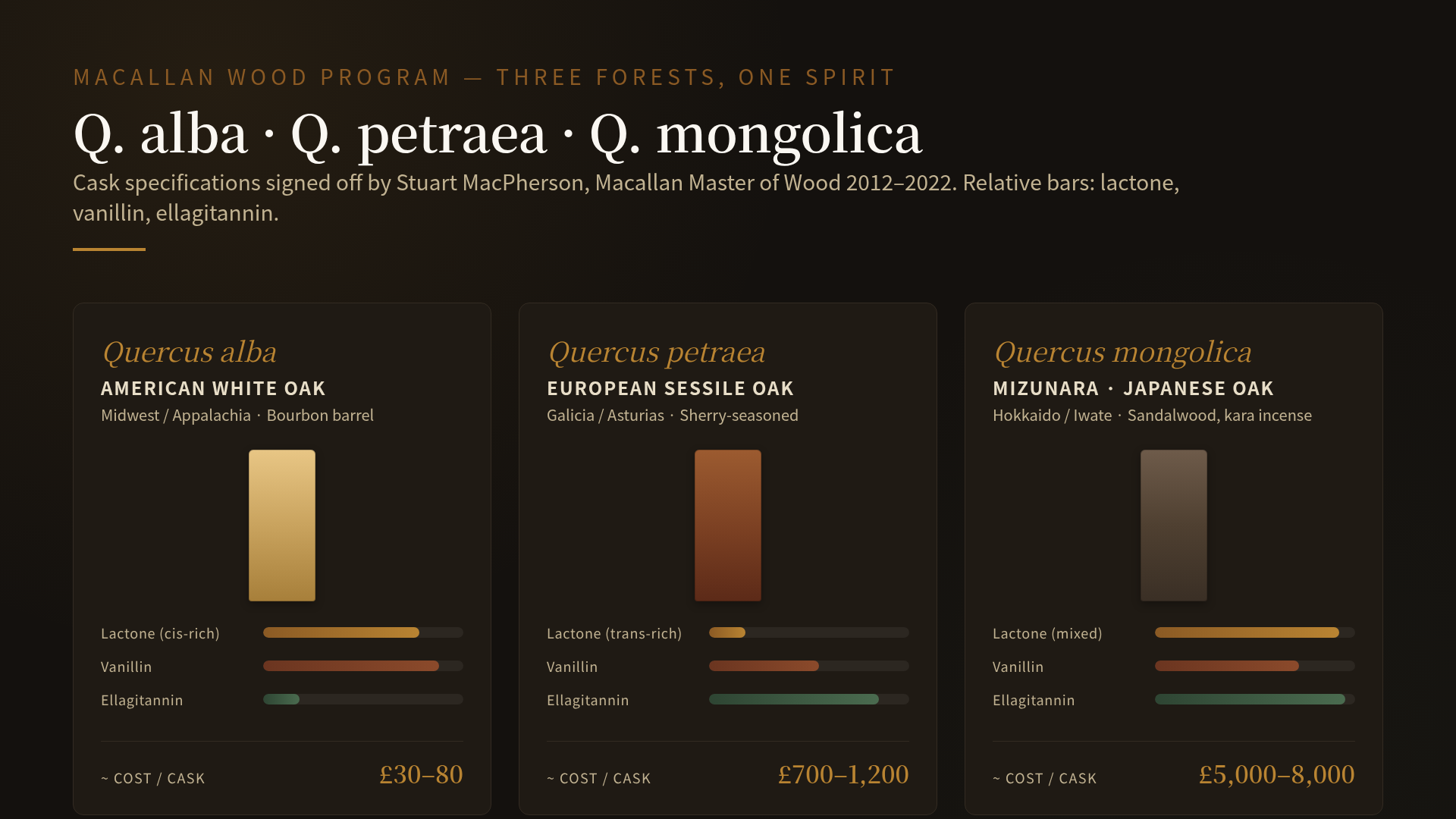
Quercus alba (American white oak)
The default oak of the bourbon barrel. Grown across the midwestern and Appalachian United States, kiln-dried or air-seasoned, charred (typically level 3 or 4), filled with bourbon mash for two to four years, emptied, dunnage-shipped to Scotland.
- Whisky lactone total content is roughly twenty times that of European oak. The cis:trans ratio is biased toward cis, with cis isomers dominant, which is what gives bourbon-cask spirit its coconut-and-vanilla front. (UC Davis Waterhouse Lab)
- Vanillin extraction is the highest of any commercial oak species in widespread use, partly because lignin content is higher and partly because the char layer pyrolyses cleanly into vanillin precursors without the heavier guaiacol shoulder that European oak produces.
- Ellagitannin load is low. The spirit picks up little astringency. The result is sweet, soft, vanilla-and-coconut, with very little dry finish.
Cost: in the £30–80 range per refill cask landed in Scotland, depending on first-fill or second-fill status. This is the cheap rung. The Triple Cask uses American oak as one of its three components and the Double Cask uses it as one of its two; without it, Macallan’s entry-tier products would not be priced where they are.
Quercus petraea (European sessile oak)
The Macallan sherry oak. Grown in Galicia, Asturias, Cantabria, and parts of southwest France, felled, air-seasoned outdoors for at least eighteen months, milled into staves at Tevasa and partner sawmills, coopered in Jerez, then sherry-seasoned: filled with Oloroso or Pedro Ximénez for typically two years inside a Jerez bodega before being emptied and shipped to Speyside. (Edrington)
- Whisky lactone total is roughly one-twentieth of Q. alba’s. The cis:trans ratio inverts: trans-isomers dominate at around 55–65% of the lactone pool in European oak samples, which is why European-oak spirit reads as drier, woodier, and less coconut-forward. (Cis-3-Methyl-4-octanolide, Wikipedia)
- Vanillin yield is moderate, somewhat lower than American oak, partly because the lignin profile is different and partly because the sherry seasoning step has already extracted some of the easily mobilised lignin fragments.
- Ellagitannin load is high. This is the source of the dry, leathery, walnut-shell astringency in Sherry Oak Macallan, and it is what the sherry-seasoning step exists to tame. Two years of Oloroso pre-soaking strips back the harshest tannin spike that would otherwise dominate the first three years of whisky maturation.
Cost: roughly £700–1,200 per sherry-seasoned hogshead landed in Speyside, which is the number industry analysts cite when explaining why Macallan 12 Sherry Oak has tracked above £100 on the British shelf for the last three years. European oak is, in MacPherson’s own description, harder to source consistently: knotted, more porous than American oak, fewer usable staves per log. (The Manual interview)
Quercus mongolica var. crispula (Mizunara)
The Japanese outlier. Grown in Hokkaido, Iwate, and Aomori. The Japanese name means “water oak”, from the high moisture content of the living wood, which is also the reason the cask leaks more often than its peers. Mizunara wood is split with an axe rather than cut with a saw because the grain refuses to yield clean staves under mechanical pressure, and the resulting staves are about 38 mm thick, meaningfully thicker than the 22–28 mm standard for European or American casks. (Edinburgh Whisky Academy)
- Whisky lactone total is, surprisingly, the highest of the three. Mizunara-matured whiskies have been shown to contain more lactones than whisky matured in either European or American oak. The really odd finding is that Mizunara carries a notable load of the trans isomer despite the cis being far more aromatically potent. The sensory output is still cis-driven, but there is more raw material than the species ranking would predict.
- Vanillin content is high. Aroma chemists describe Mizunara-aged spirit in terms of sandalwood, kara (oriental incense), and ripe pineapple, with vanilla and coconut sitting underneath as foundation notes. (Whiskipedia: Mizunara casks)
- Ellagitannin load is very high (the highest of the three), and the porosity of the wood compounds the effect by accelerating evaporation and oxygen ingress.
Cost: £5,000–8,000 per hogshead, sometimes higher. The species grows slowly, mature trees are protected as a forest resource, and the working failure rate during coopering is significantly above European or American oak. Macallan has released only a small handful of Mizunara expressions, including the 33-Year-Old 1991 Origins Sherry-Mizunara, which sat at the £12,000 end of the secondary market on release. (Bonhams auction listing) The reason Mizunara never makes it into a 12-year-old at any distillery is not romance. It is that the species refuses to perform.
Why Mizunara won’t perform under fifteen years
This is the part I find most interesting as an engineer. Mizunara has more lactone, more vanillin, and more tannin than the other two oaks. By the headline numbers, it should be the most aromatic of any cask. In practice, under twelve years of maturation, Mizunara whisky tastes thin and astringent. The signature sandalwood-and-incense character does not appear.
The mechanism, as I read the literature, is two-fold. First, the high tannin load dominates the early maturation profile, masking the lactone signal until the tannin has been blunted by ester polymerisation and oxidative cleavage, a process that takes roughly a decade. Second, the lactone precursors in Mizunara are bound up as glycosides, just as they are in European oak, and the slow hydrolysis of those glycosides into free lactones happens on a timescale of years, not months. A young Mizunara cask is leaking spirit faster than it is releasing aroma, which is the worst of all worlds for a financial-engineering perspective.
So the operating envelope for Mizunara is fifteen years and up, in a maturation programme that has the patience for it, and that prices the finished product at a level where the cask cost is amortised. The Macallan Mizunara releases are at 25 to 30 years and up for exactly this reason. Suntory’s Yamazaki Mizunara releases sit at 18 years for the same reason. Mizunara at twelve does not exist as a commercial product because the chemistry will not cooperate, not because nobody has thought to try.
(I want to call Mizunara the production-grade haunted oak of Japanese whisky and walk away. The duller and truer description is: it is a species with a beautifully calibrated end-state and a thoroughly inconvenient ramp-up curve.)
The cost ladder and what it forces
Here is the Macallan wood economy, stacked in one place:
| Cask type | Wood | Sherry-seasoned? | Approx. cost / cask | Macallan product line |
|---|---|---|---|---|
| Bourbon barrel | Q. alba | No | £30–80 | Triple Cask / Double Cask (American component) |
| Sherry-seasoned hogshead | Q. petraea | Yes, Oloroso/PX, ~2 yrs | £700–1,200 | Sherry Oak / Double Cask (European component) |
| Sherry-seasoned American hogshead | Q. alba | Yes, Oloroso/PX, ~2 yrs | £200–400 | Triple Cask (sherry-seasoned American component) |
| Mizunara hogshead | Q. mongolica | No (typically) | £5,000–8,000+ | Edition / Origins limited releases |
(Cask prices are industry-reported approximations, not Macallan-published figures. Treat them as orders of magnitude. The published figures, if they exist, sit inside Edrington’s procurement contracts.)
The cost ladder is what forces the product architecture. A Macallan 12 Sherry Oak filled entirely with European oak hogsheads at £1,000 each is, in cost-of-goods terms, an order of magnitude more expensive than a Macallan 12 Triple Cask with a substantial American-oak component. The price gap on the shelf (Triple Cask at roughly £55–65, Sherry Oak at roughly £110–130) is not arbitrary; it tracks the cooperage invoice. The Mizunara editions are not aspirational pricing; they are the cask cost amortised over a 25-year maturation at a 2% angel’s share, divided by however many bottles a single hogshead yields, plus a margin. If the cask costs £6,000 and yields 240 bottles after 25 years, that is £25 of wood in every bottle before anyone has paid for the barley, the still, the warehouse, or the marketing.
This is also why Macallan ran into a supply problem in the early 2020s. Sherry seasoning takes about two years per cycle. The number of bodegas in Jerez willing to dedicate volume to seasoning casks for a single Scotch buyer is bounded by the size of the Jerez wine industry, which has been in slow decline for forty years. The Macallan 12 Sherry Oak price spike that started around 2021 and pushed the bottle past £100 in the UK is the upstream constraint expressing itself: there are physically not enough European-oak sherry-seasoned hogsheads being produced to meet demand at the previous price. MacPherson’s 2016 audit team and Edrington’s 2023 acquisition of half of Tevasa are both responses to that constraint, attempting to vertically integrate the bottleneck.
If you are reading my Kindle book on whisky cost-performance and wondering why Glendronach 12 and 18 have crept up the cost-per-flavour-unit ranking over the last three years, this is the answer in one sentence: the same Spanish forests that supply Macallan supply Glendronach, the same bodegas season the same hogsheads, and the same supply ceiling is hitting every European-oak-heavy Speyside at the same time. Rachel Barrie’s work at Glendronach is upstream of the same procurement physics that MacPherson worked downstream of.
What you actually taste, by oak
Pour the three Macallans side by side: Triple Cask 12 (American oak heavy), Double Cask 12 (European + American), Sherry Oak 12 (European oak only). The lactone math walks straight onto your palate:
- Triple Cask 12: pale gold. Lemon zest, vanilla custard, faint coconut, white shortbread. Light body, soft mouth, short clean finish. The American-oak contribution is loud. Q. alba is doing 70%+ of the flavour work.
- Double Cask 12: amber. Honey, dried apricot, a little spice, with the coconut pulled back and a slight tannic grip on the finish. The European-oak ellagitannin is now audible.
- Sherry Oak 12: deep amber-to-mahogany. Raisin soaked overnight in dark molasses, leather, walnut skin, a long dry finish. Almost no coconut. The trans-lactone profile of Q. petraea and the heavy ellagitannin load are running the show.
Stand a Macallan Mizunara edition next to those three and you get a fourth direction entirely: sandalwood, pineapple skin, kara incense, oriental spice. The Mizunara character does not slot onto a linear scale between the other two oaks. It sits on a different axis. This is partly the trans-lactone load and partly the unique presence of certain volatile guaiacol derivatives that, as I read the literature, are reported in Mizunara more than in the other commercial oaks.
I will say what I always say at this point: this is not “the best oak”. There is no best oak. There are three oaks with three different chemical envelopes, three different cost structures, three different maturation timescales, and three different commercial logics. Macallan’s house style is the deliberate calibration of how much of each goes into each bottle, and Stuart MacPherson’s decade as Master of Wood was the decade in which that calibration was rebuilt into an auditable supply chain rather than a brand story.
The interface and the man
A cask is in the warehouse for one decade, sometimes two, sometimes more. The wood was alive for one to three centuries before that. The lignin in the stave was laid down by photosynthesis in a Galician forest in the 1800s, or in an Ohio bottomland in the 1950s, or in a Hokkaido valley in the 1700s. The cooper toasted it. The bodega seasoned it. The warehouse stored it. Stuart MacPherson signed the audit. Bob Dalgarno cut the spirit into it. Some warehouseman racked it. You, eventually, pour it.
The interesting thing about the wood program is that almost nobody in the chain is irreplaceable. MacPherson left Macallan in 2022 and the bottle is still there. He is currently Master of Wood at Ardgowan and at Nine Rivers in China, building the equivalent supply chains for distilleries that, twenty years from now, will be pouring whisky into glasses I will not live to taste. The wood program he leaves at each place is the artefact. The man moves on; the system stays.
When you next pour a Sherry Oak 12 or a Triple Cask 12 or, if you have the budget, a Mizunara edition, the bottle in front of you is the output of three procurement decisions, three species of oak, two lactone isomers, two pyrolysis temperatures, and a sherry-seasoning step. Every part of that chain has a man or a woman at the bottom of it. MacPherson is one of them. The fact that any of this ends up on a Tuesday-night table is, as far as I can tell, the standard outcome for any system run carefully enough to be worth drinking from.
Related reading
- Jim Swan’s STR cask process — what happens when you rebuild the interface of a tired barrel from the inside
- Rachel Barrie’s blend matrix at Glendronach — the same European-oak supply constraint, a different Speyside house
Sources
- The Spirits Business — The Macallan appoints a new master of wood (2012)
- Whisky Magazine — Interview: Stuart MacPherson on becoming Ardgowan’s master of wood
- Alcohol Professor — The Macallan’s Master of Wood
- The Manual — Q & A with The Macallan’s Master of Wood
- The Spirits Business — Macallan buys Sherry cask maker (Tevasa, 2023)
- Edrington — The Macallan announces new Sherry cask partnership
- The Macallan — Mastery of Wood and Spirit
- UC Davis Waterhouse Lab — Oak Lactones
- cis-3-Methyl-4-octanolide (Wikipedia) — cis-/trans-isomer ratio in oak species
- Whiskipedia — Mizunara oak whisky casks
- Edinburgh Whisky Academy — Shortcut: Mizunara oak
- MDPI Foods (2023) — Factors Modulating the Potential Aromas of Oak Whisky Barrels: Origin, Toasting, and Charring
- Bonhams — Macallan 33 Year Old 1991 Origins Sherry-Mizunara auction listing