Talisker 10 Review: Worm Tubs, Five Stills and the 1960 Fire
A Tuesday in May, eighteen degrees outside and twenty-two inside, three Glencairn glasses on a kitchen table that was not designed for tasting flights and is too high for the chair. Talisker 10 at 45.8%, Oban 14 at 43%, Clynelish 14 at 46%. Three Diageo distilleries on the western and northern edges of the Highland map, three different worm-tub answers to the same question about copper. Fifteen minutes of rest, no water in the first pass, plain crackers for the palate and a small jug for the second pass. I had cleared the morning to write about whisky and discovered, as one does, that what I actually wanted to write about was a pair of nineteenth-century brothers I would prefer the back label not mention.
The friend who lives in Tokyo and drinks too much Macallan was, mercifully, not present. I would have wanted to compare notes, and I would have ended up explaining what an inverted-U lyne arm is over a flight that cost about 18,000 yen all in. Better, this time, to read it through alone and write it down.
The brothers nobody wants on the bottle
The Talisker website will tell you the distillery was founded in 1830 by Hugh and Kenneth MacAskill. It will not tell you what Hugh and Kenneth did in the years immediately before that.
The brothers were the sons of a parish doctor on Eigg, the small island west of Skye. By the late 1820s they had returned to Skye and acquired the lease of the Talisker estate from the chief of Clan MacLeod, plus, in 1829, a 20-acre site at Carbost on the shore of Loch Harport. Their business model on the estate was sheep. To make room for the sheep, they evicted the existing tenants, the same model being run, in different hands, across most of the western Highlands and Hebrides through the first half of the nineteenth century. That model has a name now, and it is not a flattering one. The Highland Clearances were a long, regionally varied programme of forced displacement that emptied glens and coastal townships of crofting families to make grazing land profitable for landlords. The MacAskills were not the largest actors in it. They were, by the standards of their class and decade, ordinary actors in it. The whisky came after.
The distillery opened at Carbost in 1831 and was almost immediately a financial problem. By 1848, eighteen years after founding it, the brothers had lost control and the bank was running the operation. The business cycled through Anderson, then Roderick Kemp, then in 1916 was absorbed by the Distillers Company Limited, the eventual core of Diageo. The brothers stop being relevant to the bottle at the 1848 handover. They are the founders, and the founders went bankrupt.
I write this part out because the back label and the visitor centre tend to compress it into “founded in 1830 by Hugh and Kenneth MacAskill” with a soft-focus engraving and a sentence about pioneering spirit, and the actual sentence is something more like “founded in 1830 by two recently bankrupted local landlords who had spent the preceding decade clearing the people off their land and into emigrant ships, and who were out of the whisky business in eighteen years.” That sentence is harder to put on a bottle. It is also more accurate.
The five stills that should not exist
If you build a single malt distillery today, you put in an even number of stills. Two, four, six. One for the first distillation (the wash still) and one for the second (the spirit still), paired. Talisker has five. Two wash stills and three spirit stills.
This is not an aesthetic choice. It is a relic. Until 1928, Talisker ran a triple distillation regime, the same family of process Auchentoshan still runs and Springbank runs a partial version of. Three distillations from wash to spirit means three different still types, and a two-to-one wash-to-spirit ratio is not unusual for triple-distillation plants. When the distillery converted to standard double distillation in 1928, the year they aligned with the regional mainstream, they did not rebuild the stillhouse to match. They kept the five stills, redirected the flows, and absorbed the awkward production maths.
The result is one of the most unusual stillhouses in Diageo’s portfolio. Each wash still feeds, on average, 1.5 spirit stills, and you reach that with a cut-balancing schedule that nobody outside Carbost would invent from scratch. Were a consultant to walk into the stillhouse today and propose to a finance committee that they install five copper stills in a 2:3 ratio, they would be asked to come back with a different proposal. The configuration exists because it existed in 1928, and removing it would mean removing the spirit. Diageo, for nearly a century, has not removed it.
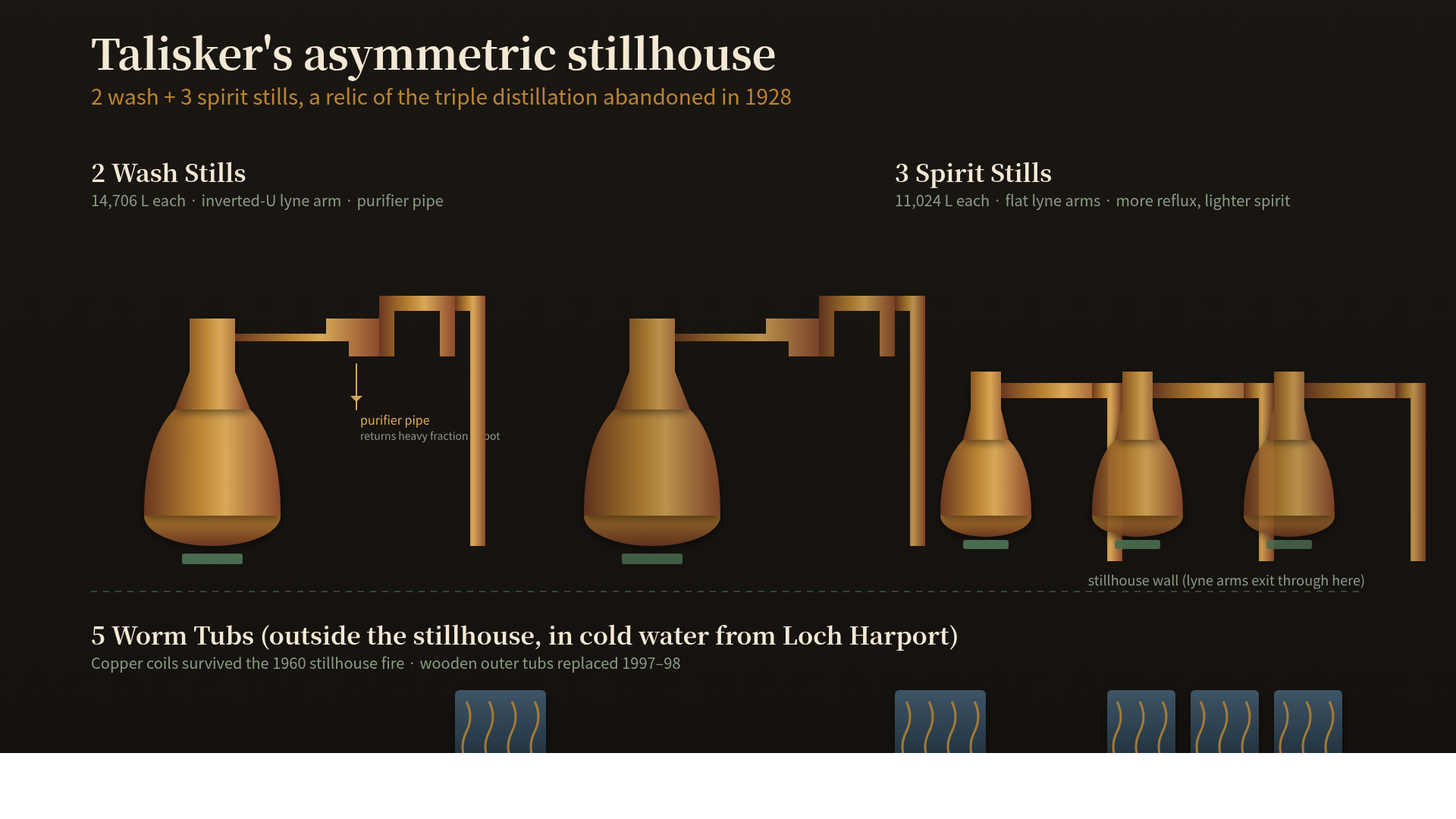
The other oddity is the shape of the wash-still lyne arms, the pipes that carry hot vapour from the top of the still to the condenser. On most distilleries the lyne arm slopes downward (favouring throughput, heavier spirit) or upward (favouring reflux, lighter spirit). At Talisker, the wash-still lyne arms drop, exit the stillhouse through the wall, and then rise and fall again in an inverted U-shape before plunging into the worm tubs outside. At the point where each lyne arm goes through the wall, a purifier pipe returns a portion of condensed vapour back to the still. The spirit-still lyne arms, by contrast, are flat: more reflux, lighter spirit, a counterweight to the heavier wash distillate.
The purifier pipe is the part most easily overlooked. It is a small piece of plumbing that, by re-condensing and returning the heaviest fraction of the wash vapour before it ever reaches the condenser, sharpens the cut and concentrates the volatile compounds that will become Talisker’s pepper signature. It is a 19th-century engineering decision, sized in inches and made of copper, that still meaningfully determines what the bottle smells like.
The fire that did not take the worm tubs
In November 1960, somebody left a valve open on the No. 1 spirit still. The still at that point was still coal-fired: under the pot, an open fire of hot coals. When the spirit overflowed, it met the flames, and the stillhouse burned down.
The five stills were destroyed. Diageo’s predecessor (then the Distillers Company Limited) had a choice in 1962 about what to rebuild. They could have used the fire as an opportunity to modernise: replace the coal firing with steam coils (which they did), replace the 2:3 still ratio with a sensible 2:2 (which they did not), replace the five worm tubs with shell-and-tube condensers (which they did not), and quietly bring Talisker into line with what an efficient mid-century distillery looked like. They chose to do none of the structural rebuilds. The stills were re-fabricated as exact replicas, including the purifier-pipe-and-inverted-U lyne-arm geometry on the wash stills, including the flat lyne arms on the spirit stills, including the asymmetric 2:3 ratio.
The worm tubs themselves, long copper coils sitting in cold outdoor water, had survived the stillhouse fire. The copper coils on the 1960 worm tubs were the same coils Talisker had been condensing through for decades before. The wooden outer tubs were eventually replaced in 1997–98, in the kind of unsensational maintenance that does not make press releases. What is sometimes claimed as “the worm tubs are unchanged since the 19th century” should be qualified: the spec is unchanged; the parts have been periodically renewed.
Five worm tubs, even small ones, are not free. They use more cooling water than shell-and-tube condensers, they take more space, they need outdoor exposure, and the cold-water flow has to be managed differently summer to winter. They are also slow. The vapour spends longer in less copper, and the copper-to-vapour surface area is roughly a fifth of what you would get from a modern condenser of equivalent throughput. Sulfur compounds (the dimethyl sulfides and mercaptans that copper would otherwise scrub off the new make spirit) pass through with less attention. They land in the receiver. They follow the spirit into the cask.
Diageo’s spreadsheet, between 1962 and 1998, had every reason to retire the worm tubs and replace them with condensers. The spreadsheet did not. The bottle is the difference.
The three glasses
Back to the May Tuesday and the kitchen table.
The Talisker 10, in the first nose, smells of a fishmonger’s display about thirty seconds after the fillets have been replaced on the ice: that particular brine that is salt plus chilled iron plus a faint, far-off iodine. Underneath that, a pepper note that is not the bright top of fresh black peppercorn but the dustier, woodier middle of a peppercorn cracked twenty minutes ago and left exposed. The smoke is the last layer, more like cool ash than active fire. On the palate, the heat arrives behind the tongue and creeps forward, the salt is fresh rather than cured, and the finish leaves the kind of soft sting on the gums that you feel after biting into a slice of pickled chilli without meaning to. Three drops of water, and the brine softens and the pepper opens out into something closer to allspice and a clove that has been sitting in a jar for a year. The phenols, in the bottle, are about 5–7 ppm, a quarter of what a standard Islay malt carries, and chemically not the same kind of phenol either, because Skye peat is not Islay peat. The smoke at Talisker is the residue of a different plant entirely.
The Oban 14, beside it, is a register lighter. The Stevenson brothers, John and Hugh, built the Oban distillery in 1794 as one of several local businesses including a slate quarry, a tannery, and a brewery, and the spirit they laid down was West Highland in a way that is geographically defensible and stylistically halfway between Highlands and Islands. On the nose it is orange peel curling on a winter table, a soft toffee that did not quite set, and a smoke that is the memory of a wood stove rather than the stove itself. The palate is honey, gentle salt, a slow burn rather than the Talisker prickle. The worm tubs here also leave sulfur compounds in the spirit, but the underlying malt is unpeated or barely peated, so the sulfury structure reads as savoury rather than smoky. It is, of the three, the easiest to drink without thinking, and that is both its strength and the reason it is rarely written about.
The Clynelish 14 is the surprise. The distillery sits at Brora on the eastern coast of Sutherland, about as far from Skye geographically as you can be while still calling it Highland, and it is one of the strangest spirits in Diageo’s mainstream portfolio. Clynelish runs a deliberately fouled feints-and-low-wines receiver (the tanks where the un-distilled fraction is collected and recycled), and the build-up of long-chain fatty residue in those tanks (the technicians call it “the gunk”) is what produces Clynelish’s signature waxy texture. Clean the tanks too thoroughly and the waxiness disappears. On the nose: a beeswax that has been warmed in the hand, lemon oil rubbed into an old wooden handle, a sweetness that is closer to sun-dried apricot than to honey. On the palate, the wax is the texture, not just the flavour. The spirit coats the inside of the mouth and the finish stays in the wax layer rather than the salt. There is a brininess, but it is sea-air-on-a-cliff brine rather than fishmonger brine. It is also a reminder that the Highland Clearances are not a Skye-only story: Clynelish was originally founded in 1819 on the order of the Marquess of Stafford (later the 1st Duke of Sutherland), who, with his wife, oversaw the clearance of around 15,000 people across a 500,000-acre Sutherland estate. The distillery existed because his commissioners thought, correctly, that displaced crofters would form a captive customer base for legal spirits if illicit ones were suppressed. Two of the three bottles on my table this evening have founder histories of the same flavour, and neither label says so.
The flight, in total cost, runs to about 18,000–22,000 yen for three bottles that you can keep on the shelf for a long time and pour against each other indefinitely. As a way of learning the Diageo Coastal Highland triangle (Skye worm tubs and 2:3 stills, West Highland small-town worm tubs and balanced doubles, Sutherland eastern coast worm tubs and waxy feints), it is one of the more efficient flights you can build at the price.
Where Talisker sits in the portfolio
In 1988, what was then United Distillers and Vintners launched The Classic Malts of Scotland: six single malts intended to represent the regional map. Glenkinchie (Lowland), Dalwhinnie (Highland), Oban (West Highland), Cragganmore (Speyside), Lagavulin (Islay), and Talisker (Island). The six bottles, sat in a row, became the introductory framework for a generation of single malt drinkers, including, much later, a smaller generation of Japanese drinkers I’m part of.
The Talisker selected for that launch was the 10-year-old. Before 1988 the distillery’s standard expression had been an 8-year-old; the move to 10 was both a marketing decision and an inventory one. Forty-five point eight percent ABV. That fraction is not the original natural cask strength but a deliberately chosen bottling strength that, when you do the maths, comes out to a tidy 82.4 British proof on the old imperial scale. It is, like much else in this bottle, a number from a different system that was kept because changing it would change the dram.
If you read the Classic Malts launch with engineering eyes, what it does is take six distilleries that were historically blend components and pull them into the single malt market without breaking the blends. Talisker was, and to a degree still is, a heavy contributor to Johnnie Walker. The 10-year-old is the share that gets to come out of the blend stack. The rest goes back into Black Label and the rest of the Diageo blend portfolio, which is why the Talisker 10 you drink and the Talisker that informs your taste of Johnnie Walker are made on the same five stills, in the same worm tubs, with the same purifier pipe.
The current Talisker distillery manager, James Houston, took over from Mark Lochhead in the early 2020s and inherited a configuration that nobody now alive helped design. Houston’s predecessors, Lochhead’s predecessors, and so on back to the post-1916 DCL managers, are all in the same structural position: they did not design Talisker; they were asked to keep Talisker running. The job is custodianship, not invention. The bottle is the cumulative result of more than a century of people declining to rationalise the asymmetry out of the system.
What to verify next time you pour one
If there is a Talisker 10 in the house, or a friend is about to open one, the things to check on your own palate are these.
First, the pepper. It is not bright, sharp, freshly cracked black pepper. It is a duller, woodier middle-of-the-peppercorn pepper, more like white pepper or allspice once it has rested in the glass for a few minutes. That register is what the worm tubs and the purifier pipe between them are doing. Without the worm tubs, the new make would have less sulfur character and the pepper would read brighter and shorter; without the purifier pipe, the cut would be less concentrated.
Second, the smoke. It is cool, low, ash-like. It is not the medicinal Islay phenol of Lagavulin or Caol Ila, and it is not the heather-honey Orkney smoke of Highland Park. It is a third kind of smoke, made from Skye peat with a marine component but a different plant balance, and bottled at about 5–7 ppm in the spirit. If you have a Lagavulin 16 or a Bowmore 12 in the cupboard, pour them side by side and feel the difference in the phenol structure rather than the phenol quantity.
Third, the brine. There is no Loch Harport seawater in the bottle. The brine is the residue of years of cask maturation in salt-rich coastal air, with some additional contribution from the sulfury new make spirit reading as savoury rather than just smoky. The brine is location, but not in the romantic sense. It is a long, slow, technically describable chemistry.
If those three registers are there and roughly in balance, you are tasting a configuration that should not have survived 1962 and a brand history nobody would write into the marketing if it were not already written. The bottle does not know what it is supposed to be. The drinker, occasionally, does.
Try this bottle
Affiliate link below. If you buy through it, LegacyDram earns a small commission and the price you pay does not change. Alcohol-related links are intended for readers of legal drinking age (20+ in Japan, 21+ in the US).
Related reading
- The Heather Half: Highland Park 12, Hobbister Peat, and What Gordon Motion Inherited from Orkney: a different peat, a different portfolio strategy, three custodians of a recipe none of them wrote
- The Reflux Equation: Why Glenmorangie’s Stills Are 5.14 Metres Tall (and What Bill Lumsden Inherited): another distillery where the geometry of the stillhouse is the spirit, and the engineer’s job is custodianship rather than invention
- Frank McHardy and the Silent Years: How Springbank’s Restart Survived Itself: the Campbeltown counterweight to the Diageo portfolio model
Sources
- Talisker distillery — malts.com / Talisker
- Wikipedia: Talisker distillery
- Difford’s Guide on Talisker history — diffordsguide.com
- Scotch Whisky on Talisker — scotchwhisky.com
- Maltspedia distillery profile — maltspedia.com
- Classic Malts of Scotland — Wikipedia
- Oban distillery history — Wikipedia
- Clynelish distillery — Wikipedia and scotchwhisky.com
- T.M. Devine, The Scottish Clearances: A History of the Dispossessed, 1600–1900 (Allen Lane, 2018)
- James Hunter, The Making of the Crofting Community (John Donald, 1976; rev. ed. 2010)