Kilchoman Farm Distillery: How Anthony Wills Built Islay's First New Distillery in 97 Years (Barley-to-Bottle)
There is a distillery on Islay that grows its own barley. The barley grows on a farm called Rockside that you can walk to from the still house. The man who decided this should be possible took up the land in 2002, started distilling on the 14th of December 2005, and released his first three-year-old whisky in September 2009. His name is Anthony Wills, and before he moved to Islay he was a wine merchant in London. The distillery he built, Kilchoman, was the first new distillery built on Islay since 1908, makes about a tenth of what Bowmore makes in a year, peats its on-site malt to twenty parts per million of phenol, buys mainland malt at fifty, and bottles a release every year that is made from nothing but barley grown in the field outside the maltings door. When I poured a glass of Kilchoman Machir Bay last winter, I was drinking the only Islay whisky on my shelf whose grain, malting, distillation, maturation and bottling all happened inside a single fence.
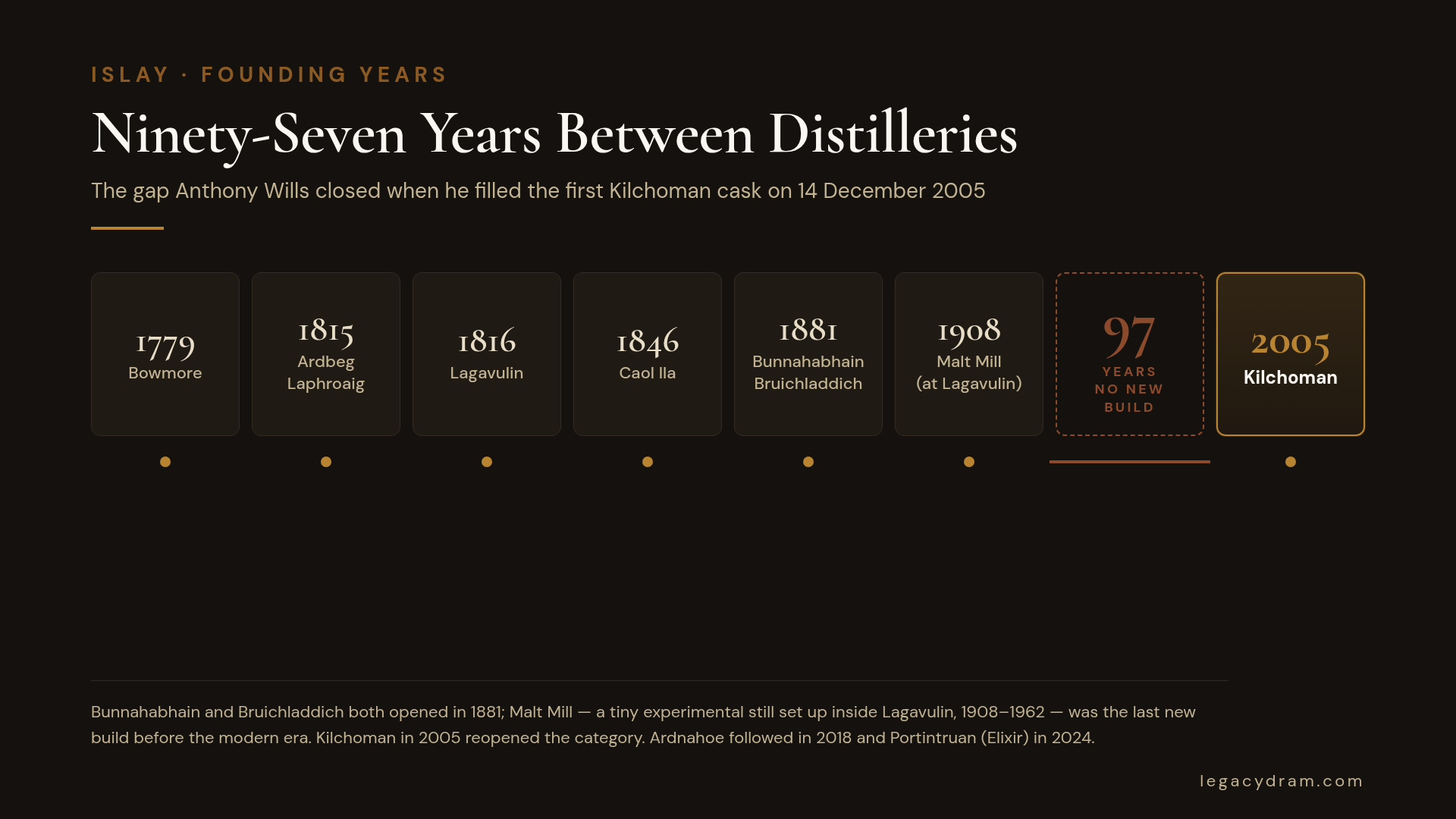
What “first since 1908” actually means
The phrase Kilchoman’s marketing uses for itself is the first new distillery built on Islay since 1908. The phrase is technically correct and structurally misleading, and the second of those things is the more interesting fact about Islay.
What was built in 1908 was a tiny experimental distillery called Malt Mill, set up inside the Lagavulin complex by Peter Mackie to copy Laphroaig (with whom Mackie had a long-running feud) and run as a kind of internal R&D project. It produced spirit until 1962, when the equipment was decommissioned and absorbed back into Lagavulin proper. So Malt Mill is the technical last-new-distillery-before-Kilchoman, but it was not really a distillery in the usual sense. It was an extra still house on someone else’s site.
The last new commercially independent distillery on Islay before Malt Mill was either Bunnahabhain or Bruichladdich, both built in 1881. So the human-scale way to read the gap is: between the construction of Bruichladdich and the first cask filled at Kilchoman, one hundred and twenty-four years went past in which no one new opened a distillery on Islay. A London wine merchant decided in 2002 that the next one should be his. The eight distilleries already in operation had been quietly making whisky for between 124 and 226 years, and none of them were asking. Wills bought into the field anyway.
Anthony Wills, before Islay
Wills was born in England and spent his career in the London wine trade before he moved to Islay in the late 1990s with his wife Kathy and their three sons. He had no prior connection to Scotch whisky as an industry. The thing he had, by his own account in later interviews, was a long fascination with the idea of farm distilling: the configuration that had been standard in the Scottish Highlands and Islands until the late 1820s, when the Excise Act of 1823 made commercial-scale licensed distillation viable and the cottage industry was progressively absorbed into a few dozen larger sites.
The model he wanted to revive was the pre-industrial one: a single estate where the barley was grown, malted, distilled, matured and (eventually) bottled. Kilchoman is, as far as I can tell, the only contemporary Scotch distillery that maintains the full chain. Springbank in Campbeltown does its own hundred-percent in-house malting but does not grow its own barley at scale. Bowmore does some of its own floor malting (about a third), but the barley is bought in. Kilchoman is the only site where you can stand outside the kiln, look across a fence, and see the field the malt came from.
The economic argument for this is not obvious, which is the part I want to spend time on, because it is the part the marketing skips.
The farm-to-bottle decision, in trade-offs
A standard Scotch single malt distillery operates as a node in a long supply chain. Commodity barley is grown across the UK by specialist farms, sold to a maltster (Bairds, Crisp, Boortmalt, or Diageo’s in-house Port Ellen Maltings), kilned to a specified phenol level, and trucked or shipped to the distillery as finished malt. The distillery mashes, ferments, distils, casks, matures, and ships unblended spirit either as casks (to blenders, independent bottlers, brokers) or as finished single-malt bottles (to retailers and importers). The chain is well-oiled, well-priced, and tightly specified.
The farm distillery rejects the chain at both ends. At the input side, the distillery grows its own barley and floor-malts a fraction of it on site. At the output side, eventually, the distillery bottles its own whisky for direct sale through its own visitor centre, online shop, and a small network of importers. The middle of the chain (the maltster and the blender) is partially or entirely bypassed.
The benefits, on paper:
- Margin retention. The distillery captures the value-added that would otherwise be skimmed by the maltster (a few percent per kilo of malt) and the blender (potentially a lot more, depending on the brand structure). A farm distillery selling bottles at retail price keeps the entire chain margin.
- Provenance. The distillery can credibly claim that a specific bottling was made from barley grown on a specific field by a specific farmer in a specific year. This becomes a marketable story.
- Operational control. The distillery does not depend on the maltster’s schedule, the blender’s tastes, or the broker’s market. Decisions can be made on the distillery’s timescale.
The costs, also on paper, are larger:
- Capital intensity. The farm distillery needs farmland (Kilchoman cultivates roughly fifteen hectares of the 155-hectare Rockside estate as barley), malting equipment (a malting floor, kiln, peat store), as well as the standard distillery kit. The investment per litre of spirit is meaningfully higher.
- Operational complexity. The distillery has to run a farm and a maltings as well as a distillery. The skill sets are different. The maintenance burden is wider.
- Yield variance. Commodity barley is sold under tight quality specifications; a maltster filters out the bad lots before the spirit producer sees them. An on-site malting absorbs the yield variance directly. A wet year on Islay (and they are mostly wet) means a smaller, worse, or more variable malt batch.
- Production cap. The farm produces enough barley to make about twenty percent of Kilchoman’s total annual output. The remaining eighty percent has to come from elsewhere, which is why Kilchoman still buys mainland malt from Port Ellen. The “100% Islay” claim applies to a specific, separately-labelled line of releases, not to the full output.
The point of laying this out as columns is that the farm-distillery model is not obviously better; it is a different position on a multidimensional cost surface. Wills picked the position he wanted, and the rest of the distillery’s identity follows from it. The marketing calls it tradition. The structure is closer to: we accepted higher unit cost in return for narrative coherence and direct-to-customer pricing power. Both descriptions are true. The second one explains why a wine merchant from London would build it.
The dual-peat strategy
The technical detail I find most interesting about Kilchoman is that it runs two different phenol specifications through the same stillhouse. This is unusual.
A quick refresher on the unit. PPM phenol is parts per million of the family of small aromatic compounds (phenol itself, plus cresols, guaiacols, syringols, 4-vinyl guaiacol) that come out of burning peat and bind to damp barley during the kilning step of malting. The number is measured on the green malt, after the kiln and before the mash, and represents what is available to be carried into the spirit. The actual phenol concentration in the bottle is roughly 10–30 percent of the malt-side number, because mashing, fermentation and distillation each strip some out, but the malt phenol is the number that gets specified in the contract between the distillery and the maltster, and it is the number that appears on the back of Kilchoman’s bottles.
Most Islay distilleries pick one number and stay there: Laphroaig and Ardbeg sit around 55 ppm, Caol Ila runs in the 30–50 range, Bowmore comes in at about 25, Bunnahabhain is essentially unpeated at 1–3 ppm. Kilchoman runs two.
- The barley grown on Rockside Farm and floor-malted in Kilchoman’s own malting house is kilned to about 20 ppm. This becomes the 100% Islay line, plus an annual edition of the all-Islay single-farm bottling.
- The barley bought from Port Ellen Maltings (the Diageo-owned commercial maltings on the south side of the island) is kilned to about 50 ppm, the same Loch Indaal peat spec that Bowmore uses one bay over. This becomes the Machir Bay, Sanaig, Loch Gorm, and the regular age-stated lines.
The two streams go through the same stills and into the same warehouses, but they are kept in separate cask programmes and bottled separately. The result is that Kilchoman is, in effect, two distilleries sharing a stillhouse: a small-scale, lower-peat, on-site-malted Islay-barley operation that releases about a fifth of the annual volume, and a larger, mid-peat, commercial-malt operation that does most of the work.
I want to be honest that this is partly a constraint and partly a design choice. The constraint is that the farm can only produce enough barley for about twenty percent of the spirit; the rest has to come from off-island, and once you are buying from Port Ellen you are buying their spec, which is set up for Bowmore. The design choice is that having decided to split the operation, Wills then labelled the split. Most distilleries with mixed supply quietly homogenise the inputs and tell a single story. Kilchoman tells two stories and keeps them on separate labels.
The trade-off, as a drinker, is that you have to read the bottle carefully. 100% Islay and Machir Bay are not the same whisky at lower volume; they are different whiskies built on different malt specifications. The on-site stuff is lighter-peated and (for cask reasons I will not get into here) tends to be more cereal-forward. The Port Ellen stuff is heavier-peated and sits closer to the standard Islay flavour envelope.
If you have only tried one and decided you like or dislike Kilchoman, you have tried one of the two distilleries inside the building.
The stills, doubled in place
The original 2005 stillhouse had one wash still and one spirit still, both made by Forsyths in Rothes (the firm that makes most of Scotland’s modern pot stills), with a relatively tall, narrow neck and shell-and-tube condensers. The spirit still holds about 2,070 litres, which is small by industry standards (Macallan’s spirit stills, for comparison, hold around 3,900 litres; Glenmorangie’s are nearly twice that). Tall narrow necks favour reflux, which means heavier compounds condense on the way up and only the lighter ones reach the condenser; the geometry produces a clean, slightly floral spirit. This is the same geometric argument I made about Bruichladdich’s tall stills and Glenmorangie’s 5.14-metre giants. Kilchoman is in the same family, at a much smaller scale.
In 2019 Wills did something specific. He built a second stillhouse next to the first, with exact replicas of the original wash still and spirit still, a second mash tun, and six additional washbacks. The capacity went from about 230,000 LPA per year to about 460,000 LPA. He could, instead, have replaced the original stills with larger ones and got the same capacity uplift more cheaply. He chose not to.
The reasoning, in interviews from 2019, was that bigger stills change the spirit. A larger surface area to volume ratio means different copper contact; a wider neck means less reflux; a longer lyne arm means different cut points. The character of Kilchoman new make is a function of the specific geometry of the original 2005 still, and Wills wanted to preserve it. So he duplicated the geometry rather than scaling it.
This is, if you have ever worked in a software environment that grew through acquisition rather than refactor, a very familiar engineering pattern. The decision is do not rewrite the core; replicate it in a second instance and run them in parallel. It is more expensive to operate (two of every machine, two of every set of consumables, two of every maintenance schedule) but it preserves the behaviour you spent a decade tuning. Bigger distilleries, when they expand, almost always upsize. Glenmorangie added stills the same height as the originals; Macallan, in their 2018 rebuild, kept the still geometry but increased the number of units. Kilchoman doubled by replication. It is the same instinct, applied to a much smaller operation.
The post-2019 distillery still produces less spirit in a year than Caol Ila does in a fortnight. The point was never to scale to industrial volumes. The point was to find the smallest viable scale at which a fully integrated farm distillery could survive, and then defend it.
The 2009 release that came out at three years old
Scotch Whisky Regulations require a minimum of three years of cask maturation before the spirit can legally be called Scotch whisky. Most Scotch single malt distilleries hold their first release until they have ten to twelve years of stock, because the flavour gain from years four through twelve is large and the market expects a mature whisky from a new producer.
Kilchoman did not wait. The first cask was filled on 14 December 2005. The first bottling went on sale in September 2009. It was three years old to the month, and the label said so.
The honest reading is that the business needed the cashflow. Kilchoman’s startup capital was raised from a small group of private investors (Wills’s own family, a handful of friends, and a few outside partners), and by 2008 the distillery had been spending against the equity raise for six years without any product to sell. The three-year-old Inaugural Release was the moment the business switched from purely consuming capital to producing it. Wills said as much in subsequent interviews: the early release was a financial necessity that the operation then turned into a brand strategy.
The strategy paid out. The 2009 release sold out quickly. By 2011 Kilchoman was releasing the first 100% Islay edition, by 2013 the sherry-matured Loch Gorm, and by 2017 the distillery had enough mature stock to release age-stated bottlings up to about a decade old. The early-release pattern (three years, sold at a deliberate-craft-distillery premium, with edition numbering rather than age stamping) has since become standard across the Scottish revival generation. Chichibu, Lindores Abbey, Daftmill, Wolfburn, Ardnamurchan, and a couple of dozen others have all followed it. In 2009, when Ichiro Akuto released the first Chichibu three-year-old in Japan the same year Wills released the first Kilchoman, the pattern was novel enough to defend. By 2020 it was the default.
The cost of the early release is that the distillery had to commit, publicly and in writing, to a younger style than the existing Islay distilleries were releasing. Laphroaig’s flagship was ten years old; Lagavulin’s was sixteen; Caol Ila’s standard malt was twelve. Kilchoman shipped at three, then four, then five, with a slow climb upward, and the brand had to make the case that young Islay whisky could be interesting on its own terms rather than as a placeholder. The case was made, in part, by the dual-peat structure (the lower-peat 100% Islay bottlings were softer and more cereal-forward at young ages than the heavier Port Ellen-malted lines, which gave the brand range), and in part by maturation in sherry casks (the Loch Gorm line) that added cask flavour the spirit had not yet developed for itself.
The trade-offs, in a column
| Decision | Benefit | Cost |
|---|---|---|
| Farm-to-bottle on a single site (Rockside Farm + on-site maltings + stillhouse + warehouses + bottling) | Provenance story; margin retention; operational independence | Capital intensity; operational breadth; yield variance from on-island weather; only ~20% of barley needs can be met from the farm |
| Dual phenol spec (20 ppm Islay floor-malted / 50 ppm Port Ellen mainland) through the same stillhouse | Two distinct lines from one capital base; honest labelling of supply differences | Doubled cask programme; two different flavour conversations to manage; consumer has to read the label carefully |
| Stillhouse doubled in 2019 by replication rather than upsizing | Spirit character preserved across the capacity change | Higher capex than upsizing the original stills; two of every maintenance schedule |
| Three-year-old maiden release in 2009 | Cashflow at year four instead of year ten | Brand had to defend young Islay whisky as a category; constrained early-flavour profile |
The shape of every row is the same: a published commitment that costs the company optionality, and that has been held long enough to become structural. Kilchoman, twenty years in, is what it is because the costs were paid. The version of this distillery that quietly dropped the farm programme, bought all its malt from Port Ellen, replaced the stills with larger ones in 2015, and waited until 2017 to release the first ten-year-old would, on paper, be more profitable per litre. It would also be Bowmore at a quarter of the volume, which is to say a worse Bowmore. The deviation is the asset.
What you taste, by line
The standard line, Machir Bay, is the 50-ppm Port Ellen malt aged primarily in ex-bourbon casks with a sherry finish, vatted from a range of ages. It comes in around 46 percent and tastes like a slightly leaner Islay flagship: campfire smoke up front, citrus and white-pepper underneath, a clean finish that owes itself to the tall narrow stills. It is what you would expect from a small Bowmore-spec distillery on the west coast: peat-forward, well-made, not heavy.
Sanaig, the 50-ppm malt finished in sherry, is denser. The phenol survives, but the cask layer of dried fruit and chocolate sits above it. This is the bottling I most often pour for people who do not normally drink Islay whisky; the smoke is present but not loud, and the sherry rounds the edges.
100% Islay, the lower-peat on-site-malted line, is the one that tastes most clearly different from the rest of the range. At 20 ppm the smoke is a top note rather than a structural element; you get more cereal, more bread crust, more of the underlying spirit character. Whether the field can be tasted, in the sense the marketing implies, is not something I can answer in a blind tasting. What I can say is that the 100% Islay and the Machir Bay are clearly different whiskies, and that the difference tracks the differences in malt spec and floor-malting style.
Loch Gorm, the 50-ppm spirit fully matured in oloroso sherry butts, is the heaviest expression of the range. It tastes of sherry and peat in the proportion that a heavily sherry-matured Highland would taste of sherry and Highland malt. It is, in my view, the closest Kilchoman comes to making a cask-led whisky, in the sense that the cask programme dominates the spirit programme. The other lines work the other way around.
The interface Wills kept
The closing observation I want to make is about scale. Kilchoman’s post-expansion capacity, 460,000 LPA, is close to what Caol Ila was producing in the 1960s, before the 1972 rebuild took it to industrial scale. It is similar to what Laphroaig was producing in the 1950s, when Bessie Williamson was running the place as the only woman owning a Scotch distillery. The number is not small in absolute terms (half a million litres of pure alcohol per year is a real distillery), but it is very small relative to what Islay’s modern majors produce.
Wills did not start the smallest distillery on Islay because he was being modest. He started a distillery the size that Islay distilleries used to be, before they grew up and started feeding blenders. The barley in the field grows the way it did. The malt is turned by hand for a fifth of the run. The stills are small enough to walk around. Whether the bottle tastes of those facts, or of the whisky industry deciding small could be a category, is what the next decade of Kilchoman will answer. The capital was raised, the field is producing, the dual peat lines are stocked, and the second stillhouse is paid for. The London wine merchant who decided in 2002 that Islay needed another distillery has, twenty years later, been proved roughly right.
What he has built is not a revival of the cottage industry that the 1823 Excise Act displaced. It is a deliberately small modern operation that has chosen to carry the operational structure of that displaced cottage industry as a constraint on its own design. The constraint is the asset. The fence around Rockside Farm is the boundary of the supply chain. The next time you find a Kilchoman on a bar list, the thing to remember is that the bottle in your glass started in a field you could see from the distillery door, and that the decision to keep it that way has cost the company a quarter of every margin it might otherwise have kept.
That is the trade. It is paid in cash. The taste, if there is one, is something else.
Related reading
- Three Levels of Peat at Bruichladdich: Adam Hannett: Islay’s other dual/triple peat operation, run from inside an 1881 stillhouse rather than a 2005 one
- Bowmore and the Floor Maltings: Eddie MacAffer: the other on-site malting on Islay, at thirty percent rather than twenty
- Jim McEwan’s Octomore and Ardnahoe: Islay’s other independent-resurgence story, from Bruichladdich 2001 to Ardnahoe 2018
- Bessie Williamson at Laphroaig 1954–1972: the previous era of Islay ownership where the proprietor lived on the island
- Caol Ila 12 and Billy Stitchell: Islay at industrial scale, fifty times larger and one minute up the coast
- Bunnahabhain 12 and Ian MacMillan: Islay at the other end of the peat spectrum, the 1–3 ppm pole
- Ichiro Akuto and the Chichibu Three-Year-Old: the same 2009 early-release decision, made the same year in Japan
Sources
- Kilchoman Distillery official: kilchomandistillery.com, including the Timeline 2005–2025, the farm distillery page, and the PPM in whisky explainer
- Scotch Whisky: Anthony Wills on why Kilchoman needs to grow and the 2018–2019 capacity expansion coverage
- The Spirits Business: Kilchoman doubles whisky production
- The Whiskey Wash: Anthony Wills on twenty years of Kilchoman
- Misako Udo, The Scottish Whisky Distilleries: Kilchoman chapter
- Charles MacLean, Whiskypedia: Kilchoman entry
- Wikipedia: Kilchoman distillery, Malt Mill
- Whisky Magazine (UK), Kilchoman interviews 2009–2025: whiskymag.com
- Scotch Whisky Regulations 2009 (statutory instrument, SWA): scotch-whisky.org.uk