Phenol PPM in Whisky: SWRI's Frances Jack on Malt vs Bottle
The first time I saw “55 ppm” printed on the back of an Ardbeg 10 box, I did the wrong maths in my head. Parts per million, I thought, meant 55 milligrams of something per kilogram of the liquid in the bottle. Which would be a lot of something, especially if that something is the aromatic compound family responsible for a whisky tasting like a beach fire in Islay in November. I was on the wrong side of a small but important piece of measurement engineering. The number on the box is real. It is not what I thought it measured.
The person whose lab put a name to what it does measure is Dr Frances Jack, a senior scientist at the Scotch Whisky Research Institute in Edinburgh, and the person I want to introduce you to today. She has spent most of her career on the analytical chemistry of peat, phenol, and the industrial protocols that let a Scottish maltster in the Black Isle and a distiller on Islay agree, in writing, on what “55 ppm malt” means. This is a very engineering kind of problem, and Frances Jack has been very engineering about it.
What the maltster is actually promising
To make peated malt, a Scottish maltster (Bairds in Inverness, Crisp in Portgordon, Port Ellen Maltings on Islay itself) germinates barley into green malt, then arrests germination by kilning it dry. In the first phase of kilning, they burn peat under the malt bed for a fixed number of hours. Peat smoke rises through the wet grain, and the aromatic phenolic compounds in the smoke — the ones that survive combustion without being cracked further down into carbon dioxide and water — condense onto the barley husk. The malt is now peated.
The maltster then quantifies how peated. This is a contractual moment. The distillery, months earlier, has ordered malt to a specification: “Laphroaig lot, 40–45 ppm.” The maltster has to be able to prove the delivered lot meets it, and the distiller has to be able to verify it on receipt. Everyone needs to be talking about the same number.
The number they agreed on is total phenolic content, measured in milligrams per kilogram of dry malt. Read as a ratio of masses, this happens to work out to parts per million, and so the industry writes it as “ppm”. The unit is dimensionally accurate. The measurement is a bulk-chemistry number, not a subjective flavour rating.
Which means the first ambiguity is buried in the word “phenol”. In organic chemistry, phenol is a single molecule: C₆H₅OH, a benzene ring with a hydroxyl group hanging off it. In the whisky trade, “phenol” is shorthand for a whole family of aromatic hydroxyl compounds pulled out of peat smoke:
- Phenol proper (C₆H₅OH) — medicinal, hospital-corridor
- o-, m-, p-Cresol (methylphenols) — tar, ashtray, coal-fire
- Guaiacol (2-methoxyphenol) — woodsmoke, sweet spice
- 4-Methylguaiacol — smokier again, more resinous
- Xylenols (dimethylphenols) — barnyard, farmyard
- Eugenol, syringol — clove, sweet char
At the palate, these compounds do not smell alike. Guaiacol at 5 ppm reads as “warm woodsmoke”. Cresol at 5 ppm reads as “creosote railway sleeper”. If two malts share a total phenolic ppm but differ in which fraction dominates, they will taste like two different whiskies. This is the first place the single-number spec starts to leak information.
Frances Jack’s laboratory
The Scotch Whisky Research Institute is a shared, industry-funded lab at the Heriot-Watt Riccarton campus in Edinburgh. Its board is drawn from Diageo, Pernod Ricard, Edrington, William Grant, Beam Suntory, and the smaller independent distillers who buy in — essentially, everyone with a still in Scotland pays a subscription and gets access. SWRI’s job is to run the analytical work that no single distillery is willing to fund alone: raw-material characterisation, congener panels, cask chemistry, sensory-panel validation, and the methods themselves — the protocols the whole industry cites when they need to speak to a maltster in the same technical vocabulary.
Frances Jack, who holds a PhD and sits in the Flavour Management group, has been the SWRI voice on peat and phenol chemistry for well over a decade. Her published work runs from the Journal of the Institute of Brewing across peat provenance (which peat bog the smoke came from, and why Orkney, Islay, and St Fergus produce phenol profiles you can distinguish by chromatograph) to more recent papers on hyperspectral imaging as a non-destructive replacement for wet HPLC. If you have ever read an industry-side statement about what a ppm actually measures, the citation trail eventually lands on SWRI, and often on Jack directly.
The core analytical method — the one behind the 40 on your Laphroaig box and the 55 on your Ardbeg box — is a variant of reversed-phase HPLC with UV or fluorescence detection. In outline:
- Grind a representative malt sample. Extract with a hot methanol-water mixture to pull phenolic compounds out of the husk into solution.
- Filter, load an aliquot onto a C18 stationary-phase column (a silica column coated with 18-carbon hydrocarbon chains — non-polar).
- Push a gradient of increasingly organic mobile phase through the column. The polar phenolics elute first; the less polar guaiacols and cresols follow at longer retention times.
- As each compound leaves the column, a UV detector at 280 nm records absorbance; the peak area, calibrated against a standard of known concentration, gives the mg/kg for that specific compound.
- Sum the individual quantifications. That sum is the “ppm” on the malt certificate.
It is a standard piece of analytical chemistry, of a kind you would find in any food-industry lab. The value of SWRI’s version is not that it is cleverer than the general technique. The value is that it is shared. Every subscribing distillery calibrates against the same reference standards, quantifies the same set of target compounds, and reports on the same basis. When Ardbeg orders 55 ppm malt and Laphroaig orders 40 ppm malt, both distilleries are being sold a number that was measured against the same rulebook. Without the rulebook, “55 ppm” would mean whatever the individual maltster’s in-house method said it meant, and no cross-distillery comparison would be possible.
That, more than any particular molecule, is what the SWRI method actually delivers: a common language between the maltster and the distiller, priced into the cost of an industry-wide subscription.
The retention chain
Now the number is on the malt sack. The malt travels to the distillery. What happens next is where the label starts to diverge from the glass.
Mashing. The malt is milled and slurried with hot water in the mash tun. Phenolic compounds are moderately water-soluble; most transfer into the wort, but a fraction stays bound to the spent grain (the draff, sold as cattle feed) and is lost to the process. Retention through mashing: roughly 80–90 percent.
Fermentation. Wort is pitched with distiller’s yeast in the washbacks and fermented for 48 to 90 hours. The yeast is not particularly aggressive toward small phenolics, but a fraction of the compounds are metabolised or bound into yeast biomass. Retention through fermentation: roughly 80–90 percent.
Distillation. This is the big loss. In a pot still, the wash is heated and vapours rise through the neck. Different phenolics have different boiling points — guaiacol boils at 205 °C, phenol at 182 °C, p-cresol at 202 °C — and their partitioning into the vapour phase is imperfect. Heavier phenolics (syringols, some xylenols) tend to stay behind in the pot ale and the spent lees. Lighter ones (guaiacol, phenol, methylguaiacols) come through more readily. On top of the physical fractionation, the copper surface of the still preferentially binds some phenolic groups — copper is one of the reasons Scotch tastes cleaner than a stainless-column-still spirit. Retention through distillation: roughly 30–60 percent, and it varies dramatically with still geometry (a tall still with high reflux loses more heavy phenolics; a squat still keeps more of them; a worm-tub condenser retains more still than a shell-and-tube).
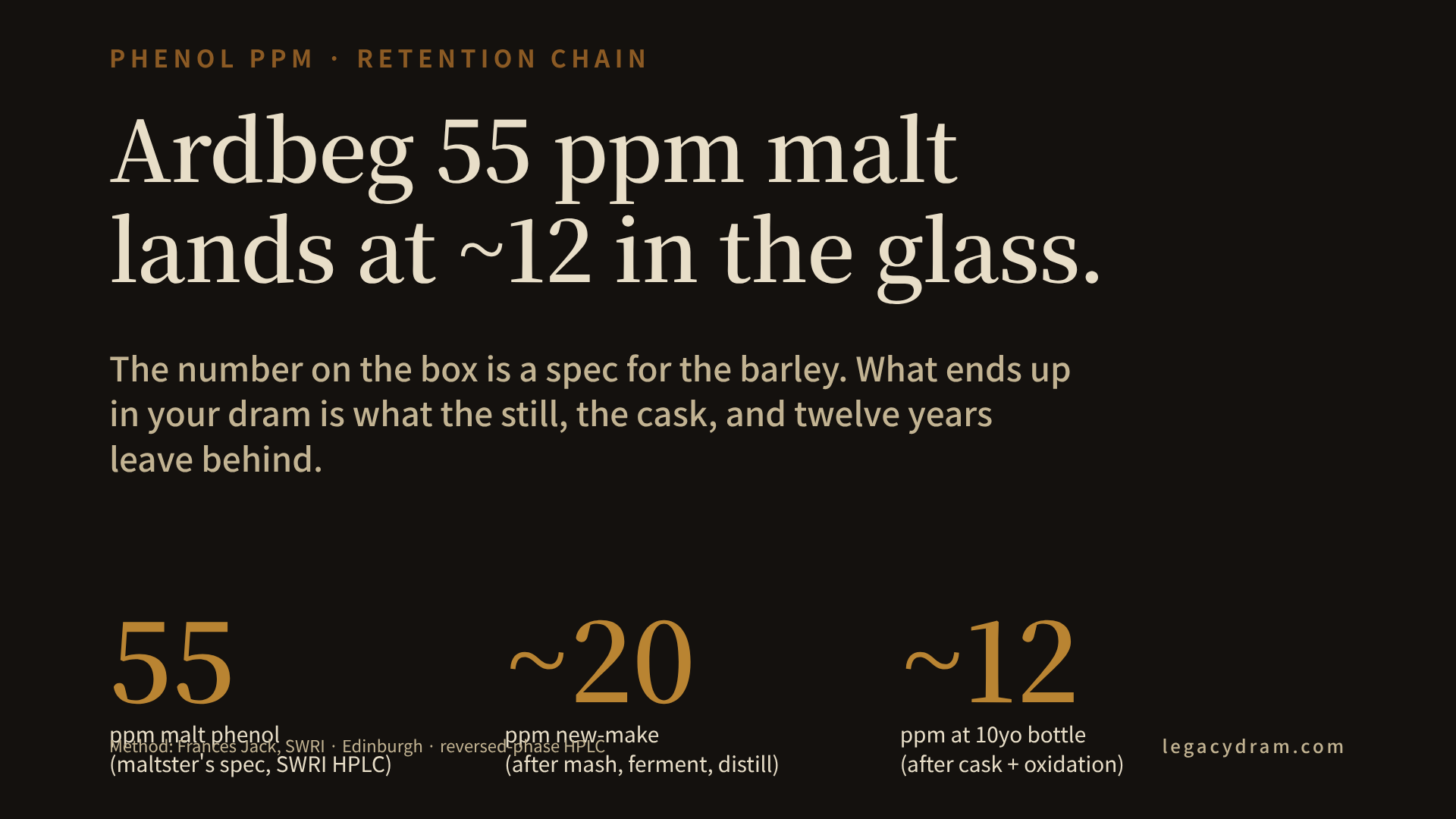
Multiply the three stages together: roughly 20–40 percent of the malt’s original phenolic mass ends up in the new-make spirit.
Cask maturation. Then the spirit spends anywhere from three to twenty years in oak. Oxidation slowly breaks down some of the phenolic compounds (phenolic hydroxyl groups are among the more oxidisable functional groups in a spirit); the toasted or charred inner layer of the cask absorbs some phenolics into its structure; and the angel’s share removes a few percent of the liquid per year, phenolic compounds and all. Over ten years, the phenolic concentration in the maturing spirit drops by roughly 30–50 percent from the new-make baseline.
Sequence the whole chain and Ardbeg 10 — which started life as a 55 ppm malt spec — lands in the bottle at somewhere between 10 and 15 ppm actual phenolic content. Laphroaig 10, from a 40 ppm malt, lands closer to 8–12 ppm. Bowmore 12, from a 25 ppm malt, is around 5–8 ppm. Lagavulin 16, from a 35 ppm malt but with sixteen years of oxidation, comes down to maybe 6–9 ppm. The bottle numbers are a small fraction of the malt numbers, and the ratio is not identical across distilleries.
At this point I want to warn you: I have written the phrase “roughly” and “approximately” more times in the last four paragraphs than I would like. This is because the actual retention rates are not published as a fixed table. They vary with fermentation temperature, still geometry, cut points, cask history, warehouse humidity, and the specific phenolic distribution in the starting malt. The 20–40 percent malt-to-spirit range is real, but the number for any given distillery would need a wet analysis of that distillery’s own new-make against its own malt spec to pin down. What we can say with confidence is that the bottle ppm is always well below the malt ppm, and often by a factor of three to five.
The Islay comparison table
The most useful thing this analysis does is let us put the published malt-side ppm numbers next to each other, without pretending the bottle-side numbers scale linearly with them. Here are the widely-cited malt specifications for the Islay distilleries, along with a rough estimate of the phenolic content the drinker actually meets:
| Distillery | Malt phenol spec (ppm) | Est. new-make (ppm) | Est. 10–12yo bottle (ppm) |
|---|---|---|---|
| Bunnahabhain (standard) | 1–2 | <1 | trace |
| Bruichladdich (Classic Laddie) | 0 | 0 | 0 |
| Bowmore (standard) | 25–30 | 8–12 | 5–8 |
| Caol Ila (standard) | 30–35 | 10–14 | 6–10 |
| Lagavulin (standard) | 35 | 10–14 | 6–9 (16yo) |
| Port Charlotte (Bruichladdich) | ~40 | 12–16 | 8–12 (10yo) |
| Laphroaig (standard) | 40–43 | 12–17 | 8–12 (10yo) |
| Ardbeg (standard) | ~55 | 15–22 | 10–15 (10yo) |
| Octomore (Bruichladdich) | 100–309 | 30–90 | 20–60 (5yo) |
Two things jump out. First, the Islay range at the malt end is enormous — Bunnahabhain sits at 1 ppm and Octomore has released bottlings above 300, a hundred-fold spread. Second, the bottle end compresses. The drinker’s phenol range is more like ten to sixty ppm, a six-fold spread, and the two ends of it (Bowmore at 5–8, Octomore at 20–60) are the same distillery family separated by fifteen years of ageing and radically different malt specs. The compression happens because retention losses are proportional at each stage; the multiplicative chain flattens the extremes.
There is also a small honesty note on Octomore. Bruichladdich has been transparent about publishing the malt-side ppm on the label — they invented the whisky-with-a-number-on-the-front aesthetic. But the number on the front is a malt spec, not a promise about the liquid. A 300 ppm Octomore, at five years old, is genuinely more phenolic than any comparably-aged Islay. It is not, however, an order of magnitude more phenolic than Lagavulin 16 in the glass. This is not Bruichladdich’s fault. It is a natural consequence of the retention chain: multiplied percentages flatten out even the extremes.
Why ppm ≠ smokiness
Even if the retention chain arithmetic were perfectly known, the malt ppm still would not predict the perceived smokiness on the palate. There are three reasons.
Which phenolic compound dominates. A malt whose phenolics are 60 percent guaiacol reads as woodsmoke and clove. A malt whose phenolics are 60 percent cresol reads as tar and ashtray. Both can register 40 ppm total. The sensory experience is different by a mile. Islay peat is richer in guaiacol relative to Highland peat, in part because of the vegetation composition of the bog — this is Frances Jack’s peat-provenance work in a sentence.
How much of the phenolic mass reaches the drinker’s nose versus their tongue. Volatile phenolics (guaiacol especially) reach the olfactory epithelium retronasally after swallowing and dominate the perceived smokiness. Heavier, less volatile phenolics (syringols, xylenols) stay dissolved in the liquid and register more as taste than as smell. Two spirits with the same total dissolved phenolic content will smell different if their volatility distributions differ.
Everything else in the glass. Sweetness (residual cask sugars, ester profile) masks smokiness. High alcohol strength (cask strength versus 40% ABV) elevates the volatile phenolic transfer to your nose. Age reduces both phenolic concentration and sweetness, sometimes not in the same proportion. This is why a Lagavulin 16 tastes so unlike Lagavulin new-make even though the phenolic mass has only fallen by, say, a factor of two.
The consequence is that the malt-side ppm is a useful engineering number and a mediocre tasting number. It tells the distiller what raw material she has bought. It tells the drinker something, but less than the drinker thinks. The bottle you hold is the arithmetic of the still, the cut, the cask, and the years, applied to that starting number. The starting number is one input among many.
What Frances Jack is doing next
The wet HPLC method that made this whole industry possible is now, in the SWRI research pipeline, being partially replaced. Frances Jack and her colleagues have published on near-infrared hyperspectral imaging as a non-destructive alternative — you shine light on the malt, capture reflectance across a range of wavelengths, and use a trained model to predict the phenolic content without needing to run the sample through a chromatograph.
The engineering appeal is obvious: HPLC is slow (an hour per sample, plus prep), destructive (you extract the malt into methanol and lose it), and requires a wet lab. Hyperspectral is fast (seconds), non-destructive, and could in principle be run on a conveyor at the maltster. If the calibration holds, malt could be spec’d in real time and the maltster could adjust kilning parameters on the fly.
The trade-off Jack’s papers are honest about: hyperspectral gives you total phenolic prediction, not speciation (which fraction is guaiacol versus cresol versus phenol). For contractual ppm compliance, that is enough. For understanding why one 40 ppm malt tastes different from another 40 ppm malt, you still need the chromatograph.
This is the pattern of most analytical chemistry: fast bulk methods for compliance, slow speciation methods for understanding. Both live in the same lab, and Jack’s work has been on shipping the bulk method out to industry while keeping the speciation method in reserve for the flavour questions that actually matter.
The number is the malt
I want to close by returning to that Ardbeg 10 box in Tokyo, and the 55 that I misread. What I understand now is that the number is a message from the maltster to the distiller, printed on the box for marketing convenience, and I was reading someone else’s mail. The label is not lying. It is telling me, if I know how to listen, that Ardbeg specifies its malt at the heaviest end of the standard Islay peating range, that the maltster used a shared method to confirm it, and that Frances Jack’s laboratory in Edinburgh sits somewhere behind the whole arrangement making sure everyone is measuring the same thing.
What is in my glass is what the still, the cut, and the twelve or so years in oak have done to that starting number. It is roughly a quarter of what the box says. The rest was lost to draff and pot ale and copper and the angels. Which is how it should be. The number is the raw material. The bottle is what’s left after Islay’s arithmetic finishes with it.
Sources: Frances Jack’s public research profile is hosted at the Scotch Whisky Research Institute in Edinburgh (Research Avenue North, EH14 4AP). Her published peat-provenance work is discussed in The Peat Provenance Mystery at Whisky Magazine. Malt-to-spirit phenol retention figures follow the industry consensus summarised in Whisky Magazine’s Phenolic fancies by Ian Wisniewski (2010) and The truth about peated whisky and phenols at Scotchwhisky.com. The retention-chain estimates in the Islay comparison table are calculated from published malt specs and typical mash/ferment/distillation/maturation loss ranges; actual per-distillery bottle phenolic contents vary with process detail.
If you want to see how the same measurement discipline plays out in a single distillery’s peat programme, my earlier piece on Adam Hannett’s three-level Bruichladdich covers Octomore’s 0-to-300 spectrum. For the peat-source-vegetation half of this story, see Gordon Motion’s Highland Park heather peat and Eddie MacAffer’s Bowmore floor malting. On the still-geometry side of the retention chain, Mickey Heads’ Ardbeg purifier and Billy Stitchell’s Caol Ila stills show how two Islay distilleries with similar malt specs land in very different places at the palate.