John Teeling and Cooley: The Harvard PhD Who Broke Ireland's 2-Distillery Whiskey Monopoly (1987)
There is a glass-walled distillery in the Liberties district of Dublin, on Newmarket Square, that the city’s tourism board calls the first new whiskey distillery in Dublin in over a hundred and twenty-five years. The bottles on the shelves inside carry the family name Teeling. The company that owns the brand and the building is, as of 2026, a Bermuda-headquartered family rum business called Bacardi. The man who supplied the founding capital for the distillery that bears the family name is not Bacardi. He is John Teeling, born in Dublin in January 1946, a Harvard-trained business academic, and he supplied the capital because in 2011 he sold the other distillery he had built (the one in County Louth that he started in 1987 in a disused State alcohol plant) to the American bourbon company Beam for ninety-five million US dollars. Beam was then bought by Suntory of Osaka. The brands that came with the sale — Kilbeggan, Connemara, Tyrconnell — are now Japanese-owned. The brand that bears the family name is now Bermudian-owned. The man at the centre of all four sentences is, in 2026, still alive, still running new projects, and has, on multiple occasions, described the sequence of events without any particular sentimentality about who ended up with what. This piece is about that sequence, and about the structural decisions that made it possible. It is not a piece about an Irish whiskey renaissance hero. It is a piece about an economist who saw an undervalued asset, ran it for twenty-four years, sold it, and used the proceeds to fund a second generation of the same family doing a different version of the same trade.
What two distilleries used to mean
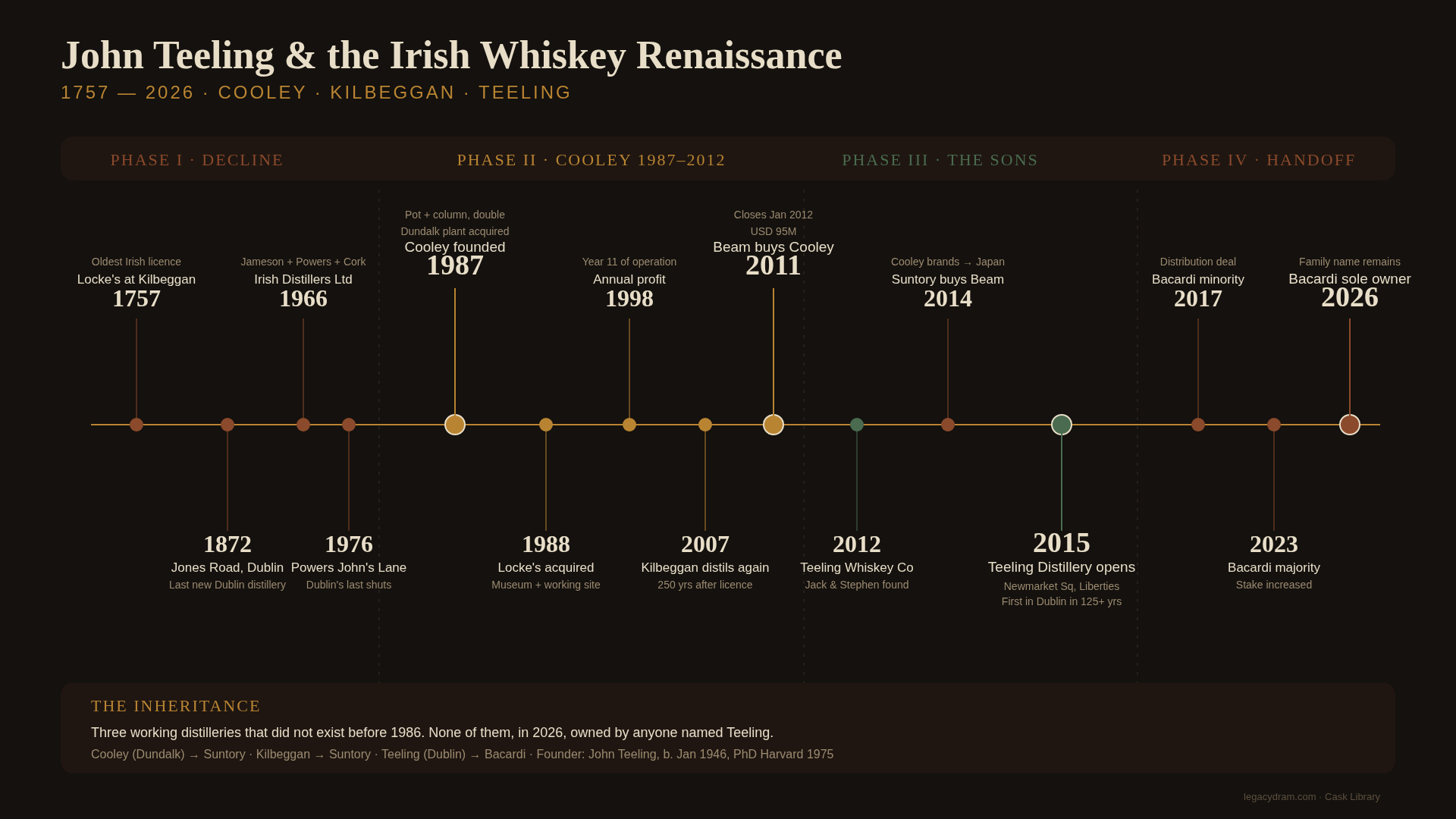
To understand why one academic founding one distillery in 1987 mattered, the number to hold in mind is two. In the spring of that year, the entire output of legal Irish whiskey was produced by exactly two companies. Irish Distillers Limited, formed in 1966 by the merger of John Jameson, John Power, and the Cork Distilleries Company, ran the New Midleton plant in County Cork and from there produced Jameson, Powers, Paddy, and the entire bonded pot still inheritance that today reaches casual drinkers as Redbreast or Green Spot. Bushmills, in County Antrim, just over the border in Northern Ireland, ran its own three pots and produced its own blends. That was it. The seven hundred separate licensed distillers that the secondary literature places in Ireland in the early nineteenth century had, by stages over a hundred and twenty years of phylloxera, prohibition, civil war, trade war with Britain, the loss of the American market, the collapse of the British Empire’s tied trade, and an extraordinary 1952 hike in Irish excise duties, become two firms. The last operating Dublin whiskey distillery, Powers John’s Lane on what is now the National College of Art and Design campus, had closed in 1976 when production was consolidated at Midleton. The last new whiskey distillery built in Dublin, Jones Road, dated to the 1870s. The trade had, in operational terms, been reduced to a duopoly.
Teeling had written about this collapse as a doctoral student. He had completed his MBA at the Wharton School in the late 1960s on a Friendly Sons of St. Patrick scholarship, and then in 1970 had won a Ford Foundation scholarship to Harvard, where he took a Doctorate in Business Studies in 1975. The thesis topic was the catastrophic decline of Irish whiskey from sixty per cent of world whisky sales in the late nineteenth century to under two per cent in the early 1970s. He had two related academic papers in print by 1971. By the time he founded Cooley sixteen years later, in other words, he had been reading the supply curve of his eventual industry for a decade and a half. This is the part of the story I want to dwell on before the operational chapters arrive, because it is the part the romantic version of Irish whiskey usually skips. Teeling did not arrive in the trade because he loved it. He arrived because he had quantified its collapse, and concluded that two operators in a category with a recognisable global brand and no living competition was an unstable equilibrium that an outsider with modest capital could disturb.
The Ceimici Teoranta plant, and an unconventional choice of stills
The site he chose, in 1987, was a State-owned industrial alcohol plant at Cooley on the peninsula in County Louth, originally operated by Ceimici Teoranta to produce neutral spirit from sugar beet. It had column stills suited to continuous production. It had warehouse space. It was being divested. Teeling acquired it, installed two pot stills with very long narrow swan necks alongside the existing column stills, and committed to a configuration that almost no one else in Ireland was running. He kept the columns, so he could make grain whisky on site. He added pots, so he could make single malt on site. He chose double distillation rather than the triple distillation that Irish Distillers used at Midleton and that Bushmills used in Antrim. Double distillation is the standard for Scotch single malt; it leaves more flavour-active congeners in the spirit than the third pass would remove. By choosing double, Teeling was making a structural argument: the customer for an independent Irish whiskey was not the customer who already drank Jameson, but the customer who already drank Scotch and could be offered an Irish counterpart that resembled what they were used to.
This is the structural decision worth dwelling on, because it propagated through everything Cooley produced for the next twenty-four years. Tyrconnell, the unpeated single malt, was double-distilled. Connemara, launched in 1996 as Ireland’s peated single malt — a category that the industry, at the time, considered a contradiction in terms — was double-distilled and made from barley dried over peat fires the way Islay malt was dried. Kilbeggan, the blended whiskey that took the Locke’s family name as a brand, was a blend of double-distilled malt and column grain produced under the same roof, on the same campus, by the same team. The format echoed, in some structural sense, what Joseph Hobbs had assembled at Ben Nevis in the 1950s: grain and malt produced and matured on a single site against the prevailing logic of the wider industry. The continuous-still inheritance Teeling was drawing on, of course, went back further than that, to Aeneas Coffey’s 1830 patent and the line of Lowland grain distilleries that John Haig had industrialised at Cameronbridge, which is, to add a turn of the historical screw, a story that originated in Dublin, where Coffey worked as the chief excise inspector.
Kilbeggan, and what to do with a museum
In 1988, the year after founding Cooley, Teeling bought the dormant Locke’s Distillery at Kilbeggan in County Westmeath. Locke’s had operated under that family name from 1843 and under various names back to the original licence of 1757, which the secondary literature treats as the oldest extant whiskey-distilling licence in Ireland. Production had ceased in 1954, and after thirty years of slow decay a local preservation society had reopened the building as a museum in 1982. There were old stills in place. There was no working production.
What Teeling did with the site is the part of the story I find structurally interesting, because it could have gone two obviously different ways and went a third. He could have left it as a museum and used the Locke’s name only as a brand. He could have torn out the museum infrastructure and converted Kilbeggan into a working distillery. He did neither. He kept the museum functioning, kept the visitor traffic, and in parallel rebuilt the working distillery alongside it. On 19 March 2007, two hundred and fifty years after Matthew MacManus’s original licence and fifty-three years after the last batch under Locke family operation, distillation resumed at Kilbeggan. The site became, as far as I know, the only working distillery in the world that is also a working museum of its own seventeenth-century technology. It is a configuration that probably could only have been assembled by someone who held both pieces (the historical site and the operational know-how) and who was willing to run them as a single asset for the same set of investors. The romantic version says he saved Kilbeggan. The operational version says he created a tourism revenue stream that subsidised the rebuilding cost.
Eleven years before he stopped losing money
The thing the Wikipedia entry mentions almost in passing, and that I keep returning to, is that it took eleven years for Cooley to reach annual profitability and fifteen years to make an accumulated surplus. Teeling had calculated, before he started, that two firms in a global category was an unstable equilibrium. The market did not agree with him on the timeline. Irish whiskey volumes were still declining in the early 1990s. The duopoly had distribution agreements that an independent could not match. Cooley had to find shelf space in markets (chiefly Germany, and parts of the United States) where independent Irish whiskey was a curiosity rather than a category. The first ten years are described in the contemporary trade press as the years Cooley did not close. The phrasing is unkind, but the trade press is not in the business of being kind. The decade Teeling spent running Cooley before it stopped losing money is, in some sense, the most boring decade of the story, and is also the decade that decided everything. Most independent ventures fail in years three to seven. Cooley did not. By the time the global Irish whiskey revival actually arrived, around 2008 to 2012, Teeling had a running distillery, a maturing inventory, and a portfolio of registered brands ready for it. That timing is the answer to the question of why the sale price in 2011 was ninety-five million US dollars and not five.
I want to be honest that the sale was the moment the academic version of the story ends and the financial version takes over. Beam Inc., the American bourbon major that owned Jim Beam and Maker’s Mark, was looking in 2011 to enter Irish whiskey, which it had no presence in, by buying an established producer rather than building one. Irish Distillers (Pernod Ricard) was not for sale. Bushmills (Diageo) was not for sale. Cooley was for sale. On 16 December 2011 Beam announced the purchase at around USD 95 million, or about EUR 71 million at the exchange rate of the day. The sale closed on 17 January 2012. The Tyrconnell, Connemara, and Kilbeggan brands went with the building. So did the rights to produce them. So did the staff. Within twenty-eight months, Beam itself was acquired by Suntory of Osaka, on 30 April 2014. The brands Teeling had built at Cooley were now, by way of two transfers in less than three years, Japanese.
The sons, the Liberties, and a name that no longer belongs to the family
This is the point in the story I have been waiting to write, because it is the point at which the structure becomes generational in a way I had not quite expected. Teeling has two sons in the trade: Jack Teeling, born in the mid-1970s, who had been managing director of Cooley before the sale; and Stephen Teeling, his younger brother. By the time the Cooley deal closed in January 2012, the two brothers had already incorporated a new company, the Teeling Whiskey Company. The startup capital, by every credible account I have been able to find, came in part from the proceeds of the Cooley sale. The plan was not to compete with Cooley on the same terrain (Beam still owned Cooley) but to open a new distillery in Dublin city, which had had no working whiskey distillery within its municipal boundaries since the closure of Powers John’s Lane in 1976. The site they chose was Newmarket Square, in the Liberties, the historic distilling and brewing quarter where Guinness still operates at St. James’s Gate, where Jameson had run Bow Street, where the Roe family had operated the largest single distillery in nineteenth-century Europe, and where Marrowbone Lane, around the corner, had been the original Teeling family distillery in the eighteenth century. The new Teeling distillery opened in 2015. The Dublin tourism board’s stock phrase, repeated more or less verbatim in every press release of the period, is the first new whiskey distillery to be built in Dublin in over 125 years. The previous one, on Jones Road, dated to the 1870s. The phrase is a bit of marketing, but the underlying claim is correct. A century and a half of distilling absence had ended.
The deflationary thing to say about this story is that the sons did not, in the operational sense, rebuild what the father had built. Cooley belonged to Beam. The new Dublin distillery was a separate company, on a separate site, with a separate product portfolio, in a separate part of the country. The father had financed it, but the brand on the bottle was Teeling, not Cooley. And the second deflation, which the tourism literature also tends to skip, is that by 2017 the Teeling Whiskey Company had sold a minority stake to Bacardi to gain access to global distribution. By 2023 Bacardi had a majority stake. On 23 June 2026 — two days before I am writing this — Bacardi completed a transaction making it the sole owner of the Teeling brand and the company that operates it. The family that founded the new Dublin distillery in 2015 to revive a name that had been a Dublin whiskey name in the eighteenth century has, by 2026, sold the company that uses the name. The bottles still say Teeling on the label. The board no longer sits in Dublin.
I am, again, trying to write this without converting it into either a celebration or a tragedy. The economics here are clean. An independent Irish whiskey company in 2017 needed distribution to reach the United States at scale, and the easiest way to acquire distribution is to sell a stake to a global drinks company that already has it. Once a stake is sold, the path from minority to majority to outright purchase tends, with consistent performance, to run in one direction. The same mechanism, run on a slower clock, took Bushmills from independence to Pernod Ricard to Diageo to José Cuervo over a hundred years. The Teeling version compressed it into a single decade. The family extracted value at every stage. The brand survived as a brand. The trade-off, the part that the press release does not mention, is that the family no longer makes the operational decisions about a building they were photographed cutting the ribbon on in 2015.
The wider field, and what got built around them
The other thing I keep wanting to say, before I lose the thread, is that Cooley was not the only independent Irish whiskey company that 1987-to-2015 phase produced, and the timing is worth setting alongside parallels that came later. Anthony Wills at Kilchoman on Islay opened in 2005 as Islay’s first new distillery in over a hundred years, a structurally similar single-founder-against-the-incumbents story on the Scotch side, against the same broad backdrop of consolidation that Cooley had pushed against in Ireland. The Springbank silent years and Frank McHardy’s role in keeping Campbeltown distilling alive is a different mechanism (keeping a continuously-licensed site from going dark), but in the same ecosystem of small-operator decisions that resisted the duopoly logic of the late twentieth century. Iain McAlister’s work at Glen Scotia is a third example of the same archetype. The Joseph Hobbs piece I wrote earlier is, structurally, the closest analogue I have so far on the Scotch side: an outsider with capital and a non-traditional plan, building a configuration that the wider industry had no precedent for and that survived the founder. Teeling did the Irish version of that story, on a longer timescale and with a different downstream beneficiary, but the family resemblance is unmistakable.
What changed because of Teeling is harder to quantify than I would like. By 2026 there are, by various counts, more than forty operating whiskey distilleries on the island of Ireland — Dingle, Slane, Walsh, Boann, Killarney, Powerscourt, Pearse Lyons, Roe & Co (re-established by Diageo on a Liberties site adjacent to its old Roe family ground), Lough Gill, Echlinville, Rademon, and so on. None of these existed before Cooley. Most of them were founded in the decade after 2012, by people who could see, in Cooley’s sale price and the Beam-then-Suntory ownership arc, that an Irish whiskey business was an asset that global drinks companies wanted to own. Teeling broke the duopoly and demonstrated the exit value, and the second-wave founders were responding to a market they could see existed because he had built the first piece of it. To call him the father of the Irish whiskey renaissance is the kind of phrase he reportedly does not particularly like, and which I would rather not use, but the economic effect of the work is not in dispute. The two-firm category he stepped into in 1987 was, by the time his sons opened the Dublin distillery in 2015, a forty-firm category.
The bottle on the shelf
The bottle of Teeling Single Grain on the shelf in 2026 is a column-distilled grain whiskey, finished in Cabernet Sauvignon casks, produced at the Newmarket Square distillery in the Dublin Liberties. The brand belongs to Bacardi. The original distillery in County Louth that Teeling built in 1987 belongs to Suntory. The eighteenth-century museum-distillery at Kilbeggan, which he kept running on parallel rails since 1988, also belongs to Suntory. The fortune that founded all three sites belongs, divided into stages, to the man himself, his sons, and the global drinks majors that bought the operational businesses from them in two successive transfers between 2011 and 2026.
I do not think there is a clean reading of this. The version where Teeling is the heroic founder who restored Irish whiskey is not quite false but underplays the fact that he sold to bourbon money, and bourbon money sold to Japanese money, and Japanese money now writes the cheques for the brands he built. The version where the sons rebuilt what the father lost is not quite false but underplays the fact that they too sold, in stages, to a Bermudian rum family, who now write the cheques for the brand that bears their family name. The version where this was always a financial trade, run by a man who had calculated the duopoly’s instability fifteen years before he started, is the cleanest reading I can give, and it is also the least romantic.
What is durable, I think, is the structural inheritance. There is a working distillery in County Louth that did not exist in 1986. There is a working distillery in Kilbeggan that did not exist in 1987. There is a working distillery in central Dublin that did not exist in 2014. None of them, in 2026, are owned by anyone called Teeling. All of them, in 2026, are running. The first thing John Teeling proved was that the duopoly could be broken. The second thing he proved was that the trade-off for proving it was that, in the end, he and his family would not own the things they had built. He has, in interviews, said this without complaint. The sons have said it without complaint. The buildings keep running. The buildings keep running because the structural decisions were sound. The names on the deeds are, in the longer view, the part that turns over.
The slope behind Newmarket Square is quiet. The column is running.
If you want to read further on the surrounding decisions: I have written on John Haig at Cameronbridge and the Coffey patent of 1830, the continuous-still inheritance that Cooley’s column stills descend from and that originated in Dublin with Aeneas Coffey; on Joseph Hobbs at Ben Nevis, the closest structural parallel I have on the Scotch side — outsider with capital, non-traditional configuration, eventual acquisition by a Japanese parent; on Anthony Wills at Kilchoman, the Islay parallel of opening the first new distillery in a region after a long absence; on Frank McHardy and the silent years at Springbank, a different mechanism (keeping a continuously-licensed site alive) for resisting consolidation in the same era; and on Iain McAlister at Glen Scotia, the third Campbeltown example of the same outsider-archetype work running in parallel with Cooley in Ireland. The broader argument about who currently owns what in modern whisky is at kenimoto.dev.