Aberfeldy 12 Review: Heather Honey, 40% ABV
I poured Aberfeldy 12 at the end of a long Tuesday in May, in a Glencairn glass at room temperature, with no audience and no plan to write anything down. The colour was a warm amber, the way maple syrup looks held against a window. The first nose was honey — not the floral, perfumed kind, but the heather honey kind that comes from a glass jar with a wax-sealed lid and tastes faintly of warm hay. Behind it, an orchard pear and a thread of lemon zest. None of that is interesting yet. What was interesting was that the person who decided what this bottle would taste like — and what Dewar’s White Label, 12, 15, 18, and 25 would taste like, which together are one of the largest-selling Scotch whisky portfolios in the world — is Stephanie Macleod, who became Master Blender at John Dewar & Sons in July 2006, has won the International Whisky Competition’s Master Blender of the Year title six years running between 2019 and 2024, and whose name does not appear on the bottle. It is not on the back label either. It is on the press releases that she did not write.
I read whisky marketing the way I read AWS pricing pages — with the assumption that the important number is the one not shown.
The water has gold in it, the marketing says
Aberfeldy sits in Perthshire, in the Central Highlands, on a small stream called the Pitilie Burn that runs alongside the distillery and is, by long local report, known for trace deposits of alluvial gold in its gravel. The distillery’s own marketing leans into this — “the golden dram”, “the only distillery in Scotland that uses these waters” — and a visitor centre in Aberfeldy town will sell you panning lessons in the burn if you have an afternoon to fill.
The gold is real. Its connection to the whisky is decorative. Fermentation tanks do not metabolise gold. They metabolise sugar, and they care about two things: nitrogen and time.
What the Pitilie Burn actually contributes is the boring half of geology: soft, mineral-light Highland water with low calcium and low magnesium, drawn from a small upland catchment. Soft water is gentle on the yeast, does not over-buffer the wash, and lets a long fermentation drift further before it is killed by carbon dioxide or by exhausted nutrients. That matters for what comes next.
The Dewar brothers — John and Tommy, sons of the original Perth wine merchant John Dewar Sr. — built the distillery on this site in 1896 and ran the first spirit through it in 1898. The choice of site was partly the railway (the line to Aberfeldy station made it cheap to ship barley in and casks out) and partly the burn. The “founders’ birthplace” story the modern brand tells is true; the marketing layer on top is younger than the buildings.
The long fermentation, and what esters actually smell like
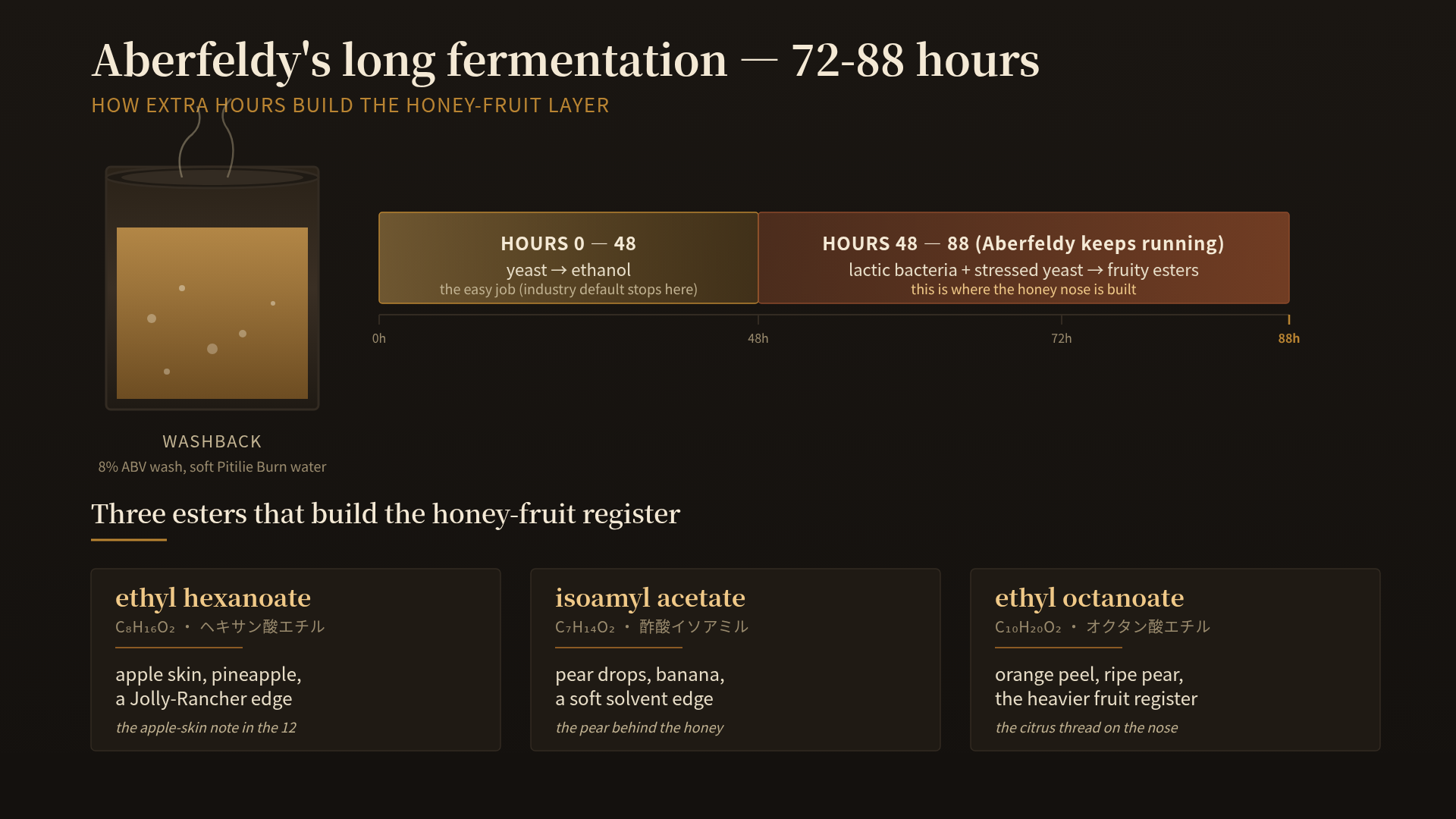
Aberfeldy’s fermentation runs long. The published figures sit between 72 and 88 hours, against a typical Scottish industry default closer to 48 to 55 hours. That is roughly half again as long as a Speyside production distillery in throughput mode.
What a long fermentation does, biochemically, is this: after the yeast has finished the easy job of converting wort sugar into ethanol (the first ~48 hours), the wash sits warm with a population of stressed, hungry yeast cells and a parallel population of lactic acid bacteria that the wash was never sterilised against. The bacteria produce lactic and acetic acids. The yeast, under stress, condenses some of those acids with residual alcohols to form esters: short, volatile, fruity-smelling molecules that survive distillation and end up in the cask.
The esters that matter for Aberfeldy’s character, in rough order of contribution:
- Ethyl hexanoate (ヘキサン酸エチル, C8H16O2) — apple skin, pineapple, the “Jolly Rancher” smell when concentrated.
- Isoamyl acetate (酢酸イソアミル, C7H14O2) — pear drops, banana, the smell of nail polish remover thinned into something pleasant.
- Ethyl octanoate (オクタン酸エチル, C10H20O2) — orange peel, ripe pear, the heavier end of the fruity register.
These are the same ester family that gives Glenmorangie 10 its citrus-cream nose and gives Glenfiddich 12 its pear-drop signature. The reason Aberfeldy’s nose reads as honey rather than fruit is that the ester layer sits underneath a heavier malt sweetness that the long fermentation also builds up — wort sugars that fermentation extracts further, plus the slightly oxidised compounds a wash develops sitting warm for a third day. Heather honey is what you get when those two layers fuse.
(There is no honey in the wash, no honey near the cask, no honey anywhere in the production chain. “Honey” is a flavour descriptor for a particular ratio of malt sweetness to fruity ester. It is the only word in English short enough to do the job, which is why every tasting note in the world reaches for it.)
The fermentation tank does not care about gold in the burn. It cares that the water it is given is soft enough to let it run on for 80 hours without choking.
The stillhouse: copper that does not get in the way
The four stills currently running at Aberfeldy were installed in the 1972 expansion, when the original direct-fired stills were replaced with steam-heated copper pots from Forsyths in Rothes. Two wash stills at 16,500 litres each, two spirit stills at 15,000 litres: relatively large for a single-malt-only operation, which is a clue that the design brief was always Dewar’s blend volume rather than collector single-malt scarcity.
The condensers are shell-and-tube, not worm tubs. That is the opposite engineering choice from the Cragganmore or Mortlach end of the worm-tub Speyside family, and the consequence is straightforward: more copper contact between vapour and cooling surface, which catalytically scrubs out volatile sulfur compounds (dimethyl sulfide, dimethyl trisulfide, heavier mercaptans) before they reach the spirit safe. What comes out is clean, light Highland spirit — the kind of new make that can carry honey-and-fruit forward without a savoury sulfur drag sitting underneath it.
Pair that with steam coils rather than direct fire (no caramelised wash crust, no Maillard “burnt sugar” residue at the bottom of the still) and the Aberfeldy spirit profile is, by deliberate design, the light, fruity, ester-forward end of the Highland spectrum. It is not trying to be heavy. It is trying to be a malt that can either bottle as a 12-year-old single malt or disappear into Dewar’s blend as the honey base note, depending on which warehouse the cask is rolled into.
That dual-use design is the constraint Macleod inherited.
The cask programme, and the bill she has to balance
Aberfeldy 12 is matured predominantly in American white oak ex-bourbon barrels (Q. alba, ~200 L), with a smaller share of ex-sherry hogsheads (~250 L) layered in for colour and a thread of dried fruit. The exact ratio is not published. Working back from the cask-strength single-cask releases and from the sherried 18 and 21-year-old Aberfeldys further up the range, the standard assumption is something like 80/20 bourbon-to-sherry in the 12, with the bourbon barrels mostly second-fill and refill rather than first-fill.
The 12-year-old bottles at 40% ABV, chill-filtered, almost certainly with a small caramel-colouring adjustment (E150a) to keep batch colour consistent — the standard mass-market Highland approach. None of that is condemnation; it is a trade-off. Non-chill-filtered Bunnahabhain 12 at 46.3% (the Ian MacMillan piece from last week) chose oily texture and natural colour over bottle stability and visual consistency. Aberfeldy 12 at 40% chill-filtered chose the opposite. Both are valid; they sit in different positions on the same trade-off axis, and a master blender who is also signing off on Dewar’s White Label cannot, in 2026, ship the Bunnahabhain answer for the 12.
Because that is the other half of the job. Aberfeldy is the largest single-malt component in the Dewar’s blended Scotch portfolio. Every cask of Aberfeldy malt that is filled in a warehouse near the distillery is, in principle, available either for single-malt bottling (Aberfeldy 12 / 15 / 18 / 21 / 25) or for blending into Dewar’s White Label / 12 / 15 / 18 / 25 / Signature. The internal economics of which liquid goes where, in what proportion, on what schedule, is the part of Macleod’s job that has no equivalent on the back label.
Stephanie Macleod, from sensory analyst to six trophies
Macleod did not start in a distillery. She started in a laboratory.
She read for her degree at the University of Strathclyde in Glasgow and stayed on at Strathclyde as a Sensory Analyst on a research project attempting to map the chemical signatures of cask maturation — which compounds in oak migrate into spirit, on what timescale, with what threshold. (This is, in a sense, the technical-research mirror of what John Glaser at Compass Box later argued the industry should disclose voluntarily.) She joined John Dewar & Sons in 1998, in the Spirit Quality Laboratories at the company’s Glasgow head office, and spent her first years on the unglamorous lab side: testing finished blends for off-notes, testing packaging for taint migration, building out a sensory panel.
In 2004, the then Master Blender Tom Aitken asked her to consider training for the role when he eventually retired. By her own account she accepted in a nanosecond. The training was three years of side-by-side blending under Aitken, and in July 2006 she stepped into the role herself — the 7th Master Blender at John Dewar & Sons since the company’s founding in 1846, and the first woman to hold the title in 160 years.
Then, between 2019 and 2024, she won the International Whisky Competition’s Master Blender of the Year title for six consecutive years. She was the first woman ever to win it in 2019, and she has been the only winner since. In 2023 Bacardi (Dewar’s parent group) added the role of Director of Blending for the wider Bacardi portfolio on top of her Dewar’s responsibilities. The single-malt portfolio she now signs off on is five distilleries wide: Aberfeldy, Aultmore, Craigellachie, Royal Brackla, and The Deveron (the Macduff distillery’s single-malt label). The blended portfolio she also signs off on is, in volume terms, several orders of magnitude larger.
Her name does not appear on the bottle of Aberfeldy 12. It does not appear on Dewar’s White Label. On both bottles the back label talks about Dewar brothers, Perthshire, the Pitilie Burn, and a man named Tommy Dewar who died in 1930. The structural fact of how a Highland single malt at 40% gets to be reliably the same Highland single malt across a global retail supply chain, year after year — that fact is invisible. It is invisible because it works.
Four glasses on the kitchen counter
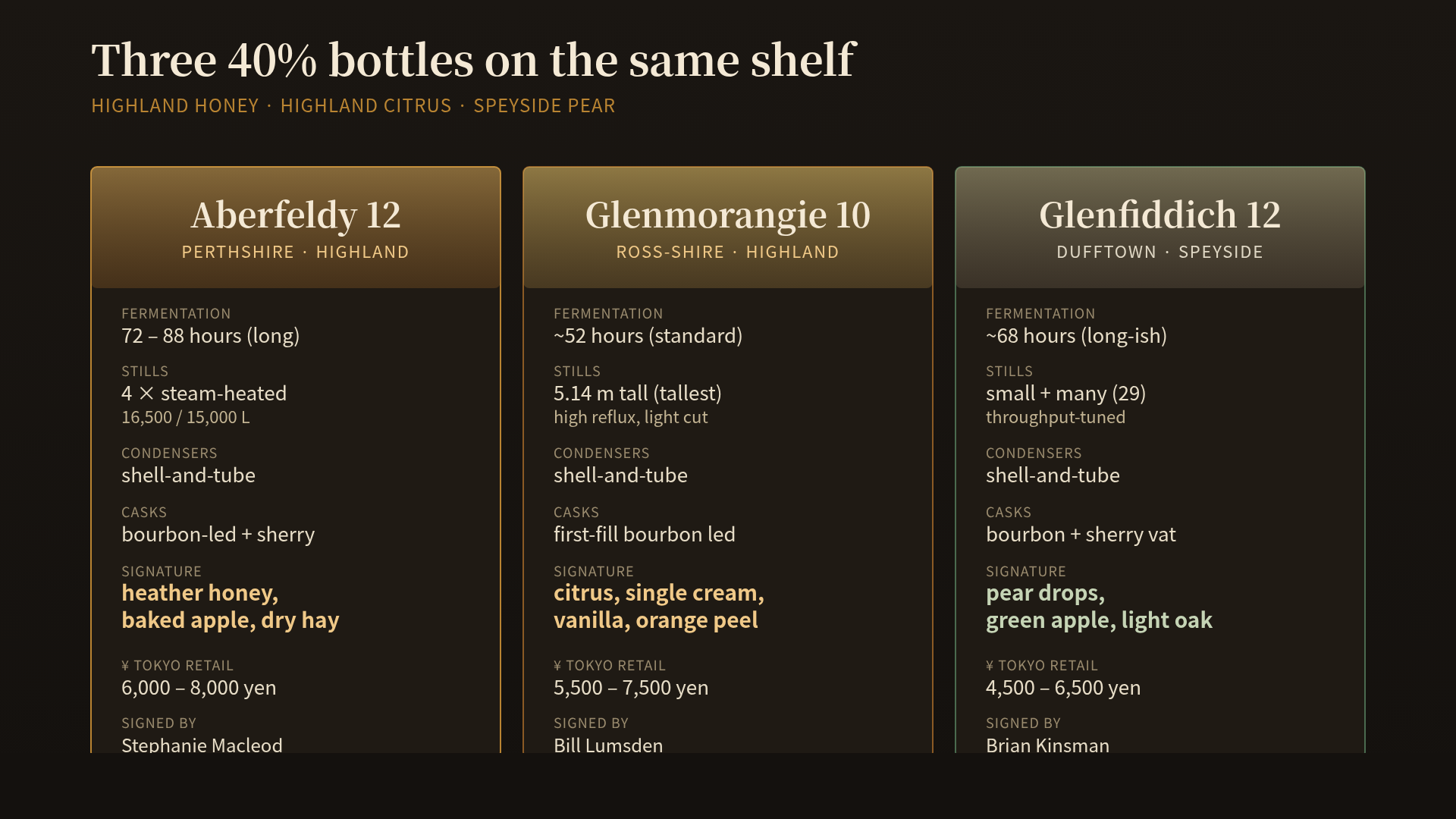
Back to the May evening. Glencairn, fifteen minutes after pouring, no water, alongside Glenmorangie 10 and Glenfiddich 12 as the two nearest reference points on a normal Tokyo-retail shelf.
Aberfeldy 12, 40%. Nose: heather honey from a wax-sealed jar, baked apple skin, a faint lemon zest that took two more sniffs to confirm. Underneath the honey, an almost imperceptible note of toasted oats. On the palate, a 40% light body that fills the centre of the tongue without weight. Honeycomb wax, baked apple, brown sugar dusted on porridge. The finish is short to medium, with dry hay and a soft vanilla, and a tiny prickle of white pepper at the very end. Add two drops of water and the honey loosens into something closer to runny acacia honey on warm toast, and the pepper softens. (At this point the apartment downstairs started playing music through the wall, and the dram became more about the music than the whisky, which is also fair.)
Glenmorangie 10, 40%, sitting next to it: same Highland family, but 5.14-metre stills with shell-and-tube condensers push the spirit even lighter, and the cask programme leans first-fill bourbon harder. The nose is more citrus and cream (orange peel, a single-cream dairy note), the palate is brighter, and the finish reads cleaner and shorter. Glenmorangie is the bottle for someone who wants the Highland spirit at its most polished and brand-typical. Aberfeldy is the bottle next to it that has a little more malt mid-palate and a little more honey at the expense of citrus clarity.
Glenfiddich 12, 40%, last in the row: Speyside, not Highland, and the difference shows. The fruit is pear and green apple rather than honey, and the cask reads as cleaner bourbon refill with no sherry layer. Glenfiddich is the supermarket benchmark for “what Speyside tastes like at twelve years and forty percent”. Aberfeldy beside it is denser, sweeter, and less crisp — a Highland honey that has more midweight on the tongue than the Speyside pear has.
(The opposite pole on the same shelf is Lagavulin 16 at 35 ppm Islay peat — a useful contrast for a reader deciding whether they want Highland honey or Islay iodine.)
If I had to choose one of the three to keep on the shelf as a default after-work pour, Aberfeldy 12 would be the answer this month. Not because it is the best dram in any abstract sense, but because the honey-pear-pepper register is the one I most often want from a 40% Highland at the end of an evening, and the 6,000–8,000 yen price band in Tokyo is a fair seat for what is in the glass.
What to confirm next time you pour one
The thing to verify on your own tongue, if you have an Aberfeldy 12 in front of you, is the honey layer’s structure.
Pour the 12, give it five minutes in a Glencairn, and pay specific attention to the join between the heather-honey sweetness and the ester-driven fruit (apple, pear, faint lemon). The honey is the malt sugar plus the long-fermentation ester layer fusing into a single descriptor. If you sniff for them separately — first chase the honey, then chase the fruit — you can feel the seam between them. That seam is what an 80-hour fermentation does to a clean Highland spirit run through shell-and-tube condensers.
Then, if you have a Glenmorangie 10 within reach, pour both side by side at room temperature. You are tasting two Highland answers to the same fermentation-and-condenser problem, with different still geometry pushing the ester balance one way (citrus-cream Glenmorangie) and the cask choice and fermentation length pushing it the other (honey-pear Aberfeldy). Both are sold at 40%, both are around the same Tokyo price band, both are signed off by master blenders whose names you will not find on the front label.
Stephanie Macleod has won Master Blender of the Year six years running. The bottle on my desk does not say so. In this industry, that is more or less what success looks like — a recipe so reliable that the customer is never asked to think about the person running it. The recipe says honey, pear, dry hay, a prickle of pepper, in a long Perthshire fermentation through shell-and-tube condensers into a bourbon-heavy cask programme at 40% ABV.
The next time you reach for Aberfeldy 12, you are drinking a Highland honey that an Edinburgh-trained chemist has kept in exact alignment with itself across two decades and roughly sixty million bottles. The gold in the burn has nothing to do with it. The chemist does.
Try this bottle
Affiliate link below. If you buy through it, LegacyDram earns a small commission and the price you pay does not change. Alcohol-related links are intended for readers of legal drinking age (20+ in Japan, 21+ in the US).
Related reading
- The Reflux Equation: Why Glenmorangie’s Stills Are 5.14 Metres Tall (and What Bill Lumsden Inherited) — the nearest Highland reference point, a different still-height answer to the same ester-forward brief.
- Bessie Williamson and the 1962 Deal That Kept Laphroaig Floor-Malted — the only previous woman in this site’s people index to have run a Scotch distillery at a comparable level of operational authority. Macleod’s modern-day counterweight to a 1954 distillery manager.
- Rachel Barrie and the Blend Matrix: BenRiach, Glendronach, Glenglassaugh — the other contemporary female master blender working at this scale in Scotch, and a useful cross-comparison for what running multiple distilleries with one signature actually looks like.
- Stuart MacPherson and the Three Oaks: Quercus Alba, Petraea, Mongolica at Macallan — the cask science underneath what Aberfeldy’s bourbon-and-sherry programme is doing more quietly.
- John Glaser and Compass Box: The Transparency Argument — the inverted position on the same trade-off. Dewar’s keeps recipes opaque by industry convention; Compass Box has spent fifteen years arguing the convention should end. Macleod and Glaser sit on opposite sides of the same disclosure question.
Sources
- Aberfeldy distillery official — aberfeldy.com
- Dewar’s distilleries portfolio — dewars.com
- Wikipedia: Aberfeldy distillery
- Bacardi corporate, “Stephanie Macleod Wins ‘Master Blender of the Year’ for Record-Breaking Sixth Time” — bacardilimited.com
- The Whiskey Wash on Macleod’s sixth IWC win — thewhiskeywash.com
- Whisky Magazine, “Master blender Stephanie Macleod on the future of Dewar’s” — whiskymag.com
- Pour and Sip, “Stephanie Macleod: from IRN Bru to Dewar’s master blender” — pourandsip.com
- Tales of the Cocktail Foundation, “Meet Stephanie MacLeod, Dewar’s First Female Master Blender” — talesofthecocktail.org
- The Spirits Business, “Bacardi makes Stephanie Macleod director of blending” — thespiritsbusiness.com
- Difford’s Guide, “Aberfeldy Distillery & Dewar’s World of Whisky” — diffordsguide.com
- Whisky-Me, Aberfeldy distillery profile — whisky-me.com
- Charles MacLean, Whiskypedia (Birlinn, 2014)
- Misako Udo, The Scottish Whisky Distilleries (Black & White, rev. ed.)
- Dave Broom, The World Atlas of Whisky (Mitchell Beazley, 3rd ed. 2020)