Masataka Taketsuru 1918: 3 Scotland Notebooks
The first thing his Glasgow landlady asked, when a twenty-four-year-old Japanese chemist checked into her lodging house in December 1918, was whether Japanese people ate rice. This detail turns up in more than one of Masataka Taketsuru’s biographies and I do not know what he answered. What I know is that within the next two years he would produce three notebooks — one at Longmorn in Speyside, one at Bo’ness in the Lowlands, one at Hazelburn in Campbeltown — that between them contained the working knowledge of the Scotch industry as it stood on the far side of the First World War. Sixteen years after that Glasgow evening he would open a distillery of his own on the northern coast of Hokkaido and start building whisky to their specifications.
Sixteen years. That is the number that keeps me writing about him. The gap between the notebooks and the distillery. Most tellings of the Nikka founding story compress the interval: notebooks in 1920, Yamazaki in 1923, Yoichi in 1934, first whisky in 1940, done. But the compression flattens what is really a very long, very reluctant wait. The notebooks sat unused in another man’s drawer for three years, then were half-implemented at somebody else’s distillery for the next ten, and only in the third decade after they were written did the person who wrote them get to build the thing they described. This piece is about those sixteen years — what was written down, who kept it, and why the person who wrote it took so long to be allowed to use it.
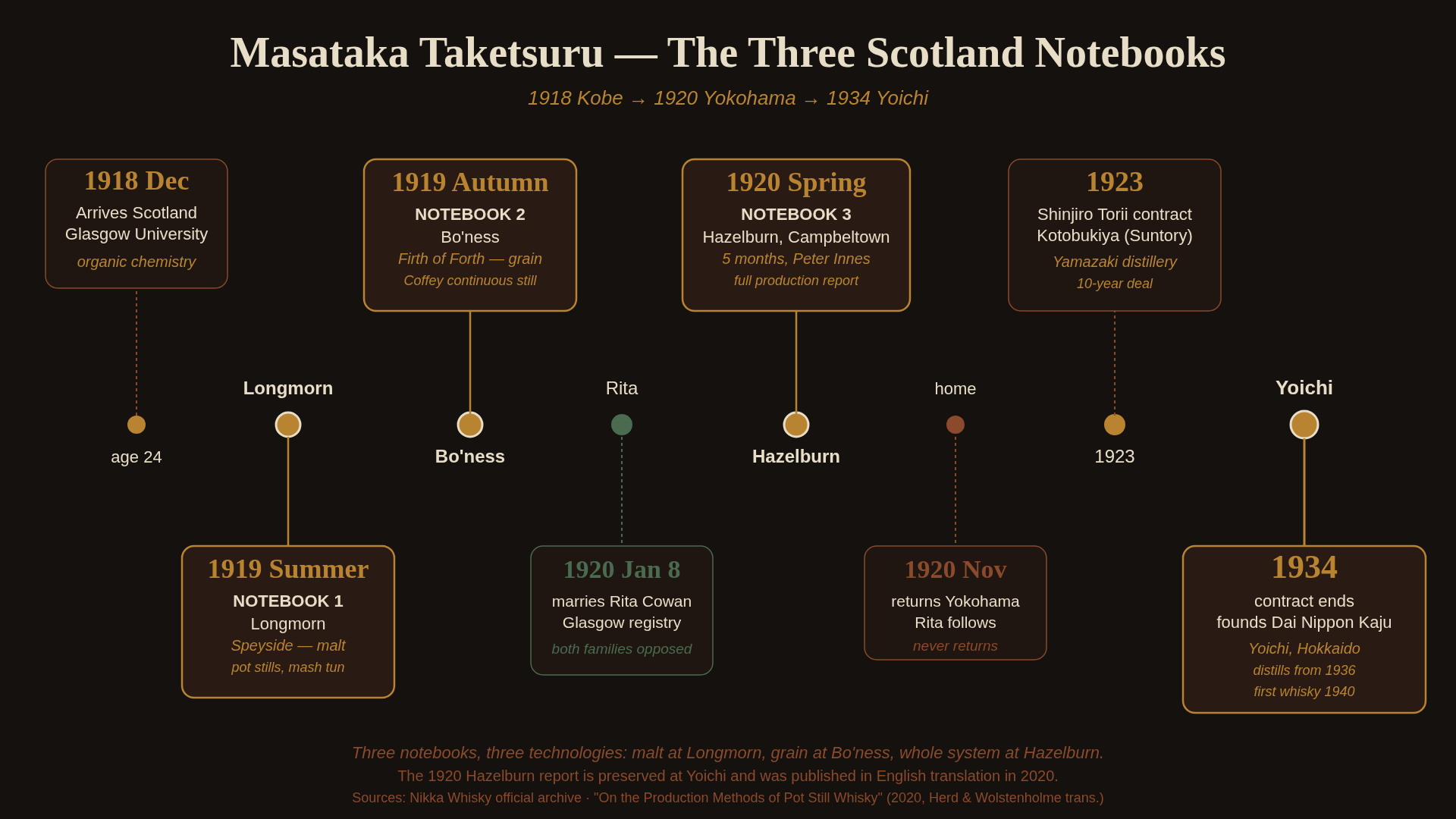
Three notebooks, not one — why he did not settle at Longmorn
It is unusual for a Japanese company in 1918 to send a twenty-four-year-old chemist to Scotland for two and a half years and treat the trip as tuition rather than as a stunt. Settsu Shuzo, the mid-sized Osaka distiller that dispatched him, had built its business on continuous-still shochu; the man who signed the cheque, managing director Iwai Kiichiro, wanted to see whether the same industrial discipline could be applied to malt whisky. The tuition consumed something in the order of sixty times Taketsuru’s annual salary.
What is more unusual is what Taketsuru did with it. The obvious move — the move an ordinary company man of the period would have made — is to settle at a single well-regarded Highland distillery, learn its craft properly for two years, and bring back a defensible replica. Taketsuru did not do this. He enrolled as an auditor at the University of Glasgow in Thomas Stewart Patterson’s organic chemistry laboratory. Then he went to Longmorn (John Duff & Co., built 1893, a large modern Speyside malt distillery). Then he transferred to Bo’ness (James Calder & Co., a Lowland grain distillery running a Coffey column). And finally he spent three months at Hazelburn in Campbeltown (Mackie & Co., which supplied blend malt to White Horse). Three locations, three distinct disciplines, three notebooks.
I want to be careful not to over-read this as strategy. The primary sources — Taketsuru’s own memoir Whisky to Watashi, first published by Nikka Whisky in 1976, and Olive Checkland’s 1998 biography Japanese Whisky, Scotch Blend — suggest that the three-site tour was as much accident as design. The introductions were arranged by a Glasgow journalist. Mackie’s decision to admit him rested on the personal enthusiasm of the works manager, P.M. Innes. Every door that opened, opened because a particular individual decided to open it. He was lucky. What he did with the luck, though, is not accidental. The reason he came back with three notebooks and not one is that he had already worked out that a Japanese whisky distillery would need to be, in effect, a small industry compressed into a single building. Malt, grain, and blending disciplines could not be sourced separately in a country where none of them existed yet. If you were going to make Scotch in Japan, you had to know how to run a whole Scotland in miniature.
Longmorn: pH readings in a distillery that did not measure them
The Longmorn notebook is the most conventionally academic of the three. It reads, page after page, like a diligent chemistry-lab exercise book. Grist temperatures. Mash-tun charge sequences. Specific gravities. And, throughout, pH. The concept of pH had been proposed by Søren Sørensen only in 1909; Longmorn’s floor operators in 1919 were not, as daily practice, measuring it. Taketsuru was. He was recording — with an instrument he had presumably brought from Patterson’s laboratory — the acidity of the wash before pitching, during fermentation, and at the moment of transfer.
I do not want to make this sound like foresight. Longmorn’s operators knew, empirically, when a wash was right; they did it by taste and hydrometer, the way they always had, and the whisky was very good. What Taketsuru needed was different. He needed the same information in a form that could be written down and shipped back to Osaka and used by somebody who had never smelt a Speyside wash in his life. He was converting inherited craft into transferable data because the transfer was the whole point of the trip. The pH readings are not there because he was ahead of the Scottish industry. They are there because he was writing an instruction manual for a distillery that did not exist yet, on the other side of the world, and inherited craft does not survive that kind of shipping.
Bo’ness: pieces of paper in a shortened pocket
Bo’ness would not let him take notes at all. The Coffey still — analyser column plus rectifier column, plate spacing, steam-entry heights, drawing-off points — was industrial-secret material, and James Calder & Co. wanted its physics kept inside its walls. So the notes he brought back from Bo’ness were assembled clandestinely. He carried cut-up scraps of paper and a shortened pencil in his pocket, ducked into the lavatory during breaks to jot down what he had just seen, and reconstructed the full sketches in the lodging house in the evenings. The detail comes from Taketsuru himself, in Whisky to Watashi, and is corroborated by every biographer since.
I have to sit with this for a paragraph because it is not merely charming. From Bo’ness’s side of the door, Taketsuru was engaged in what would today be called industrial espionage. He was a welcomed apprentice by day and, in the evenings, a competitor’s engineer duplicating trade secrets from memory. Any account that leaves out the second half of that description flatters him past the point of recognition. His notebook of the Coffey column exists, was submitted to Settsu Shuzo on his return, and would sit unused in that company’s drawer for more than forty years, until his son Takeshi imported a working Coffey still into Nikka in 1963. The notebook was the first Japanese-language description of the machine, and it was written on stolen intervals of a working shift.
Hazelburn: three months in Campbeltown, and a wife
The third notebook, from Hazelburn, is the one that came closest to being the design of a distillery rather than the description of one. Mackie & Co. made blend malt: not the boldest expression of a single distillery, but a spirit that had to fit into a house style. If the first notebook was raw material and the second was equipment, the third was the philosophy of assembly. Taketsuru was in Campbeltown for three months.
He was also there long enough to meet Jessie Roberta Cowan, the daughter of the doctor in whose house he was lodging, and to marry her at the Glasgow registry on the eighth of January 1920. Rita, as she was known, would come back to Japan with him and stay for the rest of her life. He acquired, in three months in Campbeltown, both his blending philosophy and his wife. He returned to Yokohama in November 1920 with the two Hazelburn volumes formally titled Practical Report on Pot-Still Whisky Making and handed them to Iwai Kiichiro. The Elgin and Bo’ness notebooks had already been shipped separately. Iwai’s drawer, in November 1920, contained the most complete Japanese-language technical dossier on whisky manufacture then extant anywhere.
And then Settsu Shuzo abandoned the project. The postwar depression had eaten the capital. The notebooks stayed in Iwai’s drawer.
Yamazaki, 1923: “So much the better”
In 1923 Shinjiro Torii, the Osaka wine-and-spirit merchant who had made his fortune on sweetened Akadama Port Wine, hired Taketsuru as chief engineer of the malt distillery he intended to build. The contract was for ten years at a salary that was, by Kotobukiya’s own board’s estimation, alarming. Torii was buying the only person in Japan qualified to turn the notebooks into a working building.
Where the building should stand was the first serious argument between them. Taketsuru wanted Hokkaido — cold, wet, sea-blasted, with the climate his notebooks had been written to assume. Torii wanted Yamazaki, on the southern edge of Kyoto, where the water was ancient and famous and the barley supply and the Osaka market were both close to hand. Torii’s objection to Hokkaido was practical: it was too remote, too expensive to supply, too cold for a young distillery to run reliably. Taketsuru’s answer, recorded in more than one biography, was quiet: so much the better. The cold was not, to him, an inconvenience. It was a feature of the specification.
Torii won, correctly, on business grounds. Yamazaki was built in 1923 to Taketsuru’s technical drawings but in a climate that was not his climate. The spirit went into cask, and Kotobukiya waited for it to be ready.
1929: an argument about the audience
Six years later, in 1929, the whisky came out under the name Suntory Whisky Shirofuda — white label — and Japanese drinkers refused it. Shirofuda was smoky and peat-influenced, an honest attempt at a properly made Scotch, largely in Taketsuru’s own idiom. It failed commercially. The Japanese market of 1929, raised on sake and on Akadama, found the smoke medicinal and the structure alien. Torii, whose whole commercial instinct was that a foreign drink had to be bent toward the local mouth rather than the mouth toward the drink, absorbed the lesson and began the eight-year rework that would emerge as Kakubin in 1937. I have written about the mechanics of that dispute elsewhere; the short version is that Shirofuda’s failure handed the strategic argument to Torii, decisively, and Kotobukiya’s future direction was decided.
For Taketsuru, the 1929 rejection confirmed what he had probably already suspected. The company he had been hired by was going to build a whisky he had not crossed the world to make. He served the remainder of the contract, professionally and quietly. His ten years expired on 1 March 1934, and he did not renew.
1934: the notebook-faithful distillery, sixteen years late
He went north. Dai Nippon Kaju — literally Greater Japan Fruit Juice, from which “Nikka” is the abbreviation — was incorporated in Yoichi on the western coast of Hokkaido and chartered ostensibly as an apple-juice producer, because the cash flow from apple juice would fund the distillery construction while the whisky matured. First distillation ran in 1936. The first Nikka Whisky product shipped in 1940.
The Yoichi site was chosen against every point of Torii’s 1923 objection. It was cold. It was remote. It was sea-blasted. It was the closest reproduction of the Longmorn and Hazelburn climate that could be found within Japan. The initial equipment was a Longmorn-type pot still layout, direct-fired with coal underneath and worm-tub condensers behind, a configuration Scotland itself was already retiring during the 1930s and which Yoichi has continued to run, uninterrupted, into the present. The bottles that leave Yoichi in 2026 are still coal-fired. There is no other malt distillery in Japan or in Scotland where this is true.
The Longmorn notebook and the Hazelburn notebook were, in effect, poured out into that first still house. The Bo’ness notebook was not. The Coffey column it described stayed in Iwai’s drawer for another three decades. In 1963, twenty-nine years after Yoichi opened and forty-three years after the Bo’ness notes were written, Nikka installed its first Coffey still on Japanese soil — a decision made by Masataka’s son Takeshi, working from the pencil-and-ink sketches his father had reconstructed in a Bo’ness lavatory in 1919. Two of the three notebooks were implemented by the man who wrote them. The third was implemented by his son, a generation later, from a set of sketches that had been secretly assembled forty-three years before they were used. (A separate and later thread of Nikka’s grain-whisky story runs through Joseph Hobbs and the Coffey column at Ben Nevis, which Nikka acquired in 1989, but the Bo’ness notebook was the seed of Nikka’s grain competence, and it was written in Japanese by a twenty-five-year-old on stolen breaks.)
What outlived him
Masataka Taketsuru died in August 1979, aged eighty-five. He had seen Yoichi run for forty-five years. He had seen Miyagikyo, the softer second distillery he built explicitly as Yoichi’s opposite, run for ten. He had seen his son import the Coffey column he himself had described but never installed. He had outlived Shinjiro Torii by seventeen years, and he had outlived his wife Rita by eighteen.
The three notebooks are still, in the sense that matters, running. The pH-controlled wash learned at Longmorn now feeds a coal-fired pot still on the western coast of Hokkaido and comes out as Yoichi. The Coffey column secretly sketched at Bo’ness in 1919 became, eventually, the backbone of Nikka’s grain-whisky operation. The blend-malt philosophy learned at Hazelburn is the argument that a distillery like Miyagikyo exists at all. What is hard about writing this piece is that I keep wanting to make it triumphant, and it is not. It is a story about a person whose most important design decisions were made in Scotland when he was twenty-four, and who then had to wait sixteen years to build the first of the buildings those decisions described, and another twenty-nine years, in his son’s hands, to see the last of them built at all. He was patient in a way that reads, from the outside, as impossibly disciplined. I suspect it just felt to him, at every step, like the ordinary next thing that needed doing.
Whatever it felt like, he outlived a lot of things, but not the notebooks. The notebooks outlived him. They are still, forty-seven years after his death, sitting inside the working pipework at Yoichi and Miyagikyo and running the distilleries. That is a strange kind of longevity for three pencil-and-ink volumes written by a twenty-four-year-old in the Scottish mist between the winter of 1918 and the summer of 1920.
Related reading in the Japanese whisky cluster: the 1929 Shirofuda dispute between Torii and Taketsuru is the argument this piece leaves at the door of Yamazaki; Miyagikyo, the second Nikka distillery, is Taketsuru’s own retort to Yoichi’s one-sidedness; and Joseph Hobbs at Ben Nevis is the Canadian outsider whose column still Nikka would eventually own outright. Broader arguments about who decides what is in the bottle live at kenimoto.dev.