Bushmills Black Bush 40%: Oloroso Finish Review
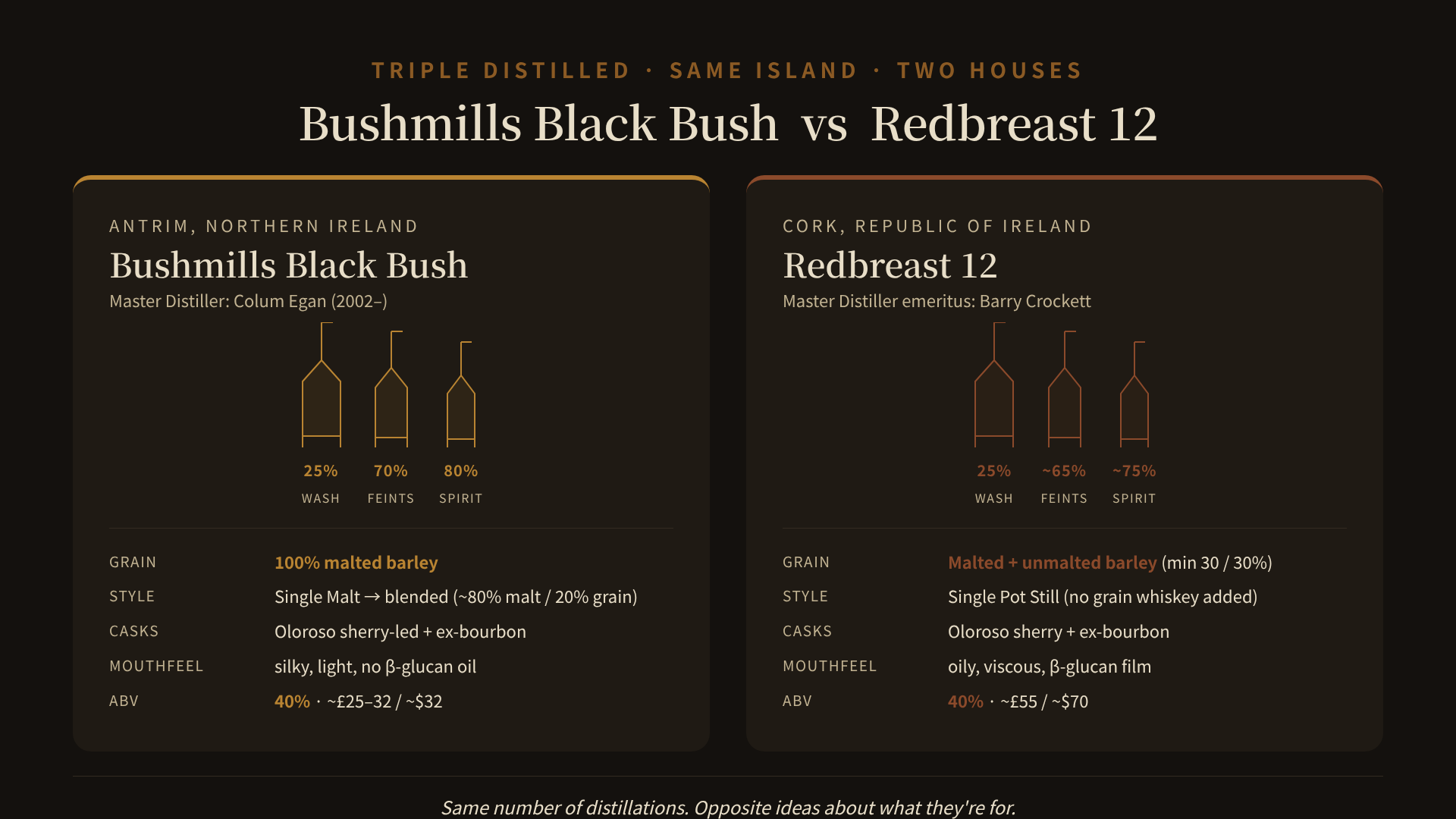
A Saturday night in late June. The kitchen sits at about twenty-three degrees because the air conditioner is losing an argument with the season. Two Glencairn glasses, two fingers each, fifteen minutes to open. On the left: Bushmills Black Bush, from County Antrim in Northern Ireland. On the right: Redbreast 12, from Midleton in County Cork. Same island. Same number of distillations: three. Two completely different ideas about what those three distillations are supposed to do.
The Redbreast comes up first on the nose, the way it always does: warmed honey, walnut skin, a thread of cloved orange. Then the Black Bush, and the room tilts. Where Redbreast’s nose lands like a Christmas pudding cooling on a counter, the Black Bush lands like a pantry door swung open on raisins that have just been toasted. Dried red fruit, almond skin, a thin line of vanilla running through the middle. No oil on the tongue. No grain weight. Just sherry and a quiet, almost embarrassed elegance.
Tonight I want to write about that elegance, and the man whose job it is to keep it from drifting: Colum Egan, Master Distiller of Bushmills since 2002.
The same word, two different bottles
Both bottles say “triple distilled” on the label. That phrase is doing very different work on each one.
Redbreast 12 is Single Pot Still: a uniquely Irish style where a mash of malted and unmalted barley is distilled three times in pot stills. The companion piece I wrote on this bottle, Redbreast 12 と Barry Crockett (Japanese), traces how an 18th-century malt tax accidentally pushed unmalted barley into the recipe and turned a tax dodge into a national style. The oiliness on your tongue when you sip Redbreast is β-glucan from the raw barley. It is thick whiskey.
Bushmills, by contrast, is Single Malt: 100% malted barley, no unmalted, no β-glucan weight. Triple distilled in big copper pots. Aged in oak. The Black Bush is then blended with about 20% column-still grain whiskey to soften the edges, so technically the label says “Blended Irish Whiskey”, but the blend tilts hard to malt (around 80%), and the malt is the whole personality of the bottle.
So you can run the same arithmetic — wash + low wines + spirit, three stills, three runs — and end up with two different bottles that share almost nothing on the palate. Redbreast has the unmalted barley pulling toward weight while triple distillation pulls toward light, and ends up at a strange oily middle. Bushmills has all the levers pointed the same way: malt only, three distillations, lots of copper. Everything subtracts. What remains is what survives that subtraction.
Two distilleries, two answers to the same equation. Same island, no fight.
The man who got there via breakfast cereal
Colum Egan grew up in Portarlington, in the Republic, surrounded by barley fields. He took a degree in production management from the University of Limerick, then spent the next decade and a bit getting paid by other people to learn skills he would later need at a distillery without knowing that was what he was doing. Nestlé-General Mills, where he worked on branded foods including — and this is my favourite line on any Master Distiller’s CV — breakfast cereals. Anheuser-Busch in London, bottling beer. Then Irish Distillers in Dublin, doing the vatting and blending of Irish whiskey. Each job was a different industrial process at scale; each one fed into a single job description he had not been hired for yet.
He completed his training at Old Bushmills and was appointed Master Distiller in 2002, Bushmills’ youngest ever at the time. He is still there as I write this, twenty-four years in.
What is striking about that tenure is what happened around him while he stood still. In 2005, Diageo bought Bushmills from Pernod Ricard for £200 million. In November 2014, Diageo swapped Bushmills to Proximo Spirits — the company behind Jose Cuervo tequila — in exchange for the other 50% of Don Julio. Three corporate owners in roughly a decade. Three different sales decks, three different sets of marketing instincts, three different ideas about what Bushmills should be when it grew up.
And yet the bottle on the left of my table is recognisably the same bottle the previous batch was, and the batch before that. That continuity is not a marketing achievement. It is an engineering achievement, and the engineer is Egan, working with Helen Mulholland on the blending bench (1994–2021) and now Alex Thomas (since November 2021). When ownership churns, the spirit safe does not get sold off with the brand. The cuts stay where the master distiller leaves them.
His predecessor at Bushmills, incidentally, was Frank McHardy, who left for Springbank in August 1996. He is the same Frank McHardy I’ve written about in Springbank’s silent years. One man’s leaving in Antrim eventually opens the door for the youngest Master Distiller in Bushmills’ history to walk in. The Irish whiskey world is small enough that everyone is somebody’s predecessor.
What the third distillation actually does
A pot still is a kettle. You boil a low-ABV wash, the alcohol vapour rises, hits cooler copper near the top, some of the heavier compounds condense back into the pot (“reflux”), and the lighter, more volatile vapour escapes over the lyne arm to the condenser. Each pass through a pot still removes weight and adds copper contact. Each pass is a filter.
Most Scotch single malts run that filter twice. Bushmills runs it three times. Here are the rough numbers:
| Stage | Still | Goes in | Comes out |
|---|---|---|---|
| 1 | Wash still (4 stills, 12,500L each) | wash, 8–10% ABV | low wines, ~25% ABV |
| 2 | Feints / intermediate still | low wines + last batch’s foreshots & feints | middle cut, ~70% ABV |
| 3 | Spirit still (2 stills, 3,500–4,000L) | middle cut | new-make, ~80% ABV |
The thing to notice is the second still. That is where Bushmills earns its third distillation. Scotch single malts typically have a wash still and a spirit still and call it a day. Bushmills sits a whole intermediate still between them, which recycles the foreshots and feints of the previous batch — the heavy, sulphurous, oily fractions you would never want in the bottle — and gives them a second chance to be re-distilled and selected against. The middle cut from that intermediate still is already cleaner than most Scotch new-make would be after two distillations. By the time it reaches the small spirit stills for the third pass, you are stripping ABV from something that has already been twice-filtered.
Egan has described the third distillation as drawing out a “summer fruits character” — fruit notes that, in his telling, were always in the new-make but stayed masked behind heavier compounds until the third pass took those compounds away. I think that is a marketing-flavoured way of saying something engineering-shaped: triple distillation does not create flavour, it unmasks it by selecting harder against everything else. The pear, the green apple, the orchard-fruit signature you get from Bushmills new-make is what is left when there is almost nothing else allowed to stand next to it.
That is also why the bottle needs sherry. Triple distilled malt, on its own, is delicate to the point of being shy. Hand it to a refill bourbon cask and you risk a thin spirit. Hand it to a first-fill Oloroso and the cask will give it everything the still took out, and then some.
The Oloroso bet
Black Bush is the bottle in the Bushmills line-up where sherry runs the show. The malt component is aged in a mix of ex-bourbon and former Oloroso sherry casks, with the sherry weighting carried much higher than on the white-label Bushmills Original. The single-malt component is reported to age around seven to ten years before blending with a smaller fraction of column-still grain whiskey, all of it then bottled at 40% ABV.
The bet, made years ago and inherited by every Master Distiller since, is this: triple distilled malt strips out so much of the original spirit’s body that a heavy sherry cask doesn’t bully the whiskey, the way it sometimes does with a more robust Speyside. It dresses it. Where a Macallan or a Glendronach in a first-fill sherry cask can feel like a wool coat over a wool jumper, Black Bush sherry feels like a cashmere scarf over a linen shirt: close to the skin, not crushing it.
I want to be careful here because “soft” and “smooth” are the two adjectives Irish whiskey has been hit over the head with for thirty years of marketing, and they tell you almost nothing. What is actually happening when you sip Black Bush is that the third pass through copper has removed the rough textures that would have given the sherry something to push against. You get the flavour of Oloroso — toasted raisin, walnut, faint cocoa — without the weight that flavour usually arrives wearing.
That trade is the entire personality of the bottle. If you want sherry that hits you in the chest, drink a Glendronach 15. If you want sherry as a long, low note that lets the cask sing without shouting over the spirit, drink Black Bush.
In the glass, next to Redbreast
Back to the two glasses.
The Black Bush at 40% opens with a nose I can only describe as a bakery’s storage shelf an hour after closing: warm raisin, almond, a faint suggestion of cocoa, and behind it a green note that I think is the malt itself, like a handful of fresh barley before anything happens to it. On the palate it is genuinely silky: not “smooth” in the marketing sense but smooth in the dictionary sense: nothing snags. The sherry shows up as toasted dried fruit, the bourbon casks show up as a thin trail of vanilla and creamy caramel, and the malt is there as a quiet cereal sweetness underneath everything. The finish is short to medium, clean, with the kind of sherry sweetness that you notice mostly because of its absence ten seconds later.
Switch to Redbreast 12 and the difference is almost violent. The Redbreast lands oily, viscous, with that famous β-glucan film coating the middle of your tongue. The same Oloroso casks have given it the same toasted raisins, but those raisins arrive sitting on a much heavier spirit. Where Black Bush dressed in sherry, Redbreast was woven from it. The spice — clove, cinnamon, the green-stalk bite of unmalted barley — is louder. The finish is longer and warmer.
Same island. Same number of distillations. Same Oloroso cask type. And one is a cashmere scarf, the other is a wool coat with the collar up.
If I am honest, the first time I poured Black Bush blind expecting it to be the more impressive bottle next to Redbreast, I was a little annoyed. It seemed under-flavoured. Then I switched glasses three times and noticed I kept reaching for the Black Bush between Redbreasts as a kind of palate rinse, but a palate rinse that had its own quiet personality. By the end of the session I had drunk more of the Black Bush than the Redbreast. The bottle that whispers wins more nights than the bottle that shouts, especially after a long week.
Price, where to find it, and when to pour it
Black Bush is, mercifully, cheap. In the UK it sits around £25–32 at supermarkets, with Tesco Clubcard members occasionally getting it down toward £19. In the US the suggested retail is roughly $32 for a 750ml, with most retailers landing $25–35. Compared to Redbreast 12 (around £55 / $70 in most markets) it is roughly half the money for an arguably more food-friendly bottle, though Redbreast wins handily on solo sipping intensity.
Pour Black Bush neat at room temperature. The fruit is the whole point and it closes up if you chill it. A drop of water lifts the green-barley note in the nose. For food, it goes where bigger sherry whiskies can’t: roast pork with apples, a wedge of aged cheddar, a slice of fruitcake. It also makes the best whiskey-and-ginger I’ve ever made: the sherry survives the dilution that would erase a more delicate single malt.
A footnote on the bottle’s identity politics: there is a stubborn Irish-American myth that Bushmills is “Protestant whiskey” because Antrim is in the predominantly Protestant North, and Jameson is “Catholic whiskey” because it comes from the Catholic Republic. The myth has no factual basis: Bushmills sold to American customers regardless of denomination throughout the 20th century, and Egan himself is from the Republic. Drink the bottle. Skip the parable.
What to verify next time you pour Bushmills Black Bush
Next time the bottle is open, try three things.
First, pour Black Bush next to any Scotch single malt aged primarily in Oloroso — a Glendronach 12 will do — and notice the weight difference. The same cask type giving you almost the same sherry flavour, but Bushmills arriving lighter by a clear margin. That weight difference is the third distillation, doing the only thing it can do: removing things.
Second, smell the bottle hot. After a sip, exhale through your nose and pay attention to what survives. The green-barley note that hangs around the back of the soft palate is the malt itself: what is left when you have triple-distilled a 100% malt wash and put it in casks that are not strong enough to erase it.
Third, pour a Redbreast 12 next to it and ask which of the two bottles you actually finish faster over the course of an evening. I do not know what the answer will be for you. I know what the answer was for me, and it was not the bottle that costs twice as much.
Colum Egan does not put his name on the label. Helen Mulholland did not put hers on the label either, and neither does Alex Thomas now. Three owners cycled through above their heads in twelve years; the bottle did not change. That continuity is the unsexiest engineering achievement in spirits, and it is what you are tasting whenever you pour a 40% bottle of Black Bush and notice that nothing in particular is wrong. Nothing being wrong, batch after batch, year after year, owner after owner, is the entire job. Pour one this week and notice it.
Try this bottle
Affiliate link below. If you buy through it, LegacyDram earns a small commission and the price you pay does not change. Alcohol-related links are intended for readers of legal drinking age (21+ in the US, 18+ in the UK/Ireland).
Related reading
- Redbreast 12 と Barry Crockett ― 麦芽税が生んだ未発芽大麦の配合: the Single Pot Still half of the Irish triple-distillation story (Japanese), and the Cork counterweight to this Antrim bottle
- Frank McHardy and Springbank’s Silent Years: Egan’s predecessor at Bushmills, and where he went next — the same Master Distiller in three different distilleries across his career
- 三回蒸留の数学:Auchentoshan と Springbank Hazelburn が「蒸留 1 回追加」で何を捨て何を残したか: the craft side of the same physics: what triple distillation removes, in numbers (Japanese)
Sources
- Old Bushmills Distillery — Wikipedia: 1784 founding, 1608 royal licence, ownership timeline (Irish Distillers 1972 / Pernod Ricard 1988 / Diageo 2005 £200M / Proximo Spirits 2014 swap for 50% of Don Julio)
- Black Bush — Bushmills official: official tasting notes, Oloroso + ex-bourbon cask maturation, 40% ABV
- “Zum Master Distiller geboren: Colum Egan im Portrait” — WhiskyExperts: Egan appointed Master Distiller in 2002, Bushmills’ youngest at the time; University of Limerick production management; Nestlé-General Mills → Anheuser-Busch → Irish Distillers career path
- “Colum Egan, Head Distiller” — SMAD profile: Portarlington, Co. Laois origin; pre-Bushmills roles at Nestlé-General Mills (cereals), Anheuser-Busch (London bottling), Irish Distillers (Dublin blending)
- “Triple distillation and a triplet of Bushmills” — More Drams, Less Drama: three-still system, ABV progression (8–10% → 25% → 70% → 80%), Egan’s “summer fruits” quote on the third distillation
- Bushmills distillery profile — Whisky.com: four wash stills at 12,500L each, two spirit stills at 3,500–4,000L
- Bushmills Black Bush — Selfbuilt’s Whisky Analysis: ~80% malt / 20% grain, Oloroso + ex-bourbon casks for the malt, ~7–10 year malt component, 40% ABV
- “Bushmills appoints new master blender” — The Spirits Business, Nov 2021: Helen Mulholland (~30 years at Bushmills) succeeded by Alex Thomas (joined 2004, Sexton Master Blender 2017, Bushmills Master Blender November 2021)
- “Frank’s wild years” — Whisky Magazine: Frank McHardy spent a decade as Bushmills Master Distiller before returning to Springbank in August 1996
- Tesco — Bushmills Black Bush 70cl and Total Wine & More: UK price £25–32 / Tesco Clubcard ~£19; US SRP ~$32 for 750ml
- “The Jameson Catholic / Bushmills Protestant divide” — Slate: the religious-allegiance myth has no basis in fact