Glen Scotia 15 Review: Iain McAlister's Campbeltown Malt
I order a Springbank 10 because I have read about Frank McHardy. I order a Kilkerran 12 because I have read about Hedley Wright. I finish both and stare at the empty glasses for a minute, and then I ask the bartender what else Campbeltown has. The honest answer is short: there is one more distillery. It has been running, on and off, since 1832. It has been closed twice. It does not belong to the family that owns Springbank, and it does not belong to the same family that runs Kilkerran. It belongs to a private group whose name you have not seen in many whisky magazines, because the magazine writers are still ordering the first two whiskies.
The bottle the bartender pours next is Glen Scotia 15.
This is not a deep cut. It is a flagship. It is the standard age statement of the third operating distillery in Campbeltown, and on most decent shelves in the UK and Japan it sits roughly two thirds of the way along, between Springbank 10 and Kilkerran 12 in price, often a few pounds either side. The reason it does not get talked about is not that the whisky is weaker. It is that the writers who write about Campbeltown have, for understandable historical reasons, written about Campbeltown by writing about the Mitchell family, and Glen Scotia is not theirs. It belongs to Loch Lomond Group. The man whose job, until recently, was to be responsible for what came out of its two stills is called Iain McAlister, and his previous job was at the water company.
The distillery that closed itself twice
Glen Scotia opened in 1832 as plain “Scotia,” founded by two men called James Stewart and John Galbraith, who between them held the offices of Dean of Guild and Provost of the town. It is one of the smaller distilleries that survived the Victorian Campbeltown boom, when the Kintyre peninsula briefly contained around thirty operating distilleries and supplied a substantial share of the blended whisky that the rest of the country drank. Most of those distilleries did not make it out of the 1920s.
In 1928, the man who then owned Scotia, Duncan McCallum, went bankrupt. By March 1930 the distillery had closed its doors. McCallum, by the account of every local history that mentions him, walked into Campbeltown Loch and drowned. The trustees of his estate sold the distillery in 1933 to the Bloch Brothers, who reopened it. That is the first silence: three years, ended only because someone else bought the bricks.
The second silence began in 1984. Scotch as a category had collapsed into oversupply (the same whisky loch that pushed Frank McHardy out of Springbank for a decade), and what was by then called Glen Scotia stopped distilling. It stayed silent until 1989, when a company called Gibson International restarted it. The same year, more famously, Springbank also came back. Two of Campbeltown’s three remaining distilleries spent most of the 1980s producing nothing while their warehouses kept the old casks maturing on their own. The math kept running even when the stills did not.
The current owners, Loch Lomond Group, acquired the distillery in 2014 and have, by the available evidence, taken the brand seriously for the first time in several decades. The whisky in the 15-year-old bottle on my table was distilled around 2011, two years before the current owners arrived, by a distillery manager called Iain McAlister, who had been in the job since 2008.
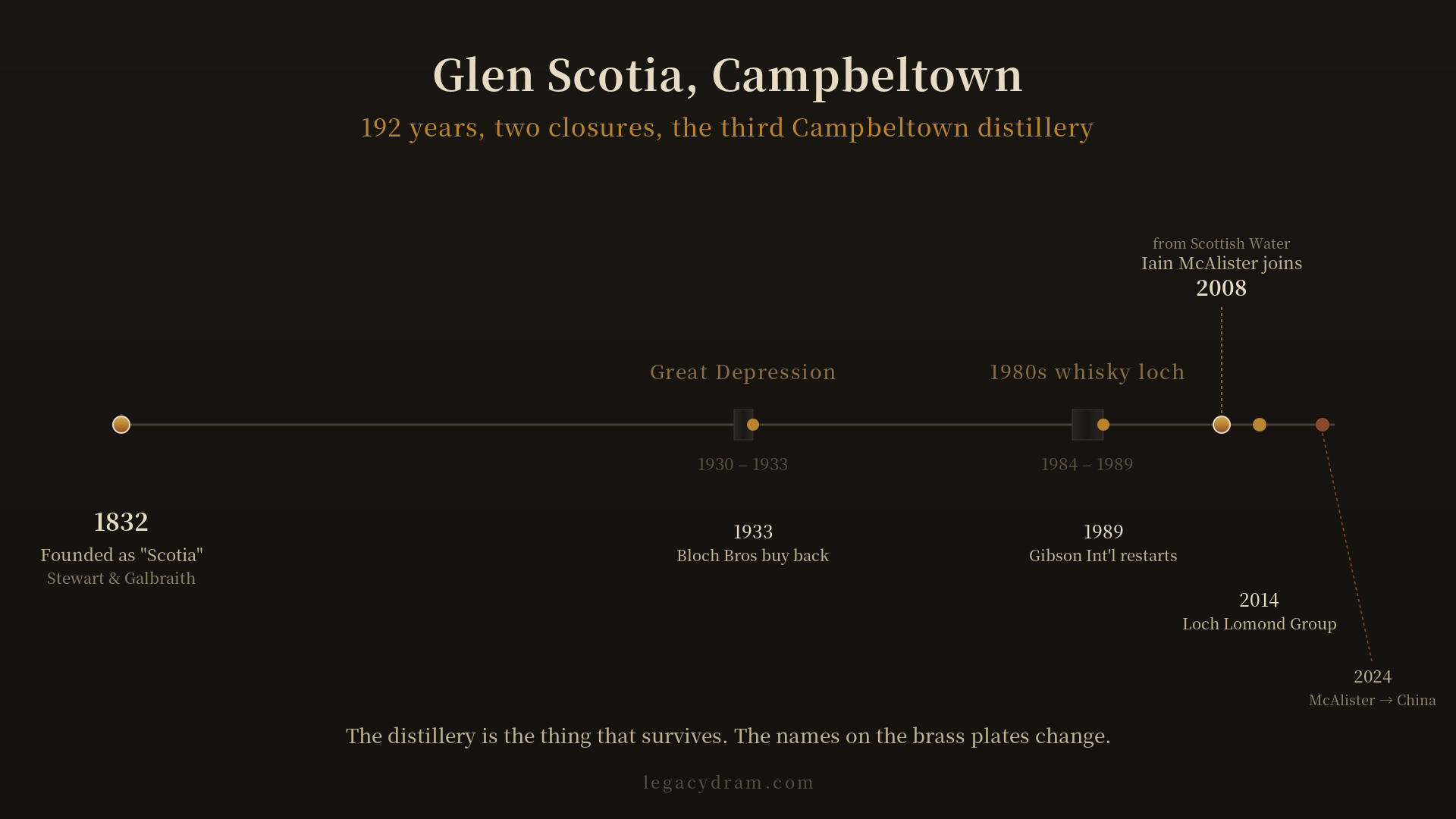
McAlister did not save Glen Scotia from anything. The distillery had been saved twice before he arrived, by people whose names appear in regional history books and not on the bottle. His job was the one after the rescue: to make sure the third closure did not happen.
A distillery manager who came from the water company
McAlister was born in Campbeltown, which matters because Campbeltown is a peninsula village of about 5,000 people on a long road that does not go anywhere else, and most of the people who work in Campbeltown distilleries grew up walking past their gates. He did not start his career inside one of them. He spent his early career working as a process engineer at Scottish Water, the public utility responsible for the country’s mains supply and wastewater treatment, on the mechanical and process side. He joined Glen Scotia in 2008 as distillery manager, and he stayed for sixteen years before leaving in 2024 to head a whisky operation in China.
This is not the typical Master Distiller resume. The dominant career paths in the trade are (a) chemistry or biochemistry degree → graduate scheme at one of the multinationals, or (b) inherited family company. The third path, the one McAlister took, is rarer and quieter: process engineer somewhere else, applied to whisky. The skills transfer better than the public-facing story suggests. A distillery is a heat-exchange network, a fermentation vessel, a column of copper, a set of pumps, a warehouse climate, and a long chain of process-control decisions. The water utility version of those same things runs on a different molecule, but the diagrams look similar.
What McAlister did at Glen Scotia, over sixteen years, was the unglamorous engineering work that the brand needed before it could afford to have a personality. He rebuilt the production cycle. He worked through the cask inventory inherited from the Gibson and Glen Catrine years (Glen Catrine was the holding company that eventually became Loch Lomond Group’s predecessor) and decided which of those casks should bottle, which should marry, which should sleep longer. He oversaw the rollout of the current age-stated lineup (Double Cask, 15, 18, 25, and the Victoriana cask-strength expression) after Loch Lomond Group’s 2014 investment. He extended the fermentation cycle on the standard production, which is one of the most quietly consequential decisions a distillery manager can make: longer fermentation gives the wash more time to develop the fruit esters and lactic-acid by-products that survive into the spirit and, eventually, into the bottle.
He is, in other words, not the man on the label and not the man giving interviews to Whisky Magazine every other year. He is the man whose name was inside the operational document chain, where the spirit was actually shaped.
The bittersweet part: the spirit in the 15-year-old bottle on my table will outlive his tenure at the distillery. He left for China in early 2024. The bottle is still here.
The geometry of the third stillhouse
To understand what makes Glen Scotia taste like Glen Scotia and not like its two neighbours, you have to look at three pieces of equipment.
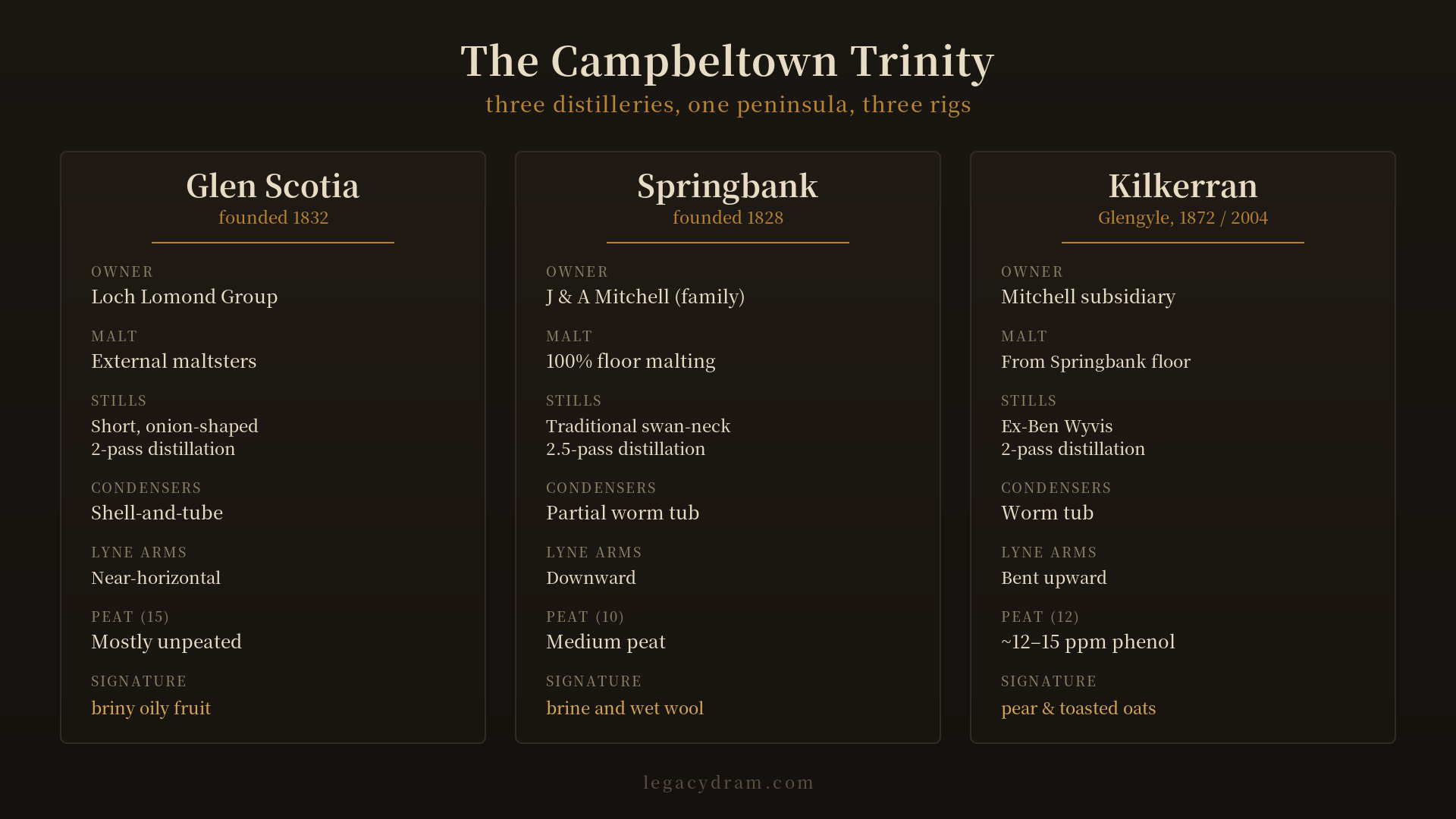
The first is the stills themselves. There is one wash still of about 11,800 litres and one spirit still of about 8,600 litres. Both are short, squat, onion-shaped, with wide bases and short necks. Short, wide stills give less reflux than tall ones (less surface area for the rising vapour to condense back on, less time for heavy congeners to fall out before they pass through), so the resulting spirit is heavier, oilier, more loaded with the long-chain alcohols and esters that show up in the glass as weight on the tongue. This is the opposite of what tall, narrow stills do at, say, Glenmorangie. Glen Scotia’s stills are built to keep flavour in.
The second is the lyne arms. The pipes that carry vapour from the still head out toward the condensers sit at a near-horizontal angle, slightly downward in some descriptions. A downward-sloping lyne arm encourages vapour to keep moving toward the condenser rather than fall back into the still. Combine the short still with the near-horizontal lyne arm and you get a spirit that is consistently more oily and heavy than a spirit run on the same wash through a Glenmorangie-style five-metre still. The geometry of Glen Scotia is on the side of the molecule, not against it.
The third is the condensers. Shell-and-tube condensers sit at the end of the lyne arms, not the older worm tubs that Cragganmore and Springbank’s Longrow run. A shell-and-tube condenser is a bundle of copper tubes inside a steel shell of cooling water, with the vapour passing inside the tubes; it offers a larger copper-to-vapour contact area than a worm tub (where the vapour runs through a single coiled pipe submerged in cold water). More copper contact means more sulphur-bearing compounds (the ones responsible for meaty, vegetable, struck-match notes) react out of the vapour and stay behind. The result is a cleaner spirit than a worm-tub distillery would produce from the same wash. So Glen Scotia, despite using short heavy stills and near-horizontal lyne arms, runs through condensers that pull the sulphur back out. The two design choices work against each other, and the bottle sits in the gap they leave.
This is also where the bottle starts to separate from Springbank. Springbank’s distillation is a 2.5-pass affair (the spirit-still output partly recirculates) through stills with some worm-tub cooling in the older runs, and uses 100% in-house floor-malted barley. Glen Scotia distils twice, condenses through shell-and-tube, and buys malt in from external maltsters. Kilkerran, half a mile away, runs Ben Wyvis stills with their lyne arms bent upward to maximise reflux, condenses through worm tubs, and uses Springbank’s floor-malted malt. Three distilleries, three rigs, one town.
What is in the glass
Glen Scotia 15, 46% ABV, non-chill-filtered, no added colour. The standard recipe is a mostly first-fill bourbon barrel matrix with some refill American oak, finished for around two months in first-fill oloroso sherry hogsheads.
On the nose, the first thing that arrives is not bonfire or brine but apple: specifically the slightly waxed skin of a Honeycrisp left on the counter for two days, with a thread of unripe pear running underneath. Then comes the brine, but it is not the wet-wool brine of Springbank. It is the cleaner, drier brine of a fish-and-chip-shop paper bag two minutes after the chips have gone, with a flick of malt vinegar somewhere in the room. The two-month oloroso finish is doing its work quietly: a low note of damp raisin, never quite getting to the rum-and-fruitcake territory of an Aberlour A’Bunadh, just enough to round the edges.
On the palate, the spirit is oilier than the nose suggests. There is a viscosity that sits in the front of the mouth for about three seconds before the apricot kicks in (dried, slightly leathery, the kind of apricot you find in a deli bag of mixed dried fruit, not the bright sun-dried Mediterranean kind). Behind the apricot, a brief whisper of something faintly smoky, not peat exactly but the smell of a smoked kipper that someone is unwrapping in the next room. This is the Campbeltown character that the magazine writers keep trying to define and that resists definition: not the salt of Talisker, not the peat of Lagavulin, not the floral fruit of Aberfeldy, but a coastal weight that is structural rather than ornamental.
The finish is short to medium and ends drier than I expect, with pepper and woodland-floor oak. There is no caramel, because there is no caramel: natural colour, and the slight haze you see if you leave the glass long enough is the long-chain fatty acid esters doing what non-chill-filtered whisky does. It is a feature, not a fault.
You can taste the engineering decisions. The shell-and-tube condensers have pulled the sulphur out, so there is no struck-match note. The short heavy stills have kept the oils in, so the texture is greasier than a Highland equivalent at the same age. The extended fermentation has left the fruit esters alive. The two-month sherry finish is a layer rather than a dominant cask programme: it is sitting on top of the bourbon spine, not replacing it.
What it costs and what it is for
In the UK, Glen Scotia 15 retails at roughly £55 to £70, depending on retailer and shelf. In Japan it sits around 8,000 to 10,000 yen, when in stock; allocations are smaller than Springbank 10, but it is meaningfully more available than the Mitchell-family bottles, which tend to sell out within hours of a shelf restock. It is not a special edition. It is the working flagship.
This is the bottle to order when you want a Campbeltown that is not running on the Mitchell-family mythology. The Mitchell side is a story (Hedley Wright, Frank McHardy, seventy-nine silent years at Glengyle, family ownership since 1837). It is a story worth telling, and I have told some of it elsewhere. Glen Scotia is a different story: a distillery that has been owned by at least seven different companies since it opened, that closed itself twice, that runs on engineering decisions rather than family decisions, and that is now operated by a private-equity-owned group out of Glasgow. The fact that the bottle is still distinctively Campbeltown despite all of that is a different kind of evidence for what “Campbeltown” actually is. It is not a family. It is a geometry: short heavy stills, coastal warehouses, the salt aerosol that the Kintyre peninsula breathes year-round, the fermentation rhythm of a small operation.
If you are working through the trinity and you started with Springbank because it is the famous one, and moved to Kilkerran because the lyne arms are interesting, Glen Scotia 15 is the one that finishes the conversation. The trinity is not complete with two whiskies.
What to check the next time you pour it
The next time you open a Glen Scotia 15, the thing to taste for is what the shell-and-tube condensers did. Compare it side-by-side with a Cragganmore 12, which runs on worm tubs: the Cragganmore will smell, very slightly, of the inside of a hot car on a summer day, an almost-metallic note that the shell-and-tube has scrubbed out of the Glen Scotia. Then compare it against a Springbank 10 of the same year. The Springbank will smell of damp wool and an extinguished bonfire. The Glen Scotia will smell of an apple eaten near the harbour. Same peninsula, same brine in the warehouse air, two different rigs.
The man whose engineering decisions made it possible spent sixteen years running the distillery and then moved to a different country. The distillery is now run by someone else. The bottle is still here. That is what the third Campbeltown looks like: the distillery is the thing that survives, the names on the brass plates change, and the next person responsible for it inherits a flow diagram that someone called Iain McAlister, who used to work at the water company, drew for them in the years between the second rescue and the next one.
So far, no third closure. The math keeps running.
Cross-links on this site: I have written about Frank McHardy and the silent years at Springbank, the family-owned half-mile-away neighbour that ran on different rails through the same 1980s; Hedley Wright, Glengyle, and the Kilkerran 12, the third member of the trinity and the upward-bent lyne arms that produced it; John Smith and the Cragganmore worm tubs, the Speyside reference point for what worm-tub condensers do that shell-and-tube does not; the MacAskill brothers at Talisker, the other coastal maritime bottle to set against Glen Scotia’s brine; and John Ramsay’s seventeen years at Edrington, the steward role at a multi-brand house, useful as a contrast to the single-distillery engineering job McAlister did at Glen Scotia.