Johnnie Walker Blue Ghost & Rare: Jim Beveridge's Closed-Distillery Blend
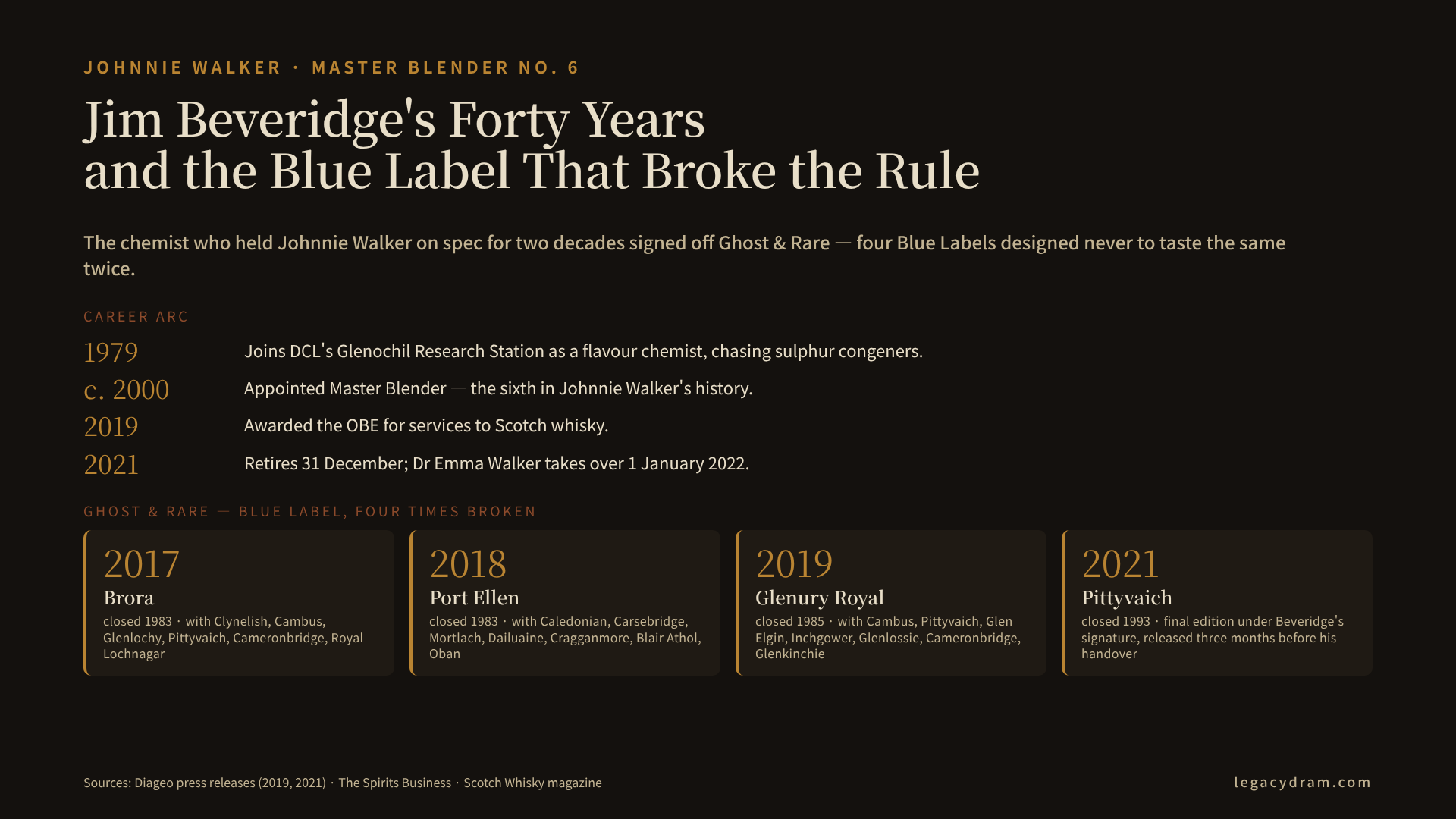
Brora distillery closed on 17 May 1983, in a year that Diageo’s predecessor company (then Distillers Company Limited) shut down ten malt distilleries in a single rationalisation. The casks already sleeping in the warehouses were not destroyed. They were inventoried, moved, and forgotten about, in the way that things are forgotten about when nobody is sure whether the company will exist in the shape that originally owned them. Thirty-four years later, in 2017, a man named Jim Beveridge opened some of those casks and bottled them under the Johnnie Walker Blue Label name, in a release called Ghost & Rare: Brora. That bottle is a quiet violation of the thing Johnnie Walker had spent more than a hundred years selling. I want to talk about why the quietest Master Blender in the building was the one who signed off the violation, and why he was probably the only person who could.
The rule he inherited
In Johnnie Walker’s century-and-a-half of trading, only six people have held the title Master Blender. John Walker himself was the first, in the grocer’s shop in Kilmarnock, in the 1820s, though the title didn’t exist yet and what he was doing then was closer to running a counter than to running a flavour brief. Five generations later, in roughly the year 2000, Dr Jim Beveridge became the sixth. He had joined the company (then United Distillers, now Diageo) twenty-one years earlier, in 1979, not as a tradesman but as an analytical chemist, working at the old Glenochil Research Station chasing sulphur compounds. “Sulphur compounds which have very distinct flavours present in whisky at low levels” is how he later described it to The Spirits Business. He arrived at a time when DCL was investing heavily in the science of blending, and a great deal of what is now standard blending practice (gas chromatography of new make, congener fingerprinting of mature stocks, statistical control of batch variance) came out of that lab.
If you want to understand the kind of person who was given the keys to Blue Label at the turn of the millennium, this matters. Beveridge was not a poet hired to taste casks and hum. He was a chemist hired to keep a number stable.
The number, in his case, was a flavour specification: a vector of congeners, in technical terms, that defined what Black Label tasted like, what Red Label tasted like, what Green Label tasted like, and what Blue Label tasted like. The job of the Master Blender at Johnnie Walker had, by 2000, become something close to running a feedback loop: each constituent malt and grain whisky changes a little year on year, as the source distilleries shift their barley, their yeast, their fill strength, their cask policy; the Master Blender’s job is to keep adjusting the blend so the output stays on spec.
That doctrine, stay on spec, is older than Beveridge by more than a century. It is the central decision of Alexander Walker (1837–1889), Johnnie Walker’s actual architect, who in the 1860s converted his father’s grocer’s blend from “a good whisky” into “a whisky that tastes the same every time you open one.” Single malt culture, which we now take for granted, prizes the opposite: the cask’s individuality, the distillery’s quirk, the year’s weather. Alexander Walker’s law is the engineering negation of that. Suppress the individual signal so the average remains identifiable. It is the reason Blue Label, on shelves from Tokyo to Lagos to Mexico City, is supposed to taste the same on every shelf.
Beveridge spent twenty years enforcing this law. I have never met him, but I read his interviews the way I read code reviews from a careful staff engineer: a great deal of “and we adjusted for that”, very little “and I had an idea.” This is the man who, in 2017, signed off Ghost & Rare.
The violation
The line “Ghost & Rare” sits underneath the words “Blue Label” on the bottle, in a smaller typeface, the way you’d phrase a special edition. It is not a new line. It is, structurally, Blue Label with the rule broken. Each edition centres on a ghost distillery (a closed distillery whose remaining stocks can never be replenished) and surrounds it with a supporting cast of rare malts and grains, some also from closed distilleries. The result is a different blend in every release.
The 2017 inaugural release used Brora at its heart, joined by Clynelish (Brora’s sister, two stills running in the village of Brora to this day, and the source of the waxy oily texture Beveridge had also leaned on in Gold Label Reserve; the Clynelish 14 core expression is where that same feints-driven signal reaches the shelf on its own), the closed Cameronbridge grain, the closed Cambus grain, the closed Glenlochy malt, the closed Pittyvaich malt, and Royal Lochnagar. The 2018 release centred on Port Ellen, with Caledonian and Carsebridge grains beside Mortlach, Dailuaine, Cragganmore, Blair Athol and Oban. The 2019 release centred on Glenury Royal, one of only three distilleries in Scottish history granted royal warrant, with a different supporting cast again. The final edition under Beveridge’s signature, released in October 2021, centred on Pittyvaich.
I want to be unromantic about what this is. Each of those releases is a different liquid. The Brora edition does not taste like the Port Ellen edition. The Port Ellen edition does not taste like the Glenury Royal edition. They share a price tier and a typeface and the family resemblance of “long-aged blend with smoky Highland coastal weight,” but they are not, in any meaningful sense, the same product.
If you walked into Alexander Walker’s office in 1875 and proposed this (we will release a series of bottles, all called Old Highland Whisky, each tasting different on purpose) he would have understood the proposal and refused it. The whole point of his life’s work was that customers in Bombay and Birmingham could buy a bottle of his blend and be sure it tasted the way the last bottle had. That assurance was the reason the blend sold at all. Variability was the enemy he had organised the business to defeat. Ghost & Rare invites the variability back in and charges $400 a bottle for it.
Why he signed it
I would like to write that Beveridge was a hidden romantic who finally, in his late career, decided to break out of the spec sheet and make something true. Here is where I have to deflate that. The reason the Brora 2017 release exists is, in large part, inventory pressure.
The casks from the 1983 closures were already in their thirties when Diageo had to decide what to do with them. Past around thirty-five years, most coastal Highland spirits begin to over-oak: the wood pulls more out of the spirit than it puts in, the fruit turns dusty, the smoke loses lift. The casks left at Brora were not improving anymore; they were running out the back of their useful window. Diageo had two options: bottle the casks as single malts at extreme prices and watch the supply die one batch at a time, or weave them into something else. Ghost & Rare is the second option. The Blue Label brand provided the price umbrella and the distribution apparatus; the closed distilleries provided the irreplaceable backbone; the format protected Diageo from the tail risk of bottling an over-oaked single malt under a famous distillery’s own name.
That is not an artistic decision. It is an engineering decision, and Beveridge was an engineer. What is the highest-value way to convert this asset before it goes off? The answer, in 2017, was to put it into Blue Label and ship it as a limited edition. The “ghost distillery experience” the marketing leans into is real, in the sense that the liquid in the bottle did come from a vanished site; it is also, less romantically, the marketing layer over an inventory disposal.
I do not say this to diminish what is in the bottle. The 2017 Brora release is, by every account I trust, very good whisky. It is just that the question “why does this exist?” has an engineering answer before it has a poetic one, and pretending otherwise is the kind of thing Alexander Walker would not have done either.
The detail the press release skipped
There is one piece of context the 2017 launch did not foreground, and that I find honest to include. In the October 2021 announcement of Beveridge’s retirement, Diageo’s own copy described the incoming Master Blender, Dr Emma Walker (no relation to the Walker family), this way: “Her innovations include the Johnnie Walker Blue Label Ghost and Rare series and Jane Walker by Johnnie Walker.”
So Ghost & Rare was her idea.
This is worth sitting with for a moment. Emma Walker joined Diageo around 2008, worked as a Master Whisky and Innovation Specialist, and proposed the Ghost & Rare concept somewhere inside her innovation portfolio in the mid-2010s. The Master Blender, Beveridge, was the person who had to sign off on whether to commit Blue Label’s name to it. He did. He signed off four editions: Brora (2017), Port Ellen (2018), Glenury Royal (2019), Pittyvaich (2021). Each one is the chemist-blender approving the next-generation designer’s proposal. This is not a heroic blender having a late-career revelation. This is a long-tenured senior approving a younger colleague’s project, repeatedly, and putting the Blue Label name on the cheque each time.
The succession became official on 1 January 2022. The Pittyvaich edition had shipped about three months earlier; the last Ghost & Rare release of Beveridge’s tenure was, in effect, his handover note. Emma Walker is now the first female Master Blender in Johnnie Walker’s two-century history, and the format she inherits is the format she invented. Whether she keeps it, whether she shifts it back toward the spec-sheet discipline she has spent a decade and a half learning from Beveridge, or whether she takes the licence she has been quietly handed and pushes it further: that is, as of this writing, not yet in any bottle.
Where this fits
If you map the people who have run flavour briefs at the world’s largest blends in the early twenty-first century, you get a smaller list than you might expect. John Ramsay at Edrington ran Macallan, Highland Park, Glenrothes and The Famous Grouse from 1991 to 2009: seventeen years of holding four bottles to spec, inventing nothing. Stephanie Macleod at John Dewar & Sons has been Master Blender since 2006, six-time Master Blender of the Year, name nowhere on the bottle. Rachel Barrie at Brown-Forman runs BenRiach, GlenDronach and Glenglassaugh in parallel. Beveridge sat at the largest of them, and his most-discussed late-career project is the one that broke his own house’s first rule.
I think Alexander Walker, if you could send him forward in a tube and pour him a 2017 Brora Ghost & Rare from a Glencairn, would object to the existence of the bottle, then drink it, then concede that the casks could not have been left to die in the warehouse. He would probably also object to the price. Engineering decisions made under inventory pressure rarely make an 1865 Kilmarnock grocer happy.
The rule he set down was stay on spec. The exception Beveridge designed, four times, was the one Emma Walker proposed and now owns. The seventh Master Blender at Johnnie Walker is the first woman, the first one whose own innovation predated her appointment, and the first one in a position to decide whether the rule or the exception is the future of Blue Label. None of the three of them (Alexander, who wrote the rule in the 1860s; Jim, who held it for two decades and then signed off the exception; Emma, who now holds both) will get to read the answer in a glass. The bottles after them will.