Highland Park 12 Review: 4-6ppm Hobbister Peat
A friend who drinks mostly Islay came over on a cold Saturday in April and made me set up a flight. Three bottles, all roughly the same price (about £40 in the UK, around 5,000 yen in Japan), all peated, all twelve years old or close to it: Talisker 10 from Skye, Bowmore 12 from Islay, and Highland Park 12 from Orkney. Glencairn glasses, a small jug of room-temperature water, and a bowl of plain crackers because we were trying to taste, not eat. I had told her in advance that the Highland Park would be “the one without a strong opinion.” This turned out to be both unfair and useful.
Highland Park 12 is the bottle people put on the shelf to say they take whisky seriously, the way I once bought a sourdough starter to say I cared about bread. It is competent, available, never embarrassing, and almost impossible to describe without using a word someone in marketing has already worn out. I have been told, on different occasions, that it is “balanced,” “Viking,” and “a great all-rounder,” and none of those phrases told me what was in the glass. So this is an attempt to do better, with one bottle as the centre of the story and two others as anchors that show what its peat isn’t.
Hobbister: a different kind of bog
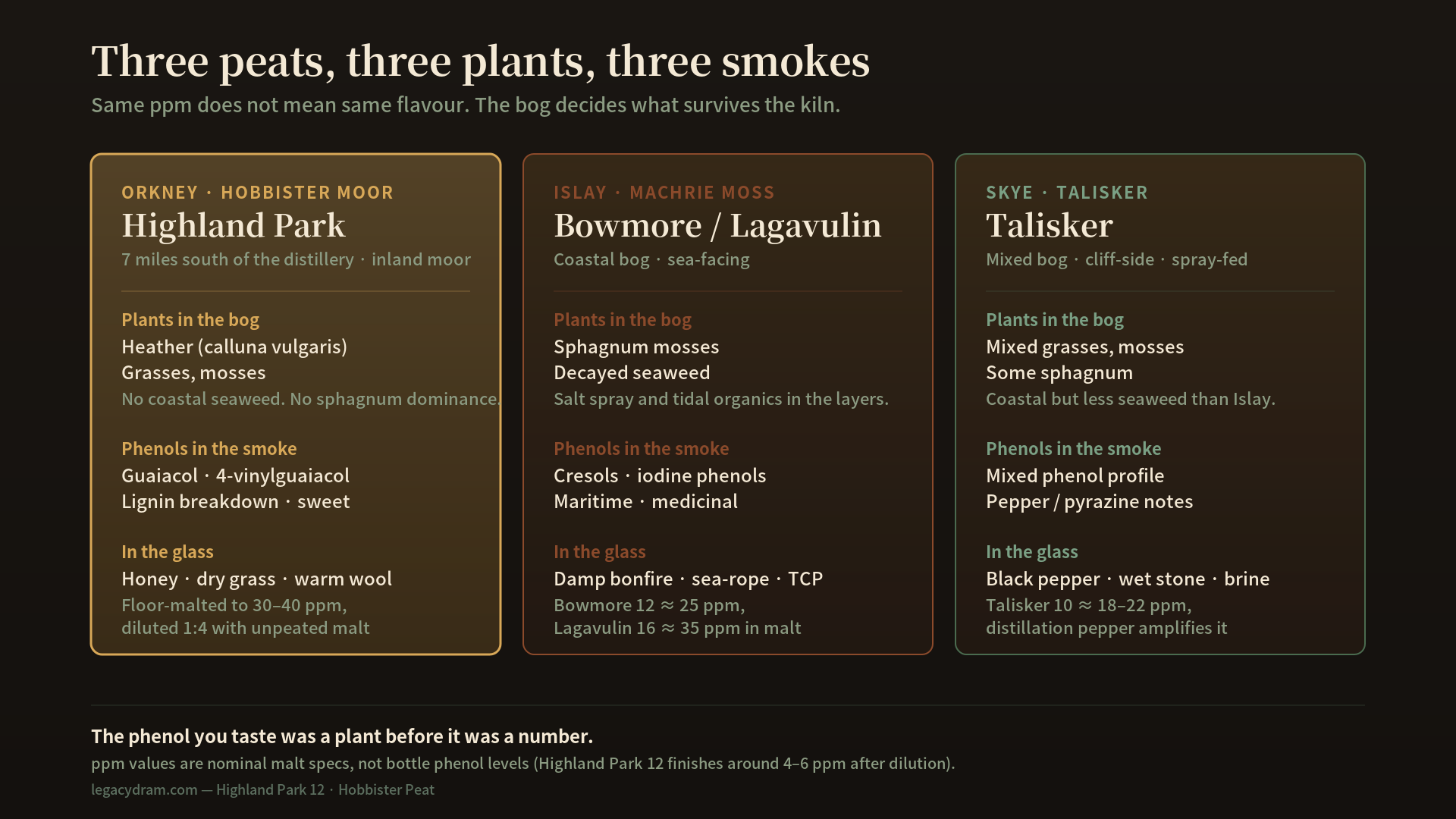
The peat at Highland Park does not come from the same kind of ground as the peat at Lagavulin. This sounds obvious in retrospect and is almost never said in the marketing copy, which prefers to talk about ppm as if peat were a single substance you could turn the dial on.
Hobbister Moor sits about seven miles south of Highland Park’s distillery in Kirkwall, on the main island of Orkney. It is moorland, not coastal bog. The dominant plant building the peat over the last few thousand years has been calluna vulgaris (common heather), with grasses and mosses underneath it. When you cut a brick of this peat, dry it, and burn it in a kiln, the smoke carries the breakdown products of those plants: lignin, guaiacol, 4-vinylguaiacol, and a family of phenols that read as sweet, herbal, slightly camphor-like.
Compare that with Islay peat, where the bogs are coastal, the plants include sphagnum mosses and decayed seaweed, and the smoke carries iodine-tinged, medicinal phenols and cresols. Or with Skye peat at Talisker, which is somewhere in between but with a salt-spray and pepper signature on top.
So when a tasting note says Highland Park is “lightly peated,” that is a number. The story underneath the number is that the peat is chemically different, not just smaller. Saying Highland Park has half the ppm of Bowmore is true. Saying it tastes like half a Bowmore is wrong. It tastes like a different plant.
This is the part of distillation engineering I find genuinely satisfying. Two bottles can have the same nominal “peat content” and still taste like they were smoked over different fires, because they were. (My friend, who up to this point had been polite, said: “Yes, OK, but I want to drink it now.” Fair.)
The 80/20 trick
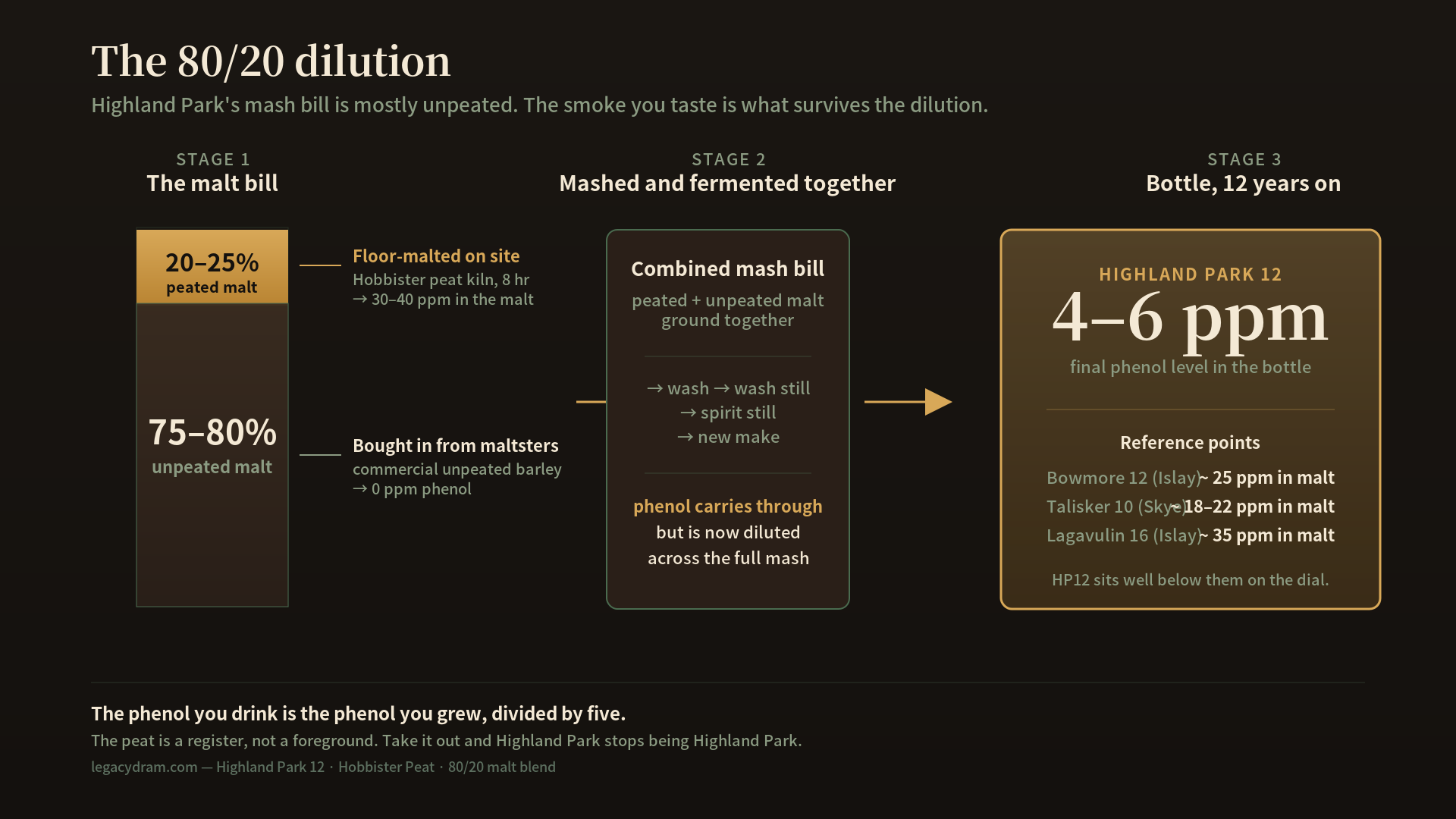
Highland Park is one of the few Scottish distilleries that still does its own floor malting: about 20–25% of its annual barley, kilned with peat from Hobbister for the first eight hours and finished with smokeless coke for around nineteen. The peated malt that comes out of those floors is specified at roughly 30–40 ppm phenol, which is in the same range as Caol Ila or a young Laphroaig, except it is heather smoke rather than seaweed smoke.
Then they take that peated malt and blend it with about 80% unpeated malt brought in from commercial maltsters, and that blended bill is what goes into the mash. The phenol level you actually drink in a bottle of Highland Park 12 is around 4–6 ppm, not 30–40. Most of the peat character is dilution-suppressed before fermentation has even started — a malt-to-bottle drop that has been measured directly by SWRI’s Frances Jack rather than assumed.
This is, in software terms, a feature flag set to about 20%. The full-volume version of Highland Park’s peat exists (you can taste it in some of the cask-strength single-cask releases), but the production house style has been calibrated, since long before anyone alive worked there, to a quiet ratio. The peat is a register, not a foreground.
The cost of this design is that Highland Park can never be the bottle a peat enthusiast reaches for first. The benefit is that the peat does what perfumers call a base note: it sits underneath everything else, gives the dram a sense of place, and disappears if you stop paying attention. You can drink Highland Park 12 with someone who claims to hate peated whisky, and they often do not notice. (I have run this experiment. It works almost too well to be a fair experiment.)
The cask side: predominantly sherry, mostly refill
The other half of the recipe is wood. Highland Park 12 is matured, per the official spec, in sherry-seasoned European and American oak casks, with about 20% first-fill and the rest refill. This is not the same as saying “80% sherry,” which is a number I have seen passed around online and which is misleading. The cask is not a sherry cask in the Spanish sense; it is an oak cask that has been seasoned with sherry for around two years before being shipped from Spain to Scotland, and most of the casks under the 12-year-old have been used at least once before by the same distillery.
Edrington, Highland Park’s parent, runs the cooperage and seasoning programme as a long supply chain. The group keeps tens of thousands of casks in Spain at any given time, with a Jerez-area cooperage partnership (centred on Tevasa) producing the staves and managing the seasoning. The Macallan, Edrington’s other big sherried single malt, sits at the front of this supply chain and gets the largest share of first-fill European oak. Highland Park sits behind it. The 20% first-fill spec on the 12-year-old reflects that order.
The flavour cost is straightforward: a refill cask gives less wood and less sherry per year of contact than a first-fill, so the 12 leans on time and dilution rather than oak intensity. The benefit is that the spirit can still be tasted under the cask. If Highland Park 12 were 100% first-fill European oak, you would be drinking something closer to a young Macallan with a peat suggestion, and the Hobbister character would vanish under raisin and tannin. The current ratio leaves the heather room to breathe.
What’s actually in the glass
Back to the Saturday flight. Glencairn, fifteen minutes after pouring, no water for the first sip.
The Talisker 10 opens with cracked black pepper on the nose and a kind of pickled-seaweed iodine that you only notice if you have just smelled something that doesn’t have it. The peat is forward, the maritime note is forward, and the body is medium-heavy. It tastes like a wet stone wall on a windy day — and I mean that as a compliment.
The Bowmore 12 is sweeter on the nose than Talisker, with peat that reads as a damp bonfire rather than a salty one, and a soft sherry layer underneath the smoke. It is the dram that most clearly shows what an Islay peat looks like when it has been smoothed down by sherry-seasoned casks and a moderate strength.
The Highland Park 12, sat next to those two, smells of warm honey on toast, dry grass, and something that took me three sniffs to place before I admitted it was the smell of an old wool jumper that has been near a real fire (not the fire itself, the jumper afterwards). On the palate, there are baked apple skins, raisins warmed in a low oven, a faint salinity that I think is suggestion rather than fact, and a finish that fades into something like a heather honey and a closed envelope of smoke. It does not punch. It hovers.
(Out of habit I tried to call this “balanced” in my notes and crossed it out. “Balanced” is what people say about a dram when they do not want to commit to describing it. What I mean is: nothing dominates, the peat is a background register, the sherry is a refill-cask warmth rather than a heavy seasoning, and the spirit’s malt sweetness sits in the middle.)
If you are a Talisker drinker, Highland Park 12 will read as quiet to the point of vague. If you are a Macallan drinker, it will read as drier and woodier. If you are coming from Glenmorangie 10, it will read as denser and smokier. It does not win against any of those reference points on their own ground; it sits in a position none of them occupy, and the position is the product.
The recipe nobody owns alone
The most interesting fact about Highland Park 12 is that nobody currently working at Highland Park decided what it tastes like.
The signature blend ratios (the 20% peated to 80% unpeated, the share of first-fill sherry-seasoned casks, the 40% bottling strength, the chill filtration) predate the people running the distillery today. The current shape of the 12-year-old, including its 2017 “Viking Honour” packaging refresh and the 2024 update that quietly dropped the Viking Honour name and brought in heather-flecked labels, was set in motion by John Ramsay, who joined Edrington as group master blender in 1991 and retired in 2009. Ramsay also built the ranges that became Highland Park 18, 25, and 40, and he was the person who handed off to Gordon Motion when he left.
Motion joined Edrington in 1998 as Ramsay’s assistant. He had studied computer science at university, visited a few distilleries on a whim, taken a postgraduate brewing-and-distilling degree at Heriot-Watt, and worked through a couple of breweries and a malting house before Edrington hired him. He took over as master whisky maker in 2008 and held the role for seventeen years. In July 2025, after twenty-seven years at Edrington, he retired. His successor is Marc Watson, a fellow Heriot-Watt graduate who came up through Edrington’s blending team on Famous Grouse and Naked Malt and spent a stint as distillery manager at Holyrood in Edinburgh before stepping into the Highland Park role.
So the bottle on my table on Saturday night was made under Motion’s watch, from a recipe Ramsay refined, on a malt blend Highland Park has been running in some form since long before either of them got there. It will, in a year or two, be made under Watson’s watch, on the same ratios, with most likely a slightly different cask blend because the inventory has rolled forward. That is the entire structure of the brand. The job of the master whisky maker, here, has not been to invent a Highland Park style. It has been to keep one running.
(There is a temptation, when writing about three masters in a row, to call this a legacy or a lineage. Both words are too solemn for what is, structurally, three industrial chemists in succession running the same recipe with quiet, mostly invisible adjustments. I will leave the solemn version to the marketing team, who already have it covered in three languages.)
A note on Vikings
The “Viking Honour” name, used on the 12-year-old between 2017 and 2024, was a packaging decision rather than a distilling one. Orkney was indeed under Norse rule from roughly the 9th to the 15th century, and Kirkwall has a Viking-era cathedral to prove it. None of this has any traceable connection to the recipe. The distillery is from 1798. The current malt blend is twentieth-century. The Viking branding is twenty-first-century brand strategy, attached to genuine local history that happens to sit nine hundred years upstream of any whisky decision.
I mention this not to be cynical, but because the brand asks you to do a kind of imaginative work (picturing a longship, a horn, a heather-cloaked island) that the bottle does not strictly need. The bottle is, on its own terms, more interesting than the costume. A heather-rich peat from a moor seven miles away, a 20% peated malt blend, a refill-heavy sherry-seasoned cask programme, three master whisky makers in succession running the same numbers. That is enough to drink to.
What to confirm next time you pour one
If you have a bottle of Highland Park 12 in the house, or you are thinking of buying one as your first foray into Orkney whisky, the thing to verify on your tongue is this: is the peat in the dram, or under it?
Pour the 12, give it five minutes in a Glencairn, and try to find the smoke without looking for it. If you sniff hard for peat, you will find it: dry grass, faint smouldering wool, a warm heather note. If you stop looking, it slips back under the malt and the cask, and what comes forward is honey, baked apple, raisin, and a soft salinity. That is the design. The peat is a register, set quietly enough to live with for a long evening, distinct enough that if you took it out you would notice the absence. Three custodians have kept it there, in that ratio, for over thirty years between them, and that is the part of the bottle worth tasting most carefully.
The next time you reach for it, you are not drinking a Viking. You are drinking a chemistry-trained Scotsman’s careful refusal to touch the dial.
Try this bottle
Affiliate link below. If you buy through it, LegacyDram earns a small commission and the price you pay does not change. Alcohol-related links are intended for readers of legal drinking age (20+ in Japan, 21+ in the US).
Related reading
- The Reflux Equation: Why Glenmorangie’s Stills Are 5.14 Metres Tall (and What Bill Lumsden Inherited) — another long-running recipe and a custodian who chose not to redesign it
- Frank McHardy and the Silent Years: How Springbank’s Restart Survived Itself — the people who carry a distillery through, rather than over
Sources
- Highland Park official — highlandparkwhisky.com
- Edrington corporate — edrington.com
- Whisky Magazine on Marc Watson and the Motion handover — whiskymag.com
- Whisky Advocate on Gordon Motion’s retirement — whiskyadvocate.com
- Decanter coverage of the Highland Park Master Whisky Maker transition — decanter.com
- The Macallan / Tevasa cooperage partnership announcement — edrington.com
- Wikipedia: Highland Park distillery