Alfred Barnard: The 1887 Atlas of 162 Whisky Distilleries
There is a reprint of The Whisky Distilleries of the United Kingdom on the lower shelf of my bookcase, a 1980s photolithograph of the 1887 original, and it is the closest thing the industry has to a census of itself before anyone in the industry was thinking that way. The man who wrote it was Alfred Barnard, secretary of a London trade paper called Harper’s Weekly Gazette. Between the spring of 1885 and the end of 1887 he visited 162 distilleries (129 in Scotland, 29 in Ireland, 4 in England) and wrote down, in mostly the same format, what he found in each: how many wash stills, of what gallonage; how many washbacks, of what gallonage; what the annual output was; what the buildings looked like; what the journey to get there involved.
I read Barnard the way a developer reads a 1995 RFC. With the suspicion that almost nothing has actually changed underneath, and a faint embarrassment that I have not read the source document until now.
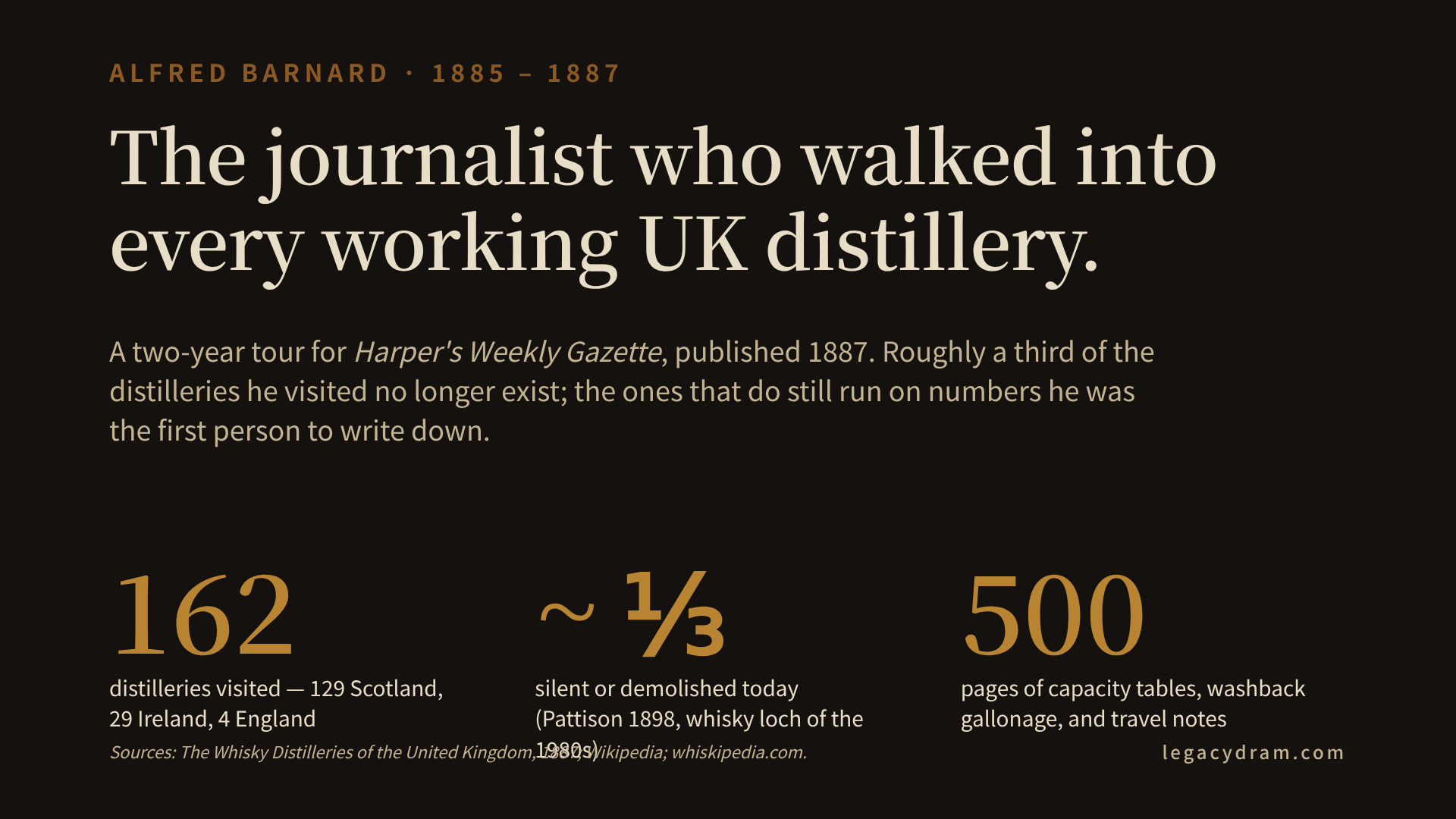
About a third of the distilleries he visited no longer exist. The ones that do exist still run on numbers he was the first person to write down in one place.
The man who did not make whisky
The temptation to romanticise this figure is enormous, and the romance is in the way of the actual point, so start with what Barnard was not.
He was not a distiller. He never owned a distillery. He had no equity in the trade. He was not a chemist, or an engineer, or a gauger; he was not Aeneas Coffey or Charles Doig or any other figure whose patent or sketch sits inside the production system. He was born in Thaxted, Essex, on 8 May 1837, into a Baptist family of no particular distinction. He died in Croydon in 1918, aged eighty-one, in the same year that Doig (a man eighteen years younger) also died. Their lives ended within months of each other and within the same wartime austerity.
What Barnard did, professionally, was hold an administrative post at Harper’s Weekly Gazette, the trade paper of the British wine and spirits industry. The job title in the contemporaneous records is secretary, which in late-Victorian usage covered something between what we would now call a managing editor and a senior commissioning editor. He commissioned and ran the trade-paper output. He was not, on the available evidence, a man with deep technical curiosity about distillation chemistry. He was a journalist with access to introductions.
The journey he embarked on in the spring of 1885 was a commission for the trade paper: Lowland first, then Highland, then Speyside, then Islay, then Campbeltown, then a crossing to Ireland, then back to a few English distilleries on the way home. It was a serial. Each distillery visit was a feature article. The book that consolidated them in 1887 was the natural product of two years of monthly instalments, and it is, in the language of its own era, a tour of the trade.
He travelled with companions. The folklore version has him as a solitary pilgrim with a notebook, and a few of the gift-shop reprints lean on that image. The text itself describes a small party. There are stretches where he is identifiably the spokesman of a group taking a coach across a moor, and there are stretches where he is being shown around by a distiller’s son who is plainly under instructions to be polite. Barnard’s heroism was clerical. He recorded. That is mostly what heroism is.
What he wrote down
The format of a Barnard distillery entry is recognisable from the first paragraph of any of them. There is an arrival passage, usually about the train station, the cart that met him, the weather, the agricultural countryside, an anecdote about a local laird or an old monastery. There is a paragraph about the buildings, with their stonework noted in some detail; he was, in his way, the first whisky journalist with an eye for the elevation of a stillhouse roof. And then there is a list of numbers.
The list of numbers is, in retrospect, the bit that mattered.
Take Glen Grant in 1887, which gets a five-page entry in the book. Barnard records two wash stills of 5,000 and 2,500 gallons, two spirit stills of 2,500 and 1,600 gallons, eight washbacks of 7,000 gallons each, a distilling capacity of 234,000 gallons a year, and actual production for the 1883–84 season of 172,917 gallons of spirit. The 1884–85 figure dropped to 140,370 gallons and he notes the dip without explaining it. He converts in imperial gallons throughout (1 imperial gallon is 4.546 litres), which is the lingua franca of the late-Victorian excise office.
I find these numbers more moving than I expected to. They are not framed as analysis. They are the equivalent of taking a screenshot of a production system in 1887 and noting the disk usage, RAM allocation, and weekly request count. They are inventory. The reason they survived is that almost no one else thought to write the inventory down.
Glen Grant in 2026 is a much larger distillery than the one Barnard documented. It has been expanded several times, the still room now holds eight pairs rather than two, the annual output has been roughly an order of magnitude higher for decades. What has not changed are the still profiles. The tall, narrow, German-bonnet wash stills with the long necks and the purifiers that Major James Grant specified are recognisably descendants of the smaller stills Barnard sketched. The shape, in the technical sense (the geometry that decides reflux and copper contact), is continuous. The capacity is not. This is, I think, the real lesson of going back and reading Barnard a hundred and forty years on: pot-still architecture is conservative, sometimes startlingly so, and the proof that it is conservative is that there is a primary source from 1887 in which the silhouettes are recognisable.
What he did not write down
It is more interesting to me what is absent from Barnard’s records than what is present.
He does not, as a rule, name the yeast. “Brewers’ yeast” is as far as he gets. The distillation industry of 1887 had no awareness, or no interest in publishing an awareness, of strain differences in Saccharomyces cerevisiae. The taxonomy of distillers’ versus brewers’ yeasts, which became the central preoccupation of a later generation of fermentation scientists, is simply not on his page.
He does not, as a rule, write about fermentation time as a flavour variable. He notes capacity and turnover, but the short-versus-long-ferment distinction that any modern distillery tour guide will explain in the first five minutes (and that determines a great deal of the fruit-ester profile of the resulting spirit) does not feature. The 1887 distiller, on the evidence of Barnard’s notes, regarded fermentation as a logistic constraint rather than an aesthetic variable.
He does not, almost ever, distinguish oak species. “Sherry casks” and “American oak hogsheads” are the rough categories. The cooperage supplier is rarely named. The species (Quercus alba versus Quercus petraea, the basis of the modern wood-program literature) is not a topic in 1887. The decision to source from Galicia versus Missouri versus Aomori is a twentieth-century preoccupation that Stuart MacPherson at Macallan, a hundred and thirty-five years later, would build a whole job description around. In Barnard’s atlas, the wood is plumbing. You need it to hold the liquid. The species is incidental.
This absence is, I think, evidence of the actual mental model of the 1887 whisky maker. The variables he treated as worth controlling were the still, the wash, the malt, the water, and the customs officer. The variables that became central to modern flavour discourse (yeast strain, fermentation time, oak species, char level, finishing) were either not understood as variables or not understood as worth writing down. Barnard’s omissions, in other words, are a fingerprint of the industry’s attention.
It is fashionable to read 1887 from 2026 as a moment of artisanal purity, when whisky makers cared more about every detail. That is wrong. Barnard’s notes show an industry that was less precise about a great many things, and confidently industrial about the things it did measure. The romance is twentieth- and twenty-first-century. The 1880s were a scale-up.
What was lost between Barnard’s book and now
The third use of The Whisky Distilleries of the United Kingdom is the one Barnard cannot have intended, and it is what makes the book load-bearing for the modern industry: it is the only systematic record of a great many distilleries that no longer exist.
The Scotch whisky industry contracted heavily in the twentieth century, twice. The first contraction was triggered by the Pattison crash of 1898 and the long depression in Speyside that followed it; the second was the whisky loch of the early 1980s, when over-production and a soft market closed roughly twenty distilleries in a wave between 1983 and 1985. Brora, Port Ellen, Banff, Glenugie, Glen Albyn, Glen Mhor, Convalmore, St Magdalene, North Port, Glenlochy, Glenury Royal, Lochside: all silent. Some have come back. Port Ellen was rebuilt and quietly re-fired in 2024. Brora reopened in 2021. Rosebank, silent since 1993, came back in 2023.
These revivals are technically possible, in part, because Barnard wrote down what their stills were. The Port Ellen team that recommissioned the distillery in the early 2020s built two new pot stills modelled on the historical geometry, and the historical geometry is partly traceable to Barnard’s 1887 measurements of the original stills. He is the citation in the modernity. The book has become a service manual for the resurrection of distilleries that closed two human generations after he died.
A second contrast is worth pulling. John Haig’s Cameronbridge appears in Barnard’s atlas, and Barnard’s description of the Coffey still in operation there (a forty-five-foot tall iron-and-copper column with the wash and rectifier paired and steam-driven) is one of the earliest primary descriptions of patent-still grain whisky as a working industrial system rather than as a chemistry-paper diagram. It is the kind of detail that is unrecoverable without a contemporaneous observer in the room, with a notebook, willing to write down the diameter of the column.
This is the relationship between Barnard and someone like Charles Doig, who I have written about before on this site. Doig drew the shape of the Speyside roof. Barnard recorded what was under it. They are the two halves of the documentary record of the Victorian distillery boom; one in elevation drawings, one in inventory paragraphs. They died in the same year, 1918, sixty-three and eighty-one respectively, both at the end of the era they were the principal documentary witnesses of.
The decision
I keep going back to the decision Barnard made in the spring of 1885, because it is not a chemistry decision and not a blending decision and not really a journalism decision either, in the modern sense. It was the decision to visit each one. Not the famous ones; not the best ones; not the ones his trade paper would get the most ad revenue from covering. He went to Glen Albyn and Glen Mhor in Inverness, and to Banff on the Moray Firth coast, and to Lochside in Montrose, and to dozens of small Highland and Lowland distilleries whose names a modern enthusiast cannot place without a reference. He went to all of them. The decision was completeness.
Completeness was, in 1885, a defensible commercial bet for a trade paper running a serial. There were enough working distilleries in the United Kingdom to fill two years of monthly instalments, and the readership, mostly publicans and wine merchants, would consume the geographical comprehensiveness as a service. The completeness, in other words, was a journalistic format choice, not a heroic gesture.
But the heroic effect of the choice was unintended, and it is what makes the book what it is. Selectivity ages badly; comprehensiveness ages into source material. The five pages on Glen Grant are useful; the entries on the silent ones are load-bearing, because no one else recorded them at scale and there is nothing else to refer back to. He went to all of them, and the all-of-them is what survived.
A short closing
I look at the reprint on the shelf and I think about how I would write the same survey of the modern Scotch industry in 2026. There are roughly 150 working distilleries again, including the new openings in the Lowlands, the Highland Islands, and Campbeltown, which is the same order of magnitude as Barnard’s number and a coincidence that pleases me. The atlas could be written again. It hasn’t been, in the same disciplined inventory format, and I don’t think it will be, because the present industry’s marketing departments would not tolerate the dryness of a single uniform schema applied to every distillery.
Glen Grant’s wash stills in 1887 were 5,000 and 2,500 gallons. Today, the still house holds eight pairs and the annual output is many times what Barnard counted. The shapes, however, are recognisably his. The man who measured them is dead. The stills are not.
Cross-links on this site: I have written about Charles Doig and the pagoda roof, the architect to Barnard’s archivist; John Haig and Cameronbridge, whose Coffey still Barnard observed in 1887; Major James Grant and the purifier at Glen Grant, the man whose still geometry Barnard documented; Bessie Williamson at Laphroaig, whose distillery Barnard visited under the Johnston family in 1887, two generations before her; and Stuart MacPherson and the three oaks, the wood-programme job that did not yet exist in Barnard’s atlas. I have also written about Benromach 10 and Gordon & MacPhail, a deliberate present-day reconstruction of the lightly peated Victorian Speyside that Barnard catalogued as the regional norm.
Primary source: The Whisky Distilleries of the United Kingdom, Alfred Barnard, Harper’s Weekly Gazette, London, 1887. Full text in the public domain via Internet Archive and Project Gutenberg. Glen Grant capacity figures cited above are from the Glen Grant entry of the original 1887 edition (cross-checked against the whiskipedia.com transcription).
Cross-checks: Wikipedia (Alfred Barnard); whiskipedia.com Barnard pages; scotchwhisky.com biographical feature. The “162” figure is stable across sources (129 + 29 + 4), with occasional drift to 161 depending on whether certain small distilleries are counted; I use Barnard’s own tally from the book’s table of contents.