Rachel Barrie: Master Blender Behind BenRiach & GlenDronach
A master blender at a typical Scotch distillery looks after one set of new-make, one stillhouse, one cask warehouse, one product line. Dr Rachel Barrie, since February 2017, has looked after three. BenRiach in the Speyside. Glendronach in the Aberdeenshire hills. Glenglassaugh on the Moray Firth coast. Three single-malt distilleries, each with its own spirit profile, its own cask programme, and its own history of mothballing, all reporting up to the same office.
Engineers know this shape. It is the on-call SRE who pages between three production environments and keeps one analytical baseline in their head. Except the on-call shift is twenty years long, the deploys are seven to twenty-one years late, and you cannot redeploy yesterday’s new make — it is already in a cask, in a warehouse in Banffshire whose contents were inherited from the last two owners.
This article is about how that job is done. I want to talk about three things: who Barrie actually is (because every Scotch career narrative tends to flatten the people involved, and her path is unusually well-documented), the chemistry of the sherry-cask portfolio that defines Glendronach in particular (Pedro Ximénez versus Oloroso, European oak versus American, why those distinctions are not interchangeable), and the structural problem of running a multi-distillery blend programme as a constraint satisfaction system rather than as a single house style.
Who Rachel Barrie actually is
Barrie was born in Aberdeen, took a chemistry degree at the University of Edinburgh, and started her professional career at the Scotch Whisky Research Institute (SWRI). SWRI sits in Edinburgh and is the industry-funded laboratory that scotch producers send their analytical questions to: yeast strain selection, congener profiling, peat phenol measurement, cask wood seasoning. The job is not customer-facing. It is the closest thing the trade has to academic chemistry done in production-relevant settings.
From SWRI she moved to the Glenmorangie Company in 1995 (the same year Bill Lumsden joined) and spent sixteen years there, of which eight were as whisky creator and master blender for Glenmorangie and Ardbeg. She then moved to Morrison Bowmore Distillers as master blender for five years, working across Bowmore on Islay, Auchentoshan in the Lowlands, Glen Garioch in Aberdeenshire, and the Laphroaig and Ardmore stocks that Beam Suntory held in inventory. In February 2017 she joined the BenRiach Distillery Company as group master blender, replacing Billy Walker, who had founded that company in 2004 and then sold it to Brown-Forman in June 2016 for £285 million.
Her remit at the BenRiach Distillery Company covers three single-malt distilleries: BenRiach, Glendronach, and Glenglassaugh. (GlenAllachie, which Walker bought separately a few weeks after the Brown-Forman sale, is not part of her portfolio. That is a different operation under different ownership and a different master blender, and the two should not be confused.) Barrie holds an honorary DSc and is, in published industry shorthand, described as the first female master blender of a Scotch distillery — a claim that has to be hedged carefully. Bessie Williamson ran Laphroaig from 1954 to 1972 as managing director, but the role was distillery management rather than the formally-titled master-blender role of the post-1990s industry; Helen Mulholland was master blender at Bushmills, which is Irish whiskey rather than Scotch. Barrie’s distinction is technical and category-specific. The more useful fact is that she has spent thirty years in production-side scotch chemistry, half of it at scale, and that she is one of the very few master blenders running three single-malt distilleries simultaneously.
The point I keep coming back to is that she came in through the analytical lab, not through the floor. Bill Lumsden at Glenmorangie, the same. Jim Swan as consultant to Penderyn, Kavalan, and Lindores Abbey, the same. The technical leadership of modern scotch shares an academic pipeline whose visible centre is the Heriot-Watt International Centre for Brewing & Distilling and whose less visible centre is SWRI in Edinburgh. If you have wondered why so many of the people deciding what is in your dram have chemistry training from the same two institutions, the answer is that the supply chain for this kind of expertise is, in fact, very small.
The three distilleries on her desk
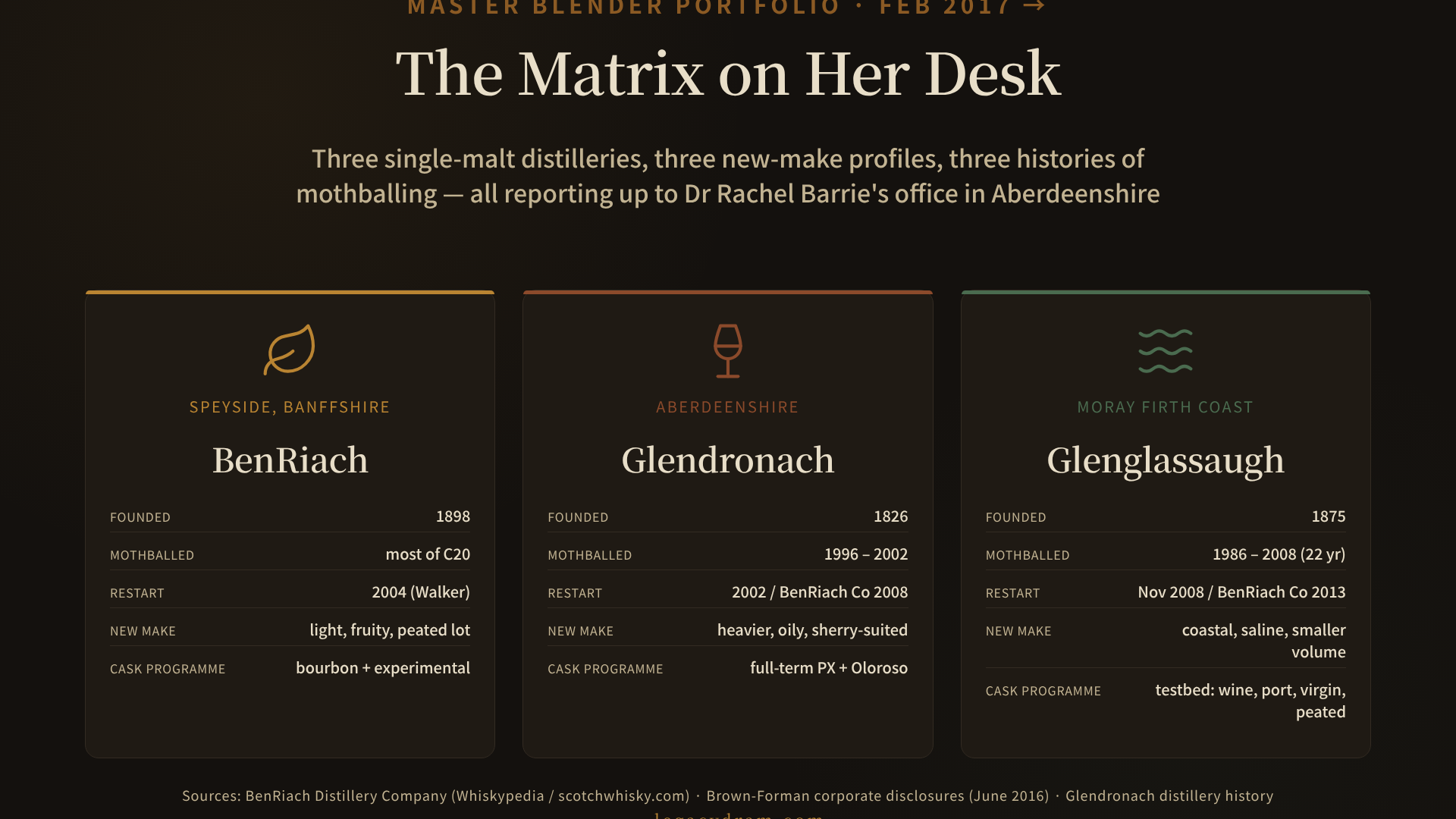
The three distilleries Barrie operates do not produce the same kind of spirit, and they were never expected to. The portfolio she inherited from Walker is, in matrix form, roughly this:
BenRiach (Speyside, near Elgin): Established 1898, mothballed for most of the twentieth century, restarted in 2004 under Walker. New-make profile: light, fruity, ester-forward, characteristic Speyside. Notable feature: a peated production lot runs alongside the unpeated, which is what makes bottlings like Smoky Twelve possible. Cask programme: bourbon and refill at the base, then a wide rotation of sherry, port, Marsala, virgin oak, and other secondary casks for finishes and limited editions. BenRiach is the most experimental of the three at the cask layer.
Glendronach (Aberdeenshire, near Forgue): Established 1826. Mothballed 1996–2002, restarted under Allied / Chivas, sold to BenRiach Distillery Company in 2008. New-make profile: heavier, more oily, deliberately suited to long sherry maturation. Cask programme: the heart of the company’s sherry identity. The 12 Original, 15 Revival, 18 Allardice, and 21 Parliament are all matured fully in Pedro Ximénez and Oloroso casks rather than finished in them. Glendronach is the distillery that Walker rebuilt around heavy sherry maturation in the late 2000s, and that identity has been kept under Barrie.
Glenglassaugh (Moray Firth coast, near Portsoy): Established 1875, closed in 1986 for what was supposed to be temporary and lasted twenty-two years, reopened in November 2008 by its then-new owners, acquired by BenRiach Distillery Company in March 2013. New-make profile: coastal, with more salinity in the spirit and a smaller production volume than the other two. Cask programme: heavily experimental, with bourbon, sherry, red wine, port, virgin oak, and a Torfa peated expression. With the smallest stock of any of the three sites, Glenglassaugh is functionally the testbed where younger expressions and unusual finishes can be tried without disturbing the older Glendronach age statements.
The matrix is what makes this hard. Each distillery has a baseline spirit chemistry (set by wort clarity, fermentation time, still geometry, cut points) that is essentially fixed once the stillhouse is built. Each has a cask inventory of perhaps fifteen to thirty thousand active casks, ageing on five- to twenty-five-year cycles. Each has a published product line whose specifications were committed years in advance. The master blender’s job is, on any given quarter, to pick the casks that will be vatted together for each bottling lot, and to make those choices reproducibly enough that next year’s Allardice tastes like this year’s Allardice without pinning the portfolio to stocks that will not exist in 2032.
It is, structurally, a multi-dimensional constraint satisfaction problem. Inputs: tens of thousands of casks per distillery with known ages, cask types, and (for the ones that have been pulled and sampled) congener profiles. Constraints: each bottling spec has a target ABV, a target age statement, a target cask-type mix, and a target sensory profile. Objective: solve next year’s bottling plan without exhausting older stock for the higher-age expressions and without committing the future to cask supplies that may not materialise.
Diageo and Edrington run their large-scale blend planning on something close to formal linear programming, with optimisation software in the loop. Mid-sized companies like the BenRiach Distillery Company sit on the other side of that line: the matrix lives in the master blender’s head and in spreadsheets, with GC-MS spot checks at decision points. Barrie is what happens when the optimiser is one person with a chemistry degree and twenty-eight years of analytical experience. She is, in the only sense that matters in this trade, the solver.
The sherry cask problem, written in chemistry
Glendronach is where the matrix gets specific, because it is the distillery in the portfolio whose identity is most exposed to a global supply constraint. Real sherry casks (actual bodega-aged, sherry-soaked oak vessels that scotch producers use for full-term maturation) do not exist in unlimited quantity, and the supply chain has been tightening for three decades.
A brief chemistry pass. Sherry casks for scotch are typically made from one of two oaks, with very different chemical profiles:
- European oak (Quercus robur, sometimes Q. petraea). The traditional choice for sherry casks in Jerez. High in ellagitannins, the hydrolysable tannins that contribute astringency and the dark dried-fruit character associated with classical sherried scotch. Lower in whisky lactones (cis- and trans-β-methyl-γ-octalactone, the ring-shaped esters that smell of coconut and incense) than American oak. The wood is denser and the grain is tighter; staves are typically slow-grown from Galician or central European forests.
- American oak (Quercus alba). Used for bourbon barrels and, increasingly, for “sherry-seasoned” casks made specifically for the scotch trade. Roughly twenty times the whisky-lactone content of European oak, lower in ellagitannins, more open grained. Faster, more vanilla-forward extraction.
Then there is what was in the cask before the whisky. Sherry casks for scotch fall into two main camps, and the distinction matters more than is usually admitted:
- Pedro Ximénez (PX) casks. PX is made from white grapes that are sun-dried into raisins, then pressed and fermented. The resulting wine carries 300 to 500 grams per litre of residual sugar (sometimes more), and is the sweetest standard sherry style. A PX-soaked cask retains a heavy load of residual sugars and aromatic glycosides after the wine is drained off. Whisky matured in PX casks pulls those sugars back out, producing the characteristic raisin, fig, espresso, and dark-chocolate notes. PX is the heavier-bodied option of the two, and tends to dominate the spirit it touches.
- Oloroso casks. Oloroso is oxidatively aged sherry: the wine is exposed to air over years of solera ageing, picking up nutty, savoury, dried-fruit notes from Maillard-type reactions and accumulated aldehydes. Crucially, oloroso is not biologically aged under flor (which is fino), so the cask carries different residual compounds. An Oloroso cask transfers nuttiness, dry dried-fruit character, and a more savoury structure to a maturing whisky, with much less of the heavy sweetness that PX brings.
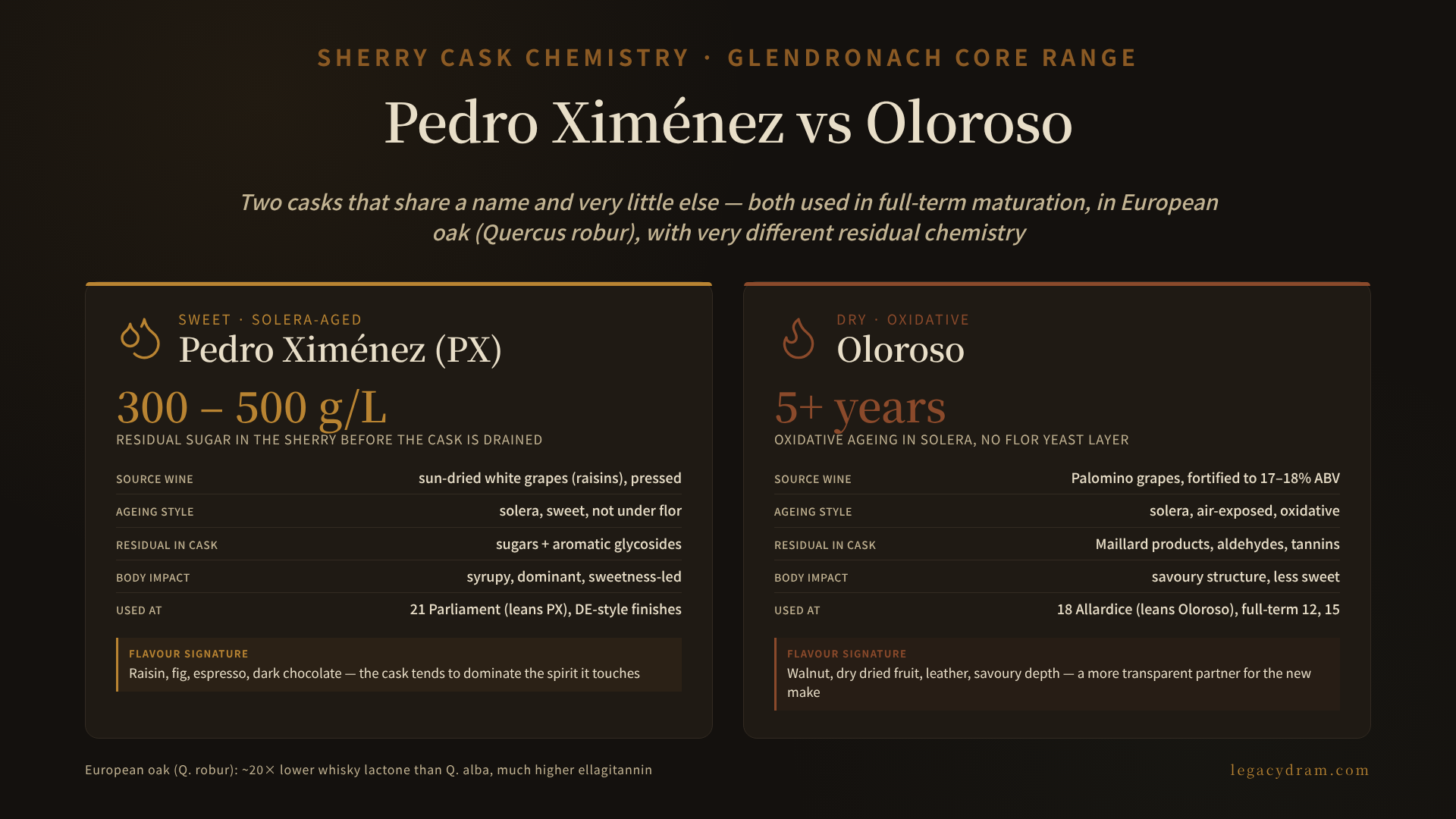
Glendronach’s classical position is that its core range (12 Original, 15 Revival, 18 Allardice, 21 Parliament) is matured in a mix of Pedro Ximénez and Oloroso casks, in European oak, for the full age stated on the label. The Allardice has historically leaned heavy on Oloroso; the Parliament is bottled at 48% ABV from a mix that leans toward Pedro Ximénez. This is not a finishing programme of the sort Glenmorangie’s Lasanta or Quinta Ruban uses. It is full-term sherry maturation, which is the more expensive option and the more supply-constrained one.
The trade-off is the one that defines the cask economy of modern scotch. Real Jerez-aged sherry casks, where wine actually spent years in the wood as part of a working bodega, are scarce and expensive. “Sherry-seasoned” casks, where European or American oak is filled with sherry for one to three years specifically to season the wood for whisky use and then drained, are more available but produce a chemically different profile: less Maillard depth, more controlled tannin load, sometimes a brighter and shallower sweetness. The Spanish wine industry’s contraction since the 1980s means that the sustainable supply of bodega-aged casks is, by most estimates, a fraction of what global scotch demand wants.
Glendronach’s commercial promise is that its age-statement range stays in true bodega-style maturation rather than drifting toward seasoning programmes. Holding that line is a procurement problem as much as a chemistry problem: it requires standing contracts with Jerez bodegas, willingness to pay several times the price of bourbon barrels, and active management of the cask inventory so that stock runs for the higher-age expressions are not exhausted by lower-age demand. None of that is visible on the label. All of it lands on the master blender’s desk.
The Glendronach gap
The Glendronach distillery was mothballed from 1996 to 2002, six years during which no spirit was produced and no fresh casks were laid down. That gap is, in 2026, fully visible in the age-statement programme. A 21-year-old expression bottled this year was distilled in 2005, and the 18 Allardice released this year sits on spirit from 2008. Anything that should have been laid down between 1996 and 2002 is simply not in the warehouse to be drawn from, and that means certain age statements have had to step around the gap.
This is the part of the inheritance that is hardest to engineer your way out of. A master blender can compensate for cask supply problems by selecting different staves, by adjusting vatting ratios, by extending or contracting the age band that goes into a given expression. A master blender cannot compensate for stock that is not there. The 2015 disappearance and 2018 reappearance of the Revival 15 is, structurally, the bill for a 1996 decision arriving twenty-two years late. Walker rebuilt the catalogue around what casks survived from the pre-1996 era; Barrie now has to extend his catalogue forward through the bottom of the gap.
What she inherited in February 2017 was, therefore, not three clean portfolios but three portfolios shaped by their previous management eras. Glendronach with its 1996–2002 gap. Glenglassaugh with its 1986–2008 gap, twenty-two years off, almost the entire ageing period of a 25-year-old whisky. BenRiach with its own production hiatus through most of the late twentieth century before its 2004 restart under Walker. Three distilleries, three different shapes of historical absence. Her job in 2017, and her job now, is to operate the future of these portfolios within constraints set by closures she had nothing to do with.
What’s in the bottle in 2026
A glass of Glendronach 12 Original in 2026 is a vatting whose component casks were filled between roughly 2008 and 2014, after the BenRiach Distillery Company restart and before the Brown-Forman handover. The master blender’s job there is to assemble a consistent profile from cohorts that include the early years of Walker’s tenure (cask programme reset, supply contracts being rebuilt) and the early years of Barrie’s tenure (her own cask selections beginning to feed the bottling plan). The Allardice 18 in 2026 sits on spirit from 2008 and earlier, which is Walker-era distillate exclusively, but matured under cask decisions partly made by Barrie. The 21 Parliament is fully Walker-era distillate, plus pre-1996 casks where any survive in usable condition.
A Glenglassaugh Revival (bottled around three years old, finished briefly in Oloroso) is the youngest commercially available scotch single malt from one of the longest-mothballed distilleries in the modern record. A BenRiach Smoky Twelve is Speyside peated spirit blended from bourbon, sherry, and Marsala wine casks, which is the kind of multi-cask vatting that requires the matrix view to even keep track of.
Across all of it, what you are actually tasting is the output of an analytical lab brain running on a thirty-year inventory across three sites, with the global sherry-cask supply chain as its outermost constraint. The master blender’s signature is not, in this case, a single house style. It is a continuity of method — the same analytical baseline applied to three different spirits, with three different cask programmes, all reporting to one office in Aberdeenshire.
I tried to draw the matrix in my head on a Sunday evening, two drams in, and gave up around the second axis. There is a reason this job pays what it pays, and a reason the people who do it well tend to have started in research labs. The bottle is the index card on the front of a multi-dimensional spreadsheet, and someone has to keep the spreadsheet honest. Since February 2017, that someone has been Rachel Barrie.
Related reading
- The Reflux Equation: Why Glenmorangie’s Stills Are 5.14 Metres Tall — same Heriot-Watt and SWRI academic root, single-distillery rather than three-distillery
- Jim Swan and the Cask That Shaved Years Off Time — the external consultant model versus Barrie’s in-house multi-site model
- Frank McHardy and the Silent Years — what happens when a mothballed distillery comes back
Sources
- Q&A With Rachel Barrie (Whiskey Reviewer, January 2018) — whiskeyreviewer.com
- The GlenDronach’s Dr Rachel Barrie: 30 years in whisky (Master of Malt blog) — masterofmalt.com
- The BenRiach Distillery Company (Whiskypedia) — scotchwhisky.com
- The Glenglassaugh Distillery Company (Whiskypedia) — scotchwhisky.com
- Glendronach distillery history (Whisky Guru) — whiskyguru.co.uk
- Pedro Ximénez Wikipedia entry — en.wikipedia.org
- Brown-Forman corporate disclosures on the BenRiach Distillery Company acquisition (June 2016)