Dunnage Warehouse 3-High: Scotch Maturation
Scotch distilleries do not stack their casks higher than three. Macallan goes to twelve. That nine-cask gap is not aesthetic.
It is a thermodynamic decision somebody made in the 1830s and keeps making every time a new warehouse goes up. In 1979, when Frank McHardy was promoted to manager at Springbank, he inherited a line of earth-floor dunnage warehouses on the shore of Campbeltown Loch that had been running on roughly the same architecture since the distillery got its licence in 1828. He retired in 2014. The floor was still there. In 2024 it still is.
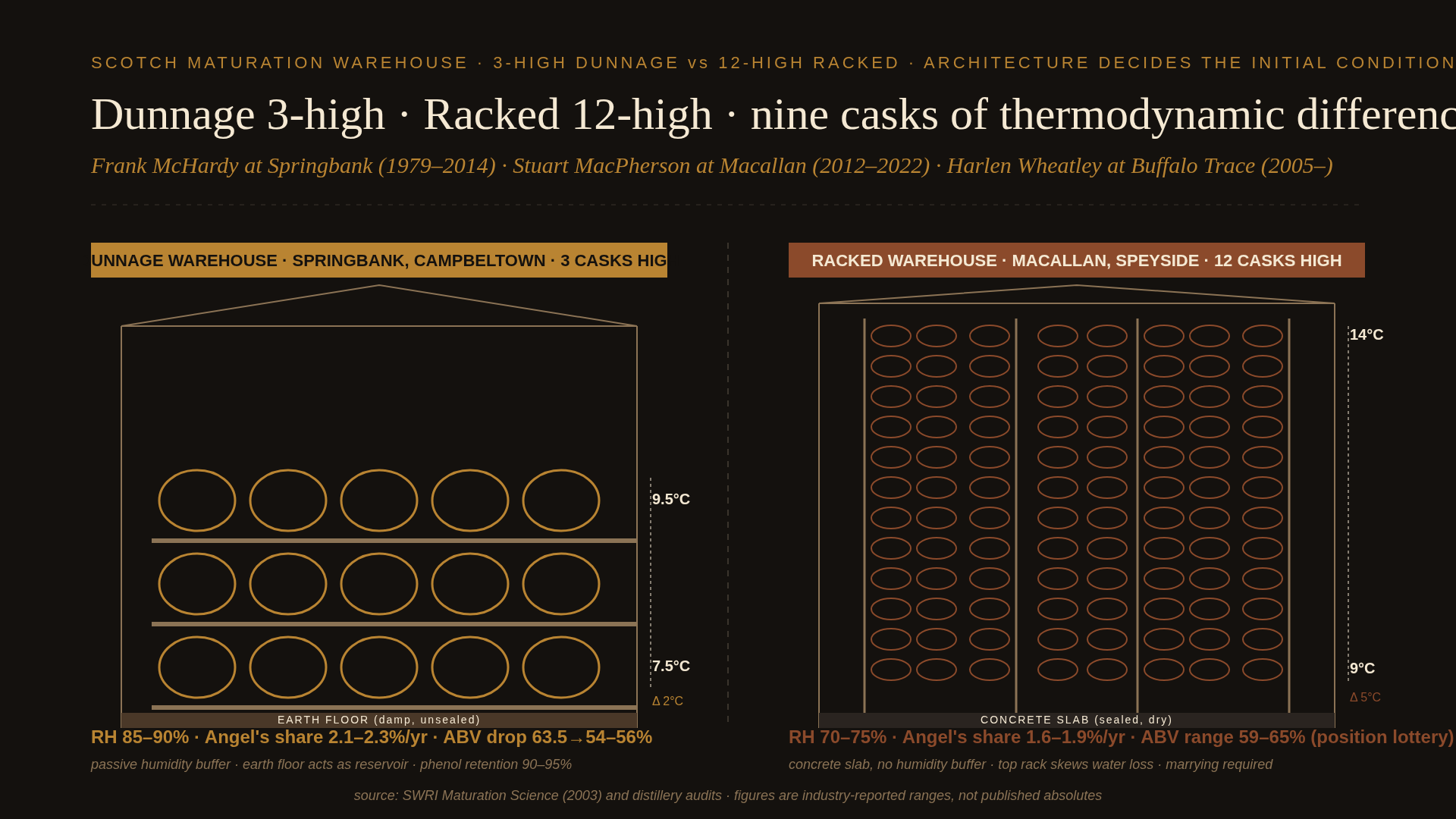
A dunnage warehouse is the old shape. Three casks high, laid on their bilges on wooden runners (the “dunnage”, a term the Scotch industry borrowed from the shipping word for the loose timber that braces cargo in a hold), on an earth or slate floor that nobody has ever bothered to seal. A racked warehouse is the newer shape. Up to twelve casks high, each slotted into a steel palletised rack bolted into a concrete floor, climate-passive but not climate-buffered. Macallan’s racked warehouses on the Easter Elchies estate stand twelve racks high (alongside sixteen traditional dunnage warehouses on the same site). The two architectures sit a hundred and twenty miles apart and run two different physics.
The floor is the point
A dunnage warehouse’s floor is not a design feature. It is the system.
An earth floor in Campbeltown or Islay sits permanently damp. The water table is a metre or two below. Capillary action keeps the top layer saturated. The air above the floor absorbs water vapour the way a wet sponge keeps a kitchen humid, and the warehouse interior settles at 85–90% relative humidity across the year, varying by roughly two or three points between a wet February and a dry June. The casks on the bottom runner sit a few inches above a damp slab; the casks on the top runner, four metres up, sit under a slate roof that gains and loses heat quickly in the Highland wind.
That is the whole physics. The floor is a slow-release humidity reservoir, the roof is a thermal buffer, and the three-cask vertical stack sits inside a column of air that moves slowly, from a 7°C floor to a 9°C roof in a Scottish January. Two degrees of gradient over four metres. The spirit inside each cask breathes evenly, slowly, into air that is already saturated enough that evaporation is thermodynamically disfavoured.
The angel’s share — the industry’s name for the fraction of spirit lost through the cask wall each year — comes in at 2.0–2.5% of cask volume. Of that loss, the ethanol fraction dominates, because in a humid environment ethanol partial pressure drives evaporation faster than water partial pressure — the saturated air outside the stave gives water nowhere to go, while ethanol still has a steep gradient. Over twelve years the spirit loses about a quarter of its volume and the alcoholic strength drops from a filling 63.5% ABV to roughly 55% ABV. The direction of the loss is set entirely by the humidity of the air outside the stave.
The racked warehouse is a different machine.
What a 12-high rack actually does
Macallan built racked warehouses at Easter Elchies on a concrete pad, with steel palletised racks that hold casks lying horizontal with no runners touching the floor. Twelve cask lengths of vertical stacking, about twelve metres of air column, with the floor sealed against groundwater and the roof pitched steeper to shed snow.
The humidity in that building settles at 70–75% RH in dry Speyside summer, drops as low as 65% in the inland hard-frost weeks, and only climbs toward dunnage figures during protracted rain. The vertical temperature gradient is 4–6°C between the ground rack and the top rack. In a Speyside July, the top rack can sit at 22°C while the floor rack sits at 17°C. The angel’s share runs 1.5–2.0% per year — the lower figure, in the aggregate, because the drier air and taller column shift the ethanol:water loss ratio away from the dunnage balance.
But — and this is the position lottery any racked distillery has to blend around — the top-rack casks lose spirit of a different composition than the bottom-rack casks. In Speyside’s drier air, water escapes the cask faster than ethanol, so a top-rack cask at twelve years can finish at 64–66% ABV, slightly above its filling strength. A bottom-rack cask in the same warehouse, in the same humidity window, can finish at 58–60% ABV. Same new-make spirit, same cask type, same calendar age. Two different liquids.
Stuart MacPherson, who ran Macallan’s wood programme from 2012 to 2022 as its Master of Wood, spent much of his tenure in Jerez auditing cask provenance from sawmill to bodega — a procurement task made all the more consequential by the fact that twelve high is twelve different liquids. The upstream wood specification and the downstream marrying programme that averages across rack position are two sides of the same house-style problem. You do not get to pick the chemistry without picking the architecture.
The maturation math, in two tables
Here is what the two warehouses do to a 63.5% ABV new-make Scotch over twelve years. The numbers are industry-reported ranges from published Scotch Whisky Research Institute work on maturation and distillery audits since. Treat them as forecasting envelopes rather than fixed figures.
Dunnage (3-high, earth floor, 85–90% RH)
| Variable | Floor rack | Top rack | Delta |
|---|---|---|---|
| Air temperature (annual mean) | 7.5°C | 9.5°C | +2°C |
| RH (annual mean) | 88% | 86% | −2 pt |
| ABV after 12 years | 54% | 56% | +2 pt |
| Angel’s share (annual) | 2.1% | 2.3% | +0.2 pt |
| Ester concentration (vs floor) | 1.00 | 1.08 | +8% |
Racked (12-high, concrete, 70–75% RH)
| Variable | Floor rack | Top rack | Delta |
|---|---|---|---|
| Air temperature (annual mean) | 9°C | 14°C | +5°C |
| RH (annual mean) | 74% | 68% | −6 pt |
| ABV after 12 years | 59% | 65% | +6 pt |
| Angel’s share (annual) | 1.6% | 1.9% | +0.3 pt |
| Ester concentration (vs floor) | 1.00 | 1.22 | +22% |
The delta between a dunnage floor cask and a racked top cask, after twelve years, is eleven percentage points of ABV. If you poured those two casks side by side into blind glasses, you would taste different whiskies. The racked top cask would read as more concentrated and more oily, the dunnage floor cask as more open and more aromatic. Neither is the “right” answer; they are two different maturation outcomes from the same filling strength because the architecture decides the initial condition for every chemical reaction that follows.
(At this point an engineer wants a design equation. The industry does not have one — maturation chemistry still runs on empirical regression against decades of cask-level data. Treat the tables as the forecasting envelope, not a model.)
Why Islay stayed dunnage
Islay is a 240-square-mile island thirty kilometres off the Argyll coast. The annual mean relative humidity is 85% or higher. The prevailing southwesterly carries salt spray a half-kilometre inland in a strong winter. Average summer temperatures run cooler than Speyside; average winter temperatures run warmer, because the sea moderates both ends of the thermometer.
In other words: the climate outside an Islay dunnage warehouse is already dunnage. The building is doing passive duplication of what the island does for free. Laphroaig, Lagavulin, Ardbeg, and Bowmore all run dunnage. Caol Ila, rebuilt by DCL (which later became part of Diageo) in 1972 under the group’s standardisation programme, is the Islay distillery most strongly associated with racked warehousing — and even then, Diageo keeps a share of its Caol Ila stock in dunnage at other sites.
The chemistry argument for Islay dunnage is specifically about phenol retention. The peat phenols in a heavily peated malt (cresols, guaiacol, 4-ethylguaiacol, syringol) are small-molecule volatiles that evaporate alongside the ethanol and water. In a 70–75% RH racked environment, phenol loss over twelve years can approach 15–20% of the filling load. In an 85–90% RH dunnage environment, phenol loss drops to 5–10%. The difference is why a 12-year Laphroaig poured today smells closer to its new-make phenol signature than a 12-year matured on the mainland in a drier warehouse would. (These are industry-reported directional ranges rather than a single audited number; distillery-level data has reinforced the direction without pinning down a magnitude.)
Peat is a procurement decision upstream — Bessie Williamson’s Laphroaig floor malting, Mickey Heads at Ardbeg — but the retention of that peat through a decade of maturation is a warehouse decision. The two decisions have to be made in the same breath or they cancel each other out.
The economic trade-off
I would like to tell you the engineering is a straight win for dunnage. It is not. Here is the honest ledger.
Dunnage costs more per cask of inventory, not less. A three-cask-high stack has roughly one-quarter of the cask density per square metre of a twelve-high rack. That means four times as much land is tied up per bottling-year of inventory. In Campbeltown or Islay, where industrial land is cheap and the local council has typically been happy to see another warehouse go up, that cost is tolerable. In Speyside, where competing demands from new distilleries have pushed land prices higher since 2015, it becomes a real line in the capex budget.
Dunnage buildings are cheaper to build than racked buildings. A dunnage warehouse is a timber-and-slate structure on an earth slab with wooden runners. A racked warehouse is a concrete slab with structural steel racking, each rack rated to hold roughly 15 tonnes of filled cask weight at the top position. A new racked warehouse is in the £1.8–2.5 million range for 20,000 casks; a dunnage warehouse of the same cask count is in the £1.0–1.4 million range but takes four times the footprint.
Dunnage is labour-intensive. Every cask on a dunnage runner has to be rolled, inspected, and sampled by hand. A racked warehouse’s cask handler is a forklift with a pallet-sized cask slot. The Mitchell family’s choice at Springbank to keep its dunnage line implies, as a matter of accounting, that they are paying for the slower maturation signal with higher labour costs per cask-year.
Racked warehouses age slightly less of their inventory per year on an angel’s-share basis — 1.6% vs 2.1% at the floor rack — but the top-rack variance means you need a more sophisticated marrying programme to produce a consistent bottling. A dunnage distillery does less marrying because the architecture already pre-smooths the variance.
The industry trajectory has been toward racked since the 1960s because labour has become expensive faster than land has. Dunnage survives at the independents (Springbank, Glengyle, Glenfarclas) and at the Islay group as a competitive statement about house style. It survives at Kilkerran because Hedley Wright, when he had Frank McHardy oversee the revival of the Glengyle distillery for first spirit in 2004, chose to carry the dunnage decision through from the parent. The architecture, in that line of thinking, is the brand. Nobody who runs a listed drinks company would phrase it that way out loud, but they understand the trade.
Passive buffering versus active control
The sharpest contrast to the dunnage model is not racked Macallan. It is Buffalo Trace’s Warehouse X.
Harlen Wheatley, Buffalo Trace’s master distiller, built the Warehouse X trial in 2013. Four small chambers, each with independent controls over temperature, humidity, airflow, and light exposure. The experiment was built to answer the question “how much can you shape maturation chemistry by shaping the air?” — a question only possible to ask if your climate is Kentucky, where summer humidity swings and winter dry spells make passive buffering fail. Wheatley’s loss rates run as high as 5–8% per year at the top of a standard rickhouse, three times a Scottish dunnage. The angel’s share is not a nickname in Kentucky. It is a budget line.
Warehouse X is the active-control approach. The passive-buffer approach is the earth floor at Springbank. They are two solutions to the same question — what sets the initial condition for every maturation reaction? — in two different climates with two different cost structures. The Kentucky engineer has to spend capital to buy the humidity that the Islay engineer gets for free from the Atlantic.
In both cases, the architecture decides the chemistry years before the stillman decides anything.
Where it shows up in the bottle
The next time you pour a Springbank 10 or a Kilkerran 12, you are drinking Frank McHardy’s architectural choice as much as you are drinking the mash bill or the still regime. The Campbeltown bottle is salted, oily, with a mid-palate density that comes partly from the slow dunnage swing between damp winter and marginally less damp summer. The spirit has spent a decade breathing a 2°C vertical gradient. Its ester profile is tight, its phenol signature well retained, its water-to-ethanol loss ratio skewed toward water.
Pour a Macallan 12 Sherry Oak next to it. Different distillate, different mash, different cask species — but also different warehouse. The Speyside bottle has spent its decade in a 5°C vertical column at 72% RH. Its ethanol loss ratio is skewed toward ethanol. Its ester concentration, cask for cask, is higher — about 20% higher at the top of the rack — but less uniform across the warehouse. The marrying programme is where that variance gets smoothed, and the marrying programme is MacPherson’s inherited problem.
Neither bottle is right. Neither is wrong. They are two different maturation outcomes from two different buildings, each of which an engineer named Frank McHardy or Stuart MacPherson signed off on because they believed the house style was in the architecture, not the label.
If I were to tell you the correct answer were “obviously, dunnage is better because tradition”, I would be writing a brochure. Dunnage is slower, more expensive per square metre, and labour-intensive. It also delivers a specific maturation outcome that cannot be reproduced in a twelve-high rack. If you want the Speyside signature of concentrated, high-ABV, cask-strength-friendly spirit, racked wins. If you want the Campbeltown signature of salt-and-oil at drinkable strength straight out of the warehouse, dunnage wins. The question is never which is right. The question is which outcome your bottle is pointing at.
Frank McHardy, from the 1979 reopening to the 2014 retirement, pointed Springbank’s bottles at the dunnage answer. That is why they taste the way they do. If you taste them tonight, the architecture is in the glass.
Related reading
- Frank McHardy and the Silent Years: how Springbank’s restart survived itself — the people-side story of the engineer who kept the dunnage architecture through two tenures.
- Macallan oak species explained: Q. alba vs Q. petraea vs Q. mongolica (Stuart MacPherson’s three-wood method) — what MacPherson did with the species decision inside the racked architecture.
- Warehouse X and the angel’s share: Harlen Wheatley’s trials — the active-control counterpart to Scottish passive buffering.
- Kilkerran 12 and Hedley Wright’s 79-year wait for Glengyle — what inheriting the dunnage architecture at a new distillery actually commits you to.