Kilkerran 12, Hedley Wright, and the Glengyle Distillery That Waited 79 Years to Bottle Its Own Single Malt
I pour two glasses of Campbeltown next to each other on a Sunday afternoon and immediately feel slightly ridiculous. The two whiskies were made by the same family, in the same town, in two distilleries that sit half a mile apart and (in some cases) share warehouses. On the left, a Springbank 10. On the right, a Kilkerran 12. The point of the exercise is to confirm that they are not the same whisky.
They are not.
The Springbank, at 46%, comes up out of the glass the way I expect Campbeltown to come up: brine and wet wool and the small ember-edge of a beach bonfire someone has kicked at on the way home. The Kilkerran, also at 46%, does something quieter. Pear skin. A thread of barley sugar. A peat that registers more like smoked oats than like a kiln floor. Same town. Same owners. Two different signatures.
The owner who paid for both signatures was a man called Hedley Wright. He chaired the family business for sixty years, did not give interviews if he could avoid it, and made the most expensive decision of his career when he bought back a distillery that had been silent since 1925 and then waited twelve more years before he let anyone buy a bottle of its single malt as a twelve-year-old.
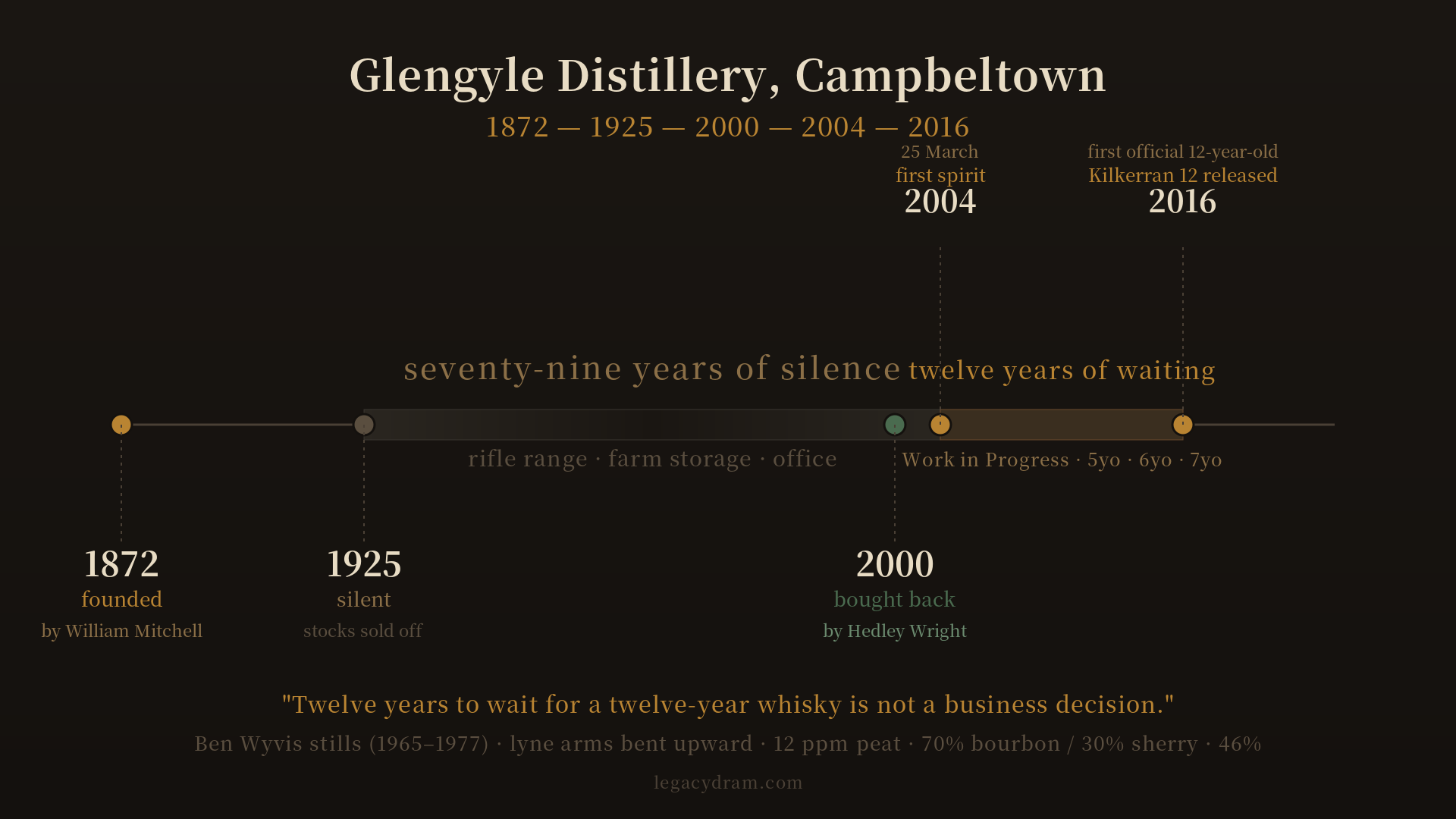
Twelve years to wait for a twelve-year whisky is not a business decision. It is a religion.
The man who chaired the family for sixty years
The bottle does not say so on the label, but the man whose decisions made it possible was called Hedley G. Wright. He was born in 1931, died on the fifth of August 2023 at ninety-two, and was chairman of J & A Mitchell & Co for over sixty years. He was the great-great-grandson of Archibald Mitchell, who in the early nineteenth century ran an illicit still in Campbeltown that eventually got legal and became Springbank. He was also the great-great-nephew of William Mitchell, Archibald’s son, who in 1872 broke with the family side and built his own distillery half a mile up the road and named it Glengyle. The family argument that produced two distilleries in the same town is one of the more domestic origin stories in Scotch whisky.
Wright inherited the chairmanship in the early 1960s and made several decisions over his sixty years in the chair that, in retrospect, look less like a series of separate decisions than a single sustained refusal to sell, modernise, or trade quality for volume. He kept Springbank floor-malting all of its own barley when nobody else of comparable size did. He kept it bottling without chill-filtration when the rest of the industry chased clarity. He kept it independent and family-owned through the 1980s whisky loch, when most of Springbank’s neighbours had either been bought by multinationals or stopped distilling. Springbank itself went silent for much of the 1980s; Wright reopened it in 1989 and pivoted decisively to single malt.
But the decision he is most likely going to be remembered for is the one he announced in 2000.
In that year, Wright bought the site of his great-great-uncle William’s old distillery, the one that had ground to a halt in 1925, been used as a rifle range, a farm storage building, and an office, and had not produced whisky in seventy-five years, and announced that he was going to bring it back.
The cynic’s version, and the longer one
It is possible to read the Glengyle revival cynically.
The Scotch Whisky Association recognises five whisky regions. Campbeltown, once home to over thirty distilleries during the Victorian boom, was, by the late 1990s, down to two operating ones: Springbank and Glen Scotia. The SWA’s working definition of a “region,” by convention rather than statute, had settled at three operating distilleries. Without a third, the case for Campbeltown as its own region rather than a footnote of the Highlands or Lowlands was thin. Wright did not lobby. He bought back the distillery his ancestor had built and put it back to work. The Campbeltown distillery count, conveniently, went from two to three.
That reading is real. The longer reading is that nobody spends what it costs to commission new mash tuns, install secondhand stills, run a distillery for years at a commercial loss, and then refuse to release a young single malt, solely as a regulatory manoeuvre. The Campbeltown question mattered to Wright, but the bottle in front of me is not a regulatory artefact. The choices that went into it are deeper than that.
The first choice was the stills. The Glengyle stillhouse runs on a pair of pot stills lifted, in 2003, out of the demolished Ben Wyvis malt distillery, a small unpeated-malt operation that lived inside the much larger Invergordon grain complex from 1965 to 1977 and was built to feed Whyte & Mackay’s blends. The stills had been sitting in storage for over twenty-five years. Frank McHardy, who managed Springbank at the time and supervised the Glengyle rebuild, did not install them as found. He had the lyne arms (the angled copper pipes that carry vapour from the still head to the condenser) bent upward, increasing reflux. More vapour condenses back into the still rather than passing through to the condenser. The resulting distillate is lighter, more orchard-shaped, more pear-and-grass than the original Highland geometry was set up to give.
The second choice was the distillation count. Glengyle runs at 2.5 distillations: the wash still feeds the spirit still, but a fraction of the spirit-still output gets recycled back through. Springbank does the same. Hazelburn, the other product of the Springbank stillhouse half a mile down the road, runs three full distillations. Longrow runs two with heavy peat. The Mitchell estate runs four different distillation profiles across two buildings, which is one of the more eccentric layouts in Scotland.
The third choice was the peat. Kilkerran’s malt comes lightly peated, at twelve to fifteen parts per million of phenol, about a fifth of what Lagavulin runs at, similar to Springbank’s standard distillate, and a long way below Longrow’s fifty-plus. The smoke is present but soft, the way an old wool coat hung in a smoke-stained pub picks up a memory of fire without smelling like the fire itself.
The fourth choice was the cask split. The Kilkerran 12 is a vatting of roughly seventy per cent first-fill bourbon and thirty per cent first-fill sherry casks, bottled at 46% without chill-filtration. The sherry component is small enough to push the bourbon profile sideways rather than overwrite it. This is a different cask philosophy from Macallan’s nearly-all-sherry approach, and it produces a different bottle.
The fifth choice was the waiting. The first new spirit ran on the twenty-fifth of March 2004. Glengyle put out Work in Progress bottlings (single malts at five, six, seven years old) between 2009 and 2015, partly to test the spirit and partly to keep the brand alive while the warehouses aged toward something Wright actually wanted to call a Kilkerran 12. The official 12-year-old was released in 2016. Twelve years of stock, twelve years on the cask. There is no shorter version of a twelve-year whisky. You wait.
What is in the glass
Two glasses on the kitchen table. Springbank 10 on the left, 46%, the standard expression. Kilkerran 12 on the right, 46%, the standard expression. Both bottles cost roughly the same. Both come from companies owned, until 2023, by the same man.
The Springbank opens with brine, not the pretty sea-spray brine of a Highland Park but a heavier, almost grease-cured brine that reads as if someone had left a wool jumper near a salt cod. There is wet rope underneath that, and then a small bonfire smoulders in the middle of the glass. On the palate it carries weight: oily mid-mouth, a little raw petrol, a finish that goes long and slightly bitter, like the rind on a kumquat. It is, unmistakably, industrial-strength Campbeltown.
The Kilkerran 12 does not try to do any of that. On the nose: pear skin, marzipan, a faint Turkish-delight rosewater note from the sherry component, and a peat that registers as the smell of toasted oats more than as a kiln floor. On the palate: lemon-cheesecake brightness up front, then leather-bound books (the kind pulled out of a back-room shelf and dusted off in an old-style hotel library), then a wave of pepper, and finally a smoke that arrives late, like a campfire someone is walking past rather than sitting at. The finish is shorter than Springbank’s and noticeably cleaner, ending in butterscotch and a curl of pecan rather than in salt.
You can taste the lyne arms.
Or, more precisely, you can taste what increasing reflux does to a spirit run from a still that was originally built to make unpeated Highland grain-warehouse malt: it strips out heavy congeners and leaves you with a brighter, fruitier, orchard-shaped distillate, onto which the small amount of peat lays as a finish rather than as a structure.
If you came expecting Springbank’s bonfire, Kilkerran will read as a disappointment. That is a misreading. Kilkerran is not a less-good Springbank. It is the answer to a different question: what does Campbeltown taste like when you take Campbeltown’s distillation rhythm (2.5 stills, full-flavour cuts, no chill-filter) and apply it to a stillhouse with different lyne arms, different copper-vapour contact time, and lighter peat? The bottle is the answer.
What it costs and what it is for
Kilkerran 12 sits at around £55 to £65 in the UK and 8,000 to 9,000 yen in Japan, when you can find it. Bottle releases are batched, the official site goes empty within hours of a drop, and you mostly buy it through specialist retailers who have an allocation. Total Glengyle annual output is around 750,000 litres of pure alcohol, which is roughly a twentieth of what Macallan produces in the same year. The bottle is not rare in any auction sense (there is no aftermarket premium worth chasing) but it is not always on the shelf either.
This is the bottle to think about if your Macallan 12 Sherry Oak has quietly become a 20,000-yen whisky and you would rather not. Kilkerran 12 does not give you what Macallan 12 gives you. The sherry component is smaller, the spirit is more peat-and-pear and less raisin-and-clove, and the cask programme is a different bet. But it is sherry-touched Campbeltown character at roughly one-third the price of the bottle that used to be the default. It is also, importantly, a sherry-touched bottle whose owner is not a multinational. The Mitchell estate is family-owned; Wright was famously uninterested in price escalation. His successors have, so far, held the line.
If you find a bottle, it is worth buying. If you have not had it, it is worth ordering by the dram in a bar with a decent Campbeltown rack, alongside, ideally, a Springbank 10 of the same year. The comparison is what the bottle is for.
What to check the next time you pour it
When you next open a Kilkerran 12, the thing to taste for is the geometry of the still: the upward-bent lyne arms that increase reflux, the resulting orchard fruit, the way the peat lays on top of the spirit rather than running through it. Hold it against a Springbank 10 if you can. The two spirits prove, in five minutes of comparison, that “Campbeltown” is not one thing but a family of things, made by one family, with internally different stillhouses.
The man who paid for that geometry (for stills lifted out of an abandoned Highland grain operation, for four years of construction work, for another twelve of patient ageing before a twelve-year bottle was finally released, for a distillery brought back from seventy-five years of silence) did not write any of this on the label. He did not, by all accounts, want to. The bottle is the interview he was never going to give.
I will think about that the next time I drink it.
The town that had been silent since 1925 is, in 2026, releasing smoke into the sky again. Hedley Wright is not. The arrangement seems about right.