Wort Clarity Explained: Grist Ratio and Fruity vs Nutty New-Make
I read tasting notes the way I read a stack trace: I assume the line everyone quotes is not where the problem started. People credit a whisky’s fruit to the still, or to the cask, the two photogenic stages a distillery tour spends the most time on. Both matter. But the first place the spirit forks toward fruity or nutty is two rooms upstream, at the moment a roller mill cracks a barley grain into three pieces of different size.
That sounds like the kind of thing a craft article says to feel clever. It is actually a particle-size problem with a measurable answer. When you mill malt for whisky, you are not making flour. You are making a deliberately uneven mixture, and that mixture has to do a second job nobody mentions: it has to filter the very liquid you will later drink. Get the mix wrong and the filter either clogs solid or leaks. Get it right and you still have a choice to make about how clear the liquid comes out, and that choice is most of the difference between a Glengoyne and a Springbank.
This is a story about that filter, the two engineers who decided which side of it to stand on, and the long-dead firm that built a machine so good it bankrupted itself.
The grist is a spec sheet for a filter
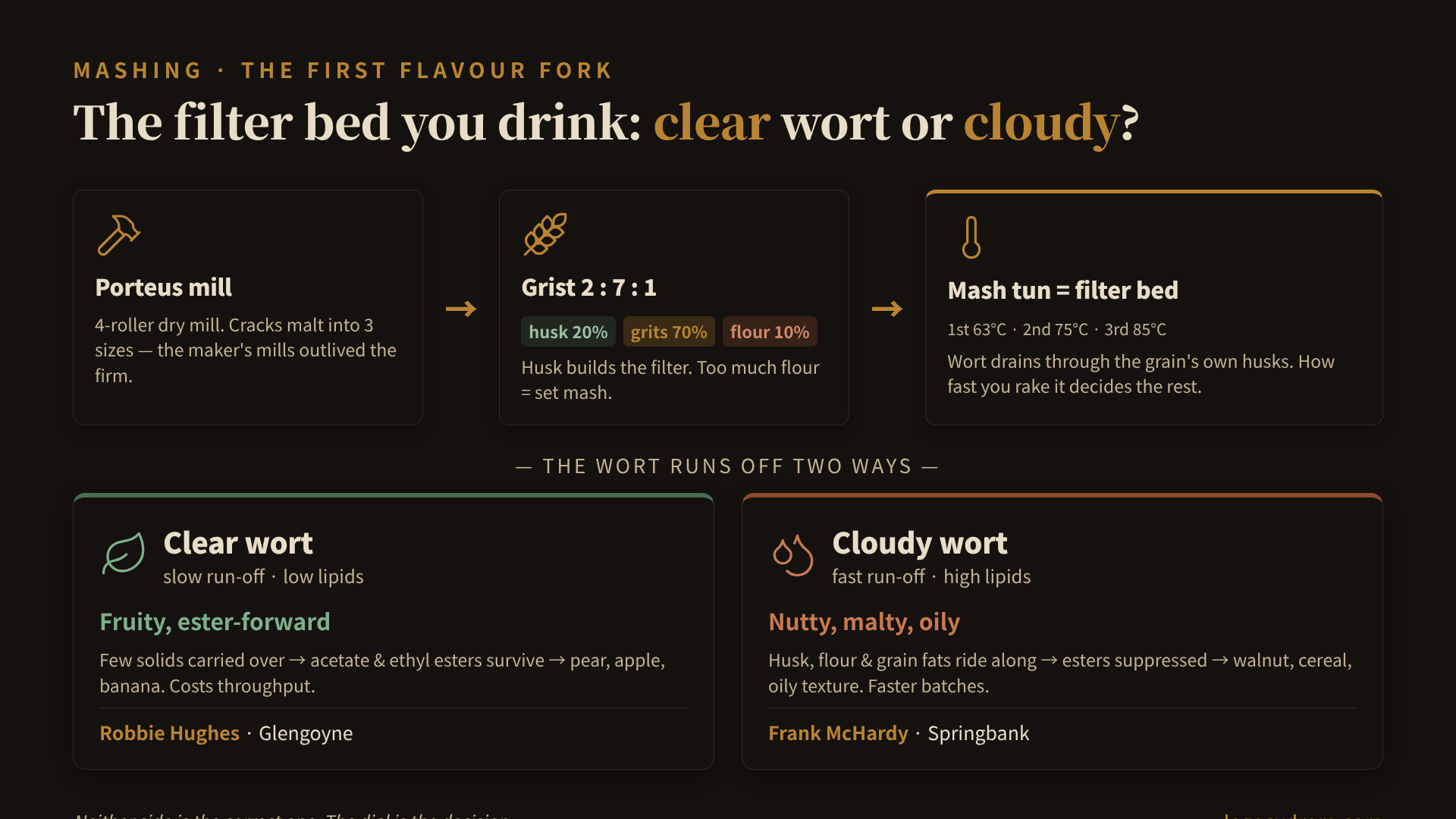
Milled malt is called grist. Run it through a standard four-roller dry mill and you get three fractions, sorted by size. The industry rule of thumb for the ratio is roughly 2:7:1: about 20% husk (the papery outer shell, coarse), 70% grits (the medium-ground starchy middle of the grain), and 10% flour (the finest dust). (Edinburgh Whisky Academy, WhiskyNet)
The first time you see that ratio it looks arbitrary, the sort of number you would expect a textbook to footnote and move on. It is not arbitrary. The grits are where the sugar lives: the fraction the hot water is there to dissolve. The husk and the flour are there to manage a fluid-dynamics problem.
Here is the problem. After milling, the grist goes into the mash tun, a large vessel where it is mixed with hot water to dissolve the sugars. The sugary liquid that results is the wort, and you have to drain it off the wet, spent grain. Drain it through what? Through the grain itself. The husks settle into a porous layer at the bottom of the tun and become a filter bed: a natural lauter filter the wort percolates through on its way out. (WhiskyNet)
Now the ratio reads like the spec it is. Too much flour, and the fine particles pack into the gaps and the bed clogs into a set mash, the brewer’s equivalent of a deadlocked thread, where the wort stops draining and a production shift quietly goes sideways. Too much husk, and the bed is so open that water sheets straight through without picking up the sugar, and your extraction efficiency (and your yield, and your accountant’s mood) drops. The 2:7:1 is the compromise that keeps the filter permeable enough to drain and tight enough to clarify. The Edinburgh Whisky Academy is blunt about the failure mode: mill too fine and the water cannot pick up the soluble sugars; mill too coarse and the water runs through too quickly. (Edinburgh Whisky Academy)
So before a single ester has formed, before the yeast is even pitched, the miller has set the permeability of the filter the whole batch will pass through. That is decision number one. Decision number two is what you do with that filter.
The dial: how clear do you let it run?
The waters go in hot and in stages. A traditional mash uses three (sometimes four) successive water charges at rising temperatures: a first water around 63–64°C, where the malt’s amylase enzymes convert starch to sugar most efficiently; a second around 75°C to extract more sugar without denaturing those enzymes; and a third around 85°C to strip the last of the sugars, at which point the enzymes are cooked and no longer needed. The later, sugar-poor “sparge” waters are usually held back and reused as the first water of the next mash. (Difford’s Guide)
That part is chemistry on rails. The interesting variable is the one the operator controls by hand: how fast you rake the bed and draw the wort off, and therefore how clear the wort runs.
- Rake slowly, draw slowly, let the husk bed do its work, and you get clear wort: few suspended solids, low lipid carry-over. Clear wort ferments toward a fruity, ester-forward spirit. (SMWS Americas)
- Rake hard, draw fast, drag husk and flour particles through with the liquid, and you get cloudy (turbid) wort: more cereal solids, more grain lipids (fats) and fatty acids carried into the washback. Cloudy wort ferments toward a nuttier, maltier, oilier spirit. (SMWS Americas)
The mechanism is not folklore. The grain lipids that ride along in cloudy wort are precursors and competitors in the fermentation: fatty acids feed pathways that suppress the light fruity esters and push toward heavier, oilier, sometimes savoury compounds. A 2024 study in the Journal of the American Society of Brewing Chemists on grist particle size and wort turbidity found that coarser milling raised turbidity and was associated with a reduced concentration of acetate and ethyl esters (the exact molecules carrying banana, pear and apple) in the new-make spirit. Clear wort keeps the fruit; turbid wort spends it. (Bathgate, J. Inst. Brew. 2019)
This is also where the sulphur lives, incidentally. Push the cereal character far enough and you get into DMS (dimethyl sulphide, a cooked-sweetcorn/vegetable note) and meatier compounds. Some distilleries want a touch of that. Most spend the still’s copper budget removing it. But that is a downstream argument; the upstream point stands: the fruit-versus-grain decision is largely made in the mash tun, in the choice of how cloudy to let the liquid run.
Two engineers, two ends of the dial
The cleanest way to see that this is a decision, not an accident, is to put two distilleries side by side and name the people who chose.
Robbie Hughes runs Glengoyne, in the Highlands just north of Glasgow, and the entire house philosophy is slow and clear. Glengoyne distils more slowly than anyone else in Scotland. Hughes’s point is that if you rush the stills you “force undesirable compounds over the neck of the still and eventually into the cask,” so they don’t rush them. (Square Mile interview) The same unhurried logic runs upstream into the mash: Glengoyne is run for a “beautifully light and fruity spirit,” and you do not get light and fruity by dragging cereal sludge into your washbacks. You get it by letting the wort run clear, keeping the lipids in the spent grain where they belong, and giving the esters a clean fermentation to form in. Hughes’s whole job is the careful, low-yield, fruit-preserving end of every dial the distillery has, and wort clarity is one of them. I wrote about the still-side half of this same philosophy — the copper reflux and the slowest spirit run in Scotland — in Robbie Hughes and Glengoyne’s slowest spirit run.
Frank McHardy spent his career at the other end. As Director of Production at J.A. Mitchell & Co (Springbank, in Campbeltown), McHardy presided over a deliberately archaic process built around a century-old cast-iron open-top mash tun, the kind of vessel most of the industry replaced decades ago with sealed, self-clearing lauter tuns. Springbank’s mash runs slow and manual and comes off cloudy on purpose, carrying husk and flour into the fermentation; combine that with long fermentation in larch washbacks and worm-tub condensers that limit copper contact, and you get Springbank’s signature: oily, nutty, malty, thick in the mouth. (Springbank process, scotchwhisky.com) McHardy could have specified a clear wort. He kept it cloudy because the oily complexity is the product. The longer arc of McHardy’s stewardship — how he kept the plant alive through Campbeltown’s silent years — is in Frank McHardy and Springbank’s silent years.
Here is the part a craft article is obliged to resist: the temptation to crown one of them. Clear wort is not refinement and cloudy wort is not crudeness. They are two coordinates on the same axis, and each man optimised for the spirit his distillery sells. Hughes’s fruit and McHardy’s oil are both intentional. If you taste a Glengoyne 12 next to a Springbank 10, you are tasting, among other things, the same decision made in opposite directions in a room nobody photographs.
The trade-off you can write on a napkin
So why doesn’t everyone just run clear and collect the fruit? Because clarity costs throughput.
A clear wort means raking gently and draining slowly, letting the filter bed do its slow work. Slow draining means each mash takes longer, which means fewer mashes per day, which means less spirit per year out of the same tun. Cloudy wort, run off fast, gets you back to the next batch sooner. The dial is not fruity-versus-nutty in a vacuum; it is fruity-and-slow versus grainy-and-fast, with a CFO-visible cost attached to every degree of clarity. Springbank’s slow open mash takes roughly ten hours to yield about 21,000 litres (a number that would make a high-throughput Speyside plant manager wince), and the oily character is part of what they are buying with that time. (scotchwhisky.com)
This is the same shape of decision as the copper-versus-time trade-off I wrote about with Forsyths and the still that wears out, and it sits one step before the fermentation-length trade-off I wrote about with Glenmorangie’s washback. Three different rooms, three different stewards, the same underlying engineering question: how much yield am I willing to give up for the flavour I want? The mash tun is just the first place that question gets answered.
The mill that was too good to sell twice
Both Hughes and McHardy were able to make their choice because of a machine neither of them built and both of them inherited. Walk into almost any Scottish distillery and the malt mill bolted to the floor was made by one of two firms: Porteus (George Porteus & Sons of Leeds) or Robert Boby Ltd of Bury St Edmunds. They are, by a wide margin, the most overlooked machines in the building: squat, painted, often older than anyone working there, and still cracking grain into a consistent 2:7:1 every morning. (Whiskipedia)
Here is the punchline, and it is a genuinely sad one for anyone who has ever shipped a product. Both firms went out of business because their mills were too good. A Porteus mill is, in the words of the people who maintain them, virtually indestructible: it seldom breaks and almost never needs replacing. (Whiskipedia) Which means that once a distillery bought one, it never bought another. There was no upgrade cycle, no consumable revenue, no replacement market. The firms engineered their own repeat business out of existence, and the 1970s–80s downturn in whisky (fewer new distilleries, fewer first-time buyers) finished the job. The reward for building the perfect machine was that the world only ever needed to buy it once.
I find that the most quietly devastating fact in all of whisky production. We tell engineers to build things that last. Porteus and Boby did exactly that, better than anyone, and the durability that should have been their moat turned out to be the thing that killed them. The mills outlived the companies that made them. Some of those mills are now over a hundred years old and will outlive everyone reading this, still patiently setting the permeability of a filter that decides, every single morning, whether the day’s spirit leans toward pear or toward walnut.
What this means for the bottle in your hand
Next time you pour something and reach for the word “fruity” or the word “nutty,” push the credit further upstream than the label wants you to. The cask gave it colour and tannin and a layer of vanilla. The still gave it weight and cut. But the direction, the choice between an orchard and a nut bowl, was very likely set in the first hour of the process, when a hundred-year-old Porteus mill cracked the malt into husk, grits and flour, and someone like Robbie Hughes or Frank McHardy decided how clear to let the resulting liquid run off a bed of its own husks.
You are, quite literally, drinking through a filter that someone designed on purpose. You just never see it.
Related reading
- Copper Is a Consumable: How Forsyths of Rothes Builds Scotland’s Stills: the same yield-versus-flavour trade-off, one room downstream at the still
- Brendan McCarron and the Yeast That Wasn’t There: what the next stage (fermentation length) does to the same fruity esters this article starts
Sources
- Edinburgh Whisky Academy, “The ideal grist ratio for making Scotch whisky”: edinburghwhiskyacademy.com
- WhiskyNet, “Malt Milling and Grist” / “Grist Composition”: whiskynet.pl
- Difford’s Guide, “Single Malt Scotch Whisky Production — Mashing”: diffordsguide.com
- SMWS, “How wort contributes to flavour”: smwsa.com
- R. Bathgate et al., “The influence of malt and wort processing on spirit character: the lost styles of Scotch malt whisky,” Journal of the Institute of Brewing, 2019: onlinelibrary.wiley.com
- “Effect of Grist Particle Size Distribution and Wort Turbidity on Ester Composition of Malt Whisky New Make Spirit,” J. Am. Soc. Brew. Chem., 2024: tandfonline.com
- Whiskipedia, “Porteus and Boby malt mills”: whiskipedia.com
- Square Mile, Robbie Hughes interview (Glengoyne): squaremile.com
- Springbank, “Process”: springbank.scot; scotchwhisky.com Whiskypedia, “Springbank”: scotchwhisky.com