DMS in Whisky: Why Copper Kills It, and Who Kept the Meat
The first time somebody tells you a whisky tastes “meaty,” it sounds like a marketing flourish. The second time, if you have Mortlach 12 open next to Glenfiddich 12, it stops sounding like marketing and starts sounding like a specific compound. Both are Speyside malts, roughly the same age, both matured in ex-bourbon casks with some sherry involvement. One tastes of pear and orchard fruit. The other tastes, unmistakably, of savoury reduction and tomato leaf. Not a little. A lot. If those were two builds of the same code base I would file a diff and start bisecting.
The diff is a molecule. Dimethyl sulfide, chemical formula (CH₃)-S-(CH₃), sits in every wash going into every still in Scotland at somewhere between 100 and 300 μg per litre. What arrives in the bottle is a small residual — single digits to about 50 μg/L in new-make, less after twelve years in oak — and the size of that residual is not accidental. It is set by two decisions the distillery made: how long they fermented the wash, and how much copper the resulting vapour saw on its way to the receiver. Alexander Cowie’s decision at Mortlach in 1897 was to let the vapour see as little copper as was structurally reasonable. Alan Winchester’s decision at Glenlivet, a century later, was to let it see as much as possible. Neither is wrong. They are two calibrations of the same catalytic reaction, chosen to produce two different spirits, and DMS is the marker in the glass that tells you which decision you are drinking.
This piece works out where DMS comes from, what copper actually does to it, how the worm-tub cluster of distilleries commit to keeping a specific fraction of it, and why the meaty character on Mortlach is not folklore but stoichiometry.
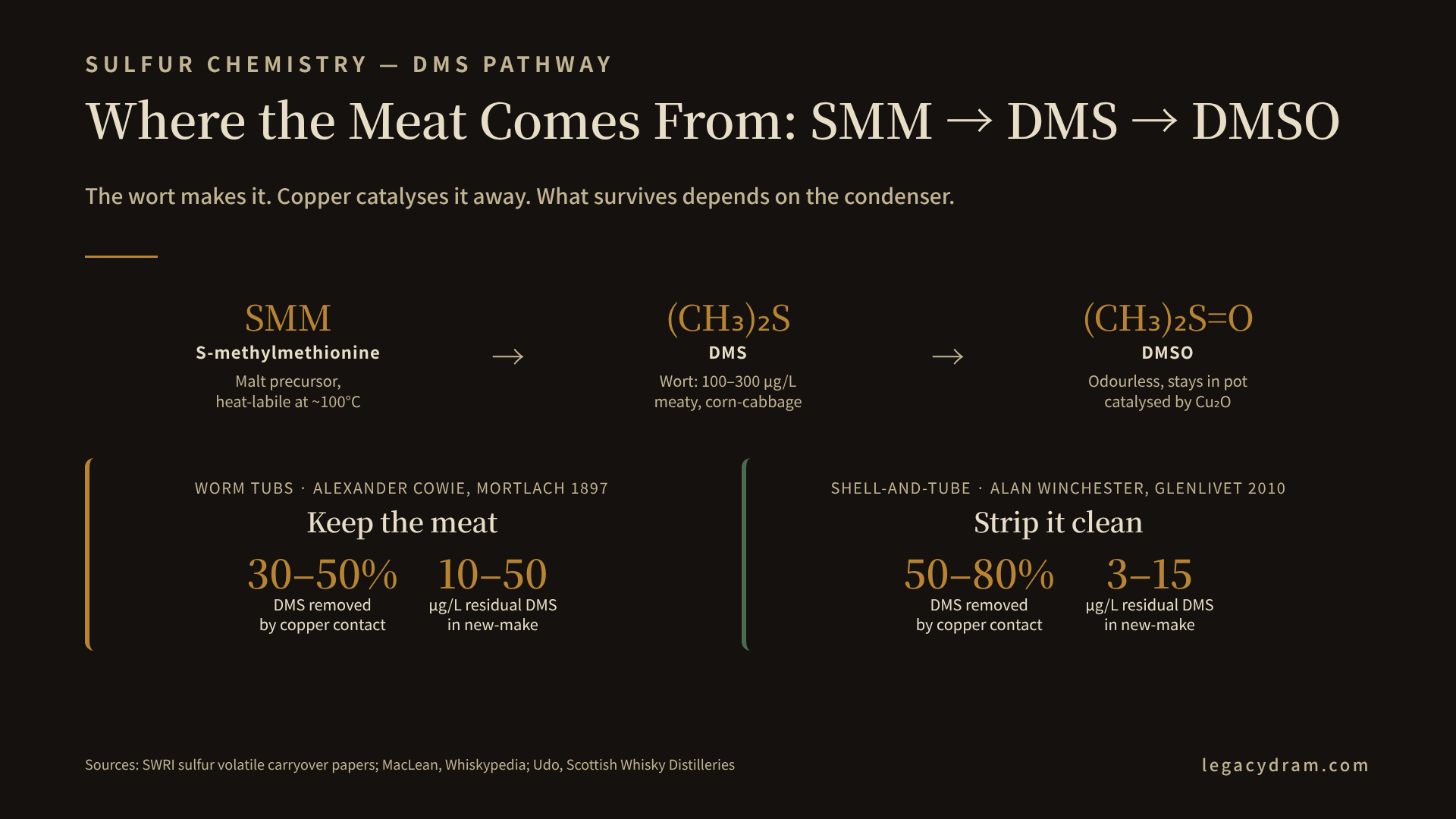
Where DMS comes from — SMM in the wort
DMS is not present in barley. It is not produced by yeast. It arrives during the wort boil, from a heat-labile precursor called S-methylmethionine (SMM, an amino acid derivative that malting builds into the grain during germination). When the wort hits ~100°C in the kettle, SMM decomposes and one of the products is DMS. Whisky makers inherit this pathway from beer brewers, who have been managing it for decades — SMM to DMS is the reason a bad lager tastes like sweetcorn.
Typical wort DMS levels at boil are in the range of 100–300 μg/L, depending on the malt spec, kilning temperature and how vigorously the wash is boiled. Peated malts run a little lower on the SMM front because peat kilning is hotter and burns off more precursor early. Long boils drive more SMM to DMS but also volatilise more DMS out of the wort itself — a two-edged sword the maltster and the distiller each get to influence.
The wash going into the wash still therefore carries a load of DMS. Fermentation modulates it further: long fermentations (Cragganmore 72h+, Mortlach 75h, Springbank 100h in some seasons) build ester weight through secondary lactic activity and yeast autolysis — the wash gets fruitier, more layered, and residual DMS gets partly masked by ester coverage rather than removed. Short 48-hour fermentations produce a cleaner wash where residual DMS reads more sharply because there is less ester structure over the top of it. This matters. When you are calibrating a house style you cannot treat the washback and the still as independent — the wash going into the still is half the argument.
What copper actually does — catalysis, not adsorption
The naive intuition is that copper “absorbs” sulfur, the way charcoal absorbs organic vapour. That is not the mechanism, and getting the mechanism wrong will lead you to the wrong conclusion about worm tubs.
Copper is a catalyst. The relevant surface is not raw copper metal but the layer of cuprous compounds — mostly Cu₂O (cuprous oxide, red-brown) and CuS (copper sulfide, black) — that form on the inside walls of the still and the condenser during operation. These are the dark patches you can see on any well-used pot still or worm coil. Cuprous oxide catalyses the oxidation of DMS to dimethyl sulfoxide (DMSO, (CH₃)₂S=O), which is essentially odourless and, importantly, non-volatile at spirit-run temperatures. DMSO does not carry over to the receiver. It stays in the pot as part of the pot ale that gets discharged after each run.
The reaction is directional. DMS → DMSO under oxidative catalysis. It does not run backwards on the still. Once oxidised, that fraction of the sulfur budget is gone.
There is a second, faster copper reaction working in parallel: hydrogen sulfide (H₂S, the rotten-egg volatile) reacts with copper metal to form CuS on the wall. This is the reaction that visibly darkens copper surfaces over a distilling season. Mercaptans (RSH compounds) go the same way. So the still is doing two sulfur-cleanup jobs at once — a fast, one-shot removal of H₂S and mercaptans by binding, and a slower, catalytic conversion of DMS to DMSO — and both of them depend on how much copper the vapour actually gets to touch, and for how long.
Cuprous compounds do not last forever. They get consumed slowly, and the still walls themselves get thinner over the decades. Richard Forsyth, running the coppersmithing shop in Rothes that makes and mends most of Scotland’s pot stills, has been public about this: copper is a consumable, not a permanent fitting. The reason distilleries send stills back for repanelling every fifteen to twenty-five years is that the copper surface is slowly being spent on exactly the reactions we are talking about.
The worm tub number — 20:1 copper surface, and what survives
Two designs of condenser dominate Scotch. A shell-and-tube unit is a vertical shell containing 50–150 thin copper tubes; vapour condenses on the outside of the tubes, water pumps through the inside. A worm tub is a single 40–60 metre copper coil sitting in an open tank of cold water; vapour condenses on the inside of the coil, water surrounds it. Same job, wildly different copper surface areas. The Edinburgh Whisky Academy and multiple engineering sources put the ratio at roughly 20:1 in favour of shell-and-tube. That is not a subtle difference. That is an order of magnitude and change.
The DMS budget follows the copper. Rough industry figures for what survives distillation into the low-wines receiver — and later into new-make spirit — look like this:
| Stage | Compound | Level (μg/L) | Notes |
|---|---|---|---|
| Wort at boil | DMS | 100–300 | From SMM breakdown at ~100°C |
| Wash after fermentation | DMS | 80–250 | Some volatile loss, some ester masking |
| Low wines (shell-and-tube) | DMS | 20–60 | 50–80% catalytic removal to DMSO |
| Low wines (worm tub) | DMS | 60–160 | 30–50% removal — less copper contact |
| New-make (shell-and-tube) | DMS | 3–15 | Second-still copper does more work |
| New-make (worm tub) | DMS | 10–50 | Landing near sensory threshold |
| Sensory threshold in spirit | DMS | 30–50 | Perceived as sweetcorn → cabbage |
The numbers vary by source — SWRI (Scotch Whisky Research Institute) papers, the industry sensory panels, and academic reviews all give slightly different bands — but the shape of the table is stable and worth staring at for a minute. A shell-and-tube distillery produces new-make where DMS is comfortably below the sensory threshold and reads, at most, as savoury depth on the second sip. A worm-tub distillery lands at or above threshold, deliberately, which is why the meaty character is not something you have to hunt for. It is right there in the glass.
Two more variables the strategist should not skip. First, the water temperature in the worm-tub tank matters counter-intuitively — colder, faster water reduces copper contact time and keeps more DMS in the run. This is the water-flow paradox that anyone reading the shell-and-tube article for the first time has to sit with for a minute. Second, the DMS budget continues to shift during maturation: some residual DMS oxidises slowly in cask across a decade, some binds into non-volatile sulfoxides, and some — especially in refill casks with lower oxygen ingress — persists all the way to bottling. Twelve years in oak does not zero the DMS number.
Alexander Cowie at Mortlach — the 1897 decision to keep it
If you want the historical anchor for the worm-tub decision, it lives in Dufftown. Alexander Mitchell Cowie, master distiller at Mortlach from 1867 through the end of the century, ratified in 1897 the six-still asymmetric layout that has produced the Mortlach house style ever since. Six pot stills, all different sizes, all feeding worm tubs — no shell-and-tube anywhere in the flow. When Diageo doubled the still count from six to twelve in 2018 they cloned every dimension, including the worm tubs, because that is what the 2.81 distillation regime around the Wee Witchie was designed to keep.
Cowie’s decision was engineering, not sentiment. He was a trained physician who came into the distillery in the 1860s to work with his father George Cowie, and he understood by direct observation that the meaty, sulfur-textured Mortlach character depended on limited copper contact — both at the still (the asymmetric setup keeps some vapour on a shorter, less refluxive path) and at the condenser (the worm tubs give the vapour perhaps a third the copper surface a shell-and-tube would provide). The wash-still to spirit-still ratios at Mortlach are unlike anywhere else in Speyside, and the whole plumbing exists to hit a specific compromise: strip enough sulfur that the new-make is not raw cabbage, keep enough that the mature spirit has meat.
He got it right. Mortlach has been a blender’s malt since the late 19th century precisely because that meaty core is a load-bearing element in Johnnie Walker Black and adjacent blends — it gives the middle of the palate the weight that a light Speyside cannot. You cannot get that weight from cask alone. You cannot get it from age alone. You get it from the DMS budget Cowie’s design chose to preserve, and that budget has been preserved by every operator who has run the still house since.
Cragganmore, Talisker, Dalwhinnie — the sibling worm-tub calls
Cowie was not alone. Roughly sixteen operational Scottish malt distilleries still use worm tubs today, most of them inherited from decisions taken in the same window Cowie was working in.
Cragganmore was founded in 1869 by John Smith, one of the few Speyside distillers with a direct railway line advantage (the Strathspey railway ran past the site), and Smith installed worm tubs from the start. Long ferments — 72 hours plus — carry a heavier ester load than most Speyside washes, and the worm tubs on the two spirit stills then preserve enough DMS to give the mature spirit its characteristic tomato-leaf and savoury undertone. The bottled Cragganmore 12 is roughly the same style Smith would have recognised in 1875. It is not a coincidence; it is a preserved copper ratio.
Talisker on Skye kept worm tubs on all five of its asymmetric-layout stills since the MacAskill brothers commissioned the distillery in 1830. Talisker’s DMS profile combines with the maritime spirit character to produce the black-pepper-meets-savoury bite that Talisker 10 is known for. This is one of the clearer cases where the sulfur budget is not incidental but a designed load.
Dalwhinnie is the interesting counter-example. Diageo removed the traditional worm tubs there in 1986, ran shell-and-tube for nine years, decided the character had drifted, and reinstalled worm tubs in 1995. That is the closest thing to a controlled A/B test the industry has run at scale, and the answer was: bring the copper contact ratio back to where it was.
The pattern across all of them: none of these distilleries retained worm tubs because they could not afford shell-and-tube. They retained them because the specific DMS residual — plus the DMDS and DMTS (dimethyl trisulfide, ~0.1 ppb detection threshold, meaty at parts-per-billion) that share the pathway — is a designed feature of the mature spirit.
Alan Winchester — the modern voice on the trade
If Cowie is the historical anchor, the modern voice on the DMS/copper trade in Scotch belongs to Alan Winchester, master distiller at The Glenlivet from 2009 through 2019 and now emeritus. Winchester has spent the last decade of his career publicly articulating what shell-and-tube Speyside actually gives up, and what worm-tub Speyside actually gains — and he is unusually specific about the fact that neither is a mistake.
Winchester has been public in Scotch Whisky and Whisky Advocate interviews about the fact that his 2010 Glenlivet expansion — six new stills copied dimension-for-dimension from the existing eight — was, in part, a decision about sulfur. Glenlivet’s fruity, orchard character depends on maximum copper contact. Tall stills with lantern-shape boil balls give maximum reflux. Shell-and-tube condensers strip DMS to essentially trace levels. The 2010 stills were built the same shape not because the shape is universally correct but because Winchester could not prove which part of the copper budget was load-bearing, and the safe move was to freeze all of them. That is the shell-and-tube philosophy in one paragraph: copper contact is the answer, and every variable that reduces it is suspect until proven otherwise.
The opposite call — Cowie’s — is equally defensible for a different target spirit. Winchester has, in interviews, been careful not to frame worm tubs as inferior. He frames them as a different calibration. That framing is the reason his voice matters here: he is the shell-and-tube distiller who is willing to explain, on the record, why worm tubs are not a hangover from the 19th century but a live engineering choice.
What you gain, what you give up
The trade in one paragraph, for the reader who wants it: keeping DMS at the 10–50 μg/L level gives you savoury depth, tomato-leaf, meaty middle, a spirit that carries weight in a blend and stands up to sherry-cask maturation. The cost is that you have to manage the sulfur budget across fermentation, still shape, cut points, and condenser type all at once — get any one of them wrong and DMS reads as cooked cabbage, mercaptans read as drain, and the whole run is undrinkable. Stripping DMS to trace levels with shell-and-tube condensers, tall stills and short cuts gives you a cleaner, more replicable, more forgiving spirit that leans on cask and ester chemistry for its structure. The cost is that you lose access to the specific savoury weight that Mortlach, Cragganmore and Talisker are known for. Neither is universally correct. Both are correct for different targets.
The phrase you should not use is “worm tubs are worse at copper contact.” They are different at copper contact, and the sixteen Scottish distilleries running them in 2026 are doing so because the target spirit needs the difference. That is Cowie’s call, ratified in 1897 and running still — and Winchester’s counter-call, made explicit by every shell-and-tube dimension he refused to change in 2010.
What you taste in the glass
Next time you open Mortlach 12, Cragganmore 12, or Talisker 10, give the second sip a minute. The first sip is dominated by alcohol and cask; the second is where the DMS residual actually sits on the palate. Sweetcorn and tomato juice at the low end; cooked cabbage if the sulfur budget got away from someone; savoury bass note, at the level a bass note ought to sit, when the calibration is right. That savoury bass note is what Cowie preserved in 1897. It is what Winchester’s shell-and-tube stripped away at Glenlivet, on purpose, in favour of orchard-fruit clarity. Both bottles are on the same shelf. Both are correctly made. Both are the result of a specific decision about DMS made by a specific person, and the person’s name is on the record even if the microgram numbers usually are not.
The engineer’s version of the compliment is that you can taste the copper ratio. The stillman’s version is that you can taste the wash. Both are true. The molecule between them — the one that survives the run and lands in the glass twelve years later — is the same one, either way. It is just present in different concentrations, because two people made two different calls about it, and neither of them was wrong.
Further reading
- Worm Tub Condenser Explained: 16 Distilleries and ~1/20th the Copper Contact — the sibling engineering hub on why sixteen distilleries retain worm tubs.
- Mortlach 2.81 Distillation Explained — Alexander Cowie’s 1897 design, the Wee Witchie, and Diageo’s 2018 clones.
- Cragganmore 12: John Smith’s Worm Tubs — the Speyside anchor for sulfur-preserving fermentation.
- Talisker 10: The MacAskill Brothers on Skye — five asymmetric stills, all on worm tubs, since 1830.
- Alan Winchester: How Glenlivet Copied the Dents — the modern master distiller’s shell-and-tube counter-decision.
- Copper as a Consumable: Richard Forsyth at Rothes — why the catalytic surface is spent, not permanent.
- Ben Nevis 10: Long John and the Nikka Connection — the hybrid worm-tub-and-column plumbing that Nikka reverse-engineered.
- SWRI (Scotch Whisky Research Institute) publications on sulfur volatile carryover in pot-still distillation — the industry reference on DMS/DMSO catalysis.
- Charles MacLean, Whiskypedia, chapters on Mortlach, Cragganmore and Talisker for the historical trace of the worm-tub decisions.
- Misako Udo, The Scottish Whisky Distilleries — six-still Mortlach, five-still Talisker, and Dalwhinnie’s 1995 re-installation as documented plant history.