Glenlivet Distillery Expansion: How Alan Winchester Doubled Capacity to 10.5M Litres by Copying the Dents
Here is a question that should bother any engineer more than it does. When a Scotch distillery wears out a still and orders a new one, why does it ask the coppersmith to reproduce the old shape exactly — down to curves that no one can explain and no one designed on purpose? Why would you copy a defect into a brand-new piece of equipment?
In 2010, The Glenlivet did this at scale. The distillery, by then owned by Pernod Ricard, opened a new stillhouse: six new stills, an extra mash tun, eight new washbacks, roughly £10 million of investment, and a 75% jump in capacity to 10.5 million litres of spirit a year. The Prince of Wales cut the ribbon on 5 June 2010. The man who had to make sure all that new copper produced the same whisky as the old copper was Alan Winchester, who had become Master Distiller the year before.
Winchester’s central engineering decision was to change nothing. The six new stills were built to the same geometry as the existing eight. Same height, same lantern profile, same lyne-arm angle. Not because he had proven that geometry was optimal, but because he could not prove which part of it mattered, and the only safe move when you cannot identify the load-bearing variable is to freeze all of them.
The reflux equation, briefly
Distillation works because different molecules boil at different temperatures. Heat the fermented wash, collect the vapour, and you can sort compounds roughly by where they sit on the thermometer:
- Ethyl acetate: a fruity ester, boils around 77°C
- Ethanol: 78.4°C
- Higher esters and aldehydes: roughly 80–110°C, the fruit and florals
- Fusel oils like isoamyl alcohol: around 132°C, heavier and oilier
- Heavy sulphury and oily compounds: well above ethanol
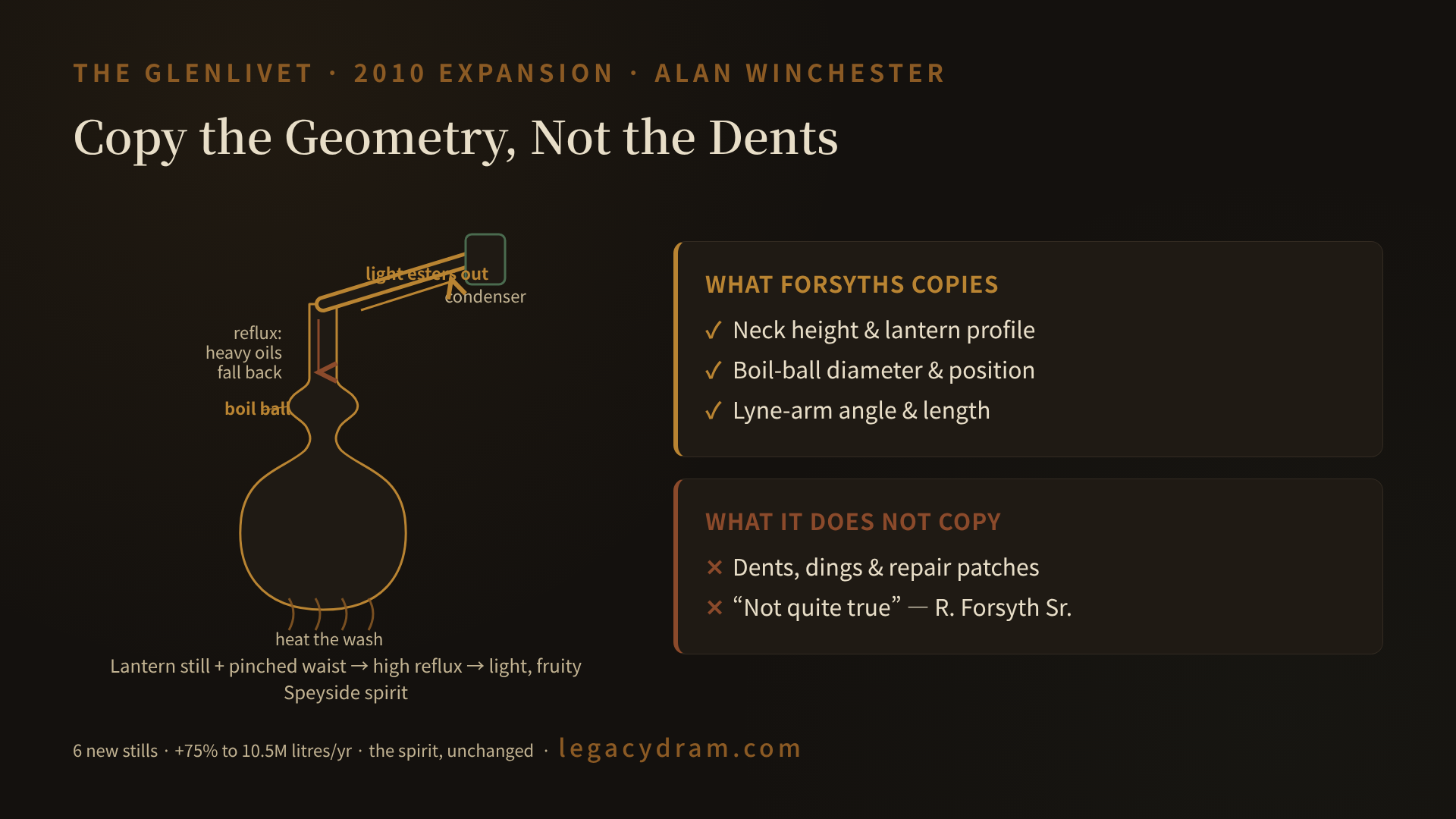
In a pot still, vapour rises up the neck. If the neck is short and squat, the vapour reaches the lyne arm and the condenser quickly, carrying most of what flashed off, including the heavy fraction. You get a rich, oily, characterful spirit. If the neck is tall, or pinched, or the vapour has to fight gravity, the heavier compounds lose energy, condense on the copper, and trickle back down to be boiled again. Only the lighter molecules survive the climb. The ratio of liquid that falls back to liquid that gets through is the reflux ratio. High reflux means light, fruity, ester-forward spirit.
The Glenlivet’s stills are lantern-shaped, with a pinched waist, what the trade calls a boil ball or boil bulb. That narrowing in the middle does two things at once: it cuts the cross-sectional area the vapour can travel through, raising reflux, and it increases the surface area of copper the vapour touches on the way back down. Copper contact matters because copper scrubs out sulphury compounds; reflux matters because it leaves the heavy oils behind. Put them together and you get the pear-skin, white-flower, vanilla lightness that the whole world now files under “Speyside.”
(At this point the engineer in the room wants to calculate the exact reflux ratio for a given boil-ball diameter. I did too. The honest answer is that the industry mostly does not compute it. It measures the spirit at the other end and works backwards. Hold that thought, because it is the whole story.)
Why you cannot just optimise
So if reflux drives the character, and we understand reflux, why not model the still, find the optimal geometry, and build that?
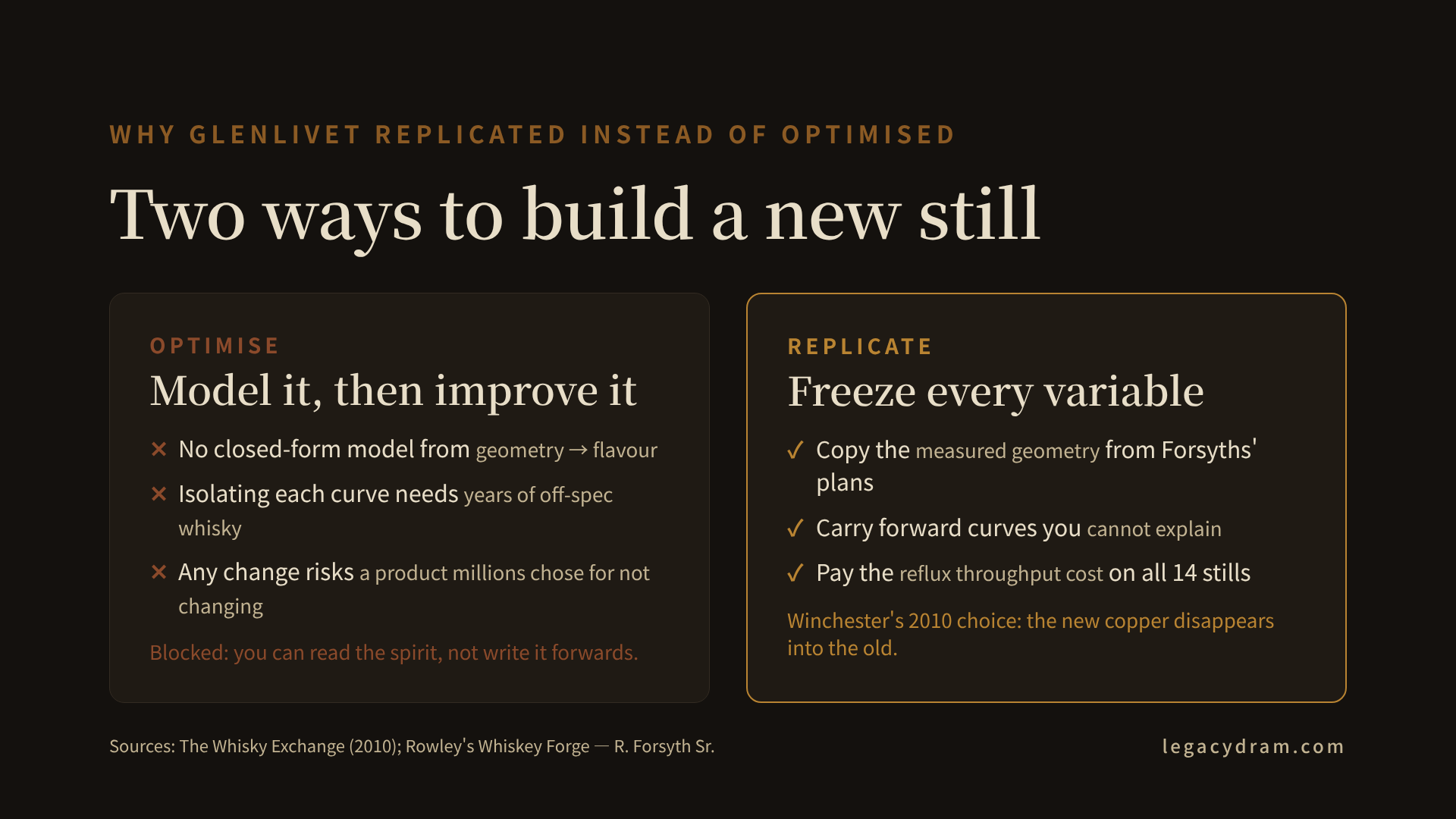
Because the model is under-determined. The spirit character that comes out of a Glenlivet still is the joint product of neck height, the diameter and position of the boil ball, the angle and length of the lyne arm, the rate you heat the wash, the reflux it produces, the copper-to-vapour contact time, and a long tail of second-order effects nobody has fully isolated. You can describe the direction each variable pushes (taller neck, more reflux, lighter spirit), but you cannot write down a closed-form function that maps “this exact curve” to “this exact flavour” and trust it to within the tolerance a brand depends on.
This is the situation every engineer recognises from a legacy system with no tests: the code works, it has worked for decades, and you genuinely do not know which lines are load-bearing. Some of those lines are almost certainly dead. Some look like bugs. But there is no test suite that tells you which is which, and the cost of being wrong is shipping a different product to millions of customers who chose you because you do not change. So you refactor nothing. You copy the file verbatim, dead code and all, and you ship.
Winchester’s version of “copy the file verbatim” was to hand the coppersmith the existing still and say: make me five more like this one.
What actually gets copied (and what is folklore)
Here is where the romantic version of the story collides with the engineering one. The myth, repeated in a hundred distillery tours, is that coppersmiths lovingly reproduce every dent, ding and repair patch from the old still into the new one, on the theory that even the accidental bumps shape the whisky.
That is not what happens. Forsyths, the Speyside coppersmith firm that has built and rebuilt most of Scotland’s stills for the better part of 160 years, keeps the original plans for the stills it makes and reproduces the measured geometry: the contours of the boiler, the height and profile of the neck, the shape and pitch of the lyne arm, the swan’s neck curve. Richard Forsyth Sr., the firm’s chairman, has been blunt about the rest. The claim that they replace old stills “down to the last ding, bump and patch,” he said, is “not quite true.” When a still wears thin (and it wears unevenly, the wash still corroding near the top over ten to twelve years, the spirit still wearing fastest in the pot), Forsyths cuts out the tired section and welds in new copper, keeping the architecture that matters and quietly dropping the accidental scars.
So the dents are folklore and the geometry is engineering. But notice that this distinction does not rescue the optimiser. Forsyths copies the geometry exactly not because each measured curve has been proven to matter, but because the bundle of curves, taken together, produces a spirit the distillery has sold for two centuries, and unbundling it to test each curve in isolation would mean deliberately making different whisky for years to gather the data. Nobody is going to authorise that experiment. The geometry is frozen for the same reason the dents got their myth: the cost of finding out which part is decorative is higher than the cost of carrying all of it forward.
The man who chose not to choose
Alan Winchester is the right person to sit at the centre of this, precisely because he is not a romantic. He grew up in Speyside, the son of a hotelier in the heart of whisky country, and came up the way most distillery managers do (on the floor, through the production side, at Glenfarclas, Glen Keith, Strathisla and Aberlour before Glenlivet itself, over a career that would run more than forty years) rather than through a laboratory. By 2009 he had been around the distillery long enough to have watched the spirit stay the same through several changes of owner. When Pernod Ricard handed him a £10 million expansion the following year, the temptation available to a different kind of master distiller (to put his signature on the spirit, to “improve” it, to angle a lyne arm a few degrees and call it modernisation) was exactly the temptation he declined.
There is a quiet irony in the position. The Scotch industry has, at its disposal, gas chromatography that can resolve the congener spectrum of a new make (the full set of flavour-active compounds beyond the water and ethanol) down to parts per billion. It can tell you precisely which esters and which sulphur compounds distinguish a Glenlivet from a Macallan. And then, when it comes time to build new stills, that same industry hands a coppersmith an old pot and says make it look like this one, because the analytical power to describe the spirit has never translated into the predictive power to design it forwards. We can read the whisky perfectly and still cannot write it from scratch. Winchester’s job in 2010 was to protect that gap, not close it.
He has said the highest compliment the distillery receives is that some Japanese distillers built their stills to mimic the shape of The Glenlivet’s. That is the same instinct running in the other direction: if you want this character, do not try to derive it: copy the geometry of someone who already has it. The shape is the specification. The spirit is the test that the shape passed, decades ago, for reasons no one fully wrote down.
The cost of the conservative choice
It would be dishonest to present this as obviously correct, because freezing every variable has a real price, and Winchester paid it.
The first cost is throughput. A high-reflux still is, mechanically, a machine that throws away part of its output on every cycle: vapour you boiled with energy you paid for, condensed and sent back to boil again. A squat, low-reflux still of the same volume would push more spirit through per run. By replicating the lantern shape across six new stills, The Glenlivet bought 75% more capacity while keeping the per-still inefficiency baked in. They scaled the bottleneck instead of removing it, on purpose, because the bottleneck is the flavour.
The second cost is that you forfeit the option to ever genuinely improve. If there is a better Glenlivet hiding in a two-degree change to the lyne arm, the conservative strategy guarantees you will never find it, because you have made “don’t touch it” a permanent rule rather than a default you occasionally test. Glenmorangie’s Bill Lumsden, working under the same inability to redesign his inherited still geometry, at least pushed his experiments into the cask program and the mash bill. Glenlivet’s bet is narrower: keep the spirit identical and let scale, not reinvention, be the growth story.
And the third cost is harder to name. When you institutionalise “copy what works and do not ask why,” you slowly lose the people who could answer why. The knowledge that the boil ball matters more than the neck, or vice versa (if anyone ever knew it), does not survive in a culture whose first principle is don’t change anything. The dents become folklore precisely because the reasoning behind the geometry was never written down, only carried forward. Replication preserves the artifact and quietly discards the understanding.
Set against all that is the thing the conservative choice actually buys, which is not nothing: a customer who opened a Glenlivet 12 in 1995 and opens one in 2026 gets the same whisky, distilled in stills built thirty years apart, and cannot tell the difference. In a product whose entire value proposition is consistency across decades, that is not timidity. It is the spec being met.
What you taste
Pour a Glenlivet 12 and the lantern stills are right there in the glass. The lightness on entry, the orchard fruit and the lack of heavy oily weight on the finish — that is the high-reflux character the boil ball produces, the heavy fraction left behind in the neck where it belongs. None of it is mystery. It is undergraduate distillation, expressed in copper that was shaped to a plan Forsyths keeps in a drawer.
What you cannot taste, and that is the point, is which still made it. Some of the spirit in a modern Glenlivet came off copper installed before Winchester took the role; some came off the six stills the Prince of Wales opened in 2010. They are indistinguishable, by design, because a man who could have signed his name on the whisky chose instead to make the new equipment disappear into the old. The most consequential engineering decision in that £10 million stillhouse was the decision to make sure you would never know it had been built.
Related reading
- Forsyths of Rothes: Why Copper Is a Consumable — the coppersmith that actually rebuilds Scotland’s stills, and why copper wears out
- The Reflux Equation: Why Glenmorangie’s Stills Are 5.14 Metres Tall — another master who inherited a still shape he was not allowed to change
- Glen Grant’s Purifiers: Major James Grant, Dennis Malcolm and Engineered Reflux — a Speyside neighbour that engineers its reflux a different way
Sources
- The Whisky Exchange Blog — The Glenlivet Expansion: Interview with Alan Winchester (2010), thewhiskyexchange.com
- The Glenlivet distillery — Wikipedia (2010 expansion: six new stills, capacity to 10.5m litres, opened by the Prince of Wales)
- Matthew Rowley, Replacing That Worn-Out Still — Every Ding and Dent? — Rowley’s Whiskey Forge (Richard Forsyth Sr. on what is and is not replicated)
- Whisky stills: does shape matter? — Scotch Whisky (boil ball, pinched waist, reflux)
- The Glenlivet official — theglenlivet.com