Mortlach 2.81 Distillation Explained: The Wee Witchie Still
The first time I saw the number 2.81 attached to a distillation count, I assumed it was a typo. Distillation in single malt is supposed to come in clean integers. Two for almost everyone in Scotland. Three for Auchentoshan and Hazelburn. Two-and-a-half if you want to be precise about Springbank. Those are the integers and the one fraction the textbooks use. Then there is Mortlach, in Dufftown, claiming 2.81. The decimal goes two places. It is the kind of magic number that, if I saw it in a configuration file, I would file a ticket asking why.
Mortlach has run something close to that 2.81 average since 1897. The six pot stills behind the number are all different sizes. The smallest of them is called the Wee Witchie and is treated, internally, as a kind of partial-reflux filter that other stills feed into. In 2018 Diageo finished doubling the still count from six to twelve, and they replicated every still dimension-for-dimension. The configuration that produces 2.81 is now stamped twice into the still house, and the company’s bet is that the next century of Johnnie Walker Black depends on those copies being faithful.
This article works out where 2.81 actually comes from, what the Wee Witchie does to the vapour passing through it, why Diageo paid roughly twice the per-litre cost of a greenfield distillery to make exact copies of a 19th-century still layout, and how the whole arrangement is structurally different from Springbank’s 2.5, the only other published fractional distillation count in Scotch.
The named engineer who ratified the design was Alexander Mitchell Cowie. The year was 1897. He was, by training, a medical doctor.
Where the 2.81 actually comes from
I want to start by saying out loud what every honest source on Mortlach says quietly. Diageo has never published the exact recipe that produces 2.81. The cut points, the proportion of weak feints that gets diverted into the Wee Witchie, the exact blend ratios between lanes. These live in the still house as continuity knowledge, passed from one operator to the next, not in any datasheet I have ever seen. The 2.81 figure itself was popularised by Charles MacLean and is now everyone’s shorthand for what happens inside the house. (Whiskipedia)
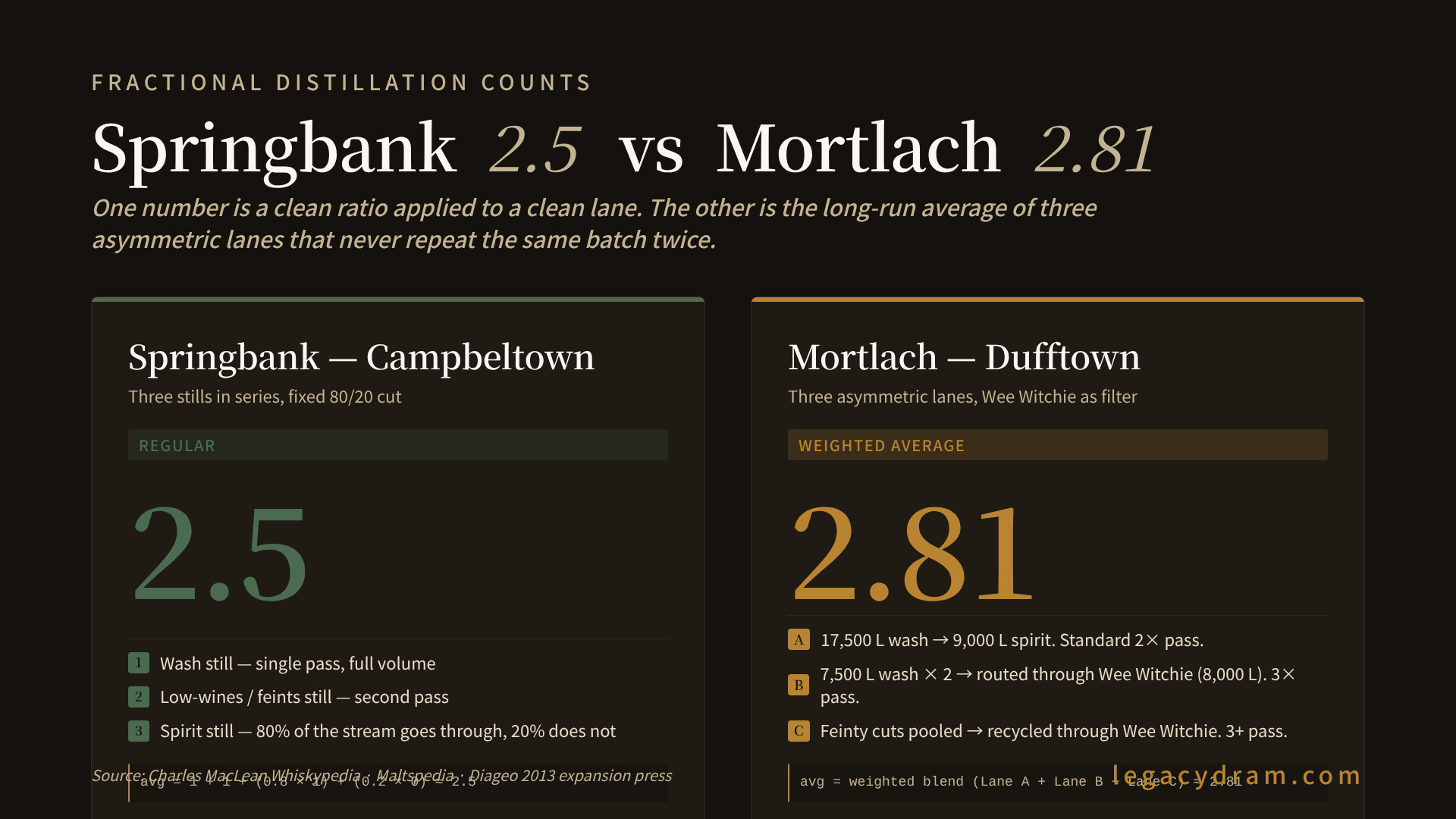
Given those caveats, the rough shape of the calculation is this. Mortlach has three wash stills (7,500 L × 2, plus one 17,500 L) and three spirit stills (8,000 L, 8,500 L, 9,000 L). The simplest reading splits production into three lanes:
- Lane A (standard two-pass). The large 17,500 L wash still feeds the largest spirit still (9,000 L). Two distillations, conventional cut, indistinguishable from how most Speyside distilleries work.
- Lane B (partial triple). The two small 7,500 L wash stills run a shorter, weaker wash, and a controlled fraction of their output is routed to the Wee Witchie for a second spirit pass. The portion of the stream that gets diverted sees three distillations.
- Lane C (feints recycling). The heads and tails (feinty fractions) cut from multiple stills are pooled and re-run through the Wee Witchie. Some material in this lane sees more than three passes by the time it ends up in the spirit safe.
Blend the three lanes in the proportions Mortlach actually uses, and the per-litre average comes out near 2.81. Two would be too light. Three would erase the asymmetric flavour. The decimal is the consequence of asymmetric volumes meeting fixed cut ratios, not anyone’s deliberate target. Cowie did not sit down in 1897 to engineer a 2.81 average. He engineered a still house, and the average was what came out.
Which is the part of the story I find most enjoyable, because it inverts the usual marketing direction. Mortlach is not 2.81 because someone in marketing picked an interesting number. The number got chosen by what the lanes produced. The marketing team came along eighty years later and noticed it was strange enough to put on a label.
The Wee Witchie’s job: a partial-reflux filter, not a small still
The Wee Witchie is the smallest of the three spirit stills, at roughly 8,000 L. In a normal two-pass distillery you would expect three spirit stills of similar size, all doing the same job in parallel, with their output blended at the spirit safe. Mortlach does not work this way. The Wee Witchie is not a parallel unit. It is downstream of the other stills.
This is the bit I want to slow down on, because the standard explanation that “Mortlach distils 2.81 times” makes it sound like every drop goes through 2.81 passes. It does not. Most of the spirit goes through two passes (Lane A). A smaller fraction goes through three (Lane B). The recycled feints (Lane C) go through more. The 2.81 is the per-litre weighted average, not the number any individual molecule sees.
The Wee Witchie’s role in that arrangement is what a chemical engineer would call a partial reflux filter. It takes input that is mostly weak feinty fractions from earlier stills (heads and tails that another distillery would just throw back into the next wash run), and runs them through another distillation cycle with deliberate inefficiency.
The mechanism, in five lines:
- The feinty input is high in long-chain esters and heavy sulfur compounds (DMS and DMTS: dimethyl sulfide and dimethyl trisulfide) that would taste rough if they reached the spirit safe at full concentration.
- The Wee Witchie runs hot enough to boil ethanol and lighter esters, but the small pot geometry forces a lot of vapour-to-copper contact on the way up.
- Heavy compounds preferentially condense on the cold copper surface and trickle back down for re-boiling.
- The lighter esters that survive the cold zone make it through to the condenser.
- The result is a spirit stream that retains some of the meaty character of the feinty input (Mortlach’s signature), but not all of it. The fraction that gets through is the part the still operator wants.
This is what makes the Wee Witchie a filter rather than a distiller. Its design intent is partial pass-through. Run the same input through a tall, narrow modern still with high reflux ratio, and you would get a much lighter spirit and lose the character that makes Mortlach work as the heavy backbone of Johnnie Walker Black. Run it through a short, fat still with low reflux, and you would get all of the heavy compounds and the spirit would be undrinkable on its own. The Wee Witchie sits in the middle on purpose. The 8,000 L volume, the specific neck-to-base ratio, the angle of the lyne arm: Cowie chose each of those to land on a particular point in the partial-pass-through gradient.
A note for the partial-pressure people: the surface-area-to-volume ratio of an 8,000 L pot still is high enough that copper interaction dominates the chemistry of what survives. In a 20,000 L still the same calculation would push you toward heavier output, not because chemistry changed but because there is less copper per litre of vapour. This is why a “scale up by 2.5×” instruction would have produced different spirit. Diageo’s 2018 expansion did not scale up. It cloned.
Springbank’s 2.5 is regular. Mortlach’s 2.81 is not.
The other published fractional distillation count in Scotch is Springbank’s 2.5, and the comparison is illuminating because the two numbers come from very different processes.
Springbank’s 2.5 means something specific. The wash still runs once. The output goes to the low-wines/feints still and runs a second time. About 80% of the second still’s output then runs a third time through the spirit still. The remaining 20% does not. Mix the streams in those proportions and the average extra-pass count after the first works out cleanly, landing the per-litre average just under 2.5. The point is that the number is regular. It comes from a clean ratio (80/20) applied to a clean lane structure (one wash still, one intermediate, one final, in series).
Mortlach’s 2.81 is not regular. It does not come from a single clean ratio. It comes from the interaction of three asymmetric lanes, each with its own internal cut, blended at the spirit safe in proportions that depend on how the still operator is running that batch. The same week-to-week variation in feed quality can shift the effective per-litre average a tenth of a point in either direction. The 2.81 is the long-run average across all those batches, not a recipe applied to each batch.
If Springbank is a 2.5-pass process, Mortlach is a process whose long-run sample mean happens to be 2.81. The distinction matters for what each distillery can claim about consistency. Springbank can replicate. Mortlach can only converge. Over enough batches, the asymmetric lanes average out, and the resulting spirit lands in the same window. Cowie’s design assumed the still house would run for decades, not for individual batches, and the spirit character was the steady-state distribution, not the per-batch output. This is an unusual engineering posture for a process plant, and Diageo inherited it without trying to refactor it.
Alexander Mitchell Cowie, 1897, with Charles Doig
The man whose engineering decision produced this configuration was Alexander Mitchell Cowie (born 1861). He was the son of George Cowie, the former railway surveyor who had bought the distillery in 1853. Alexander had trained as a medical doctor at the University of Aberdeen and worked in Vienna and Hong Kong before being recalled in 1896 to take over after his father’s illness. (Wikipedia)
He worked with the Speyside architect Charles Doig (the same Doig who designed the pagoda roofs that became visual shorthand for Scottish distilleries), and the configuration they finalised in 1897 is, with minor maintenance, the configuration running in Dufftown today. It is unusual in a few specific ways:
- Three wash stills of two different sizes. Two at 7,500 L, one at 17,500 L. Most distilleries would standardise.
- Three spirit stills of three different sizes. 8,000 / 8,500 / 9,000 L. Again, most distilleries would standardise.
- A spirit still designated as a filter for other stills’ output. This is not how spirit stills are normally used. The Wee Witchie’s downstream role implies that Alexander treated the still house as a directed flow graph, not as a set of parallel units.
I will not call Alexander a genius. The records of his thinking that survive are mostly administrative, and the technical details were almost certainly worked out jointly with Doig and with the still house operators his father had trained. What I will say is that the engineering choice he ratified in 1897 was unusual for its time and has remained unusual for the 129 years since. No other distillery in Scotland has copied the asymmetric six-still + designated filter layout. Diageo, when they expanded Mortlach, did not invent a new layout either. They built a second copy of Alexander’s.
2013–2018: Diageo doubled the still count and cloned every dimension
In 2013 Diageo announced a £30 million expansion of Mortlach. The plan was to roughly double the annual production capacity. The expansion was scaled back during 2013–2014 when the broader Scotch market softened, but the still-house portion went ahead. By 2018 Mortlach had a second still house containing six new stills (three wash and three spirit), each one a copy of one of the original six. (The Scotsman, 2013)
The economics of this decision are worth pausing on. Roughly £30 million for a doubling of capacity works out to a per-litre figure of new annual capacity well above the industry benchmark for greenfield Speyside distilleries with conventional shell-and-tube condensers and standardised still sizes. The premium Diageo paid is the cost of exact replication: hand-fabricated copper, individual still sizes that cannot share manufacturing runs, and bespoke condenser arrangements rather than off-the-shelf parts.
The interesting question is why Diageo paid that premium. The answer is in the downstream blending. Johnnie Walker Black Label is one of the largest-selling blended Scotches in the world. The recipe specifies a heavy “meaty” component from Speyside, and Mortlach is the source of that component. If Diageo had standardised the new stills (even slightly, even just by rounding the 8,000 / 8,500 / 9,000 L spirit stills to a common 8,500 L), the resulting spirit would have drifted away from the existing character. The drift might have been small enough to be invisible in single-cask tasting. It would have been intolerably large at Black Label’s volume, because the blender’s recipe is tuned to a specific Mortlach profile and would have needed re-engineering at the blending stage to compensate.
So the premium is, in software terms, the cost of forward-compatibility maintenance for a 129-year-old API. Diageo’s choice was to build a second, identical machine rather than evolve a new one. The blender’s specification stayed unchanged. The legacy code kept compiling.
The 2018 decision to clone Alexander Cowie’s still house dimension-for-dimension was, in operational terms, the decision not to take any of the modernisation choices that were technically available. Each substitution, each rounding of still volumes, each standardisation of cut routing was rejected in favour of replication.
What lands in the bottle
The current Mortlach single malt range (12 “Wee Witchie”, 16 “Distiller’s Dram”, 20 “Cowie’s Blue Seal”) was launched in 2018, the same year the expansion completed. The naming is not coincidence. Diageo named the entry-level bottling after the smallest still in the house, the one whose partial-reflux behaviour is most responsible for the spirit’s character. It is a marketing decision that, for once, points at the actual engineering.
The 12-year, at 43.4% ABV, opens with a dry, slightly meaty note that no shell-and-tube Speyside spirit can produce. Behind the meat there is dark sugar, roasted hazelnut, and a thin thread of sulfur that reads as struck flint rather than struck match. The flavour signature is consistent with what the Wee Witchie’s filter mechanism predicts: most of the heavy esters and DMTS-family sulfur compounds got recycled out during the partial-reflux step, but enough survived to leave a residue. With three drops of water the meaty layer recedes and the lane-B fruit-ester layer rises. This two-layer behaviour, where water makes the spirit more complex rather than diluting it toward neutrality, is itself a fingerprint of the asymmetric lane structure.
If I open a bottle of Mortlach 12 next month, what I will be tasting is the steady-state output of a still house designed in 1897, doubled in 2018, and never refactored. The reason the bottle in front of me tastes the way it does is that several generations of owners (Cowie’s heirs, John Walker & Sons after 1923, DCL, Guinness, and finally Diageo) each had the technical opportunity to standardise the asymmetric six-still configuration and each declined.
What I find most interesting, as someone who reads other people’s legacy code for a living, is the discipline this requires. Every time the still house comes up for capital review, someone has to defend the cost of replication against the cost of refactor. For 129 years, the replication argument has won. The 2.81 is not a number that anybody picked. It is the number that survives every five-year capex cycle.
Related articles
- Whisky Purifier Pipe Explained: Glen Grant’s 1872 Bolt-On Reflux and Dennis Malcolm’s 63 Years: another late-19th-century retrofit that has survived every owner since
- Glengoyne’s Slowest Spirit Run: Robbie Hughes, Copper Reflux, and the Seven-Hour Distillation: what happens at the opposite end of the spectrum, where slow distillation deliberately strips weight
- Cragganmore 12 and John Smith: Speyside’s Other Worm Tub Survivor: Speyside’s other heavy-meaty exception
- Loch Lomond’s Straight-Neck Rectifying Still: Michael Henry’s Variable Reflux: variable-reflux engineering, the inverse of Mortlach’s fixed configuration
- Glenfarclas’s Direct-Fired Stills and Six Generations of the Grant Family (JA): a different route to a similarly heavy Speyside spirit
Sources
- Charles MacLean, Whiskypedia (Mortlach chapter on 2.81 derivation)
- Misako Udo, The Scottish Whisky Distilleries (Mortlach detail)
- Dave Broom, The World Atlas of Whisky (Wee Witchie diagram)
- Whiskipedia, “Wee Witchie and Mortlach distillation”: whiskipedia.com
- Maltspedia, Mortlach distillery technical specs: maltspedia.com
- Words of Whisky, “Mortlach Distillery & Its Incredibly Wacky Still House”: wordsofwhisky.com
- Edinburgh Whisky Academy, copper interaction and reflux references
- The Scotsman, “Diageo to reinvent Mortlach with £30m investment” (2013)
- Wikipedia, Mortlach distillery