Worm Tub Whisky List: 16 Scotch Distilleries
I have spent parts of the last three weeks trying to work out why anyone still uses worm tubs. Not from the “isn’t tradition lovely” angle — the surviving Speyside worm-tub distilleries occupy roughly 12% of malt whisky production capacity in Scotland, so this is not a rounding error — but from the harder engineering angle. Worm tubs consume more cooling water, take more floor space, are physically outside the stillhouse, are worse at heat exchange, and their behaviour changes with the ambient air temperature in a way that a distiller has to work around week by week. If I told you a manufacturing process still ran on a 19th-century condenser design because it produced a subtly better output that you could not measure in one variable but could taste, you would probably file a ticket asking whether the incumbent was covering something up. And you would sometimes be right. And sometimes not.
There are, as of 2026, about 16 operational Scotch malt distilleries with worm tubs. Dalwhinnie, Cragganmore, Mortlach, Talisker, Springbank, Old Pulteney, Balmenach, Craigellachie, Glenkinchie, Speyburn, Benrinnes, Edradour, Glen Elgin, Royal Lochnagar, Ardnahoe, Ballindalloch (Edinburgh Whisky Academy count, and add Brora since May 2021, whose worm tubs were rebuilt from archive plans). Everyone else uses shell-and-tube condensers, or a hybrid — Speyburn runs both types in parallel. The 16 are what is left of a technology that, in 1930, was the default and, by 1970, was clearly on the way out.
This article works through what worm tubs actually do to vapour chemically, what the copper contact ratio between the two condenser types really is, what the water-flow paradox teaches you about summer versus winter production, and who at Brora consciously chose to rebuild worm tubs from zero. If you have already read the Cragganmore piece on the John Smith choke, the Mortlach 2.81 partial-reflux setup, or the Talisker MacAskill worm tubs, this is the technology hub they all sit under.
What a worm tub is, mechanically
Vapour leaves the spirit still through the lyne arm and needs to be condensed back to liquid before it hits the receiver. There are two ways to do this at industrial scale, and only two.
Option A — the worm tub. A single copper pipe, typically 5–8 cm in diameter at the top, tapering as it descends, coiled into a helix maybe 40–60 metres long from top to bottom. The whole coil sits in a tank of cold running water, historically wood or cast iron, more recently sometimes stainless steel. Vapour enters at the top of the coil, condenses on the walls, and the mixture (liquid + any uncondensed vapour) descends to the bottom for the receiver. The tank is open to the sky. Water flows in cold at the bottom, exits warmer at the top, and the exit temperature tells the stillman how the run is going.
Option B — the shell-and-tube condenser. A cylindrical shell, typically 1–2 metres tall, containing a bundle of thin copper tubes — the exact count varies, but 50–150 is the usual band. Vapour passes through the shell around the outside of the tubes; cold water is pumped through the inside of the tubes. Because you have so many small tubes rather than one big one, the total copper surface area exposed to the vapour is dramatically larger.
The maths of this is what matters. A worm tub gives you a single tube’s worth of internal copper surface. A shell-and-tube gives you the sum of ~100 smaller tubes’ internal surfaces. The Edinburgh Whisky Academy and multiple whisky-engineering sources put the surface area ratio at roughly 20:1 in favour of shell-and-tube. Some references push this to 30:1 depending on the specific unit. Either way, we are not talking about a modest difference. Worm tubs give the vapour a fraction of the copper contact.
This is not, on its own, a flavour argument. Nobody drinks copper. It is a catalysis argument.
The sulphur chemistry, in one paragraph and one table
Wash contains sulphur compounds. Some arrive from the barley, some from the yeast, some are produced during fermentation. Copper reacts with them. Two of the volatile sulphur compounds we care about are dimethyl sulphide (DMS, CH₃-S-CH₃, cabbagey, tomato-juice on the low end) and dimethyl trisulphide (DMTS, CH₃-S-S-S-CH₃, meaty, rubbery, at the parts-per-billion level detectable). Their precursor is methanethiol (CH₃-SH), which reacts with hydrogen sulphide (H₂S) to form the polysulphides during and after distillation. Copper catalyses two things: the removal of H₂S and mercaptans by forming copper sulphide on the wall (dark spots, real, visible in any old worm tub), and, less obviously, the reaction pathways that generate DMDS and DMTS from methanethiol precursors. In other words, copper is doing two contradictory jobs at once — cleaning up some sulphur, promoting some. The net effect depends on how much copper the vapour sees, and for how long, and at what temperature.
| Compound | Formula | Sensory character | Threshold | What copper does |
|---|---|---|---|---|
| Hydrogen sulphide | H₂S | Rotten egg | ~10 ppb | Removes (forms CuS) |
| Methanethiol | CH₃SH | Cabbage, drains | ~2 ppb | Removes and reacts onward |
| Dimethyl sulphide | DMS | Cooked cabbage, tomato juice | ~10–30 ppb | Partial removal |
| Dimethyl disulphide | DMDS | Rubber, onion | ~7 ppb | Complicated |
| Dimethyl trisulphide | DMTS | Meat, savoury, cooked veg | ~0.1 ppb | Copper salts can promote it |
You will notice DMTS has a threshold about a hundred times lower than DMS. The reader who spent five minutes wondering whether “meaty new-make” is a marketing flourish should now be able to reason backwards: no, it is a real molecule, and the reason it survives a worm-tub run is that a coil in cold water offers roughly 1/20th of the copper surface a shell-and-tube would, and DMTS is measurable at 0.1 ppb, so even a small residual dose lands on the palate. (Sources: encyclopedia.pub review of Sulfur Compounds in the Whisky Production Process; the Annandale Distillery technical note on copper.) The Craigellachies, Glenkinchies and Speyburns of the world are what happens when you commit to that residual dose.
At this point the reader is going to want the trade-off in one line, which is the wrong instinct — the good news is that the interesting bit is the counter-intuitive water-flow question, which I will get to. First, the map.
Who still uses them, and why the map matters
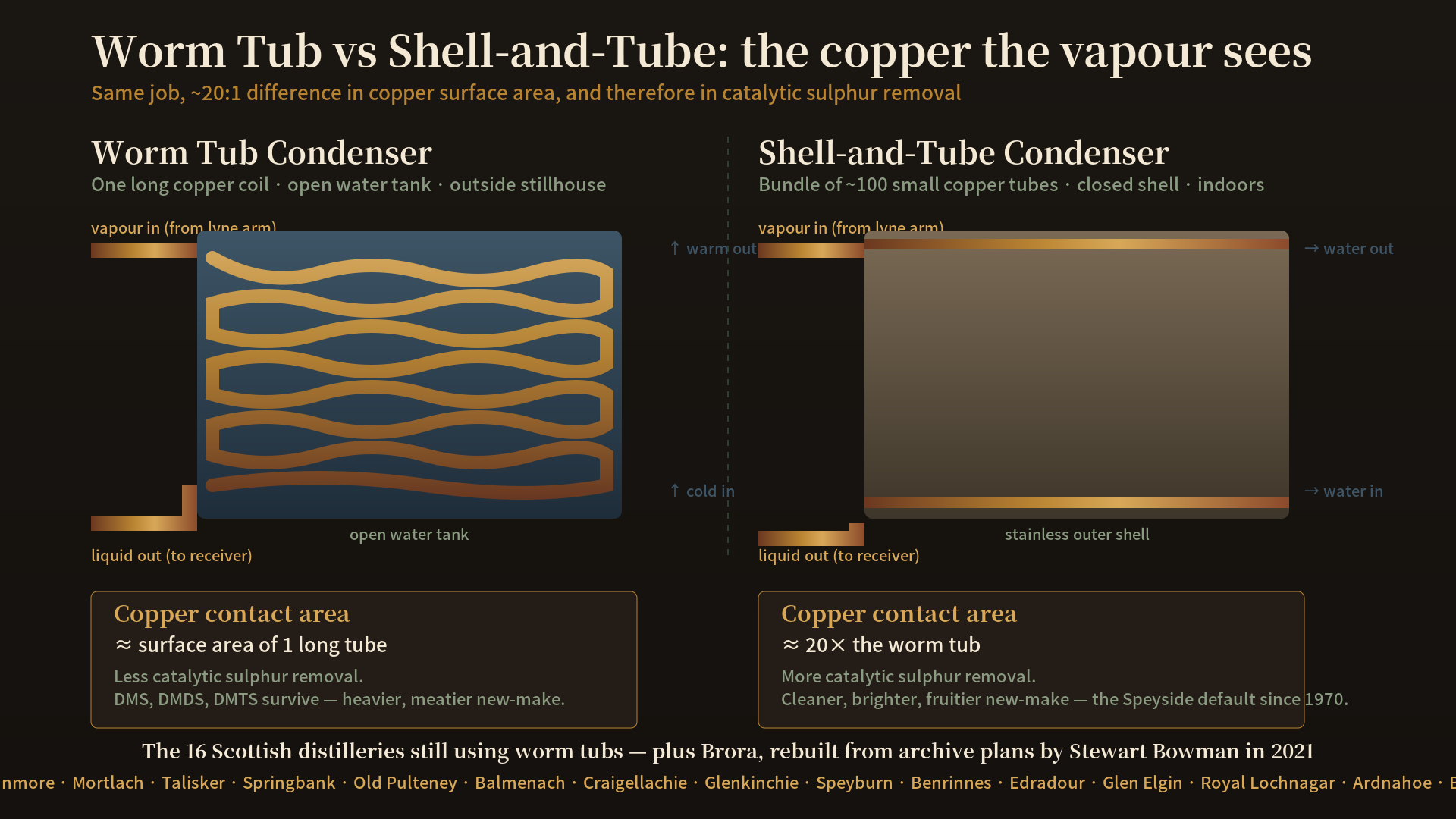
Of the roughly 140 operational malt distilleries in Scotland today, these 16 (plus Brora) are the ones still committed to worm tubs. The list is worth staring at for a minute:
| Distillery | Region | Worm tub notes |
|---|---|---|
| Dalwhinnie | Highland | Worm tubs 1898–1986, shell-and-tube 1986–1995, worm tubs re-installed 1995 |
| Cragganmore | Speyside | Worm tubs since 1869; copper tubs replaced with stainless steel spring 2022 |
| Mortlach | Speyside | Six original + six clone stills, worm tubs on all |
| Talisker | Skye | Five stills, asymmetric layout, worm tubs since 1830 |
| Springbank | Campbeltown | Worm tubs on all three stills, part of the 2.5-distillation setup |
| Old Pulteney | Highland (Caithness) | Worm tubs since 1826 |
| Balmenach | Speyside | Inver House-owned |
| Craigellachie | Speyside | Copper worms retained inside stainless outer tubs since 2014 refit |
| Glenkinchie | Lowland | Fast-flow, sulphury profile |
| Speyburn | Speyside | Runs both worm tubs and shell-and-tube |
| Benrinnes | Speyside | Diageo-owned, part of the Flora & Fauna lineage |
| Edradour | Highland | Two stills, small worm tubs |
| Glen Elgin | Speyside | Worm tubs since 1900 |
| Royal Lochnagar | Highland | Two stills |
| Ardnahoe | Islay | Founded 2017, deliberately chose worm tubs from zero |
| Ballindalloch | Speyside | Founded 2014, wooden worm tubs, run hotter than usual |
| Brora | Highland | Reopened 2021, worm tubs rebuilt from archive plans |
The odd entries on that list are Ardnahoe (2017), Ballindalloch (2014), and Brora (2021). Those three are the ones where somebody in the 21st century looked at the shell-and-tube trade-off, and knowingly picked the older technology anyway. That is where the interesting engineering question lives, because the other 14 have inherited their worm tubs from a decision taken decades before anyone alive had a vote.
The Cragganmore-in-stainless-steel move (2022) — half a preservation
If you look at the table carefully you will spot two entries where the material is now stainless steel: Craigellachie (since 2014, copper worms inside stainless outer tanks) and Cragganmore (since spring 2022, tubs entirely in stainless steel). Diageo has clearly decided the wooden and cast-iron shells of the traditional worm tubs are the maintenance headache, not the coils themselves. The stated goal is to preserve the geometry that produces the character while making the whole assembly last longer and be easier to clean.
The interesting question is: does that work? A stainless steel outer shell should not affect the spirit — vapour is inside the copper coil, not in contact with the wall — but water thermal behaviour is now slightly different because stainless has different heat conductivity from wood or cast iron. In Cragganmore’s case the coil itself remains copper, so the catalytic surface is unchanged; the change is really about maintenance cost. In Craigellachie’s case, similar. So this is not a “worm tub in name only” story; it is a preservation of the copper-per-vapour ratio with an updated tank material. It is also the kind of decision that a factory engineer would make and a purist would not — which is, historically, how most of these decisions have been settled.
That said, the trade-off is not entirely absent: any change to water flow or temperature behaviour in the tank, however small, affects how quickly the vapour condenses inside the coil, which affects the copper contact time. Which brings us to the paradox.
The water-flow paradox — colder is heavier
Here is the thing that made me stop and re-read the Scotch Whisky Ask the Professor column three times. If you make the cooling water in the worm tub faster and colder, the spirit comes out heavier and more sulphury. Not lighter. If you slow the flow down and let the water warm up, the spirit is lighter.
The intuition of anyone who has done any basic thermodynamics is exactly backwards. You would think: cold water = fast condensation = less time for vapour to react = more sulphur retained. That part is correct. What is counter-intuitive is the framing: the sulphur is being retained because it does not have time in contact with the copper, not because the copper is doing anything different. Warm slow water means the vapour lingers as vapour longer, moves along the coil more gently, has more contact time with the copper wall, and more of the volatile sulphur compounds get catalysed away.
Craigellachie, Glenkinchie and Speyburn are the archetypes of the fast-flow, sulphury profile. Ballindalloch runs their tubs hotter than usual and deliberately chases a lighter character despite using worm tubs — a designed compromise between the two condenser worlds. Dave Broom and other whisky writers have flagged this paradox for years, but if you are an engineer reading it for the first time, take a minute. This is why the same worm-tub distillery gets a slightly different new-make in July than in February. The exit-water temperature at the top of the tub is one of the main knobs the stillman has, and it moves the spirit character in the opposite direction of what feels natural.
Dalwhinnie 1986 → 1995 — the empirical proof, and the lost plans
The Dalwhinnie case is the closest thing the industry has to a controlled A/B test.
In 1986, during a Diageo (then UDV) modernisation, the traditional cast-iron worm tubs at Dalwhinnie were removed and replaced with shell-and-tube condensers. The stated rationale, as with everywhere else at that time, was cooling efficiency, water consumption, and maintenance. The change was made in the plant without public announcement, as such changes generally were. And then the new-make character shifted enough that by the mid-1990s the company decided the change had been a mistake and moved to reverse it.
In 1995, Diageo re-installed worm tubs at Dalwhinnie. According to the Scotch Whisky whiskypedia entry, the original engineering drawings had been lost, and the team had to work out empirically how to run the new worms to hit the pre-1986 Dalwhinnie character. The new tubs were made round and wooden, in part because they were the first thing visitors would see. The water flow pattern differed from the old cast-iron tanks. That, more than the copper coil itself, was apparently enough to shift the character slightly again.
I have not been able to find the name of the Diageo engineer who signed off on the 1995 re-install decision, and I do not want to invent one. What is public is that the decision was taken, the plans were lost, the reconstruction was empirical, and the new worm tubs are what has produced Dalwhinnie 15 (their flagship expression) ever since. If you want the cleanest possible engineering evidence that condenser choice matters at a tasting-perceptible level, this is it: a distillery removed worm tubs, missed the character, and paid to put them back nine years later.
Stewart Bowman at Brora — the from-zero decision
The one worm-tub decision I can name a person for, cleanly and on the record, is Brora.
Stewart Bowman is the master distiller Diageo appointed when the silent Brora distillery was reopened. Brora had been closed in 1983; by the time Diageo committed to reopening it in the late 2010s, the original stills had been mothballed but the worm tubs were, according to the Diageo press release for the 2021 reopening and the Whisky Advocate coverage, in a state of disrepair. Bowman, working with Diageo’s archivists and blenders, rebuilt the worm tubs using existing archive plans, replicating the pre-1983 condenser geometry as closely as they could reconstruct it. On 19 May 2021, he sealed the first cask.
This is the from-zero moment. Brora is not a case of “we inherited worm tubs and did not change them.” It is a case of somebody in 2021 looking at a decommissioned distillery, having the option of installing anything, and deliberately choosing to reconstruct the older condenser design because the pre-1983 Brora character depended on it. Diageo paid to do this, and Bowman is the engineer of record. The archive plans they used to reconstruct the coils are the closest the industry has to a scientific specification of the pre-1983 spirit character — and even so, Bowman has been publicly clear that the goal was to get as close as possible, not to guarantee identity. Recreating a spirit from geometry and water is not an exact science.
The Ardnahoe (2017) and Ballindalloch (2014) founders made similar from-zero choices without archive plans to guide them, but Bowman’s is the one with the paper trail. It is also the one where you can taste the trade-off consciously chosen. Brora new-make and mature Brora are, in the Diageo lineup, positioned specifically against the light Speyside style that shell-and-tube produces.
What you gain, and what you give up
The reason to run worm tubs, then, in one paragraph: heavier and more textured spirit, retaining more DMS/DMDS/DMTS and the meaty character they carry, at the price of higher water use (open tanks lose more to evaporation than closed shells), more floor space (usually outside the building), seasonal variability the stillman has to manage manually, more maintenance on the tanks themselves, and — for wooden or cast-iron tanks — a shorter service life than a stainless shell-and-tube unit. The chemistry is the point; the maintenance is the cost. Anyone who tells you worm tubs are strictly better or strictly worse has missed that this is a trade-off, not a verdict.
The reason to run shell-and-tube: cleaner, brighter, fruitier spirit, tighter run-to-run consistency across a calendar year, lower water and space consumption, and a piece of equipment that lasts decades with routine servicing. Most of Glenlivet, Glenfiddich, Macallan, and the modern high-volume Speyside is on shell-and-tube for good and non-mystical reasons. It is not the wrong choice; it is a different choice for a different desired output. (If you want to see the same efficiency-vs-character trade-off pushed one architectural step further — pot-still batch versus continuous column — the Coffey still versus pot still piece is the sibling to this one.)
Neither is correct in general. They are correct for different products, and the sixteen distilleries still running worm tubs in 2026 are doing it because their specific spirit character depends on it. Cragganmore in stainless-steel-tanked coils, Dalwhinnie in wooden re-installed tubs, Brora in archive-plan-rebuilt coils, and thirteen others, all making a slightly different bet on the same underlying chemistry.
What this tastes like in the glass
The next time you open a bottle of Cragganmore 12, a Talisker 10, or a Mortlach 12, pay attention to the second sip. Not the first — the first is where you are still adjusting to the alcohol and the finish is dominated by the cask. The second sip is where the meaty, sulphury undertone from the worm tubs starts to sit on the palate, particularly with water. It is not a defect. It is DMTS at parts per billion, DMDS at slightly higher, and a small residual dose of DMS behaving like a savoury bass note under the fruit and the oak. If you have ever wondered why Cragganmore does not taste like Glenfiddich even though both are Speyside malts aged in similar casks, the coil-in-cold-water outside the stillhouse is a large part of the reason.
The engineer’s version of the compliment is that you can taste the geometry. The stillman’s version is that you can taste the water temperature. Both of those are true. And the name on the last consciously-made version of that decision at scale is Stewart Bowman, at Brora, in 2021, working from a set of drawings that had been in a Diageo archive for nearly forty years.
Further reading
- Scotch Whisky magazine’s Worm tubs: the inside story — the best single overview of the surviving Scottish worm-tub distilleries.
- The Annandale Distillery copper technical note — good on the two-way catalytic role of copper (removes some sulphurs, promotes others).
- encyclopedia.pub’s Sulfur Compounds in the Whisky Production Process — the underlying chemistry, threshold values, and the DMS/DMDS/DMTS pathway.
- Related engineering pieces on this site: the Cragganmore choke (John Smith, 1869), the Mortlach 2.81 partial-reflux setup (Alexander Cowie, 1897), the Talisker asymmetric five-still layout (the MacAskill brothers, 1830), and Frank McHardy at Springbank on the 2.5-distillation regime that runs through Springbank’s own worm tubs.