Forsyths Coppersmiths Rothes: Why Whisky Pot Stills Wear Out, and How Richard Forsyth's Family Replaces Them
A pot still looks like permanent infrastructure. It sits in the still house like a boiler or a pressure vessel, polished and architectural, the sort of thing you depreciate over decades and otherwise forget. So it surprises most engineers to learn that the still is the one piece of the distillery you are slowly consuming. The copper does not just hold the spirit and shape it; it reacts with the spirit, sacrifices atoms to it, and thins out a little with every batch. You are not running spirit through a machine. You are running it through a slowly dissolving electrode that happens to be still-shaped.
The man whose family has spent four generations replacing that dissolving metal is Richard Forsyth, who took over A. Forsyth & Son in Rothes in the mid-1970s. Forsyths is the coppersmith behind most of the pot stills in Speyside and a great many beyond it, and the firm’s existence depends on a fact the marketing tours skip: copper is a consumable.
The reaction that eats the still
Start with the job copper is actually doing, because everything downstream — the wear, the cost, the flavour — follows from one reaction.
Fermentation and the first distillation produce sulphur compounds, and most of them smell terrible. The lightest is hydrogen sulphide (H₂S), rotten eggs. Then there is DMS — dimethyl sulphide, (CH₃)₂S — the boiled-cabbage and tinned-sweetcorn note that signals an under-cleaned spirit. Its heavier relative, dimethyl trisulphide (DMTS), smells of onion and overcooked vegetables and is detectable at vanishingly small concentrations. Left in the spirit, these are not subtle; they are the difference between a whisky that smells of orchard fruit and one that smells of last night’s dinner.
Copper removes them, and it does so by reacting, not by filtering. As the vapour climbs the still and meets the warm copper wall, sulphur compounds bond to the metal and leave as copper sulphide (Cu₂S), the dark patina that coats the inside of every working still. (Whiskipedia) In word-equation form for the simplest case:
2 Cu + H₂S → Cu₂S + H₂↑
Read that equation as an engineer and the punchline is on the left-hand side. The copper is a reactant. Every sulphur molecule it scrubs out takes copper with it. The patina is not dirt building up; it is the still’s own surface being converted, flake by flake, into something that eventually gets cleaned away. The metal that makes the spirit clean is destroyed by the act of cleaning it. (Scotch Whisky)
This is the part that reframes the whole vessel. A condenser or a still neck is not wearing out from heat and pressure alone, the way a steel pipe would. It is being spent as a chemical reagent, in proportion to how much sulphur it is asked to remove. The cleaner the house style, the harder the copper works, and the faster it goes.
Contact ratio: the design variable hiding in the shape
If copper is a reagent, then the question every distillery has to answer is: how much of it should the vapour touch? This is the copper:spirit contact ratio, and it is the single most important number in the shape of a still, even though no one prints it on the bottle.
High contact means lots of copper surface per litre of vapour, and lots of time against it: tall stills, upward-angled lyne arms, shell-and-tube condensers packed with copper pipes, slow distillation. The vapour brushes metal everywhere it goes, sulphur reacts away, and you get a light, clean, ester-led spirit. Low contact means the opposite: short stills, downward lyne arms, outdoor worm tubs (a long copper coil in a cold-water tank, with far less surface than a shell-and-tube), fast runs. Sulphur survives, and you get a heavy, meaty, savoury spirit. (Annandale Distillery)
Neither is correct. They are different briefs, and the trade-off is real on both sides:
| High copper contact | Low copper contact | |
|---|---|---|
| Geometry | Tall stills, shell-and-tube condensers, slow run | Short stills, worm tubs, fast run |
| Spirit character | Light, clean, fruity, low sulphur | Heavy, meaty, sulphurous, savoury |
| Copper wear | Faster — more reaction, more erosion | Slower — less reaction, longer life |
| House example | Glenmorangie, Glengoyne | Mortlach, Cragganmore, Talisker |
This is also where the contact ratio connects to designs I have written about as separate stories. Bolt a purifier onto the lyne arm and you force extra reflux, more vapour back onto copper. Build the neck 5.14 metres tall and you make the vapour climb past more metal. Run the spirit still painfully slowly and you buy contact time with patience. Run it into a worm tub and you deliberately starve the vapour of copper to keep the sulphur. Those articles describe four ways to set the contact ratio with shape. What none of them mention is that every one of those choices also sets a wear rate. The distilleries chasing the cleanest spirit are also the ones whose copper dies youngest.
Tired copper, and the bill for fresh metal
Here is where the consumable becomes a balance-sheet problem.
A still does not wear evenly. The hardest-working copper — the lower neck, the lyne arm, the condenser, wherever sulphur reacts most — thins fastest, while the upper body that mostly sees clean vapour lasts longer. The wall is monitored by ultrasound, the same non-destructive thickness gauging you would use on any pressure vessel, and when a section drops below a safe minimum it is cut out and replaced. (Whiskipedia) Distilleries plan stoppages of a few weeks to do it; the still house goes dark while the coppersmiths work.
There is a failure mode before the wall ever gets dangerously thin, and it is the one that matters for flavour: tired copper. As the surface erodes and over-patinates, it stops presenting fresh, reactive metal to the vapour. A tired still removes sulphur less effectively, and the spirit drifts — heavier, a little vegetal, off-style — long before the metal is structurally spent. (Whiskipedia) This is why condensers are sometimes loaded with sacrificial copper packing: cheap, replaceable metal deliberately placed to take the chemical hit so the expensive vessel does not, and so there is always fresh copper in the vapour path. You are, in effect, feeding the reaction a tribute so it leaves the structure alone.
The lifespans are not small numbers, but they are finite, and they depend heavily on how the still is heated:
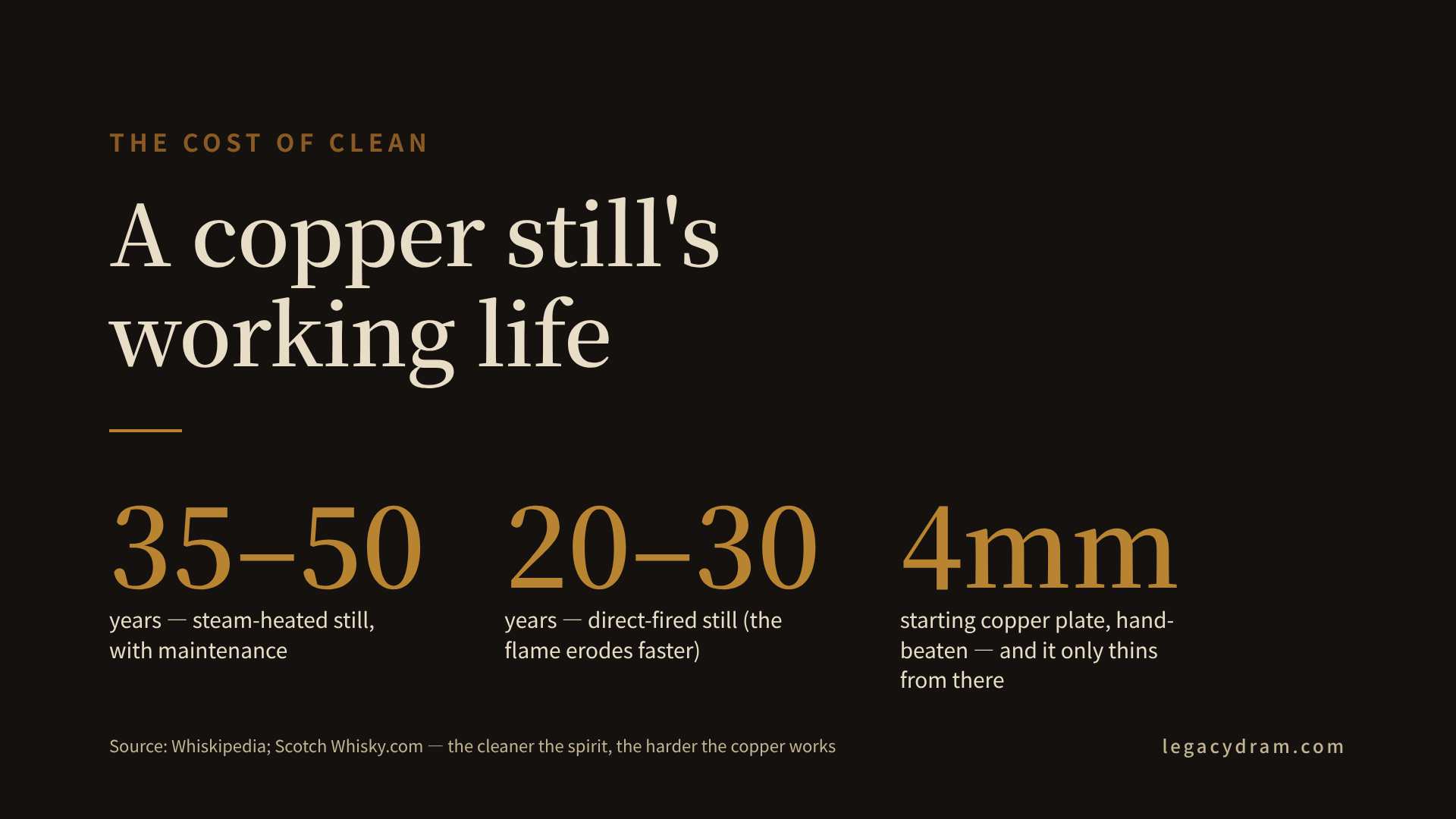
A steam-heated still, gently coaxed, can run 35 to 50 years with maintenance; a direct-fired one, with a naked flame scorching the base, erodes faster and lasts perhaps 20 to 30. (Whiskipedia) Major copper repairs come around at least every several years for hard-worked sections. (At this point the engineer in you wants to build the amortisation model: replacement cost per litre of pure alcohol, discounted over the asset life. I started one too. The honest version needs the still price, the production volume, and the wear rate, and distilleries guard all three, so the model stays on the napkin where it belongs.)
The point survives without the spreadsheet: a still is not capital you buy once. It is a slow consumable with a refill cost, and the refill is a hand-built copper vessel.
Richard Forsyth and the trade in a consumable
Which is the whole business model of the family in Rothes.
Forsyths traces back to a brass and copperworks that Alexander Forsyth bought from the retiring Robert Willison in 1933, having served his apprenticeship there in the 1890s. His son Ernest — known to everyone as “Toot” — took over after the war and replaced the old riveting with welding. Then in the late 1960s the third generation, Richard and William, came in, and Richard took over management in the mid-1970s and turned a local copperworks into a firm that now ships distillation equipment from Korea to Kentucky to Jamaica. The fourth generation, Richard Ernest, is managing director today. (Forsyths; Whisky Magazine)
What they sell is, at bottom, the consumption of copper. Stills are still made the slow way: a design is drawn on a computer, then 4mm copper plate is cut into panels and hand-beaten into the swells and shoulders of a still before welding and polishing. (Whisky Magazine) Richard Forsyth’s own justification for why it cannot be any other metal is the entire thesis of this article in one blunt sentence:
“If you used steel it would eat through the still in no time at all.” — Richard Forsyth (Whisky Magazine)
Read that carefully. He is not saying steel lacks copper’s catalytic gift, though it does. He is making the materials-engineering point that copper is the metal that survives the corrosive, sulphurous, acidic environment of a still long enough to be worth replacing. Steel would corrode catastrophically. Copper corrodes gracefully, slowly, in a way you can gauge with ultrasound and budget for in years. The genius of copper is not that it is permanent. It is that it wears out on a schedule.
Now the trade-off, both sides, because pretending a consumable has no downside is how craft writing turns into a brochure.
What the copper buys: a catalyst, a sulphur scrubber, and a flavour dial all in one material, with a wear rate slow enough to plan around. No other affordable metal does the chemistry and lasts decades. That combination is why every malt distillery on earth runs copper somewhere in the vapour path.
What the copper costs: it is a recurring capital line, not a one-off. The cleaner the spirit you chase, the more contact you design in, the harder the copper works and the sooner you pay Forsyths again. A distillery’s house style is partly a maintenance-cost decision wearing a flavour costume. The light, clean malts are quietly spending more copper than the heavy, meaty ones; they just get a more delicate spirit in return.
There are people trying to escape the schedule from the other end. In Toyama, the team behind Saburomaru’s cast-bronze ZEMON still reach for a tougher alloy to fight the wear problem with metallurgy rather than replacement: a different answer to the same erosion that keeps Forsyths in business. Bronze and copper are not the same trade, and that is a story of its own. But it tells you the wear is real enough that people are re-engineering the metal to beat it.
What wears out, and what you taste
The thing I keep returning to, as an engineer, is that the still is the rare piece of industrial equipment whose consumption is the product. A milling machine that wore away into the parts it cut would be a defect. A still that wears away into the spirit it cleans is working exactly as designed. The copper sulphide patina building up inside is the visible receipt of sulphur removed; scrub it back to bright metal and the spirit briefly turns vegetal until a new patina — a new layer of partly-sacrificed copper — settles in.
So when you next drink something clean and bright — a light Highland malt, a fruit-forward Speysider — taste the absence in it. The missing rotten-egg, missing boiled-cabbage, missing onion notes are not missing because someone filtered them out. They are missing because copper atoms reacted with them and left the building as patina, and somewhere in Rothes that reaction is being measured by ultrasound and quietly costed toward the day a few weeks of darkness fall on the still house and Richard Forsyth’s people arrive with fresh 4mm plate and hammers.
The bottle in your hand is, in a small and literal sense, partly made of the still that made it. You are drinking the difference between the copper that went in and the copper that came out.
Related reading
- Bolt-On Reflux: Major James Grant’s 1872 Purifier at Glen Grant — setting the contact ratio with a device
- The Reflux Equation: Why Glenmorangie’s Stills Are 5.14 Metres Tall — setting it with height
- The Slowest Spirit Run in Scotland: Robbie Hughes at Glengoyne — setting it with speed
- Cragganmore 12: Worm Tubs, John Smith, and the Heavy Side of Speyside — the opposite setting, copper deliberately starved
Sources
- Forsyths Ltd — Our History
- Whisky Magazine — The Forsyth’s saga
- Whiskipedia — The role of copper in spirit production
- Scotch Whisky.com — Why are whisky stills made from copper?
- Annandale Distillery — Copper (technical notes)