Benromach 10: How Gordon & MacPhail Reverse-Engineered the Speyside the 1960s Threw Away
The most famous name in old whisky never made any of it. For a century, Gordon & MacPhail bought spirit, filled their own casks, and waited: they were a shop and a bottler, not a distillery. Then in the 1990s they did something a broker is not supposed to do: they bought a silent distillery and started making whisky themselves. Benromach 10 is what came out, and it tastes, deliberately, like a Speyside from before the industry got efficient. When I poured it next to a modern unpeated Speyside, the difference was a thin thread of smoke and a heavier, oilier body the others had quietly dropped decades ago.
Three glasses, a Wednesday, the kind of grey Tokyo afternoon that makes a lightly peated dram feel like the right idea. Benromach 10 at 43%, a Glenfiddich 12 at 40% standing in for the modern Speyside consensus, and a Cragganmore 12 at 40% as the heavy, worm-tub end of the old register. The flight is not about which is best. It is about reading, in three glasses, a flavour decision that an entire region made and then un-made, and that one bottler decided to make again on purpose.
The shop that never distilled
Gordon & MacPhail started in 1895 as a grocer’s shop in Elgin — tea, provisions, and whisky over the same counter. A young apprentice named John Urquhart joined in those early years, became senior partner in 1915, and from that point the firm stayed privately owned by the Urquhart family. What they built was not a distillery but the opposite of one: a maturation business. They bought new-make spirit from distilleries all over Speyside, filled it into their own casks, and sat on it for years or decades. Their reputation (and it is not an exaggeration to call it the most respected name in old single malt) was built entirely on choosing other people’s spirit and waiting longer than the distilleries themselves were willing to wait.
So when I say the Urquharts wanted to own a distillery, I should be honest about how strange that ambition was. A bottler who buys a distillery is taking on every cost, risk, and unglamorous chore (barley, yeast, effluent, a payroll, a still that fouls) that the bottling model exists to avoid. The clean version of the story is that it was “always the ambition of John Urquhart.” The deflating version is that it took four generations and the better part of a century to actually do it, and that the man whose ambition it supposedly was had been dead for decades by the time it happened. George Urquhart (“Mr George”) joined his father in 1933. Ian Urquhart came in 1967, David in 1972, Michael in 1981. It was the third generation, with the fourth already in the building, who finally pulled the trigger.
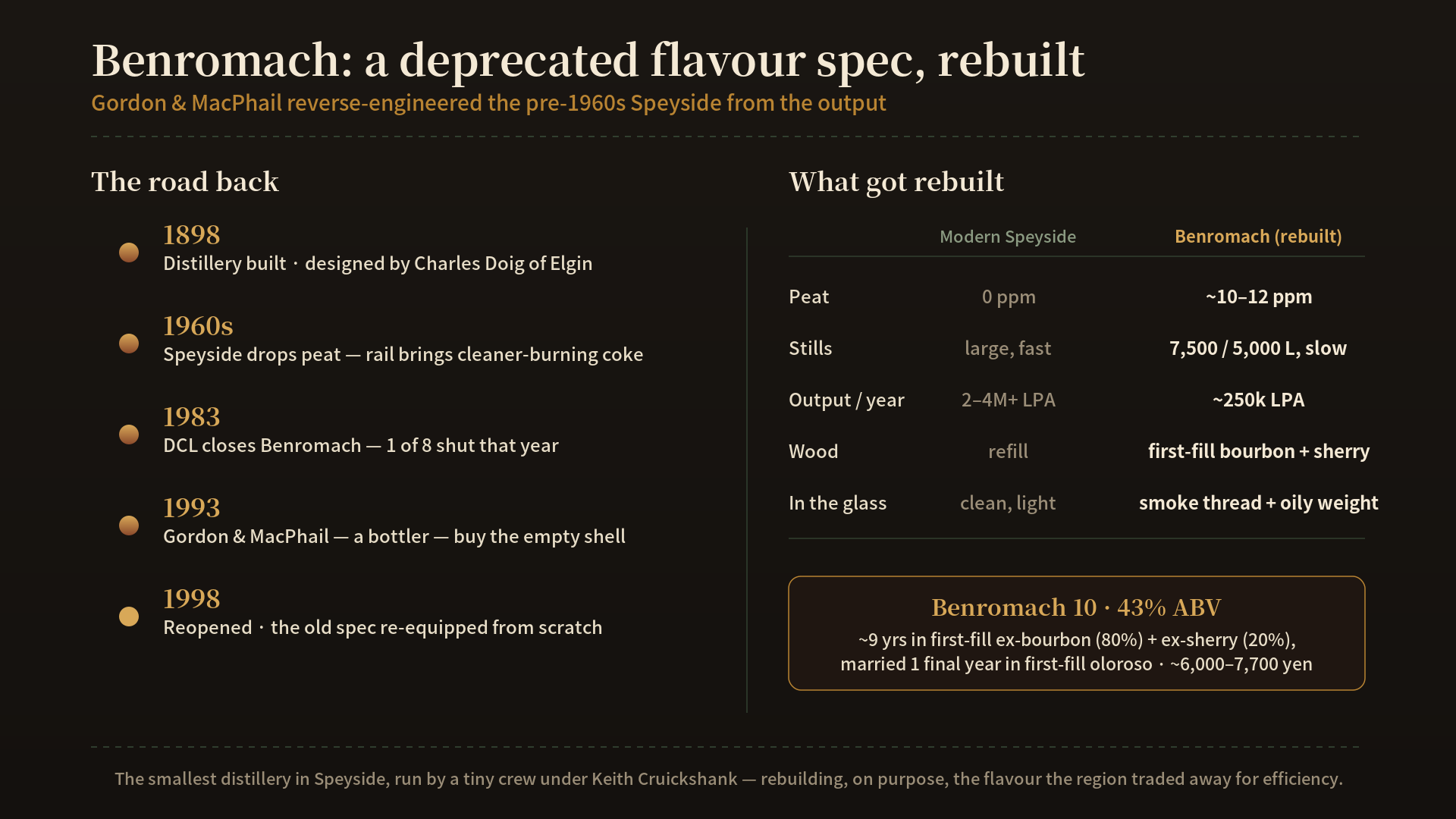
The chance came in 1993. United Distillers — the DCL successor that would become Diageo — had closed Benromach ten years earlier, in 1983, one of eight DCL distilleries shut that year. Of those eight, Benromach is the only one still alive today. Gordon & MacPhail bought the emptied buildings and the remaining stock, twelve miles from the steps of their Elgin shop, and then did the thing that bottlers don’t do. They spent five years re-equipping it. HRH Prince Charles reopened the distillery on 15 October 1998. A grocer had become a distiller.
What the 1960s threw away
Here is the part that should interest anyone who has ever maintained a system long enough to watch it abandon a good design for an efficient one.
Speyside used to be peated. Not Islay-peated, but peated — because before the railways, peat was simply the fuel you had for drying malt, and a faint smokiness was the regional baseline, not a feature. Then the rail network reached the north and brought coke and coal with it. Coke burns hotter, cleaner, and more evenly than peat, with far less smoke, and it does not leave its character in the barley. One by one, through the mid-twentieth century, Speyside distilleries dropped peat and moved their malting in-house to mechanised Saladin boxes and, later, to centralised maltsters. Glen Moray ran floor maltings until 1958 and a Saladin box until 1978; the trajectory was the same everywhere. By the time the single malt boom arrived in the 1980s, “Speyside” meant clean, fruity, unpeated, light — and a couple of generations of drinkers learned that this was simply what the region was, rather than what it had recently decided to become.
The flavour spec that got deprecated was: lightly peated malt, a heavier and oilier spirit, and sherry wood to carry the weight. The industry didn’t lose it by accident. It traded it away for throughput, consistency, and lower cost — the same trade every maturing codebase makes when it deletes the slow, characterful path because the fast, generic one is cheaper to run. Nobody filed a regret. The old spec just stopped being made.
What Gordon & MacPhail decided, when they had a blank distillery and could equip it however they liked, was to build that deprecated spec back from first principles. Not to preserve a surviving line (there was nothing left to preserve) but to reconstruct, deliberately, the pre-1960s classic Speyside that the region had thrown away. This is reverse-engineering in the strict sense: the original was gone, the documentation was the whisky itself, and they had to rebuild the process from the output.
The spec, rebuilt
The reconstruction has a few load-bearing decisions, and none of them is the efficient choice.
Lightly peated malt. Benromach malts to roughly 10–12 ppm phenol — phenols being the family of smoke-derived compounds (the same ones, in vastly larger quantity, that make Islay whisky medicinal) that survive from the peat fire through to the spirit. Ten to twelve ppm in the barley is a whisper: most of it is lost in distillation, so the smoke in the glass is a thread, not a wall. That thread is the single clearest signal that you are drinking a recreated old-Speyside profile rather than a modern one.
Small stills, run slowly, by hand. Benromach is the smallest distillery in Speyside: one pair of stills, a 7,500-litre wash still and a 5,000-litre spirit still, producing somewhere around 250,000 litres of alcohol a year. Its larger neighbours make two to four million; the giants make over ten. A small still run slowly gives the spirit more contact time and a heavier, oilier body than a big fast-charged still optimised for volume. This is a deliberate cost: every litre Benromach makes is more expensive in labour and time than the same litre from an automated neighbour. The distillery runs on a tiny crew, and the man who has shaped its spirit since the day it reopened, Keith Cruickshank, started there in 1998 as the sweeper, worked up to distiller, and then to distillery manager and master distiller. The least heroic-sounding career in whisky produced one of its more particular spirits.
First-fill wood, sherry-led. Benromach 10 matures for about nine years in a combination of roughly 80% first-fill ex-bourbon and 20% first-fill ex-sherry casks, then spends a final year married together in first-fill oloroso sherry wood before bottling at 43%. “First-fill” means the cask is on its first use for Scotch (the most active, most assertive wood you can fill), and the sherry component supplies the dried-fruit weight that the old heavy Speysides leaned on.
I want to be careful not to turn this into a heroism story, because it isn’t one. Gordon & MacPhail did not rescue a tradition; the tradition was already dead, and they chose to incur the ongoing cost of running the most inefficient distillery in the region in order to make a flavour the market did not strictly need. It is a defensible bet, and it is also an expensive, slightly stubborn one. The honest framing is that they spent real money to un-win an argument the industry had settled in favour of efficiency forty years earlier.
There is a neat closing of a loop in the architecture, too. Benromach was built in 1898 and designed by Charles Doig, the Elgin architect responsible for the pagoda-roofed malt kiln that became the visual signature of Speyside. Doig’s pagoda existed to vent the smoke of a peat-and-coke kiln — back when drying malt over fire was something every distillery did on site. Gordon & MacPhail reopened a Doig distillery to make a Doig-era style of spirit. The building and the spec were designed for the same century.
Three glasses
Benromach 10, 43%. The nose opens with the thread of smoke first: not bonfire, not iodine, more like the smell of a struck match held a foot away, or the last of the woodsmoke clinging to a coat you wore near a fire last night. Under it sits the sherry: not the sticky raisin of a heavily sherried bruiser, but dried fig and a little orange peel, with a malt-loaf sweetness behind. The body is the giveaway. At 43% it fills the centre of the mouth with an oily weight that the other two glasses, for different reasons, do not have. The smoke runs underneath the fruit the whole length of the palate and into a finish that stays warm and faintly ashy. Add a few drops of water and the smoke recedes slightly and the sherry steps up; the spirit takes water well, which a thin spirit usually doesn’t. This is the recreated old-Speyside in one glass: smoke as a seasoning, weight as a structure, sherry as the support.
Glenfiddich 12, 40%, refill American oak. The modern Speyside benchmark, and a good one. The nose is brighter and cleaner: pear, green apple, a touch of vanilla, no smoke anywhere. On the palate it is narrower and lighter, sits higher in the mouth, and finishes short and tidy. There is nothing wrong with it; it is the efficient spec done well, and for twenty-five years most drinkers, including me, would have called it the more obviously pleasant pour. Beside the Benromach it reads as the dram the industry chose when it decided what Speyside should be — recognisable, reliable, and missing exactly the two things (the smoke thread, the oily weight) that Benromach went back to retrieve.
Cragganmore 12, 40%. The heavy, worm-tub survivor — a Speyside that stayed dense through a different route, by cooling its spirit in worm tubs rather than by peating its malt. There is no smoke here, but there is weight, and a savoury, dried-mushroom depth that Benromach doesn’t have. Reading Cragganmore beside Benromach is the useful part of the flight: they arrive at “heavy old Speyside” from opposite directions — Cragganmore through still geometry and cooling, Benromach through peat and small slow stills. Neither is the fruity-light consensus, and tasting them together is the fastest way to hear what that consensus quietly removed.
Where Benromach 10 sits, and what to verify
At Tokyo retail in May 2026 the bottle runs roughly 6,000–7,700 yen, which lands it squarely in the connoisseur-cost-performance band — more than the supermarket Speysides, well under the prestige sherry bombs, and arguably the most interesting thing you can buy at the price if you want to taste a flavour decision rather than just a flavour. My own cost-performance notes file exactly this kind of bottle under “the dram that teaches you something per yen,” and Benromach 10 earns the slot.
What I would ask any drinker to check the next time they have it in front of a modern Speyside:
The smoke thread. Find it on the nose before anything else, and notice how thin it is. If you are used to Islay, you will almost miss it. That thread is the ~10–12 ppm spec, and it is the clearest evidence in the glass that someone rebuilt a pre-1960s style on purpose.
The body at 43%. Hold it in the centre of the mouth against the Glenfiddich. The Benromach is oilier and heavier, and that is the small slow stills and the first-fill wood, not just the extra three percent of alcohol.
The sherry as support, not spectacle. The oloroso marrying year is doing structural work — dried fig, a little leather — underneath the smoke, rather than dominating. That balance is the recreated old-Speyside in miniature: peat, weight, and sherry holding hands the way they did before the region let go of all three.
This is the same shape of decision I keep finding behind the bottles that interest me. A century before Benromach reopened, Alfred Barnard walked Speyside cataloguing distilleries that mostly still peated their malt; Benromach 10 is, in a real sense, his Speyside rebuilt for the present. And the worm-tub Cragganmore on the table is the other way a 19th-century weight survived into the present — preserved rather than reconstructed.
I keep coming back to John Urquhart, the apprentice who joined a grocer’s shop in the 1890s and is supposed to have wanted, all along, to own a distillery. He never did. The shop he joined spent a hundred years becoming the most trusted maturer of other people’s whisky, and only after he and his son were gone did the family finally buy a silent distillery and rebuild, from its own buildings outward, a flavour the whole region had agreed to forget. The ambition outlived the man by the better part of a century. Benromach 10 is the thing he wanted to make and never tasted — a Speyside the 1960s threw away, reverse-engineered by the people trained by the people he trained.
Try this bottle
Affiliate link below. If you buy through it, LegacyDram earns a small commission and the price you pay does not change. Alcohol-related links are intended for readers of legal drinking age (20+ in Japan, 21+ in the US).
Related reading
- The Speyside That Stayed Heavy: Cragganmore 12, John Smith’s 1869 Choke, and Why the Worm Tubs Are Still There: the other route to a heavy old Speyside — preserved through still geometry and worm tubs rather than reconstructed through peat. The natural second glass beside Benromach.
- Alfred Barnard’s 1887 Atlas: One Man, 162 Distilleries, and the Speyside Before It Got Efficient: the Victorian Speyside that Benromach 10 deliberately recreates — Barnard catalogued the region while it still peated its malt as a matter of course.
- Charles Doig, the Pagoda Roof, and 56 Distilleries: the Elgin Architect Who Drew Speyside: Doig designed Benromach in 1898, pagoda kiln and all — the building was made for the peated era whose spirit Gordon & MacPhail rebuilt a century later.
- George Urquhart and Gordon & MacPhail: The Maturation Doctrine Behind Benromach: the same family company seen from the maturation side — George Urquhart’s long-cask doctrine, which shaped the Benromach 10 itself.
Sources
- Benromach distillery — benromach.com / Our Story
- Gordon & MacPhail — gordonandmacphail.com / Benromach Distillery
- Gordon & MacPhail timeline — gordonandmacphail.com / Our History
- Wikipedia: Benromach distillery
- Wikipedia: Gordon & MacPhail
- Scotch Whisky on Gordon & MacPhail — scotchwhisky.com
- “Benromach, The Smallest Distillery in Speyside” — wordsofwhisky.com
- “Meet Benromach Distillery Manager, Keith Cruickshank” — maltwhiskytrail.com
- Benromach Aged 10 Years — benromach.com
- “Why Peat Is Popping Up In Non-Peaty Scotch” — whiskyadvocate.com
- Misako Udo, The Scottish Whisky Distilleries (Black & White, rev. ed.)
- Charles MacLean, Whiskypedia (Birlinn, 2014)