The Still Before Coffey: Robert Stein's 1827 Continuous Still and the Better Machine That Lost
In December 1827, at a distillery called Kilbagie on the flat carse land of the Scottish Lowlands, a distiller named Robert Stein filed a patent for a machine that did something no still in the country had done before: it produced spirit continuously, without ever being emptied and refilled. The patent number was 5583. The machine worked. It was, by the standards of the next two hundred years, the founding object of the entire grain-whisky industry. And almost nobody reading this will have heard of the man who built it, because three years later a former Irish exciseman named Aeneas Coffey patented a cruder version of the same idea, and it is Coffey’s name, not Stein’s, that the industry put on the still.
This is a piece about the man who got there first and lost. I want to be careful, in advance, about what kind of story this is. It is not a story about a robbed genius and a thief. Coffey did not steal Stein’s design; he replaced it with a worse one that happened to be more useful, which is a different and more uncomfortable thing. If you have ever watched a more elegant piece of engineering lose to a clumsier one that was simply easier to keep running, you already know the shape of this. The whisky industry learned the lesson Silicon Valley would later give a name to, a century and a half before anyone wrote worse is better on a whiteboard.
The problem Stein was actually solving
Robert Stein was born in 1770 into one of the two great Lowland distilling dynasties. The Steins, along with the Haig family they were married into, ran the largest grain distilleries in Scotland: Kennetpans and Kilbagie in Clackmannanshire, and a scattering of others through Fife and Kinross. These were not romantic Highland farm-stills. They were industrial operations, some of the largest manufacturing sites in Georgian Scotland, and most of what they produced went south to England as cheap base spirit for the gin trade. Kilbagie in its prime was distilling on a scale that dwarfed any malt distillery; the neighbouring Stein farm had pioneered Scotland’s first powered threshing machine back in 1787. This was a family that mechanised things for a living.
The constraint Stein lived under was the pot still, and specifically its arithmetic. A pot still is a batch process. You fill it, you heat it, you collect the vapour, you condense it, and then you stop, empty it, clean it, and start again. Every cycle throws away most of the volume and most of the heat to recover a small amount of stronger spirit. For a Highland distiller making a few thousand gallons a year of flavourful malt whisky, this is fine; the flavour is the product, and the inefficiency is the price of it. For a man trying to supply the English gin trade with neutral spirit by the hundred thousand gallons, it was a bottleneck made of copper and firewood. Stein’s whole working life pointed at one question: how do you make a still that never has to stop?
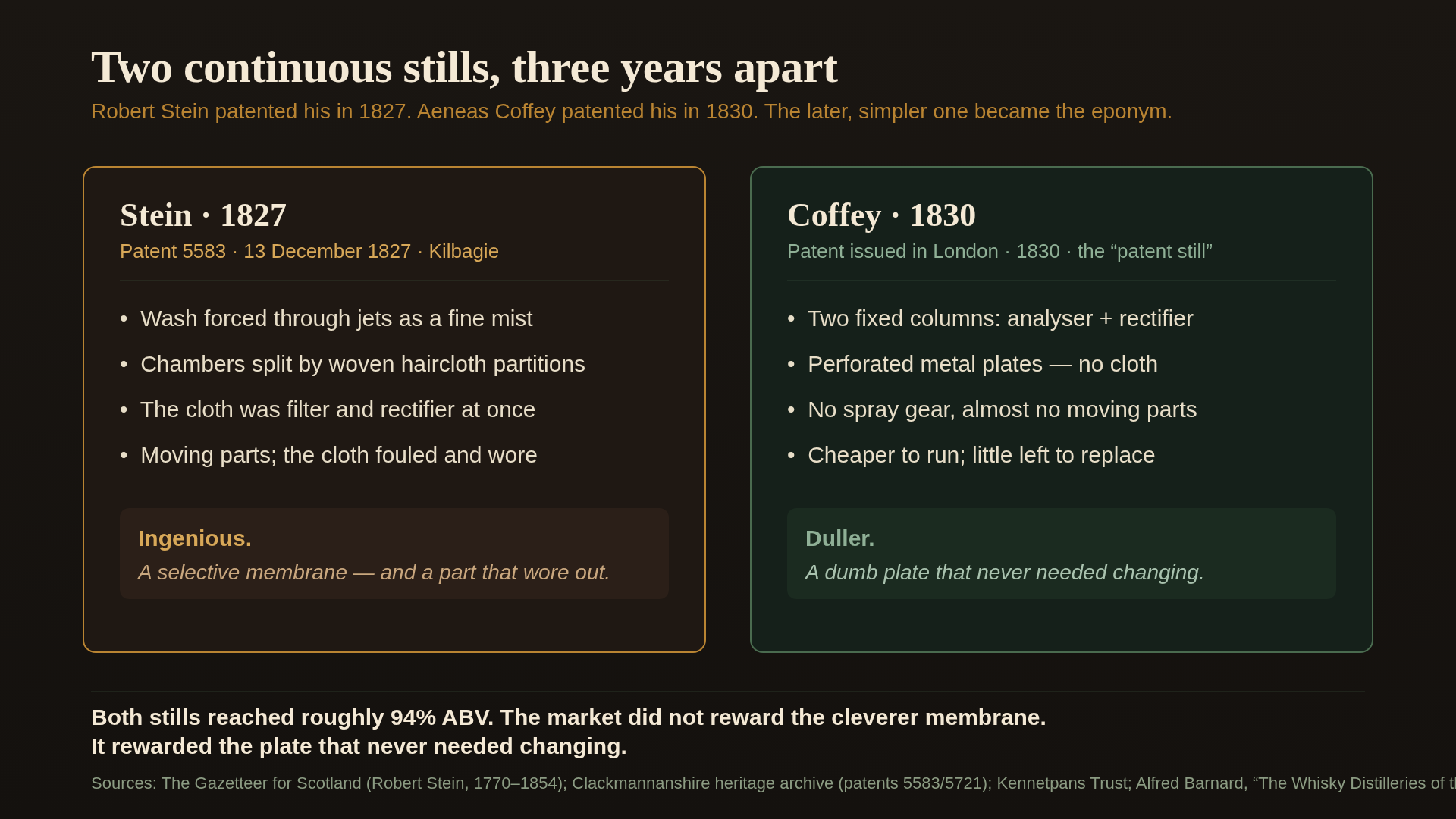
His answer, patented in 1827 and refined in a second patent (number 5721) the following year, was genuinely ingenious, and it is worth describing because the cleverness is the whole tragedy. According to the Clackmannanshire heritage records that hold the patent details, Stein’s still atomised the wash. A piston mechanism forced the fermented liquid through jets so that it struck metal prisms and burst into a fine mist, a shower of droplets with enormous surface area, which is exactly what you want for fast evaporation. This mist passed through a long vessel divided into a series of compartments, and the partitions between those compartments were made of woven haircloth. The cloth did two jobs at once. It let alcohol vapour permeate through while holding back water and the heavier residues, so it acted as a filter and a rectifier in the same component. Steam rose, alcohol climbed compartment by compartment, spent wash drained away, and spirit came off the top at strengths around ninety-four to ninety-six percent. Continuously. The first full-scale production version was installed at Kirkliston, west of Edinburgh, and the design spread through the family’s distilleries.
Read that description again and notice what Stein had done. He had invented a selective membrane. In 1827, decades before anyone understood the physical chemistry of why a woven fabric might pass ethanol vapour and resist water, he had built a still whose central working element was a smart material doing a job we would now hand to a precisely engineered fractionating plate. It is the kind of idea that, described to a modern chemical engineer, earns a low whistle. It is also, for exactly the same reason, the kind of idea that breaks.
What Coffey did, which was less
Aeneas Coffey was an Irishman, a career excise officer who had spent his working life measuring the output of stills for the tax authorities and the last few years of it watching the Stein-design stills run, imperfectly, on both sides of the Irish Sea. In 1830 he filed his own patent in London for what he called the patent still, and what the whole industry would soon call the Coffey still. The petroleum refiners who adopted the same geometry forty years later called it a fractional distillation column, which is what it is.
The honest thing to say is that the secondary sources do not entirely agree on which of the two machines was more complex. The Kennetpans Trust history describes Coffey’s design as bigger and in some ways more elaborate than Stein’s. But complexity of construction is not the variable that decided this. The variable that decided it was what happened when the thing had been running for six months. And on that question the verdict is not ambiguous at all. Coffey threw away the part of Stein’s machine that was cleverest, and that was the entire point.
Coffey’s two columns, the analyser and the rectifier, are stacks of fixed perforated metal plates. Wash trickles down one column against rising steam; alcohol-laden vapour rises up the second against its own condensed reflux. Each plate is, in effect, one distillation, and by stacking thirty or forty of them you perform thirty or forty distillations in a continuous series. There is no spray mechanism. There is no piston atomising the wash into prisms. And, crucially, there is no cloth. The selective membrane that was the genius of Stein’s design is simply gone, replaced by a dumb sheet of perforated copper that does a less elegant version of the same job and never, ever needs replacing.
Here is the part where I am supposed to tell you that Coffey was the true visionary who saw what Stein could not. I am not going to write that, because it is not what happened. What happened is duller and more important. Stein’s haircloth partitions fouled. They clogged with the solids in the wash, they wore out, they had to be cleaned and replaced, and a still whose central component is a consumable fabric is a still that fights you every week of its working life. Coffey’s plates did not foul in any way that mattered, did not wear, and did not need a skilled operator babysitting a piece of cloth. Coffey’s still was cheaper to buy, cheaper to run, and almost impossible to break. It was the worse machine in every respect a 1990s engineer would have admired, and the better machine in the only respect a distillery accountant cared about, which is the cost of the spirit coming out of the bottom over twenty years of operation.
The cleverer the part, the more ways it has to fail. Stein had built the more intelligent still and, in doing so, had built the more fragile one. Coffey built something an idiot could keep running, and the market, which is mostly run by people who would rather not employ a genius to mend a sheet, chose the thing an idiot could keep running.
Their own cousin switched
The cruellest evidence for this is in the family. John Haig, the Lowland grain distiller whose Cameronbridge plant became the seed of what is now Diageo, was a Stein by blood; his mother was a Stein, and the two families were the joint owners of the Lowland grain trade. Haig had been running Stein-design continuous stills at Cameronbridge since the 1830s. He had every reason of loyalty, capital, and sunk cost to stay with the family machine.
He switched to Coffey within a few years. He did not switch because the family design had failed to work; it had worked well enough to make him one of the largest grain distillers in Scotland. He switched because Coffey’s still made spirit more cheaply and with less trouble, and Haig was a businessman, not a sentimentalist. When the man who is married into your dynasty, who installed your machine and made money with it, quietly tears it out and bolts in your rival’s instead, the argument is over. The market has spoken in the one voice it cannot fake, which is the voice of a relative choosing against you with his own money.
What I find genuinely poignant, reading the records, is how long Stein’s machines hung on anyway, half-beaten. They did not vanish in 1830. When Alfred Barnard toured the British distilleries in the 1880s and wrote the survey that I have leaned on more than once for this site, he found Cameronbridge running two Stein stills and two Coffey stills, side by side, in the same building. The Kennetpans accounts record some Stein stills still in service into the 1920s, nearly a century after the patent. The machine was not a failure. It made whisky for ninety years. It simply lost the future, slowly, to a thing that was easier to live with, while its inventor’s name detached from it and floated away.
What is actually his
So what survives that belongs to Robert Stein? Not the still; that became Coffey’s by linguistic conquest, the way the Biro became a generic name and Bissell became a verb. Not a brand; there is no bottle on any shelf in 2026 with his name on it. What survives is the entire category of grain whisky, and through it the entire architecture of blended Scotch, and through that the global existence of the industry. Continuous distillation is the platform on which everything cheap and everything scalable in Scotch whisky was built, and Stein is the man who first made it work at production scale. Every column still running anywhere in the world tonight, including the one Joseph Hobbs bolted into Ben Nevis in 1955 against the grain of the whole industry and the Coffey stills that became Nikka’s signature in Japan, traces its lineage back through Coffey’s improvement to the idea Stein patented in 1827. He invented the thing. He just did not get to name it.
For readers who came to my work through the Kindle title on cost-performance whisky, this is the deep reason any blended Scotch can exist at the price it does. The grain spirit that makes up most of the volume of your Friday-night blend is cheap because continuous distillation is cheap, and continuous distillation is cheap because of a chain of engineering decisions that begins, demonstrably, at Kilbagie in 1827. The price on the bottle is, in part, a number Robert Stein set in motion and never got to see.
The carse is empty now
Stein died in 1854, in Clackmannan, a few miles from the distillery where he had built the machine. He was eighty-four. He had lived long enough to watch his cousin replace his still, long enough to watch Coffey’s name become the word for the thing he had invented, and long enough, if he was paying attention, to understand that the future he had opened was going to be walked into by someone else’s design. The Gazetteer for Scotland, which is one of the few places that records him as a person rather than a footnote to Coffey, gives his dates plainly and moves on, which is roughly what history did.
Kilbagie is gone as a whisky distillery. Kennetpans, the great Stein site next door, is a roofless ruin on the Forth shore that a small trust is trying to keep from collapsing entirely, and most people who drive past the carse where the largest distilleries in Georgian Scotland once stood have no idea anything was ever there. There is no statue. There is no visitor centre with a tartan-draped narrative about the lone genius of the Ochils. There is a patent number, 5583, in a record office, and a machine that bears another man’s name, and a global industry that rests on a foundation he poured and that has, almost completely, forgotten him.
I think about this when I read the marketing copy on a single grain whisky, the kind that talks about heritage and craft and the patient column still. The column still is patient. It is also, in its direct ancestry, the second-best solution to a problem a cleverer man solved first and worse-for-business. The history of technology is mostly written by the survivors, and the survivors are mostly not the people who had the best idea. They are the people whose idea was easiest to keep running after the inventor went home. Robert Stein had the best idea. It cost him his name. The still in the warehouse still runs every day, and it answers to someone else when called.
If you want to read further on the surrounding decisions: I have written on John Haig and the Coffey still that made blended Scotch possible, which is the downstream commercial story of the technology Stein started and Coffey finished; on Alfred Barnard’s 1887 survey of 162 distilleries, the source that records Stein and Coffey stills running side by side at Cameronbridge; on Joseph Hobbs and the column still he installed at Ben Nevis in 1955, a much later outsider’s bet on continuous distillation; and, in Japanese, on Takeshi Taketsuru and the Coffey still that became Nikka’s signature. My broader argument about who really built modern Scotch is at kenimoto.dev.