Sam Bronfman: How Seagram Bought Chivas Regal for £85,070 (1949)
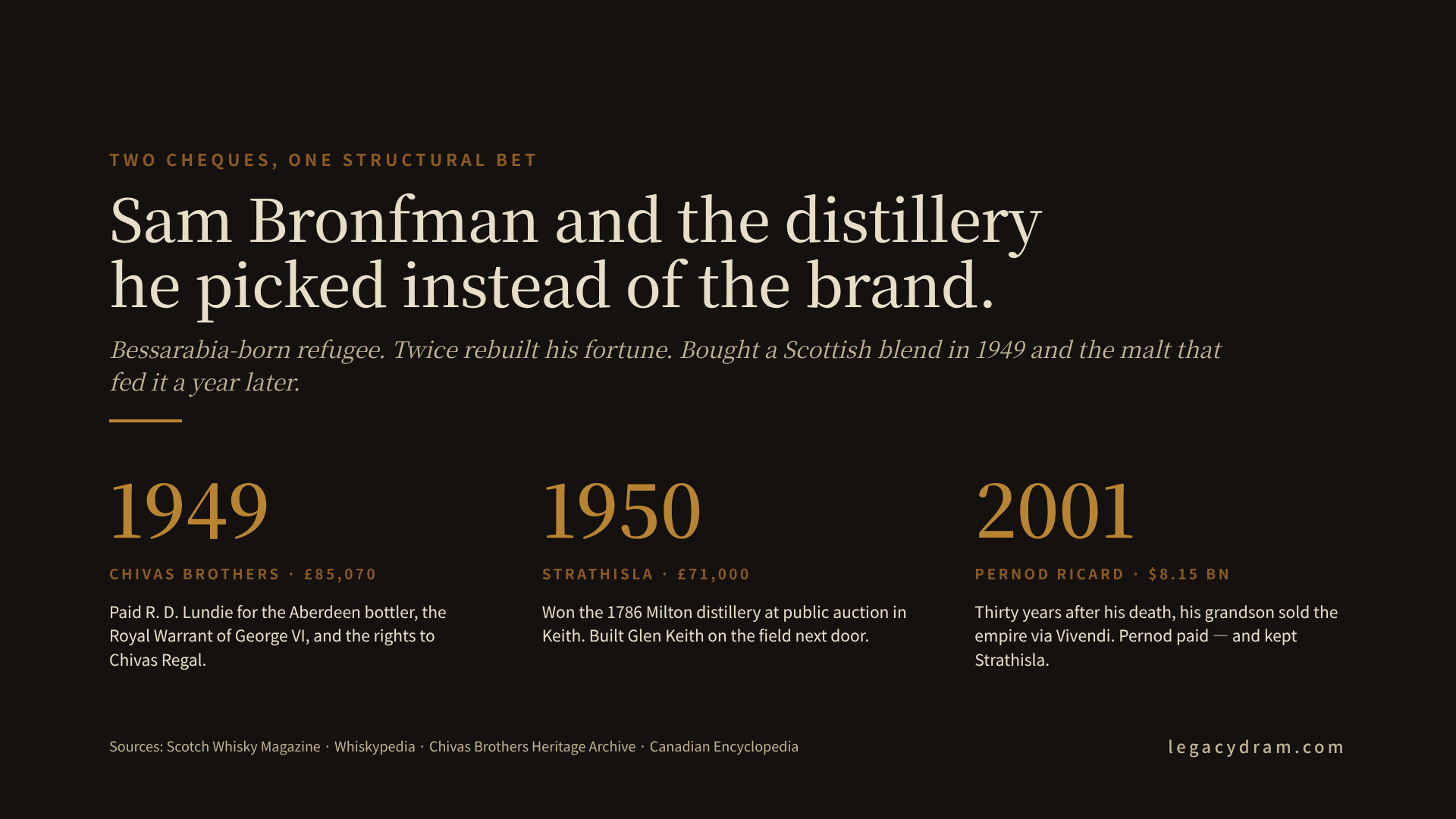
In 1949, in the office of an Aberdeen solicitor, a cheque for £85,070 was written out in favour of a man named R. D. Lundie. The signature on it belonged to Samuel Bronfman, born sixty years earlier on a ship leaving Bessarabia, and the thing the cheque bought was a small Aberdeen grocer’s business with a Royal Warrant, a bottling hall, a Highland brand called Chivas Regal, and stock. A year later a second cheque, for £71,000 this time, was written at a public auction in Keith for a small Speyside distillery called Milton, which Bronfman immediately renamed Strathisla. He had now spent under £160,000 to acquire a brand and the malt distillery that would become its spine. The bottle of Chivas Regal 12 on my shelf in 2026 is the long downstream of those two cheques. The Distillers Company Limited, which spent the same decade looking the other way, is not on my shelf at all. Bronfman’s empire is not on my shelf either. The blend is.
Bessarabia, Manitoba, and a hotel that found its margin in alcohol
Bronfman was born in 1889. The birth happened either in Soroki, in what was then Russian-imperial Bessarabia and is now Moldova, or on the ship that was taking the family out of it, depending on which biographer you trust. The family were Jewish refugees of the late-imperial Russian pogroms, and they did not pick the destination at random: a small wave of Bessarabian Jews had been resettling in Saskatchewan since the mid-1880s under a Canadian government scheme intended to populate the prairie. They landed at Wapella, moved south to Brandon, Manitoba, and in 1903 bought a hotel.
The hotel is the part of the biography I want to dwell on, because it is where the rest of the story is already implicit. The family observation, made by the teenaged Sam working the front desk, was that the room rates kept the lights on and the bar made the money. He persuaded his father to let him run the bar side as a separate concern. Within a few years he was running liquor distribution out of three hotels. By the early 1920s he was selling mail-order whisky into the prairie provinces, by 1924 he had a small distillery in LaSalle, Quebec, and that distillery was incorporated under the unembarrassed name Distillers Corporation Limited. Four years later he bought the much larger Joseph E. Seagram & Sons of Waterloo, Ontario, and merged the two into Distillers Corporation-Seagrams Ltd. It was, in Canadian whisky terms, a complete vertical: still, warehouse, brand, distribution. He was thirty-nine.
I am going to handle the Prohibition years once and then move on, because they are the part of the story that gets romanticised and the part that misled me when I first read about Bronfman. Between 1920 and 1933 American consumers wanted whisky and could not legally buy it. Canadian producers could legally make it and could legally export it. The trade that filled the gap was: Canadian whisky shipped legally to bonded warehouses in places like the French islands of Saint-Pierre and Miquelon, or to border points such as Windsor, Ontario across from Detroit, where it was transferred to American smugglers who then ran it across. Seagram, like every other Canadian producer of any size, was on the legal side of this transaction. Bronfman was never criminally convicted. He was also not naive about who his customers were. In 1935, two years after Repeal, Seagram paid the United States Treasury a $1.5 million settlement on back excise taxes for liquor that had been “illegally exported,” a phrase that the firm and the Treasury both seemed to find acceptable. He emerged from the thirteen Prohibition years with cash, distribution relationships across North America, and a working knowledge of the Scotch supply chain, which by then he was already buying from.
The Scottish play, and the man who knew the distilleries
Bronfman did not move on Scotland alone. His operational partner from the mid-1930s onward was a Glasgow whisky broker named James Barclay, known to everyone as Jimmy, who had spent his childhood inside an active distillery, knew most of the surviving family owners personally, and could value Highland stock by walking through a warehouse. The Bronfman biographies tend to describe Barclay as a friend; the trade press is more accurate, describing him as a man “literally raised in a distillery and who knew the history of the distilleries of Scotland like the back of his hand.” Bronfman supplied the capital and the strategic intent. Barclay knew which doors to knock on and what was behind them.
The first move, in 1935, was Robert Brown Ltd of Paisley, a small blender bought, in the convention of the time, mainly for its stock of mature whisky. The Second World War interrupted further moves. When the war ended, the Scotch industry was in an unusual state: stocks were thin (distillation had been curtailed under wartime restrictions from 1939), the dollar trade was newly critical to the British balance of payments, and several second-tier brand owners were carrying debt from the long Pattison-shadowed decades when the industry had been quietly contracting. It was, in short, a buyer’s window for someone with North American cash.
In 1949 that window opened on Chivas Brothers, an Aberdeen grocer-and-bottler that had been on Castle Street since the early nineteenth century, held a Royal Warrant from George VI, and owned the rights to a luxury blend launched in 1909 under the name Chivas Regal 25 Year Old. Lundie, the owner, wanted out. Barclay valued the firm and brokered the deal. The price was £85,070, about £3.5 million in 2026 money, which is to say, less than a Mayfair flat for a registered Scottish brand with a royal endorsement and a small but real stock of aged whisky. Bronfman wrote the cheque from Montreal and asked Barclay what came next.
What came next, in 1950, was Strathisla. The distillery had then been operating under the name Milton on a site in Keith since 1786 and was the oldest continuously operating malt distillery in the Highlands. Its previous owners had run it into receivership, and it was being auctioned in public to satisfy creditors. Barclay attended the auction on behalf of Chivas Brothers and bid £71,000 — about £2.9 million in 2026 money. He won the lot. Strathisla, the cornerstone, was now in the same hands as the brand that would be built on top of it. To raise output, Bronfman commissioned an entirely new distillery, Glen Keith, on the field next door. He had now spent £156,070 to acquire what was, in 2026 ownership terms, the spine of one of Pernod Ricard’s two largest brands.
What Bronfman did not invent
I would like to write here that Bronfman engineered the modern premium-aged blend. He did not. Chivas Regal 12 Year Old had been on American shelves since 1939, launched at 42.8% ABV for the United States market by the previous owners of the brand under the consigning eye of the then master blender. It was already a category; it had been before the war. The Chivas Brothers archive timeline gives credit where it is due, and the 12 is not Bronfman’s invention. He bought it.
The thing he did at the very top end of the line, in 1953, was authorise his master blender Charles Julian to assemble a new 21-year-old blend to mark the coronation of Queen Elizabeth II. Julian called it Royal Salute, after the traditional twenty-one-gun salute given on royal occasions, and the casks reserved for future bottlings were set aside in a vault at Strathisla. This was a real extension upward, a tier above the existing premium 12, made possible because Bronfman now controlled the stock to support it. But the press release lineage that calls Bronfman the architect of premium-aged blending is sentimental and wrong. The architecture was already there. He inherited it.
What he actually did is more interesting, in my view, and it is the structural decision the whole piece is finally about. By the late 1940s the prevailing Distillers Company Limited model for blended Scotch, the model that dominated the industry, was brand-led: a blending house in Edinburgh or Glasgow owned the brand, the bottling, and the customer relationship, and bought malt from whichever Highland distillery was selling that season. Brands were the asset. Distilleries were the suppliers. Bronfman, given the choice between buying more brands or buying the source, bought the source. Strathisla, then Glen Keith next door, then over the following decade Glenlivet (1977), Glen Grant, Longmorn, and Benriach: a Speyside-led portfolio whose centre of gravity sat in the same handful of Keith-and-Rothes glens. The house style that resulted, with Strathisla and Longmorn at the front of the malt fraction, is the Speyside character that anchors Chivas Regal 12 to this day. He chose the geography, not the marketing copy.
What the empire became, and what survived
Bronfman died in 1971, by then a billionaire and the chairman of the largest spirits firm in the world. The company was inherited by his son Edgar Sr., who ran it competently through the 1970s and 1980s, and then by his grandson Edgar Jr., who decided in the late 1990s that the family’s future lay in entertainment rather than alcohol. Edgar Jr. sold Seagram’s spirits and wine division to the French firm Vivendi in 2000 in exchange for shares in what he believed would be a media powerhouse. Vivendi’s media bet failed inside two years. The Seagram spirits portfolio was broken up: Chivas Brothers, with Strathisla, Glen Keith, Glenlivet, Longmorn, and the rest of the Speyside core, went to Pernod Ricard for $8.15 billion in 2001 and has been operated as a Pernod subsidiary ever since.
The Bronfman family fortune from the spirits side of the house, which had taken three generations to build, was largely destroyed in the trade for Vivendi shares. The holding company is gone. The brand offices in Montreal are gone. The thing that survived is the geography. Strathisla still stands on its 1786 site at Keith, still feeds Chivas Regal as its house spine, still has the Royal Salute vault under its slate roof. Glen Keith, which Bronfman built from scratch on the field next door, was mothballed in 1999 and recommissioned in 2013, and is still running. The acquisitions Bronfman made for the malt rather than the badge are the ones that worked.
This is the Canadian outsider pattern I keep noticing in the Highland record. Joseph Hobbs, who arrived at Ben Nevis in 1944 with a Coffey still and a thousand head of cattle, did the same thing on a smaller scale and at a single site, and was rewarded forty years after his death by a Japanese acquirer who wanted the structural configuration he had built. Bronfman did it at industrial scale across most of Speyside, and was rewarded thirty years after his death by a French acquirer who wanted the same thing: a vertically integrated Speyside production base attached to a globally distributed premium-aged blend. Both men were resident outsiders to the Scottish whisky establishment. Neither was invited to the trade’s polite tables. Both worked through brokers and bought what the established firms thought was the boring part of the supply chain. Both were right about which part of the supply chain was the durable one.
The cheque, the distillery, the parrot
I find Bronfman a difficult man to write about with warmth. He was, by his own family’s later accounts, autocratic and difficult, less sentimental about the brands he bought than about the businesses he could build under them, and openly bored by the Highland romance that the marketing department later wrapped around Chivas. He saw Strathisla, I think, the way an industrial buyer sees a working plant: not the slate roof and the pagoda silhouette, but the stillhouse, the warehouse capacity, the malt yield per ton, the proximity of Longmorn and Glen Keith for blending optionality. He bought a Royal Warrant for £85,070 not because it flattered him but because he had calculated what a royal endorsement was worth in the American market in 1949 and that the answer was very much more than £85,070. He was not romantic about whisky. He was extremely accurate about it.
There is a quiet thing at the end of the story that I keep coming back to. The Pattisons of Leith, the loudest blending firm of the 1890s, used trained parrots in tied public houses to repeat the brand name at drinkers: five hundred birds and no underlying assets, and the firm took the entire Victorian Scotch boom down with it in December 1898. Half a century later Bronfman, a man who would have understood the Pattison balance sheet at a glance, bought the opposite. He spent on the assets that did not need to repeat anything: a 1786 distillery, the spring above it, the stocks already in the warehouse, the neighbouring glen on which to build Glen Keith, the inherited Royal Warrant on the brand he could now reliably supply. The parrots were long dead. The distillery is still in operation. The cheque held. The malt is still in the glass.
The bottle of Chivas Regal 12 on the shelf in 2026, at 40% ABV, contains a blend whose malt spine still leans on Strathisla and Longmorn, made on a site Bronfman bought in 1950 at a Keith public auction, owned now by a French company in Paris that wrote an $8.15 billion cheque to a Canadian family who had decided, two generations after their grandfather, that they would rather own a media company. He is buried in Montreal. The empire he assembled is dispersed. The brand-and-distillery he paired in 1949 and 1950 is still working, in the same buildings, on the same water, anchored to the same malt. The structural decision held, and it held in the only way that matters in this industry, which is that the liquid the decision produces is still drinkable seventy-six years later and is still being made the way he wired it up.
I do not think Bronfman would have minded that the holding company is gone. I think he would have minded the brand going. I think he would have noticed, with the calm satisfaction of someone who had calculated correctly once, that the part of the operation he had paid the most attention to is the part that is still here.
If you want to read further on the surrounding decisions: I have written previously on Joseph Hobbs and the cattle ranch at Ben Nevis, the small-site Canadian outsider whose 1955 vertical-integration play at Ben Nevis runs almost exactly parallel to Bronfman’s at industrial scale, and whose distillery was acquired by a Japanese parent for the same reason Pernod kept Strathisla; on John Haig at Cameronbridge and the Coffey patent of 1830, the technical decision that made grain-led blended Scotch possible in the first place and so created the market Bronfman bought into; on the Pattison crash of December 1898, the leverage failure that ended the Victorian boom and left the Scotch industry in the consolidated, partially distressed state that Seagram could acquire into half a century later; on John Ramsay’s seventeen years at Edrington, the corporate-board counterpart against which Bronfman’s single-owner decisions read as a different category; and on Charles Doig, the Elgin surveyor whose pagoda silhouette became the visual identity of the Speyside distilleries Strathisla anchors. The Japanese parallel of the outsider-in-his-own-industry pattern I have written about in the Joseph Hobbs piece above. My broader argument about who owns what in modern Scotch is at kenimoto.dev.