GlenDronach 15 Revival Review: Full-Term PX Sherry, 46%
There is a particular kind of disappointment that only a whisky shelf can produce, and I felt a version of it on a warm evening this June. A friend who had recently discovered he liked sherry casks asked me to name one Highland malt under about £90 that would show him what “sherried” actually means. I reached, by reflex, for the bottle I always used to reach for, and then remembered that for three years that bottle did not exist.
It is not that the distillery burned down or that the owner went bankrupt. The bottle vanished for the most undramatic reason a whisky can vanish: it got popular faster than it could get old. The thing people wanted was a fifteen-year-old whisky, and fifteen-year-old whisky takes, with some reluctance, fifteen years. You cannot hurry it, you cannot borrow it from next year, and if everyone shows up at once you simply run out and have to tell them to come back in 2018.
The bottle is GlenDronach 15, the one they call “Revival,” and it is the clearest example I know of a flavour that is really an inventory problem wearing a tasting note.
The chemist who bet the distillery on sherry
The decision that made this bottle worth drinking belongs to Billy Walker, who is a chemist by training and a contrarian by temperament. In 2008 he and two partners bought GlenDronach, a quiet Highland distillery near Huntly that had spent the previous decades mostly feeding blends and, for six of those years, not running at all. Walker looked at a Scotch industry that was busy making everything lighter, fruitier and faster to mature in cheap bourbon barrels, and decided to do the opposite.
His opposite was sherry. Not a splash of it at the end — the whole maturation, in casks made of Spanish oak that had held Pedro Ximénez or oloroso, for the full fifteen years. This is the part the marketing tends to dress up as alchemy, so let me deflate it: there is no magic in a sherry bomb. There is the boring, expensive decision to buy first-fill Spanish oak casks, which cost several times what a refill bourbon barrel costs, fill them with new spirit, and then leave the money sitting in a warehouse, untouched, for a decade and a half while the accountants quietly weep. Walker’s gift was not a recipe. It was a tolerance for waiting that most public companies cannot afford.
He named the relaunched 15 year old “Revival,” ostensibly for the distillery’s return to independent ownership, and the name turned out to be more honest than intended.
The arithmetic of fifteen years
Here is the maths that the romance of whisky usually hides.
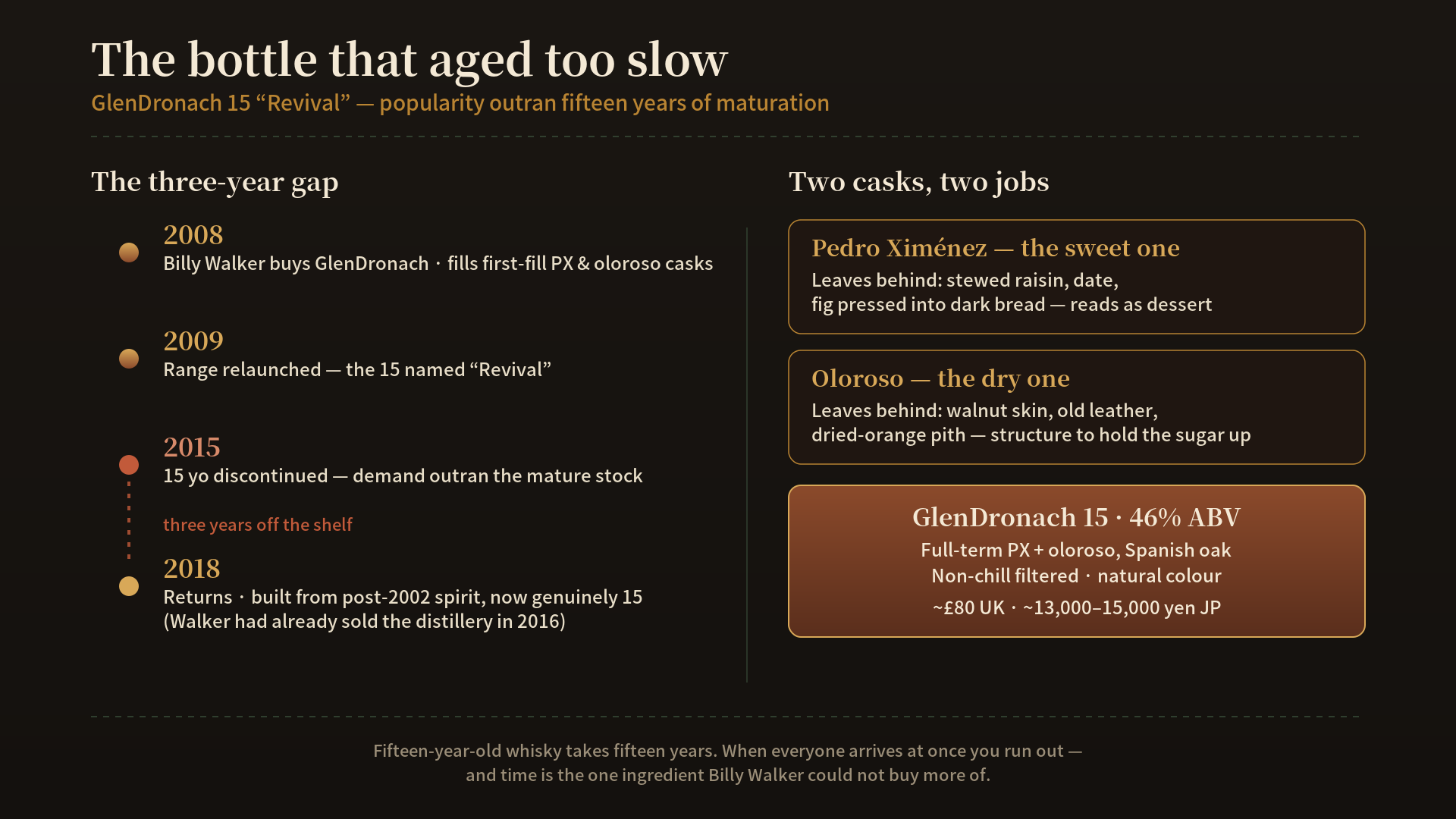
Walker relaunched GlenDronach’s range in 2009. The sherried style caught on — among the sort of drinker who reads cask types the way I read them, GlenDronach 15 became the answer to “what should I buy that tastes seriously of sherry without costing what a Macallan costs.” And then demand did what demand does to a product whose supply was decided fifteen years earlier by someone who had no idea this would happen: it outran it.
To keep selling the 15, GlenDronach needed a steady stream of casks turning fifteen. But it also wanted to hold its older, scarcer stock back for the limited single-cask and higher-age bottlings that built the distillery’s reputation among collectors. Those two demands competed for the same finite barrels. Something had to give, and in 2015 the thing that gave was the 15 itself. They discontinued it rather than dilute it or sell it younger under the same name.
It came back in 2018, after a three-year absence, and the reason the gap was exactly that long is quietly moving if you sit with it. GlenDronach had restarted distilling in 2002 after its silent years. Spirit laid down in 2002 and 2003 turns fifteen in 2017 and 2018. The relaunched Revival is built from that post-2002 production — the first whisky from the genuinely revived distillery to actually reach the age on its own label. The bottle did not just return. It waited until it was telling the truth.
PX and oloroso, and what each leaves behind
There are two sherry casks doing the work in this bottle, and they are not interchangeable.
Pedro Ximénez is the sweet one. PX is a thick, dark, almost syrupy sherry pressed from sun-dried grapes, and the cask that held it leaves behind a residue of concentrated, jammy sweetness — think raisins that have been stewed down, dates, a smear of fig pressed into dark bread. PX is what makes a sherried whisky read as dessert.
Oloroso is the dry, savoury one. It is a nutty, oxidative sherry aged in contact with air, and its cask gives less sugar and more structure: walnut skin, old leather, a faint bitterness like the pith of a dried orange, the smell of a wooden drawer that has held tobacco. Oloroso is what keeps a PX-heavy whisky from collapsing into pudding.
Marry the two over fifteen years at 46% ABV, non-chill filtered and with no caramel colouring to fake the depth, and you get a whisky whose darkness is earned by the wood rather than dialled in by an additive. The 46% matters too: it is strong enough to carry the oils that chill filtering would strip out, which is why the spirit clouds slightly with a little water and coats the glass when you swirl it.
Three glasses, one warm evening
On the kitchen table: GlenDronach 15 Revival at 46%, Aberlour A’bunadh (a batch-strength sherry monster, this one around 60%), and Glenfarclas 15 at 46%. Three Speyside-adjacent sherried malts, no ranking, no scores, lined up only because they answer the same question three different ways. I also kept a glass of plain GlenDronach 12 nearby as a baseline, because tasting the 15 next to its younger sibling tells you what the extra three years and the heavier cask weighting actually bought.
The GlenDronach 15 smells, first, like a fruitcake that has been sitting in a tin since Christmas: dark and slightly boozy, raisin and date over a base note of damp brown sugar, with something drier underneath — old leather, a struck match held a room away. That whisper of sulphur is not a flaw; it is the signature of genuine Spanish oak sherry casks, and people who grew up on bourbon-cask malts sometimes mistake it for one. On the palate the PX arrives first as stewed dark fruit, then the oloroso pulls it back with walnut and a bitter-orange edge, and the finish is long and drying, leaving cocoa powder and clove on the back of the teeth. With the GlenDronach 12 alongside, the gap is obvious: the 12 is brighter, thinner, more cooking-chocolate; the 15 has the leather and the depth of fruit that only the longer time in heavier casks delivers.
The A’bunadh next to it is the same family at a different volume — louder, hotter, younger-tasting despite no age statement, all cask-strength PX intensity with the leather mostly burned off by the alcohol. It is a thrilling drink and a slightly exhausting one; you respect it more than you relax with it. The Glenfarclas 15, by contrast, is the well-mannered cousin: a sherried malt that has been kept on a tighter leash, more dried apricot and honey than fruitcake, the oak more restrained, the whole thing quieter and a touch more genteel. Where the GlenDronach pushes the sherry forward, the Glenfarclas keeps the distillery’s own waxy, grassy character in the conversation.
The honest verdict is that the GlenDronach 15 sits in the middle of these two and is, for the money, the most complete demonstration of what full-term PX-and-oloroso maturation does. It is darker and more leathery than the Glenfarclas, more composed and drinkable than the A’bunadh. At roughly £80 in the UK and somewhere around 13,000–15,000 yen in Japan when you can find it, it is not cheap, but it is doing something the cheaper sherried malts cannot, and the reason it can is the same reason it once disappeared.
What to verify next time you pour one
If there is a GlenDronach 15 in front of you and you want to taste the decision rather than the marketing, three things to check.
First, the match-struck sulphur on the nose. It should be there, faint, behind the fruit. It is not a defect; it is the fingerprint of real Spanish-oak sherry casks doing full-term work. A whisky that has been sweetened by a quick sherry finish on a bourbon base will not give you that drawer-and-leather undertone — it gives you sugar without the savoury counterweight.
Second, the two fruits. See if you can pull the PX (jammy, raisined, sweet) apart from the oloroso (nutty, dry, leathery). The whole architecture of this bottle is the tension between those two casks, and once you can taste them separately you can taste Walker’s actual decision: how much sweetness to allow, and how much dry structure to hold it up.
Third, and this is the one I think about, the age. The bottle in your hand exists because someone filled a cask with new spirit fifteen years before you opened it and then did nothing — the hardest, least glamorous thing in whisky. For three years they could not give you this dram at all, because the only thing that makes it is time, and time was the one ingredient Billy Walker could not buy more of. By the time the Revival genuinely caught up to its own age statement in 2018, Walker himself had already sold the distillery and moved on to start another one, leaving Rachel Barrie to hold the sherry line at Brown-Forman. The sherry came back. He didn’t. You are drinking the patience he left behind.
Try this bottle
Affiliate link below. If you buy through it, LegacyDram earns a small commission and the price you pay does not change. Alcohol-related links are intended for readers of legal drinking age (20+ in Japan, 21+ in the US).
Related reading
- Billy Walker and GlenAllachie: the chemist who rescued four distilleries and then, at 72, bought a fifth on his own: the full career arc of the man behind this bottle — GlenDronach was one of the four he saved
- Aberlour A’bunadh and Graeme Cruickshank: how it stays A’bunadh when every batch is different: the same sherry obsession solved a different way — no age statement, full cask strength, batch by batch
- The Blend as Matrix: How Dr Rachel Barrie Runs BenRiach, Glendronach, and Glenglassaugh From the Same Office: who inherited GlenDronach after Walker sold to Brown-Forman, and how the sherry style is maintained now
Sources
- Glendronach Revival 15 Year Old returns — Scotch Whisky
- GlenDronach relaunches 15-year-old single malt — The Spirits Business
- The GlenDronach 15 Year Old Revival — Master of Malt
- Billy Walker purchases GlenAllachie distillery — The Whisky Barrel
- Why did Billy Walker buy Glenallachie? — Scotch Whisky
- GlenDronach 15 year old Revival, 46% — Whisky Advocate
- GlenDronach Revival 15 Year (2018 Re-Release) — Distiller