Glenmorangie Fermentation: Brendan McCarron's Long-Ferment and Allta Wild-Yeast Approach to Honey-Citrus
When I poured Glenmorangie Original the first time, what I noticed was the citrus. I was told to expect honey, and the honey was there too, sitting under the citrus like a second floor. I assumed the citrus came from the 5.14-metre stills, the tall ones Bill Lumsden has written about, the ones that bend the spirit toward light and floral. That is partly true. The other part is the fermentation tank, sitting two rooms before the still, which spends about fifty-something hours turning sugar into alcohol and a small fortune in esters.
The person responsible for that tank, on the day-to-day, is Brendan McCarron, who carries the title Head of Maturing Whisky Stocks and whose name appears on no bottle. Lumsden’s job, since his promotion at LVMH-era Glenmorangie, is portfolio-wide. He answers for both Glenmorangie and Ardbeg, for cask design programmes that take eight years to land, for whatever Private Edition lives on next year’s roadmap. McCarron’s job is narrower and more diurnal. He watches what happens inside copper and inside wood at one distillery in Tain, and inside the warehouses where its casks sleep.
I read whisky tasting notes the way I read benchmark numbers, with the assumption that what is not measured is what actually matters. The reflux equation is measured. The cask programme is measured. The fermentation step is the part of Glenmorangie that gets the least column inches and does, by my back-of-envelope reading, somewhere between thirty and forty percent of the flavour work. This article is about that part.
What the washback is doing while no one is watching
A washback is a fermentation tank. At Glenmorangie it is a stainless-steel vessel of roughly fifty thousand litres, filled with wort (sweet liquid extracted from malted barley) and dosed with yeast. The job is to convert sugars to ethanol. The biology is straightforward: yeast eats sugar, produces ethanol and CO₂, and a small set of side reactions throws off the compounds you will later taste.
Most Scotch distilleries run fermentations of forty-eight to fifty-five hours. The yeast finishes its primary work (the alcohol production) within the first two days. After that, the wash goes to the still.
Glenmorangie runs longer. The figure that turns up in industry sources, including in distillery visitor materials and in interviews Lumsden has given over the years, is in the range of fifty-two to sixty hours, reported as “long fermentation” rather than as a tight specification. The exact duration varies with batch and season; the policy is what matters. They wait.
Those extra hours are the interesting part. After about forty-eight hours the Saccharomyces cerevisiae, the distillers’ yeast doing the alcohol work, has largely finished. The ambient bacteria in the washback, principally Lactobacillus, become more active in the now-acidic, lower-sugar environment. They produce lactic acid. Lactic acid lowers the pH, and at low pH a set of secondary reactions, the esterification of fatty acids with ethanol, runs faster.
That is where the fruit comes from.
The three esters that make the bottle taste the way it does
If you had to name the molecules carrying the fruit in a Glenmorangie new make, three keep turning up in gas chromatography reports for Highland malts with long fermentations:
- Ethyl hexanoate (C₈H₁₆O₂, ethyl caproate): pear and pineapple, slightly waxy. This is the ester that most clearly tracks fermentation length. Short ferments produce relatively little; long ferments produce more, because the precursor (hexanoic acid) accumulates during the late, lactic phase.
- Isoamyl acetate (C₇H₁₄O₂, the “banana” ester in any brewing textbook): banana, ripe pear. This one is produced mainly by the yeast itself during primary fermentation, so it sets a floor rather than tracking duration, but it is what gives the new make its overt orchard-fruit character.
- Ethyl octanoate (C₁₀H₂₀O₂, ethyl caprylate): orange peel, waxy pear, a faint creaminess on the back palate. This one needs the late lactic phase to express well, and it is what I think I am tasting in the citrus layer of Original 10.
Other compounds matter (phenylethyl alcohol for the roses-and-honey note, various medium-chain ethyl esters for the wax), but those three are the headline grabbers. The honey under the citrus, in the language of a chromatograph, is mostly ethyl hexanoate and ethyl octanoate cooperating with a small contribution from vanillin pulled out of the cask later.
The trade-off is one you can write on a napkin. Long fermentation gives you more ester. Long fermentation also means each washback turns over less frequently. Fewer batches per year, less throughput, more storage tank capacity needed to buffer the schedule. Every additional hour of fermentation has a CFO-visible cost. Glenmorangie has decided that cost is worth paying, and the decision is renewed every time McCarron and the production team approve the fermentation schedule.
Distillers’ yeast, brewers’ yeast, and the strain that doesn’t show up on the label
The Scotch industry runs almost entirely on distillers’ yeast, selected strains of Saccharomyces cerevisiae bred for high alcohol tolerance and a well-characterised side-product profile. The dominant supplier strains, including the M strain family from Mauri (one of the long-standing industry yeast houses), have been the de facto standard at most Highland distilleries since the 1960s. Glenmorangie uses an M-strain-family yeast in its standard production, alongside the consistent practice in the trade. The actual strain is not published on any bottle.
You sometimes hear distilleries described as using “brewers’ yeast”, the Saccharomyces cerevisiae strains optimised for beer production. The brewers’ strains tolerate less alcohol, but they generate a noticeably different ester and higher-alcohol profile. Mortlach famously runs some brewers’ yeast alongside distillers’ yeast. Glenmorangie historically has not. The standard production wash is pitched with distillers’ yeast, fermented long, and sent to the tall stills.
That is the boring, repeatable answer. The interesting answer is what happens when McCarron and Lumsden agree to break it.
Allta, and the problem with wild things
Allta (Gaelic for “wild”) was released as Private Edition Number 10 in 2019. It was, as far as I know, the first commercial Scotch whisky to advertise its use of wild yeast as the headline feature. The yeast was Saccharomyces diastaticus, isolated from barley grown in the fields surrounding the Glenmorangie distillery in Cadboll. The strain was identified, cultured, and pitched into the washback in place of the standard distillers’ yeast.
Wild yeast sounds romantic. It is also why you cannot buy Allta in continuous bottlings: wild things, by definition, do not file release notes.
The problem is biological. S. diastaticus carries an enzyme, glucoamylase, that the standard S. cerevisiae distillers’ strains do not. Glucoamylase hydrolyses dextrins (the longer sugar chains that ordinary distillers’ yeast cannot eat) into glucose, which the yeast can ferment. The practical consequence is a higher final ethanol yield, a different residual-sugar profile, and a noticeably different ester portfolio. Allta’s new make read, by the published Glenmorangie notes, with much more savoury bread and grain character than the standard spirit and a different distribution of fruity esters underneath.
The release was a one-off because S. diastaticus, in industrial practice, is the yeast you spend money to keep out of your other tanks. It does not stay where you put it. A wild yeast batch that contaminates the standard production line would shift the flavour profile in ways you would only catch in lab and would have to dump weeks of spirit to fix. The Private Edition cycle gave Glenmorangie a contained way to release one batch, document it, and then disinfect everything before the next standard washback was pitched.
This is the wild-versus-controlled trade-off in its cleanest form. Individuality up, repeatability down. A distillery whose flagship is Original 10 and whose contract with the drinker is “this tastes like Glenmorangie every year” cannot run wild yeast as a default. They can ship it once, badged as a private edition, with a story attached. That is what Allta is. The release is sometimes credited solely to Lumsden, since the Private Editions are his roadmap. But the operational work of running a S. diastaticus batch through a production washback and then scrubbing the line is McCarron’s territory, and the resulting spirit lived in the warehouses he is responsible for until it was bottled.
Where the three jobs sit, and which job is McCarron’s
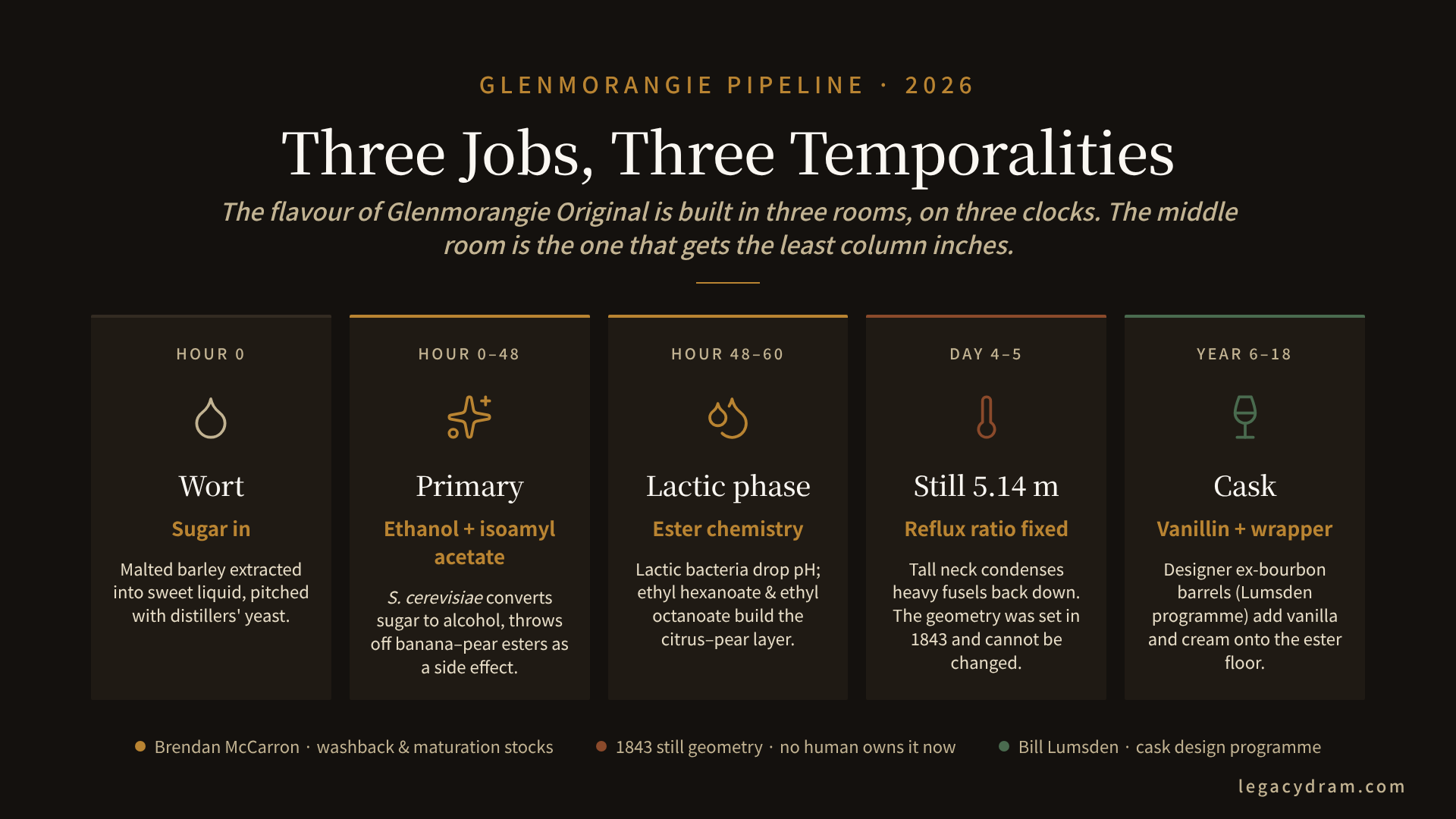
Glenmorangie’s flavour pipeline, written as a system diagram, has three stages with three different temporalities.
Fermentation runs on the scale of a working week. The washback decisions (yeast strain, pitching rate, fermentation duration, temperature profile, choice to run a wild-yeast Private Edition) are weekly and seasonal. They are largely operational: a decision made today shows up in the spirit safe in three days. McCarron, as the on-site lead for the maturing whisky pipeline at Glenmorangie, is the person closest to these decisions. He is not the only voice. Production managers, the lab, and Lumsden are all in the room. But he is the one who lives with the consequences in cask.
Distillation runs on the scale of the still itself. The 5.14-metre wash stills and the upward-angled lyne arms make most of the structural decisions automatically. Reflux ratio is geometric. There is room to tune the cut points, where the spirit safe operator switches from foreshots to heart to feints, and that tuning matters. But the spirit envelope is fixed by metalwork that has been the same shape since 1843 and was duplicated, identically, when LVMH funded the 2009 stillhouse expansion. No one in 2026 changes the still.
Maturation and cask finishing run on the scale of a career. Lumsden’s Designer Casks programme commissions Missouri Ozark white oak by stave, specifies seasoning regimes measured in years, sends the wood to Kentucky bourbon producers to fill before it comes back to Tain, and turns into a Glenmorangie bottling six to eighteen years after the original specification. The cask decisions in Original 10 today are the ones Lumsden was making in the mid-2010s. McCarron’s title (Head of Maturing Whisky Stocks) puts him in the warehouses where those casks are sleeping, working out which barrel ends up in which expression on which year. The upstream cask specification is a Lumsden output, though, not a McCarron one.
The structure is not heroic. It is a division of labour, with the boring part (the fermentation tank, fifty-something hours, lactic bacteria producing flavour because the pH dropped while no one was looking) assigned to the engineer whose name does not go on the marketing. Most production at most distilleries is organised this way. It is one of the structural reasons whisky writing tends to default to whoever the brand chooses to send to journalists.
McCarron does the press, sometimes, in the trade magazines. Lumsden does the international interviews. The split is roughly accurate to the work.
What this means for the bottle in your hand
If you have an Original 10 in front of you, sit with the citrus for a minute before you go to the honey. The pear and the orchard-fruit notes are mostly the fermentation step: the ethyl hexanoate from the long ferment, the isoamyl acetate from the yeast itself. The clean delivery, the lack of fusel weight, is the still doing its 1843 thing. The faint vanilla and the cream finish are the bourbon barrel and a fraction of toasted oak. Three stages, three contributions, in roughly that order.
If you have a Lasanta (the Oloroso and PX-finished bottling), the fermentation step did the same work. The Oloroso wrapper adds walnut, raisin, sherry tannin on top of the same ester floor. The new make underneath the Lasanta is, to a good approximation, identical to the new make underneath Original. McCarron’s washback chose what the fruit layer would be. Lumsden’s cask programme chose what would be loaded onto it.
If you have a bottle of Allta on a shelf somewhere, hold on to it. Wild yeast does not get repeated.
McCarron’s column on the Glenmorangie org chart sits before the still, in the fifty-something hours when the yeast is still alive and the room smells like a wet bakery. No one writes about that room. When you next pour a Glenmorangie 10, the honey is held up by a lactic-bacteria-mediated esterification reaction that ran in a stainless-steel tank three weeks before the spirit ever touched copper. You are tasting that column, whether you knew his name or not.
Related reading
- The Reflux Equation: Why Glenmorangie’s Stills Are 5.14 Metres Tall: the still-side companion to this piece; same distillery, different organ
- Stuart MacPherson and the Three Oaks of Macallan: what the cask layer does when the upstream spirit is fixed
- Rachel Barrie and the Blend Matrix: a Highland contemporary who started her career at Glenmorangie under Lumsden
- Aberfeldy 12 and Stephanie Macleod’s Trophies: another Highland distillery whose long fermentation (60–72 hours) does similar fruity-ester work
Sources
- Glenmorangie official: glenmorangie.com
- Bill Lumsden interviews and Private Edition release notes (Glenmorangie Experience pages)
- Whisky Magazine, Highland fermentation profiles: whiskymag.com
- Charles MacLean, Whiskypedia, Birlinn: Glenmorangie chapter on fermentation specs
- Misako Udo, The Scottish Whisky Distilleries: Glenmorangie spec sheet
- Journal of the Institute of Brewing: Piggott & Conner papers on ester formation in malt whisky fermentations
- Wikipedia: Glenmorangie, Saccharomyces diastaticus