Glenfiddich 1886 Origins: William Grant's Second-Hand Stills
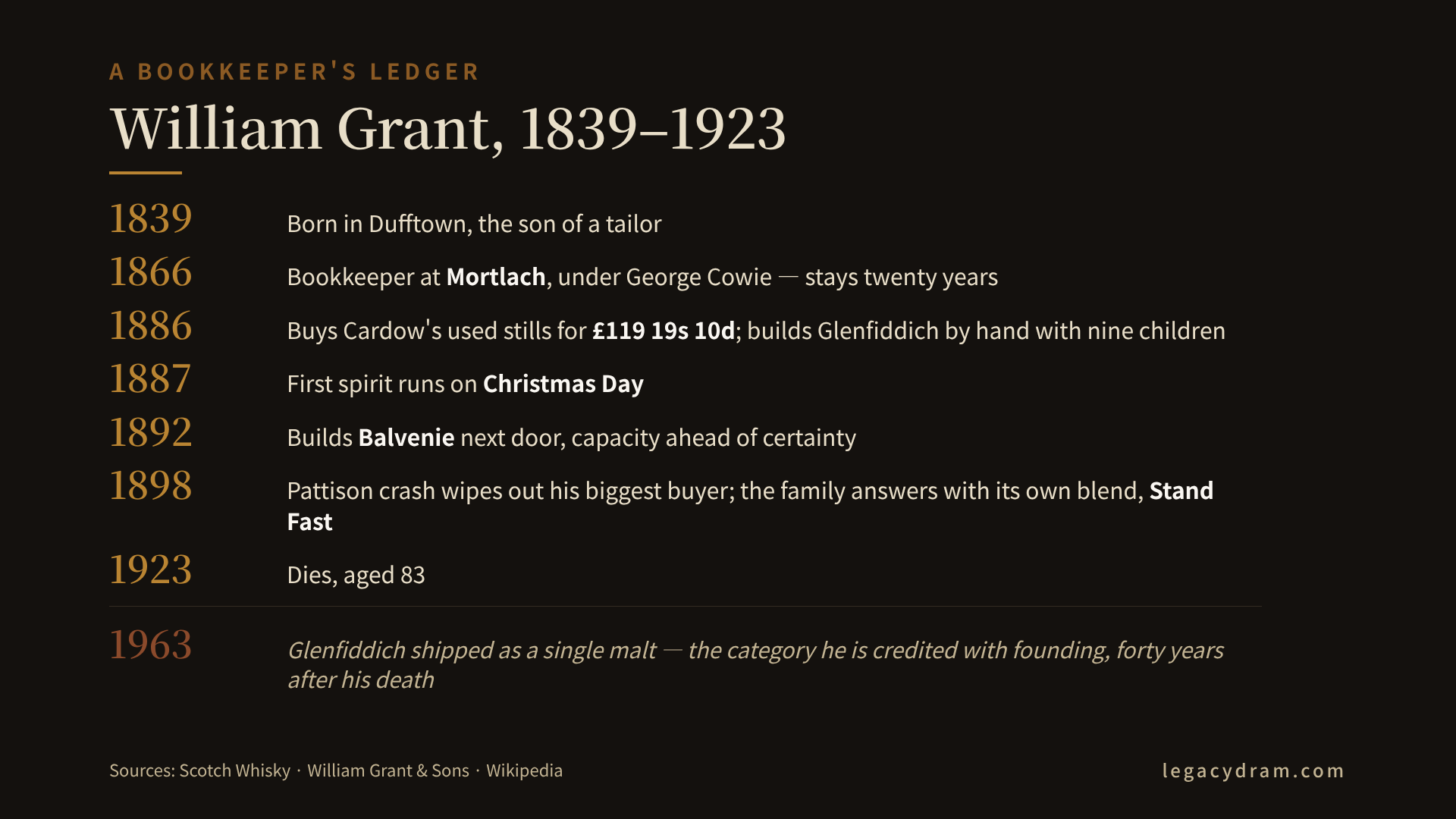
In the autumn of 1886, a forty-six-year-old bookkeeper walked twelve miles across Speyside to buy a worn-out set of distilling equipment that somebody else had decided to throw away. His name was William Grant. He had heard that Elizabeth Cumming, who ran the Cardow distillery (the place we now spell Cardhu), was rebuilding her still house and selling off the old plant. Grant offered her everything he had been saving for two decades and walked away with the lot — stills, mash tun, the whole second-hand kit — for £119 19s 10d. (Scotch Whisky) Tuppence short of a round hundred and twenty pounds. He then went home and, with his seven sons, two daughters, and a single hired stonemason, built the Glenfiddich distillery around that pile of used copper.
I want to be careful here, because this is the kind of story the whisky industry loves to round up into legend. The bookkeeper who became a magnate. The family who built an empire by hand. There is a version of this article that ends with William Grant standing on a hilltop foreseeing the global single malt category. That version is false. What actually happened is that a middle-aged man with nine children and no capital for new equipment made a calculated bet on second-hand hardware, and the bet did not have to work. For most of the people who tried something similar in 1886, it didn’t.
Twenty years of someone else’s ledger
Grant was born in Dufftown in 1839, the son of a tailor. (Wikipedia) The early CV is not the CV of a distilling visionary. He herded the family’s cattle as a boy, apprenticed as a shoemaker, and did a stint at a lime works. Then, in 1866, he took a job as the bookkeeper at Mortlach — at the time the only distillery in Dufftown — under the owner George Cowie. He stayed twenty years. Cowie eventually promoted him to manager.
Two decades is a long time to keep another man’s accounts. It is, I’d argue, the most important and least romantic fact in the whole story. Grant did not learn distilling in a flash of inspiration; he learned it the way most durable expertise is actually acquired — by being responsible for the boring parts of someone else’s operation for long enough to understand exactly what everything cost. He knew the price of barley, the price of coal, the wage bill, the yield per ton, the margin on a filling. When he finally costed out his own distillery, he was not guessing. He had been reading the answer off Mortlach’s books since the year of the Second Reform Act.
He also, the records say plainly, “saved money throughout this period to set himself up as a distiller.” Twenty years of a manager’s salary, banked against a single purchase. That is the capital that walked to Cardow.
The decision: buy used, build cheap, start fast
Here is the constraint Grant was actually solving for. He had enough money, after twenty years, to do exactly one of two things: buy a modest set of new stills and have nothing left to build the house they would sit in, or buy used stills cheaply and spend the difference on land, stone, and a roof. New copper for a full still house in 1886 was a serious capital line. A second-hand set from a distillery that was upgrading anyway was an order of magnitude less.
He chose used. He resigned from Mortlach in September 1886, took a lease on a patch of ground called Glenfiddich — Gaelic for “valley of the deer” — and in the summer of that year began laying the foundations himself. (Press and Journal) Seven sons carried stone. Two daughters worked the site. One paid stonemason did the work that genuinely needed a craftsman. After roughly a year of this, the stills he had bought from Elizabeth Cumming ran their first spirit on Christmas Day 1887.
If you have ever stood up a system on second-hand infrastructure because the budget for new hardware did not exist, you already understand the shape of this decision. Grant took on what an engineer would now call inherited technical debt: a set of stills he did not design, with whatever quirks of dent and geometry Cardow had baked into them over their working life, and he wired his entire business around them because they were what he could afford. The trade he made was capital efficiency and speed in exchange for control. He gave up the ability to specify his own spirit from first principles. In return he was distilling, and selling, years before a fully-financed competitor would have finished pouring concrete.
There is a clean parallel a few valleys north, which I’ve written about in the case of Glenmorangie: when William Matheson founded that distillery in 1843, he too bought second-hand stills — disused gin stills — because new onion-shaped pots were beyond his budget. Those tall, narrow gin stills accidentally gave Glenmorangie its light, high-reflux character, and the distillery has been frozen at that geometry ever since. Two Scottish founders, four decades apart, both broke and both buying other people’s cast-offs, and in both cases the used hardware they could merely afford became the permanent specification of the spirit. The thing you bootstrap on tends to be the thing you can never change.
What the gamble cost, and what it nearly cost
It is easy, reading backwards from a company that now sells more single malt than almost anyone, to forget how exposed Grant was. He had liquidated twenty years of savings into used equipment and a building. He had pulled his entire family’s labour into an unproven distillery in a year — the late 1880s — when the Speyside hills were filling up with new distilleries chasing the blended-whisky boom, several of which would not survive the next decade. If the spirit had been poor, or the market had turned before he had stock to sell, there was no second tranche of capital. The downside was not a bad quarter. The downside was a tailor’s son and nine children with nothing.
And the market did turn. In 1898 the Pattison brothers of Leith — flamboyant whisky blenders who had been propping up the entire trade with reckless credit — collapsed in one of the great frauds of the era. (Wikipedia: William Grant & Sons) The Pattison crash took a column of distilleries down with it, because Pattisons had been everyone’s biggest customer. They were Grant’s biggest customer too. A founder who had bet the family on selling bulk fillings to blenders had just watched his single largest buyer evaporate, eleven years into the business.
What Grant and his sons did next is the second decision in the story, and it is the one I find more impressive than the stills. Instead of going down with their customer, they went around him: they started blending and selling their own whisky, under their own name. The blend they built was called Stand Fast, after the Clan Grant motto, and it gave the family the one thing a distillery selling only bulk fillings never has — its own cashflow, its own brand, its own buyers — at the exact moment the rest of the industry was learning what it cost to depend on someone else’s. (The logic of owning your blend rather than feeding someone else’s runs right through the era; I’ve traced the other side of it in John Haig and the rise of blended Scotch.) The man had spent twenty years watching how money moved through a distillery. When his channel to market collapsed, he did not need to be told to build a new one.
The expansion bet sits in between these two. In 1892, with Glenfiddich barely five years old and already selling, Grant built a second distillery next door: Balvenie. He converted an existing mansion house on the land and stood up a second set of stills, doubling his capacity before he had any guarantee the demand would hold. With hindsight it looks like confidence. At the time it was leverage, taken on by a man who had been comprehensively broke six years earlier. The Balvenie that David Stewart would later spend a career finishing in port and sherry wood was, at its founding, another roll of the same dice — capacity built ahead of certainty by a family that had no margin for the bet to go wrong.
The hardware outlived the man
Here is the part that turns the engineering into something closer to elegy.
The whole reason a distillery’s spirit has a fixed character is that the shape of the still — the height of the neck, the angle of the lyne arm, the exact volume and dents of the pot — governs how much vapour falls back to be redistilled and how much escapes to the condenser. Change the shape and you change the whisky. Glenfiddich, like its Speyside neighbours who froze their geometry in the 1870s, long ago made the preservation of its still shape a matter of doctrine. When a still wears out, it is replaced like-for-like; the geometry is copied, not improved. The distillery keeps coppersmiths to do exactly this.
Sit with what that means. The still shapes Glenfiddich now guards with such care, and reproduces to the dent, descend from a set of equipment that William Grant did not design, did not commission, and chose only because it was the cheapest copper he could walk home with in 1886. The idiosyncrasies of Elizabeth Cumming’s discarded Cardow stills — the accidental, second-hand geometry of a budget purchase — hardened over a century into the specification that a global company now spends money to never change. The constraint became the character. The thing he settled for became the thing nobody is allowed to touch. The character of one of the world’s best-selling single malts is, at root, the fossil of a decision made under financial duress by a man with nine children and no other option.
William Grant died in 1923, aged eighty-three, having built two distilleries and a family firm that still bears his name. He did not live to see the rest of it. The thing the world now thanks him for — Glenfiddich sold not as anonymous blending fodder but as a single malt, a bottle from one distillery standing on its own — did not happen until 1963, when his descendants shipped it to England and, in doing so, are widely credited with creating the modern single malt category. That was forty years after the bookkeeper was in the ground. He spent twenty years keeping someone else’s ledger, gambled the savings on someone else’s stills, built the house with his own children’s hands, saved it from the Pattison crash by improvising a blend, and then died four decades before the bottle that would carry his name into the world even existed.
When you next pour a Glenfiddich, what you are tasting is, in the most literal sense, the long shadow of a £119 19s 10d transaction. The light, pear-and-orchard Speyside character in the glass traces back through a hundred and forty years of careful non-change to a set of stills a bookkeeper bought second-hand because new ones were beyond him. He never saw the category he is said to have founded. The hardware he could barely afford outlived him by a century and is, as far as anyone at the distillery is concerned, never to be altered. That is the standard fate, I think, of anyone who builds something on a constraint tight enough to be worth remembering: the constraint outlives you, and everyone downstream mistakes it for the plan.
Related reading
- The Reflux Equation: Why Glenmorangie’s Stills Are 5.14 Metres Tall — another broke founder who bought second-hand stills and froze their accidental geometry forever
- Bolt-On Reflux: Major James Grant’s 1872 Purifier and Glen Grant — a different Grant, the same Speyside doctrine of never touching the still that works
- John Haig, Cameronbridge, and the Coffey Still — the blended-Scotch machine that William Grant decided, after 1898, to stop depending on
Sources
- Scotch Whisky — Whisky heroes: William Grant
- William Grant (businessman) — Wikipedia
- William Grant & Sons — Wikipedia
- Press and Journal — How Glenfiddich distillery in Dufftown has gone against the grain since 1886
- Glenfiddich — William Grant & Sons