The Queen of the Whisky Trade: How Elizabeth Cumming Rebuilt Cardhu, Sold Its Old Stills to a Bookkeeper, and Handed Its Heart to Johnnie Walker
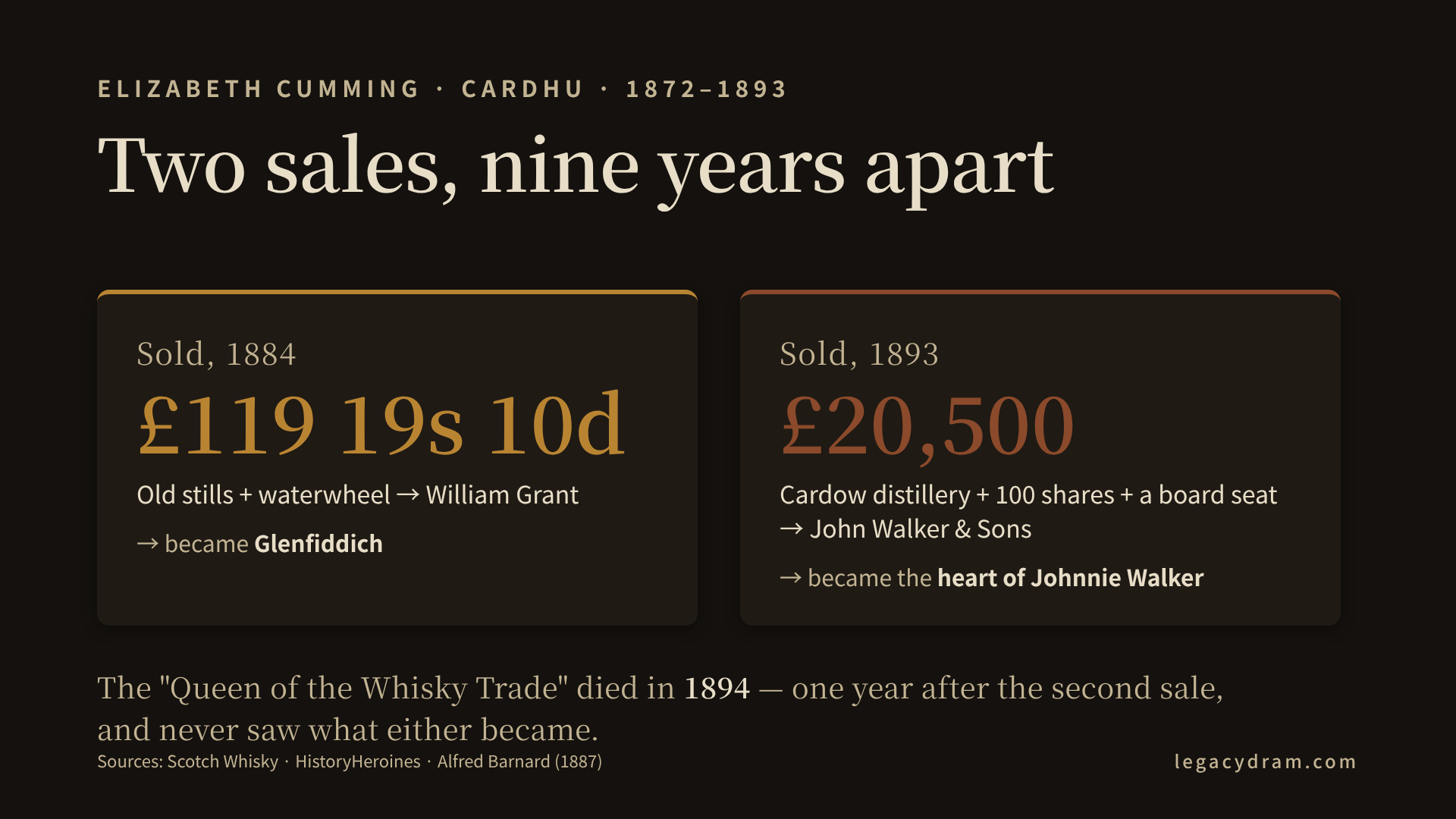
In 1884, on the north bank of the River Spey, a widow named Elizabeth Cumming sold a worn-out set of stills and a waterwheel to a Dufftown bookkeeper for £119 19s 10d. The bookkeeper was William Grant; the equipment became Glenfiddich. That transaction is famous now, and I have written about it before, from his side of the table: the broke man who built an empire around someone else’s cast-off copper. This is the other side. The person who decided that copper was surplus, who had a new still house already going up to replace it, and who would spend the rest of her short life turning a smuggler’s farm into something a global blender would pay a fortune to absorb.
Her contemporaries called her the Queen of the Whisky Trade. (Scotch Whisky) I want to take the crown off for a moment, because the title flattens what is actually the more interesting story: a series of unsentimental decisions made by a woman with no margin for any of them to go wrong.
The inheritance nobody would have chosen
The distillery began as a hiding place. In 1811 a couple named John and Helen Cumming leased Cardow farm, on the high ground above the Spey in Speyside, and distilled illicitly. Helen ran the smuggling end of it: when the excisemen rode up, she would invite them in for refreshment, slip out to the yard, and raise a red flag over the barn to warn every other illicit still in the glen. (HistoryHeroines) She lived to ninety-seven. The flag is the part the marketing remembers, because it is charming. It is also the only part of the Cardow story that fits the legend the industry prefers.
The licence came in 1824, after the Excise Act made legal distilling viable. The farm passed to John and Helen’s son, Lewis Cumming, and Lewis married Elizabeth. Then, in 1872, Lewis died.
Look at the position Elizabeth was actually left in, because the “Queen” framing erases it. She was forty-five. She was pregnant with a third son. She had two young boys already and a five-year-old daughter who died, suddenly, three days after her husband. (HistoryHeroines) She had a working farm and a small, primitive distillery to run, and she did not even own the ground the distillery stood on; the Cummings held it on a lease. This is not the opening scene of a triumph. It is the opening scene of a liquidation that didn’t happen because the widow refused to let it.
Decision one: build bigger on land you have to buy first
The standard move for a small farm distillery in the 1870s was to keep it small. Distilling was a sideline to the farm; the equipment was cheap and worn; the market was bulk fillings sold to blenders down in the central belt. Elizabeth could have run Cardow exactly as Lewis had and drawn a modest living from it.
She did the opposite. Over the following decade she registered the Car-Dhu trademark (putting a name on the liquid at a time when most farm distilleries sold anonymous spirit by the cask), and then, in 1884, she committed to the decision that defines her. The original distillery sat on ground the family only leased. So she secured a feu, a form of Scottish land tenure, over an adjoining plot, bought herself a piece of Speyside she would actually own, and built a brand-new distillery on it with three times the production capacity of the old one. (Scotch Whisky)
I’d like to write that this was visionary, that she saw the single malt future and built ahead of it. That version is false. What she was solving for was much more concrete and much less romantic: a distillery you don’t own the land under is a distillery you can lose. The feu and the new build were, before they were anything else, a way of converting a precarious tenancy into an owned asset with real capacity. Growth was the instrument; security was the goal. She was a widow making the freehold permanent before anyone could take it from her.
And here is where the two stories I keep telling on this site meet. The old plant (the small stills, the waterwheel) was now surplus. Down in Dufftown, a forty-six-year-old bookkeeper named William Grant had spent twenty years saving a manager’s salary to start his own distillery and could not afford new copper. So Elizabeth sold him the lot for £119 19s 10d, and Grant carried it home and built Glenfiddich around it. The accidental geometry of Elizabeth Cumming’s discarded Cardow stills hardened, over the following century, into the permanent specification of one of the best-selling single malts on earth. She thought she was clearing out old equipment to make room for new. She was, without knowing it, founding a competitor.
The verdict from 1887
Three years after the rebuild, the chronicler Alfred Barnard walked the length of British distilling for his survey The Whisky Distilleries of the United Kingdom. He reached Cardow and wrote a sentence about its owner that I find more honest than the “Queen” epithet, precisely because it is so dry:
Mrs Lewis Cumming personally conducted the business for nearly seventeen years, and to her efforts alone is the continued success of the distillery entirely due.
Note what it does not say. It does not say she was charming, or a character, or a woman of unusual courage. Those are the things Barnard wrote about her mother-in-law Helen, whom he called “a most remarkable character” with “the courage and energy of a man.” About Elizabeth he records, instead, a balance-sheet fact: the place worked, for seventeen years, to her efforts alone. That is the contemporary verdict of a man with no reason to flatter her, and it is worth more than the nickname.
Decision two: sell the thing you built
In September 1893, Elizabeth Cumming sold Cardow.
This is the decision the “Queen” story has the hardest time with, because it does not look like a victory. She had spent twenty-one years building an owned, expanded, trademarked distillery with three times its original capacity, and then she handed it to a blender. The terms, when you read them, are the work of someone who had been doing this for a long time: £20,500 for the distillery excluding the maturing stock, plus 100 shares in John Walker & Sons worth around £5,000, plus a seat on the Walker board for her son John, with a guaranteed minimum salary. (Scotch Whisky) It made Cardow the first malt distillery John Walker & Sons ever bought, and it kept a Cumming inside the company that now owned the family’s name.
Why sell at all? The honest answer is partly grief and partly arithmetic. Her eldest surviving son, Lewis, had died suddenly; her second son, John Fleetwood Cumming, had been pulled out of medical studies in Aberdeen to come back and run a distillery he had not chosen. (Scotch Whisky) And the structural problem was the one every small Speyside distillery faced in the 1890s: a single malt distillery selling bulk fillings is wholly dependent on the blenders who buy them. You have one product, sold to a handful of customers, with no brand of your own reaching a drinker. Elizabeth had built a genuinely good asset that was, nonetheless, a price-taker.
So she made the trade that runs underneath this whole site: she gave up independence to buy permanence. She could have kept Cardow as a proud, small, family-owned distillery and watched it stay a price-taker, vulnerable to every swing in the blending trade, including the one that, five years later, would take down half of Speyside when the Pattison blending house collapsed. Or she could fold it into a blender big enough to guarantee it would never be silent, take shares and a board seat so the family kept a hand on it, and accept that the name on the door was no longer hers alone. She chose the second. It is the mirror image of the bet William Grant made nine years earlier with her old stills: he sold his bulk-filling dependence to build his own blend; she sold her independence to join someone else’s. Same problem, opposite solutions, the discarded stills of one distillery sitting at the centre of both.
You can read the other half of the Walker side of this, the consistency machine that Cardhu was bought to feed, in the story of Alexander Walker’s blending doctrine. And the inheriting-widow decision Elizabeth made has a near-perfect counter-case in Bessie Williamson at Laphroaig, who inherited a distillery sixty years later and, faced with the same sell-or-stay question, negotiated to keep production independent inside the sale rather than handing it over. Two women, two inheritances, two opposite readings of the same trade-off.
What she never saw
Cardow, by the way, is not how we spell it now.
The distillery kept the old spelling for decades. “Cardhu”, closer to the original Gaelic Càrn Dubh (“black rock”), became a trademark in 1965 and was not made the distillery’s official name until 1981, when its then-owners launched it as one of the first modern single malts. (Scotch Whisky) Today it is owned by Diageo, most of its spirit disappears into Johnnie Walker, and the marketing calls it the “heart of Johnnie Walker”: the soft, lightly floral Speyside malt at the centre of the best-selling blended Scotch in the world.
Elizabeth Cumming saw none of it. She died in 1894, one year after she signed Cardow over to the Walkers. She never saw it called Cardhu, never saw it become a single malt sold under its own name, never saw the blend it fed grow into the largest in the world. The light, orchard-and-honey character that makes Cardhu work as the soft core of Johnnie Walker is, in a real sense, the spirit she built when she tripled the distillery in 1884. The global blend it now anchors stands on the decision she made in 1893 to let go of it.
That is the part the crown obscures. The Queen of the Whisky Trade was a pregnant widow who turned a leased smuggler’s farm into an owned, expanded, branded asset; sold her old copper to the man who would become her family’s rival; and then, rather than clutch the independence she had fought twenty-one years to secure, traded it for the one thing a small distillery can never guarantee itself: permanence. She bought her distillery a future and did not live to see a single year of it. The heart still beating at the centre of Johnnie Walker is hers. She just never got to hear it.
Related reading
- Second-Hand Stills and a Bookkeeper’s Gamble: How William Grant Built Glenfiddich — the same 1884 transaction, told from the buyer’s side of the table
- Bessie Williamson and the Inherited Distillery — a widow’s inheritance sixty years later, and the opposite answer to sell-or-stay
- Alexander Walker’s Consistency Doctrine — the blending machine that Cardhu was bought to feed (JA)
Sources
- Scotch Whisky — Whisky heroes: The Cumming family, Cardhu
- Scotch Whisky — Cardhu (Whiskypedia)
- HistoryHeroines — Helen and Elizabeth Cumming – Women Behind the Whisky
- Cardhu distillery — Wikipedia
- Alfred Barnard, The Whisky Distilleries of the United Kingdom (1887)